
The Primordial Monotheist: A Comparative and Historical Analysis of the Patriarch Abraham in Secular and Religious Tradition
Presented by Zia H Shah MD
Abstract
This research report provides an exhaustive investigation into the life, legacy, and theological significance of Abraham, known as Ibrahim in the Islamic tradition, by synthesizing data from secular archaeology, historical-critical scholarship, and the diverse scriptures of the world’s religions. The primary evaluative framework for this study is derived from the Quranic corpus, specifically the verses identified in the “Abraham.docx” reference material, which characterize the patriarch as a Hanif—a primordial monotheist whose submission (Islam) transcends the later sectarian boundaries of Judaism and Christianity. The report scrutinizes secular archaeological theories regarding the Middle Bronze Age and the historicity of the patriarchal narratives, contrasting traditional views with revisionist perspectives that treat the Abrahamic cycle as a late literary construct of the Persian period. Furthermore, the analysis conducts a comparative study of the “Covenant” and the “Sacrifice” narratives, adjudicating the divergent claims regarding Isaac and Ishmael through the lens of Quranic ethics and narrative structure. Special attention is paid to minority traditions, including the Mandaean view of Abraham as an apostate and the Baha’i Faith’s recognition of him as a Manifestation of God. By exploring the linguistic and geographical debates surrounding Bakkah and the Valley of Baca, the study attempts to reconcile the “first house of worship” with the historical record. The final synthesis demonstrates that while secular and non-Islamic sources offer valuable historical context, they often project later nationalistic and theological priorities onto a figure whom the Quran describes as a universal Ummah (nation) unto himself.
The Quranic Criterion: Defining the Hanif and the Millat Ibrahim
The starting point for any rigorous analysis of Ibrahim must be the ontological definitions provided within the Quranic text, which serve as the primary criteria for judging all other historical and religious accounts. According to the Quranic verses loaded for this study, Ibrahim is characterized by his absolute fulfillment of divine trials and his rejection of sectarian labels. The Quranic declaration that Ibrahim was “neither a Jew nor a Christian” (3:67) establishes a theological boundary that necessitates a re-evaluation of the Judeo-Christian narratives. This verse identifies him as a Hanif, a term signifying one who is upright in faith and turns away from error or idolatry toward a pristine monotheism.
The Quranic portrait is centered on the concept of the Millat Ibrahim (the religion or way of Ibrahim), which is presented as the original, uncorrupted faith of humanity. This “way” is not a new religion founded in the 7th century CE but a restoration of the primordial path of submission to the One True God. The effectiveness of Ibrahim as a criterion lies in his status as an Ummah (a nation or community) in his own right (16:120), implying that his character and actions embody the entirety of divine guidance.
| Quranic Concept | Theological Definition | Functional Role in Judgment |
| Hanifan Musliman | One who is upright and has submitted. | Dismisses later sectarian identities as anachronistic. |
| Khalil | The Intimate Friend of God. | Sets the standard for personal relationship with the Divine. |
| Millat Ibrahim | The way/creed of Ibrahim. | Serves as the benchmark for authentic monotheistic practice. |
| Ummah | A leader/nation in himself. | Validates Ibrahim as a universal, rather than tribal, figure. |
The trials of Ibrahim, as mentioned in verse 2:124, are not merely biographical footnotes but are the “words” (kalimatin) that he fulfilled to earn his station. This fulfillment is what differentiates the Quranic Ibrahim from the biblical Abraham; while the latter is often portrayed as a figure of doubt or one who argues with the Divine, the Quranic Ibrahim is characterized by Qanit (constant obedience) and Haleem (forbearance). These traits provide the moral lens through which we must judge the historical “plausibility” of the narratives found in other traditions.
Secular Archaeology and the Historicity of the Patriarchal Age
Secular scholarship has long struggled to find a definitive “time slot” for Abraham in the archaeological record. The challenge lies in the fact that no contemporary inscriptions or monuments from the Bronze Age mention him by name, leading many researchers to conclude that the patriarchal age is a literary construct rather than a historical reality.
The Middle Bronze Age Theories: Glueck and Albright
In the early to mid-20th century, archaeologists like Nelson Glueck and William Albright argued that the biblical stories of Abraham reflected the social milieu of the Middle Bronze I (MB I) period, roughly 2100 to 1900 BCE. Glueck identified a pattern of settlements in the Negev that flourished during this period and then vanished, which he believed corresponded to the “local color” of Abraham’s nomadic wanderings. Albright supplemented this by suggesting that Abraham was a “donkey caravaneer” plying trade between Mesopotamia and Egypt, a theory that attempted to ground the Genesis account in the economic realities of the ancient Near East.
However, this traditional school of thought has been heavily criticized. The “donkey caravaneer” hypothesis, for instance, does not align with the scriptural portrayal of Abraham as a wealthy pastoralist with large herds of sheep and cattle. Moreover, the chronological gap between the MB I period and the eventual writing of the biblical texts (often dated to the Persian period) introduces significant uncertainty regarding the transmission of historical memory.
Alternative Chronologies and the Search for Olishem
More recent research has attempted to move Abraham even further back in time. Some scholars place the patriarch at the end of the Early Bronze Age or the Late Chalcolithic, citing the destruction of Sodom and Gomorrah as a key historical marker. This “new chronological revolution” suggests that the traditional dates for kings like Hammurabi and the Egyptian pharaohs are being redated, potentially shifting the Abrahamic era to approximately 2300 BCE.
A notable secular discovery mentioned in the Book of Abraham (though debated in its own right) is the plain of “Olishem” (Abraham 1:10), which some researchers identify with a major administrative center in northern Syria/Turkey. The existence of a ruler named Šennam and a mixed population of Hurrians and Semites in this region provides a plausible historical setting for “Ur of the Chaldees,” which the Quran situates as the birthplace of Ibrahim.
| Archaeological Phase | Date (Approx.) | Key Argument for Abrahamic Link |
| Late Chalcolithic | 3500–3000 BCE | Fits certain “Early Flood” chronologies. |
| Early Bronze III | 2300 BCE | Destruction of Numeira/Bab edh-Dhra (Sodom/Gomorrah). |
| Middle Bronze I | 2100–1900 BCE | Glueck/Albright “Local Color” hypothesis. |
| Middle Bronze IIA | 1900–1750 BCE | “Low-end” biblical dating; Egyptian hegemony in Canaan. |
| Persian Period | 538–332 BCE | Composition of the Torah; Abraham as an idealized founder. |
The “Fort Abram” inscription, found in the victory list of Pharaoh Shishak I (c. 925 BCE), mentions a site in the Negev called “pa’ha-q-ru-a ‘i-bi-ra-ma”. While this is a thousand years after the traditional dates of Abraham, it suggests that his name was attached to geographic landmarks in the region long before the biblical texts were finalized, pointing to a deeply rooted historical memory.
Historicity as a Narrative Program
Despite these efforts, many secular historians view the patriarchal age as a “late literary construct”. They argue that the Book of Genesis was compiled to serve the interests of Jewish landowners returning from the Babylonian captivity, who used the figure of “father Abraham” to assert their ancestral right to the land against those who had remained in the territory. In this view, Abraham is an eponymous ancestor—a figure created to represent a people—rather than a historical individual.
The Quranic verses provide a profound counter-critique to this secular skepticism. By describing Ibrahim as an Imam for all people (2:124) and emphasizing his rational discovery of God (6:75-79), the Quran moves the discussion from “social organization” to the “certainty of faith”. The Quran suggests that the historical Ibrahim is accessible not through broken pottery, but through the enduring “Station of Ibrahim” (2:125) and the rituals of the pilgrimage that have been preserved for millennia.
Judaism, Christianity, and the Rivalry for Abraham’s Heritage
The relationship between the three primary “Abrahamic” religions is often characterized as a struggle over the true interpretation of the patriarch’s character and covenant. Each tradition highlights different aspects of his life to justify its own communal identity.
Judaism: The Ethnic Foundation and the Merit of the Fathers
In Judaism, Abraham is the “founding father” of the covenant between the Jewish people and God. He is primarily an ethnic ancestor—Avraham avinu—through whose physical descent the Twelve Tribes are born. Jewish tradition emphasizes his observance of the Torah (or its essence) centuries before it was revealed at Sinai, portraying him as a “loyal monotheist” in a polytheistic world.
A central concept in Jewish theology is zekhut avot (“the merit of the fathers”), which posits that the righteousness of Abraham brings mercy to his descendants. Circumcision is the “sign of the covenant” (Genesis 17), a permanent physical mark that distinguishes the offspring of Abraham from all other nations.
Christianity: The Spiritual Father and the Protocol of Faith
Christianity reinterprets Abraham as the “spiritual progenitor” of all believers, regardless of their physical lineage. Paul the Apostle, in Romans 4, celebrates Abraham as a man who was justified by faith before he was circumcised. This serves to “de-Judaize” Abraham, making him a prototype for Gentile Christians who are “heirs according to the promise” through their faith in Jesus Christ.
| Theological Feature | Judaism | Christianity |
| Paternity | Physical/Ethnic (through Isaac/Jacob) | Spiritual (through Faith in Christ) |
| Covenant Sign | Physical Circumcision | Circumcision of the Heart |
| Focus | Adherence to Torah/Deeds | Justification by Faith |
| Eschatology | The Land of Canaan | The New Jerusalem/Heavenly Home |
The “Binding of Isaac” (Akedah) is seen in Christian thought as a “type” or precursor to the sacrifice of Jesus on the Cross. The “ram caught in the thicket” is viewed as a substitute, foreshadowing the “Lamb of God” who takes away the sins of the world.
The Quranic Judgment on Sectarian Claims
The Quranic verses provide a sharp critique of these developments. Verse 3:65 asks, “Why do you argue about Ibrahim, when the Torah and the Gospel were not revealed until after him?”. This logical intervention highlights that Abraham preceded the institutional forms of Judaism and Christianity, and therefore cannot be claimed exclusively by either.
The Quran further rejects the idea of zekhut avot (merit of the fathers) as an absolute guarantee of salvation. In verse 2:124, when Ibrahim asks about his offspring, the response is: “My covenant does not include the wrongdoers”. This shifts the focus from lineage to individual righteousness and submission, judging the sectarian claims as being based on pride of descent rather than the “straight path” of Ibrahim.
Minority Traditions: Baha’i, Druze, and Mandaean Perspectives
Beyond the three main branches, other traditions offer unique, sometimes contradictory, interpretations of Abraham that further complicate the historical picture.
The Baha’i Faith: Progressive Revelation
In the Baha’i Faith, Abraham is recognized as a “Manifestation of God,” a supreme religious figure who brought a new level of divine guidance to humanity. Bahá’u’lláh, the founder of the faith, claims descent from Abraham through his third wife, Keturah. The Baha’i tradition affirms that Abraham built the Kaaba with Ishmael and that the voice of God commanded him to offer up Ishmael, not Isaac, as a sacrifice.
The Baha’i perspective aligns with the Quranic view of Abraham as the “Founder of monotheism,” but it extends the “Abrahamic” lineage to include figures like Krishna, Zoroaster, and Buddha as part of a “progressive intervention” in human history. This universalizing of Abraham matches the Quranic description of him as an Imam for all people, though it departs from the Quranic focus on a specific chain of Semitic prophets.
The Druze Faith: The Third Spokesman
The Druze faith, which emerged from Ismaili Islam in the 11th century, considers Abraham one of the seven “spokesmen” (Natiq) prophets who appeared throughout history. He is revered as the third spokesman, preceded by Adam and Noah, and followed by Moses, Jesus, Muhammad, and finally Hamza ibn Ali.
The Druze view Abraham as an essential teacher of Tawhid (uncompromising monotheism), yet they reject many of the ritualistic practices associated with the other Abrahamic faiths, believing that external rituals can hinder a true relationship with God.
Mandaeism: The Apostate Priest
The most striking divergence comes from Mandaeism, a Gnostic religion that reveres John the Baptist but views Abraham as a “false prophet” or an “apostate”. According to Mandaean literature like the Ginza Rabba, Abraham was originally a Mandaean priest from a family that worshipped the “Great Living God”. However, he is said to have violated Mandaean law by undergoing circumcision (which they prohibit) and leading a group of people to Canaan to found a new religion.
| Tradition | Status of Abraham | View of Other Traditions |
| Baha’i | Manifestation of God | Validates Isaac and Ishmael |
| Druze | Third Spokesman (Natiq) | Revere him alongside Greek philosophers |
| Mandaeism | Apostate/False Prophet | Rejection of the Jewish covenant |
The Mandaean claim provides an intriguing “negative confirmation” of the Quranic narrative. While Mandaeans view Abraham’s actions as apostasy, their tradition confirms that he was a figure who “broke away” from the polytheism and rituals of his Mesopotamian home to follow a new path. This aligns with the Quranic definition of a Hanif as one who “turns away” from the established path to the path of truth.
The Crucible of the Sacrifice: Ishmael vs. Isaac
The identity of the “son of sacrifice” is perhaps the most contested point between the Bible and the Quran, serving as a marker of communal identity and theological exclusion.
The Biblical Akedah: The Binding of Isaac
Genesis 22 explicitly states: “Take your son, your only son Isaac, whom you love…”. Biblical commentators argue that although Ishmael was older, he had already been “sent away” (Genesis 21), leaving Isaac as the “only son” in Abraham’s household at the time of the test. The narrative focuses on the Akedah (the binding), where Isaac is a passive participant who is “bound” by his father.
The Quranic Dhibh: The Submission of the Son
The Quranic account (37:100-113) describes the son as a “forbearing boy” (ghulamin haleem) but does not explicitly name him in the moment of sacrifice. However, traditional Islamic exegesis identifies the son as Ishmael, noting that the announcement of Isaac’s birth is given only after the account of the sacrifice is concluded (37:112).
| Narrative Detail | Bible (Genesis 22) | Quran (Surah 37) |
| Identification | Isaac (“only son”) | Generally Ishmael (firstborn) |
| Participation | Passive/Bound | Active/Submission |
| Moral Focus | Test of Abraham’s obedience | Ethical allegory of surrender |
| Outcome | Ram as a substitute | “A great sacrifice” (dhibhin ‘azeem) |
Using the criteria of the Quranic verses, the biblical account is judged as being “redacted” or “corrupted” to favor the lineage of Isaac. The Quranic focus is not on the identity of the son as a matter of ethnic pride, but on the spiritual state of both father and son. By consulting the son, the Quranic Ibrahim demonstrates that the sacrifice is not an act of “paternal authority” but a collective act of Islam (submission to God).
Geography and the Sanctuary: Bakkah and the Kaaba
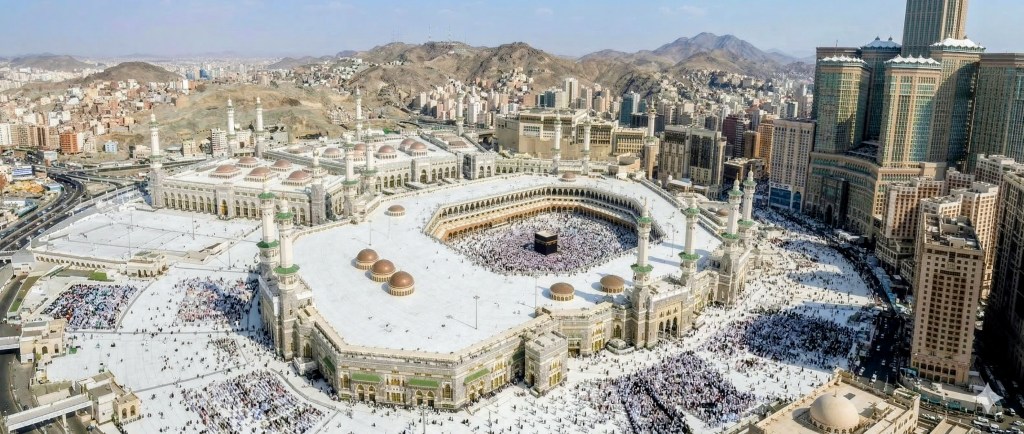
The Quranic assertion that Ibrahim and Ismail raised the foundations of the “First House” at Bakkah (3:96) presents a significant challenge to secular historical-critical geography.
The Bakkah-Mecca Linguistic Link
Muslim scholars generally equate Bakkah with Mecca, citing it as an ancient name derived from the Arabic bakka (to crowd or congest). Some linguistic theories suggest that the “B” and “M” were interchangeable in ancient South Arabic dialects, explaining why the Quran uses Bakkah in verse 3:96 but Makkah in verse 48:24.
The “Valley of Baca” in Psalm 84
A major point of interreligious debate is Psalm 84:6, which describes pilgrims passing through the “Valley of Baca” (Emeq haBakha). Muslim apologists argue that this is a direct biblical reference to the arid valley of Mecca, which “makes it a place of springs” through the faith of the pilgrims and the well of Zamzam. They cite various biblical commentaries that describe the bakha as a type of balsam tree that grows in dry, waterless regions like Mecca.
Christian and secular scholars, however, argue that the “Valley of Baca” is a location in the Holy Land, on the route to Jerusalem (Zion), and has no connection to Arabia. They point out that the Hebrew root B-K-H means “to weep,” and that the valley is a metaphorical or literal “Valley of Tears” through which pilgrims pass on their way to the Temple of Solomon.
Secular Critiques of the Meccan Sanctuary
Secular historians like Patricia Crone and Michael Cook have famously questioned whether Mecca was a ritual site at all in pre-Islamic times, noting the absence of the city’s name in 7th-century external records and the discrepancy between the Quranic description of a “valley with cultivation” and the actual arid geography of Mecca.
Recent revisionist studies propose that “Bakkah” and the “Masjid al-Haram” originally referred to locations in the Levant or the Sinai, such as the Hermon Valley or the area around Petra. These theories suggest that the “House of God” was a universal, moral concept that was only later anchored to the physical city of Mecca by the Umayyad caliphs.
The Quranic verses, however, provide their own internal geographical “criteria.” Verse 14:37 describes the valley as “barren” (ghayri dhi zar’in), but verse 2:126 contains a prayer for “fruits” for those who believe. This suggests an environment that is transformed by divine blessing, a theme that matches the “place of springs” in Psalm 84. Furthermore, the “Station of Ibrahim” (2:125, 3:97) is presented as a “clear sign” (ayatun bayyinatun), suggesting a tangible, physical location where the memory of Ibrahim’s mission has been preserved.
Judgment: Evaluating External Sources by Quranic Criteria
When we apply the Quranic criteria derived from the “Abraham.docx” file to the external religious and secular sources, several foundational judgments emerge.
1. The Criterion of Identity: “Ibrahim was not a Jew”
The Quranic verse 3:67 is the ultimate judge of the Judeo-Christian traditions. It asserts that Abraham cannot be defined by the legalistic or ethnic frameworks of Judaism or Christianity because he preceded them. Therefore, secular and religious accounts that treat Abraham primarily as a “Jew” or the “Father of the Jewish Nation” are judged as being limited by nationalistic redaction. The Quranic “Ibrahim” is a universal prophet of Fitra (natural disposition).
2. The Criterion of Submission: The Fulfillment of Trials
The Quran describes Ibrahim as the one who “fulfilled” his obligations (53:37) and was “obedient to Allah” (16:120). Sources that portray Abraham as arguing with God (as in the Genesis account of Sodom and Gomorrah) or being “bullied” by his wife Sarah (as in the banishment of Hagar) are judged by the Quran as being anthropomorphic distortions of a prophet’s character. In the Quranic view, God does not “need” a human partner to argue with, and a prophet does not “question” the divine command once it is understood.
3. The Criterion of Continuity: One Message, Many Messengers
The Quran judges all previous revelations as having the same “core” as the message of Muhammad—the Millat Ibrahim. Therefore, secular theories that view Islam as a “new” religion founded in the 7th century are judged as being historically short-sighted. The Quranic verses suggest that “Islam” is the perennial state of those who submit to the God of Ibrahim. The “revisionist” theories that see early Islam as a “Community of Believers” (including Jews and Christians) actually align more closely with the Quranic universalism of Millat Ibrahim than the later exclusivist interpretations.
4. The Criterion of the Sanctuary: The Primacy of the First House
The Quranic claim that the “First House” established for mankind was at Bakkah (3:96) is a judgment against any religious history that places the Temple of Solomon as the primordial sanctuary. By establishing the Kaaba as the original site of monotheism, the Quran re-centers sacred history away from Jerusalem and back to the foundations raised by Ibrahim and Ismail. Secular archaeology’s failure to find early records of Mecca is seen through the Quranic lens as a failure to recognize the “hidden” or “protected” nature of the Haram.
Thematic Epilogue: Ibrahim as the Eternal Nation
The study of Abraham across secular and religious sources reveals a figure who is as much a “site of contestation” as he is a “point of unity”. He is the “Man of Many Names”—Abram, Abraham, Ibrahim—but he remains, in the words of the Quran, an Ummah unto himself.
The “Abrahamic Dream” of a unified brotherhood of faiths often falters because each tradition insists on reading Abraham through its own “narrative program”. For the Jew, he is the root of the olive tree; for the Christian, he is the faith of the traveler; for the Mandaean, he is the apostate who left the river for the desert; and for the Baha’i, he is the first light in a progressive dawn.
However, the Quranic criteria provide a profound synthesis. By defining Ibrahim as a Hanif, the Quran invites us to look past the “sectarian identity politics” that have shaped the last two millennia. Ibrahim is presented as a “rational monotheist” who looked at the setting sun and the fading moon and realized that the Truth must be something that does not set.
The thematic core of Ibrahim’s legacy is Taslim—the act of throwing oneself into the fire of divine will and finding it to be “coolness and peace” (21:69). This is the ultimate “word” that Ibrahim fulfilled. Whether he lived in the Middle Bronze Age or at the dawn of the Persian Empire, whether his “First House” was in the Hijaz or the Levant, the Ibrahim of the Quran remains a “paragon of virtue” and a “teacher of humanity” whose message of Tawhid is as relevant to the modern secular world as it was to the idol-worshippers of Ur. In the final analysis, to follow the Millat Ibrahim is to follow the “straight way” that leads away from tribalism and toward the universal recognition of the One.


 The Glorious Quran and Science
Leave a comment