

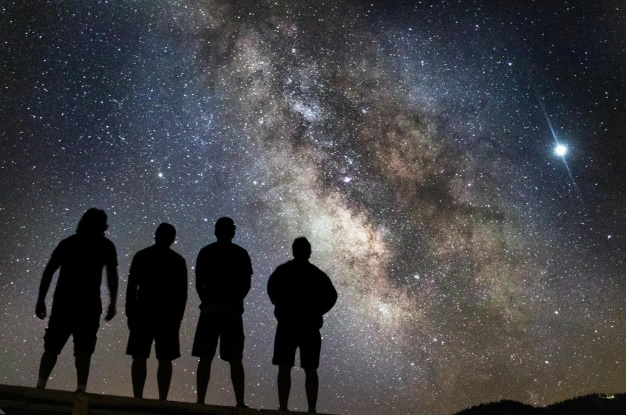
The cosmos held in being: a commentary on Qurʾān 30:25 and 35:41
Presented by Zia H Shah MD with help of Claude AI
Abstract
This commentary examines two pivotal Qurʾānic verses—30:25 and 35:41—that declare the heavens and the earth stand firm and persist solely by God’s command and sustaining grip. Drawing on modern astrophysics, quantum mechanics, and cosmological fine-tuning data, the scientific analysis reveals a universe whose existence depends on constants calibrated to precisions of 1 part in 10¹²⁰ and whose very atoms cohere only through forces that must be tuned within fractions of a percent. Philosophically, these verses anticipate the critique of necessary causation that David Hume would not articulate until seven centuries after al-Ghazālī’s Tahāfut al-Falāsifa (1095 CE): the observation of one event following another never proves that the first caused the second. Internet Encyclopedia of Philosophy Theologically, the verses anchor the doctrine of occasionalism—the position that God alone is the true efficient cause of every event, while natural “causes” are merely habitual occasions for divine action. ThequranStanford Encyclopedia of Philosophy The commentary traces how Qurʾānic verses such as 8:17 (“You did not throw when you threw, but God threw”), 35:41, 30:25, 22:65, 6:17, 11:56, and 55:29 converge to form the scriptural foundation upon which al-Ghazālī erected his systematic occasionalism. Finally, incorporating the contemporary scholarship of Zia H. Shah MD, Chief Editor of The Muslim Times, the analysis shows how twentieth- and twenty-first-century discoveries—quantum indeterminacy, Bell’s theorem, the Big Bang, and the simulation hypothesis—have made occasionalism not a medieval curiosity but a metaphysical framework with striking modern resonance. Thequran
The Arabic text and Abdel Haleem’s translation
Qurʾān 30:25 (Sūrat al-Rūm)
Arabic:
وَمِنْ آيَاتِهِ أَن تَقُومَ السَّمَاءُ وَالْأَرْضُ بِأَمْرِهِ ۚ ثُمَّ إِذَا دَعَاكُمْ دَعْوَةً مِّنَ الْأَرْضِ إِذَا أَنتُمْ تَخْرُجُونَ
M.A.S. Abdel Haleem translation:
“Among His signs, too, is the fact that the heavens and the earth stand firm by His command. In the end, you will all emerge when He calls you from the earth.” My Islam
This verse appears within a passage (30:20–27) that catalogues the āyāt (signs) of God in creation—from human diversity to the sleep-wake cycle. The key clause is أَن تَقُومَ السَّمَاءُ وَالْأَرْضُ بِأَمْرِهِ — “that the heavens and the earth stand firm (taqūm) by His command (amr).” The Arabic root q-w-m (to stand, to be established) conveys active subsistence, not static existence. The heavens and earth do not merely happen to be here; they stand because a command sustains them. The verse then pivots to eschatology—resurrection by a single divine call—linking cosmic sustenance to the final reconstitution of matter, as if to say: the God who holds galaxies in place can reassemble scattered atoms.
Qurʾān 35:41 (Sūrat Fāṭir)
Arabic:
إِنَّ اللَّهَ يُمْسِكُ السَّمَاوَاتِ وَالْأَرْضَ أَن تَزُولَا ۚ وَلَئِن زَالَتَا إِنْ أَمْسَكَهُمَا مِنْ أَحَدٍ مِّن بَعْدِهِ ۚ إِنَّهُ كَانَ حَلِيمًا غَفُورًا
M.A.S. Abdel Haleem translation:
“God keeps the heavens and earth from vanishing; if they did vanish, no one else could stop them. God is most forbearing, most forgiving.” My Islam
Here the verb is يُمْسِكُ (yumsiku), from the root m-s-k, meaning to hold, grasp, or prevent from slipping away. The Arabic أَن تَزُولَا (lest they vanish or cease) uses the root z-w-l, signifying removal, disappearance, or dissolution. The verse asserts three linked claims: (1) God actively holds the heavens and earth from collapsing or dissolving; (2) should they vanish, no being besides God could prevent it; and (3) God’s cosmic sustaining power is exercised alongside His attributes of forbearance (ḥalīm) and forgiveness (ghafūr), linking His maintenance of physical reality to His patience with human sin. The juxtaposition is theologically significant: the same God who could let the cosmos unravel instead sustains it, just as He could punish immediately but instead forgives.
A universe balanced on a razor’s edge: the scientific commentary
The Qurʾānic assertion that the heavens and earth “stand firm by His command” and are “kept from vanishing” resonates with one of the most remarkable discoveries of modern physics: the universe’s existence depends on an astonishing degree of fine-tuning in its fundamental constants and forces.
The fine-tuning of cosmic constants
The Standard Model of particle physics contains 26 freely adjustable parameters whose values are not predicted by any known theory but must be measured empirically. The New Atlantis Physicist Martin Rees identified six numbers—the strength of gravity relative to electromagnetism (N ≈ 10³⁶), nuclear efficiency of fusion (ε = 0.007), the density parameter (Ω ≈ 1), the cosmological constant (Λ ≈ 10⁻¹²² in Planck units), the amplitude of density fluctuations (Q ≈ 10⁻⁵), and the number of spatial dimensions (D = 3)— Wikipediaeach of which must fall within extremely narrow ranges for a universe capable of sustaining structure and life to exist. The cosmological constant, for instance, must be fine-tuned to approximately 1 part in 10¹²⁰. Faithfulscience A slightly more positive value would cause space to fly apart before stars could form; a slightly more negative value would cause universal collapse. WikipediaEveryStudent Roger Penrose calculated that the probability of the universe’s extraordinarily low-entropy initial state occurring by chance is 1 in 10^(10¹²³)—a number so vast that writing it out would require more zeros than there are subatomic particles in the observable universe. Discovery Institute
The forces that “hold” existence together
The strong nuclear force, roughly 10³⁸ times stronger than gravity, binds quarks into protons and neutrons and binds nuclei together against electromagnetic repulsion. Wikipedia If this force were 2% stronger, all hydrogen would convert to helium in the early universe—no water, no long-lived stars. Wikipedia If weakened by roughly 50%, complex atomic nuclei would be unstable. Wikipedia Without it, no element beyond hydrogen could exist. Scienceandculture Gravity itself, described by general relativity as spacetime curvature, must be calibrated so precisely that on a ruler spanning the observable universe, the life-permitting range for the gravitational constant occupies only about 9 nanometers—the width of a protein molecule. Faithfulscience
The Qurʾānic imagery of God “holding” (yumsiku) the heavens from vanishing gains striking scientific depth when we learn that 95% of the universe consists of invisible entities—dark matter (~27%) providing gravitational scaffolding that prevents galaxies from flying apart, and dark energy (~68%) providing the anti-gravitational pressure that prevents universal collapse while maintaining cosmic expansion. WikipediaCenter for Astrophysics NASA has described dark matter as essentially “the glue holding the universe together.” The tug-of-war between gravity and dark energy is precisely what sustains the universe in its current state: a balance so exact that its disruption in either direction would be catastrophic.
Quantum indeterminacy and the collapse of classical causation
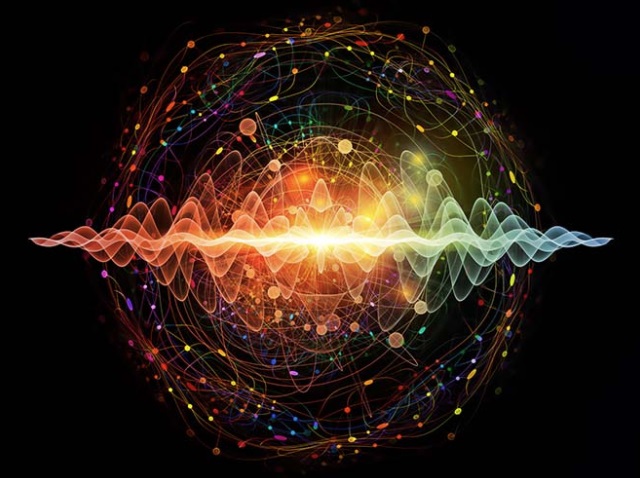
At the subatomic level, quantum mechanics reveals a world that is fundamentally probabilistic, not deterministically causal. Thequranthequran The Heisenberg uncertainty principle, Bell’s theorem (experimentally confirmed by Aspect, Clauser, and Zeilinger—earning the 2022 Nobel Prize), and the phenomenon of quantum entanglement all demonstrate that no local, deterministic hidden-variable theory can explain quantum behavior. Thequran When a photon strikes a half-silvered mirror, nothing in physics determines whether it will pass through or reflect—only the probability is fixed. thequran This indeterminacy at the foundations of matter resonates with the Qurʾānic claim that the natural order has no autonomous power: the “decision” at each quantum event appears genuinely open, as if waiting for a cause beyond the physical system to resolve it.
No autonomy in nature: the philosophical commentary
From habitual conjunction to divine custom
The philosophical core of Qurʾān 30:25 and 35:41 is a radical claim about ontological dependence. The verses do not merely say God created the heavens and earth in the past; they say God stands them firm and holds them from vanishing in the continuous present. This implies that existence is not a self-sustaining property of matter but a gift renewed at every instant. Philosophically, this challenges the Aristotelian view—dominant in both Greek and medieval Islamic falsafa—that substances possess inherent natures (ṭabāʾiʿ) with intrinsic causal powers.
Al-Ghazālī, in the 17th Discussion of his Tahāfut al-Falāsifa, mounts a devastating critique of precisely this assumption. Stanford Encyclopedia of PhilosophyThequran His central argument is that “the connection between what is habitually believed to be a cause and what is habitually believed to be an effect is not necessary.” Stanford Encyclopedia of Philosophy When we see fire touch cotton and the cotton burn, we observe temporal sequence—one event with (maʿahu) the other—not one event by (bihi) the other. The causal connection itself is never perceived. Thequran Al-Ghazālī makes a critical distinction between concomitant occurrence (al-ḥuṣūl ʿindahu) and causal production (al-ḥuṣūl bihi). We witness the former; we infer the latter out of habit. Stanford Encyclopedia of Philosophy
This argument anticipates David Hume’s famous critique of causation by approximately 650 years. ResearchGate Hume concluded that our belief in causal necessity is merely a psychological habit; Medium al-Ghazālī reached a similar epistemological conclusion but drew a radically different metaphysical lesson. ThequranInternet Encyclopedia of Philosophy Where Hume arrived at skepticism, al-Ghazālī arrived at God: the regularity we observe is not the product of autonomous natural powers but of divine custom (ʿāda)—God’s habitual way of acting, which He freely maintains and can freely suspend. Thequran +3
The cotton-and-fire thought experiment
Al-Ghazālī’s most celebrated illustration—placing cotton in contact with fire—operates on three levels simultaneously. Epistemologically, it demonstrates that we never observe the causal power itself, only the succession of events. Internet Encyclopedia of Philosophy Modally, it shows that cotton burning upon contact with fire is logically contingent, not necessary: there is no contradiction in imagining fire touching cotton without burning occurring. Internet Encyclopedia of Philosophy Theologically, it appeals to the Qurʾānic precedent of Abraham, whom God protected in a fire (21:69: “O fire, be cool and peaceful for Abraham”), as proof that God can and does suspend the habitual pattern when He wills. Thequran Modern chemistry, interestingly, adds an empirical footnote: combustion requires oxygen, not merely fire. Cotton sealed in a vacuum would not burn upon contact with flame—a demonstration that the relationship between fire and burning is more complex and mediated than naive observation suggests. Taylor & Francis Online
God as al-Qayyūm: the theological commentary
The divine name that holds reality together
The theological weight of 30:25 and 35:41 is anchored in one of God’s most exalted names: al-Qayyūm—the Self-Subsisting, the Sustainer of all that exists. This name appears in the Qurʾān’s greatest verse, Āyat al-Kursī (2:255): “God: there is no god but Him, the Ever Living, the Ever Watchful (al-Ḥayy al-Qayyūm). Neither slumber nor sleep overtakes Him… His throne extends over the heavens and the earth; it does not weary Him to preserve them both.” Islam AwakenedThequran The theological architecture is clear: God’s sustaining of reality is not a strain on His power but an effortless, continuous act flowing from His essential nature as al-Qayyūm.
Multiple Qurʾānic verses reinforce this vision of continuous, active divine governance:
- Qurʾān 55:29: “Every day He is engaged in a [new] matter” — creation is not a past event but an ongoing process. ThequranThequran
- Qurʾān 22:65: “He keeps the heavens from falling down on the earth without His permission” Quran O — the sky’s stability is an active divine choice, not a passive natural state.
- Qurʾān 13:2: “It is God who raised the heavens with no visible supports” — the absence of visible pillars points to an invisible sustainer.
- Qurʾān 67:19: “None holds them [birds] aloft except the Most Merciful” — even the flight of a bird is attributed to God’s sustaining will. thequran
- Qurʾān 11:56: “There is no creature that walks the earth but He grasps it by its forelock” — God’s control extends to every living being.
- Qurʾān 6:17: “If God touches you with affliction, no one can remove it except Him” IslamAwakened — all harm and relief flow from God alone.
Tawḥīd as the rejection of autonomous causation
The theological motivation for denying autonomous natural causation is the doctrine of tawḥīd (divine unity). Al-Ghazālī argued that to attribute independent causal efficacy to created things would constitute a subtle form of shirk (associating partners with God). Thequran If fire could burn by its own inherent power, that power would be independent of God—an autonomous agency operating alongside the divine will. This is theologically inadmissible. WikipediaThequran As the Qurʾān declares in 8:17: “It was not you who killed them but God, and when you [Prophet] threw, it was not your throw but God’s.” My Islam +2 Even a deliberate human action—the Prophet casting sand at the Battle of Badr—is re-attributed to God as its true agent. ThequranIslamic Studies Human beings and natural objects are, in this framework, instruments or occasions (asbāb) through which the sole Actor works. Thequran Al-Ghazālī summarized this worldview with an evocative metaphor: “The universe is like a grand theater where God is the only actor—what we call ‘characters’ (creatures) are merely costumes or instruments through which the sole Actor works.” Thequran
From Qurʾānic verses to systematic occasionalism: how scripture shaped al-Ghazālī
The scriptural chain of reasoning
Al-Ghazālī’s occasionalism Thequran was not a philosophical novelty imported from outside Islam. Thequran It was, as Zia H. Shah MD has argued extensively, the logical conclusion of taking the Qurʾān’s statements about divine sovereignty at face value. The chain of reasoning proceeds through several stages:
Stage 1 — God as the sole Creator and Sustainer. Verses like 35:41 (“God keeps the heavens and earth from vanishing”), Thequran 30:25 (“the heavens and earth stand firm by His command”), Thequran and 2:255 (“it does not weary Him to preserve them both”) Islam Awakened establish that the cosmos depends on God’s active, continuous will for its existence. ThequranThequran If God withdrew His sustaining power, reality would dissolve.
Stage 2 — God’s direct agency in ostensibly natural and human events. Verse 8:17 (“You did not throw when you threw, but God threw”) My IslamThequran and 6:95 (“It is God who causes the seed grain and the date seed to sprout”) Thequran attribute specific events—warfare, germination, rain—directly to God, not to intermediate causes. Even sensory perception is attributed to God: “Who controls hearing and sight?” (10:31). Thequranthequran
Stage 3 — God’s continuous creative engagement. Verse 55:29 (“Every day He is engaged in a [new] matter”) ThequranThequran and the concept of kun fa-yakūn in 36:82 (“His command, when He wills a thing, is only to say to it, ‘Be!’—and it is”) portray creation as an instantaneous, ongoing divine act, not a chain of mechanical causation. Thequranthequran
Stage 4 — The possibility of miracles as proof of non-necessary causation. The Qurʾānic accounts of Abraham unharmed in fire (21:69), Moses’s staff becoming a serpent, and the splitting of the sea demonstrate that God can and does suspend the habitual patterns of nature. Thequran If fire necessarily burned, Abraham’s survival would be logically impossible. Since it occurred, the “necessity” of natural causation is an illusion. utmStanford Encyclopedia of Philosophy
Stage 5 — Al-Ghazālī’s synthesis. Drawing these threads together, al-Ghazālī concluded in the Tahāfut that God is the sole true cause of every event. Created things have no inherent causal powers. Thequran +2 What we call “natural laws” are descriptions of God’s customary way of acting (ʿāda or sunnat Allāh)—consistent patterns that He freely maintains and can freely alter. Thequran +3 Science discovers regularities in God’s habits, but the habits rest on divine will, not autonomous natural necessity.
The Ashʿarī theological tradition within which al-Ghazālī worked reinforced this conclusion through its distinctive atomistic metaphysics: the world is composed of atoms bearing momentary accidents (aʿrāḍ) that cannot persist for two consecutive instants of time. God must recreate every atom and every quality at each moment. Stanford Encyclopedia of PhilosophyGhayb As one scholar summarizes: “God rearranges the atoms that make up this world anew at every instant, and in so doing God continuously creates the accidents that inhere in these atomic substances.” ThequranStanford Encyclopedia of Philosophy The universe, on this view, is not a self-sustaining mechanism but something more like a film projection—a rapid succession of individually created frames that give the illusion of continuous, autonomous motion. Daily Times
Zia H. Shah’s modern occasionalist synthesis
Zia H. Shah MD, a physician practicing in upstate New York and Chief Editor of The Muslim Times, Thequran has produced a substantial body of work at The Glorious Quran and Science (thequran.love) that reexamines al-Ghazālī’s occasionalism through the lens of contemporary science and philosophy. His contributions represent one of the most sustained modern efforts to show that occasionalism is not merely defensible but intellectually compelling in light of twenty-first-century knowledge.
Occasionalism as “the metaphysics of Inshallah”
Shah’s most evocative formulation captures the essence of his project: “Al-Ghazali’s doctrine of Occasionalism is essentially the metaphysics of ‘Inshallah.’ It is an attempt to rigorously explain reality as the Qur’an depicts it—utterly contingent on God at every moment.” Thequran +2 The everyday Muslim phrase Inshallah (“if God wills”), Shah argues, is not mere piety or cultural habit but an ontological claim: every future event, from a heartbeat to a harvest, occurs only because God actively wills it at the moment of its occurrence. Thequran The Qurʾānic usage reinforces this: Joseph says “Enter Egypt, Allah willing, in security” (12:99); Moses says to Khiḍr, “You will find me patient, if Allah wills” (18:69). Even prophets condition future outcomes on God’s will. Thequran Shah contends this radical contingency is precisely what occasionalism formalizes at the philosophical level. Thequran
Quantum mechanics as an unexpected ally
Shah draws extensively on quantum physics to argue that modern science has undermined the very foundation that al-Ghazālī’s critics stood on—necessary, deterministic causation. In his article “Quantum Entanglement, Ghazali’s Occasionalism, and God’s Continuous Sustenance of the Universe,” Shah writes that the 2022 Nobel Prize in Physics, awarded for experiments confirming violations of Bell inequalities, demonstrated that “no local hidden variable theory can reproduce all quantum predictions”—meaning the classical picture of objects with inherent, deterministic causal properties is empirically refuted at the fundamental level. Thequran
Shah argues that quantum entanglement, in which measuring one particle instantaneously correlates with the state of its distant partner without any signal passing between them, suggests that “causality is not material, local, or necessary—aligned with occasionalist metaphysics.” Thequran He further notes that quantum tunneling—where particles traverse energy barriers they classically lack the energy to cross—shows that “outcomes are probability-governed, not cause-effect determined.” ThequranDaily Times Shah observes that “Ghazali’s occasionalism had been losing ground since Averroes in Muslim Spain and since the Renaissance in Western Europe, until the 1920s when quantum mechanics began to develop.” He expresses hope that “with increasing knowledge, his occasionalism and God’s sovereignty will keep on rising even in the scientific arena.” Thequran
The Big Bang and the vindication of creation in time
Shah emphasizes that modern cosmology has resolved a key philosophical debate in al-Ghazālī’s favor. Al-Ghazālī’s opponents among the falāsifa held that the universe was eternal—a self-sustaining system requiring no temporal beginning. Al-Ghazālī insisted on creation in time. Internet Encyclopedia of Philosophy The discovery of the Big Bang confirmed that the universe had a temporal beginning approximately 13.8 billion years ago, vindicating al-Ghazālī’s position against his rationalist critics. thequranThequran As Shah writes: “Modern cosmology removed a major philosophical objection to occasionalism—the idea of an eternal, self-sustaining universe. Instead, the universe appears radically contingent, having come into being from nothing physical, which is exactly what an occasionalist would expect.” thequranThequran
Shah further notes that even Stephen Hawking’s proposal that the universe could “create itself from nothing” under the law of gravity fails to escape the problem, because it presupposes the existence of physical laws—prompting George Ellis’s pointed question: “Who or what ‘dreamt up’ the laws of physics?” thequran
Nature as “a theater of divine will”
Shah describes the natural world as “a theater of divine will, a collection of signs (āyāt) pointing beyond themselves to God.” ThequranThequran This phrase captures the occasionalist reinterpretation of natural law: the regularities science discovers are real and reliable, but they are descriptive of God’s habitual action, not prescriptive laws binding an autonomous nature. Shah frames this as a form of “theological critical realism”—science genuinely discovers how events regularly unfold, but the ultimate “why” lies in God’s will. Thequran Natural laws, in this framework, are “His customs in managing the universe, not independent machinery.” ThequranThequran
Shah draws an intriguing parallel with the simulation hypothesis: if a sophisticated computer simulation is entirely dependent on an external intelligence for every aspect of its operation, then the idea of continuous divine governance becomes more conceivable by analogy. ThequranThequran Just as a simulated world has no autonomous existence apart from its programmer, the physical universe, on the occasionalist view, has no autonomous existence apart from God. Shah argues that quantum physics, cosmology, simulation theory, and even the Many-Worlds Interpretation all “underscore the radical contingency of our particular history,” Thequran making occasionalism not a pre-modern relic but a framework that resonates with cutting-edge thought. Thequran
The deterministic causal chain reinterpreted
In his article “Determinism, First Cause, and Al-Ghazali’s Occasionalism,” Shah addresses the Laplacean worldview head-on. He argues that the scientific observation of a deterministic causal chain since the Big Bang is compatible with occasionalism when understood at two levels of description: “Every event is both fully caused by prior events and fully caused by God. To the believer, these are different levels of description—one horizontal, within creation; the other vertical, from Creator to creation.” Thequran He uses the metaphor of a tapestry: “The entire causal network of the cosmos is like a tapestry woven in real-time by God. The Big Bang was the first thread He laid down… and every subsequent thread in the fabric of reality is His weaving too.” Thequran The scientific fact that the universe has a 13.8-billion-year causal history is thus “perfectly compatible with the theological fact that ‘Every day He is engaged in an affair’ (Qur’an 55:29) of sustaining creation.” ThequranThequran
Epilogue: The universe as a sustained syllable
There is an ancient theological intuition, shared across the Abrahamic traditions, that creation is not something God did once and walked away from. The thirteenth-century Christian philosopher Thomas Aquinas said that if God’s support were withdrawn, the universe would lapse back into nothingness in an instant. ThequranThequran The Qurʾān says it more concretely: God holds the heavens and earth from vanishing (35:41). The verb is active, present, continuous. The cosmos is not a self-winding clock. It is more like a word being spoken—existing only as long as the Speaker sustains the utterance.
Modern science has given us extraordinary tools to map the structure of this sustained utterance. We know that the cosmological constant is fine-tuned to 120 decimal places. WikipediaCatholic Answers We know that the strong nuclear force holds each atomic nucleus together against forces that would otherwise tear it apart in femtoseconds. Scienceandculture We know that dark matter provides the invisible scaffolding without which galaxies would dissipate, National Geographic and that dark energy prevents universal collapse while maintaining expansion. We know that quantum events resolve into definite outcomes without any deterministic mechanism to compel them. Thequranthequran At every scale—from the quantum foam to the cosmic web—the universe displays what the physicist Paul Davies called a character of being “finely adjusted to make possible the development of life.” Discovery Institute
Al-Ghazālī would not have been surprised. For him, the regularity of nature was never evidence of nature’s autonomy but evidence of God’s faithfulness—His commitment to maintaining a stable order Ghazali in which human beings can live, learn, and worship. ThequranGhayb The “laws” of physics are, in this reading, the habits of the Lawgiver. They are utterly reliable because God is utterly reliable. But they are not necessary in the way that a logical truth is necessary, because God is free. Wikipedia
Zia H. Shah captures this integration of ancient theology and modern discovery when he writes that “a cohesive picture emerges: a universe that is empirically lawful yet metaphysically contingent, consistent in its observable patterns yet ultimately reliant on an external Sustainer.” Thequran The Qurʾān’s claim that “the heavens and the earth stand firm by His command” is, on this reading, not a pre-scientific naïveté to be outgrown but a metaphysical insight that science continues to deepen without being able to replace. The deepest question physics can formulate—Why is there something rather than nothing?—remains precisely the question the Qurʾān answers: because God spoke, and continues to speak, the universe into being. كُن فَيَكُونُ — “Be!” — and it is. But the “Be” never stops echoing. It is renewed at every instant, in every atom, across every light-year, by the One who neither slumbers nor sleeps. Thequran

 The Glorious Quran and Science
Leave a comment