
For the suggested Quranic dictionary or concordance, please click here
Presented by Zia H Shah MD with help of Gemini
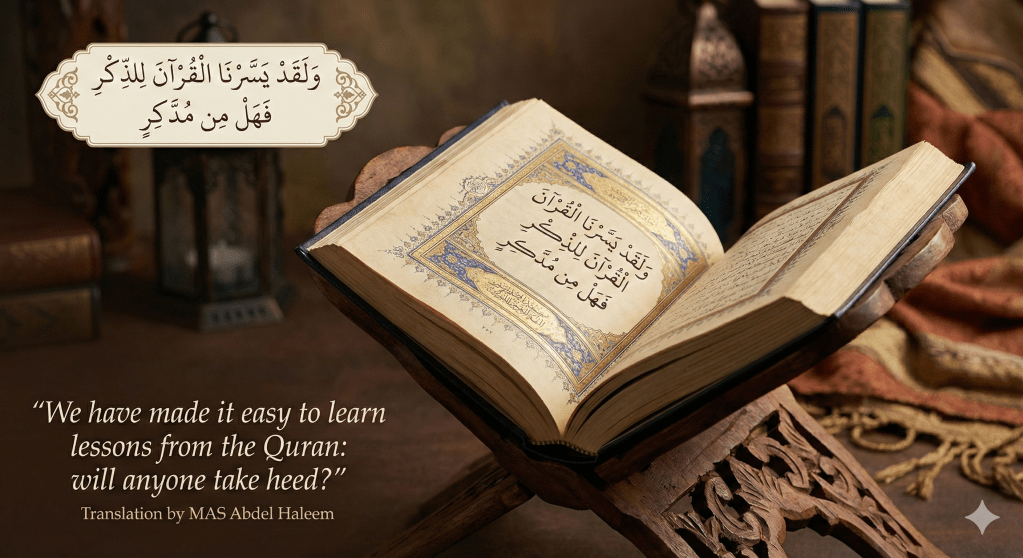
The verse quoted in the title is mentioned four times in Surah Qamar: “And We have certainly made the Quran easy to remember. So is there anyone who will be mindful?” is a repeated verse in Surah Al-Qamar (54:17, 22, 32, 40). It signifies that God has made the Quran easy to memorize, recite, understand, and derive lessons from, urging humanity to take advantage of this.
The Morphological Architecture of the Quran: A Computational and Genomic Synthesis of the Arabic Root System
Presented by Zia H Shah MD
Audio teaser: Arabic roots and the DNA code
The linguistic structure of the Glorious Quran presents a unique intersection of mathematical precision, cognitive optimization, and ontological depth. This research report evaluates the relationship between the approximately 78,000 words of the Quranic text and its foundational matrix of roughly 2,000 trilateral roots. By analyzing the non-concatenative morphology of Classical Arabic through the lens of modern computational linguistics and the “Linguistic-Genomic Thesis” proposed by Zia H. Shah MD, the analysis demonstrates that the Quranic lexicon functions as a sophisticated linguistic software designed for maximum communicative efficiency and semantic preservation. The report examines how the trilateral root system (jadhr) facilitates rapid vocabulary acquisition and cognitive retention for non-native learners, utilizing tools such as the Quranic Arabic Corpus for morphological and syntactic analysis. Furthermore, the report explores the profound parallels between the three-letter Arabic root and the triplet codon architecture of DNA, suggesting a unified design across the Book of Nature and the Book of Scripture. This synthesis positions the Arabic language not merely as a historical vehicle for revelation, but as a premeditated, clear (mubīn) medium that resists linguistic entropy and serves as a primary sign (āyah) of guided evolution and divine orchestration.
Quantitative Philology and the Statistical Landscape of the Quranic Corpus
The statistical profile of the Quran provides the foundational data for understanding its linguistic economy and the structural miracle of its composition. While the total number of words in the Quranic text is generally cited between 77,429 and 77,915, depending on the specific methodology of counting attached particles and pronouns, the number of unique lexical entries is significantly smaller. This discrepancy between the total volume and the unique vocabulary highlights a high degree of lexical efficiency, where a compact set of roots generates the entirety of the sacred text’s meaning.
Traditional and modern scholars have meticulously documented these counts to ensure the preservation of the text’s integrity. For instance, classical scholars like Al-Farahidi recorded approximately 77,439 words, a figure that matches contemporary computational tallies. These counts are not merely academic exercises but serve as a linguistic checksum, ensuring that the text remains unchanged across generations and various recitation styles, such as the Hafs and Warsh narrations.
| Statistic Category | Estimated Count | Source Reference |
| Total Number of Words | 77,797 – 77,880 | |
| Total Number of Letters | 327,792 – 330,709 | |
| Total Unique Words | 5,277 – 18,994 | |
| Number of Separate Lexical Entries (Roots) | ~1,850 – 2,000 | |
| Words in Makki Surahs | 47,638 | |
| Words in Madni Surahs | 30,159 | |
| Common Words Covering ~50% of Text | 125 | |
| Average Word Length (Letters) | 4.23 – 4.25 |
The variance in the count of unique words—ranging from 5,277 to nearly 19,000—stems from the complex morphology of the Arabic language. In a standard analytic language, a word and its plural might be counted as two unique units. However, in the Quranic Arabic Corpus, a word is often reduced to its base lemma or trilateral root. This allows researchers to see that the 78,000-word corpus is actually built upon a highly concentrated foundation of approximately 2,000 root words.
The average word length in the Quran is approximately 4.25 letters, demonstrating a consistent phonetic rhythm that aids in oral recitation. Furthermore, the distribution of these words across the 114 chapters shows a deliberate balance. The Makki Surahs, which focus on the core principles of faith and the oneness of God, contain roughly 47,638 words, while the Madni Surahs, addressing social laws and community regulations, contain 30,159 words. This statistical division reflects the Quran’s transition from establishing metaphysical foundations to implementing social structures.
The Trilateral Root Architecture: The Jadhr as a Generative Semantic Engine
The Arabic language is structurally unique due to its non-concatenative morphology, which is predicated upon the triconsonantal root system, known as the jadhr. This system functions as a generative semantic engine, where nearly the entirety of the Arabic lexicon is derived from a finite set of three-letter cores. These three radical consonants encode an abstract semantic essence that remains constant across divergent grammatical forms.
Mechanics of Root-and-Pattern Morphology
Unlike Indo-European languages that rely heavily on linear affixation, Arabic employs a root-and-pattern system. This involves interweaving the three-letter root with specific vocalic templates or patterns, known as awzān. The root provides the semantic anchor, while the pattern determines the functional application of the word.
For example, the root {k-t-b} encapsulates the abstract concept of writing or collecting information. By inserting this root into different patterns, the language generates an expansive variety of terms that are all logically connected to the central idea of writing.
| Derived Word (Transliteration) | Arabic Script | Grammatical Form / Meaning |
| Kataba | كَتَبَ | Verb (Form I): He wrote |
| Kitāb | كِتَاب | Noun: Book / Scripture |
| Kātib | كَاتِب | Noun: Writer / Scribe |
| Maktūb | مَكْتُوب | Passive Participle: Written / Decreed / Destiny |
| Maktaba | مَكْتَبَة | Noun of Place: Library / Office |
| Istaktaba | اِسْتَكْتَبَ | Verb (Form X): He asked (someone) to write |
This morphological cohesion prevents semantic drift, a common occurrence in evolved languages where words lose their original logical connection to their roots over time. In Arabic, a speaker who encounters an unfamiliar word can immediately isolate its root consonants and grasp its general semantic field, a feature that points toward a system designed for maximum communicative efficiency.
Mathematical Precision and the Logic of Derivation
The mathematical potential for word generation from the 28 letters of the Arabic alphabet is staggering. The number of possible pure triliteral roots is approximately 21,952 ($28 \times 27 \times 27$, accounting for certain phonetic constraints). Traditional dictionaries typically document between 5,000 and 11,347 lexical roots, with the Quran utilizing a refined subset of approximately 1,850 to 2,000 roots to construct its entire message.
Computational analysis reveals that the Arabic root is not an infinite value but a finite one, typically restricted to three letters, with occasional quadrilateral (four) or quintuple (five) radicals. This finite nature allows the language to be modeled as a system of linear functions where the root serves as the constant and the added morphological patterns act as independent variables. The process of derivation follows a consistent mathematical standard:
$$f(x) = ax + b$$
In this equation, the derived word is the dependent result, where the root provides the base value and the morphological patterns provide the rate of semantic change. The system includes built-in logical limits, such as structural failure if a root were to reach six letters, which preserves the stability of the language’s mental lexicon.
Digital Exegesis: The Quranic Arabic Corpus and Computational Linguistics
The study of the Quranic root system has been significantly enhanced by natural language processing (NLP) and computational technology. The Quranic Arabic Corpus, developed at the University of Leeds, serves as a primary digital resource for researchers seeking to explore the morphology and syntax of the text.
Word-by-Word Grammatical Analysis
The corpus provides a word-by-word analysis that maps out the syntax of the entire Quran. Each word is annotated for its part of speech, grammatical case, gender, and number. Most importantly, it links every word back to its trilateral root, allowing users to navigate through all occurrences of a specific root within the text.
For instance, the dictionary section of the corpus allows a user to select a root, such as {r-h-m} (mercy), and view every instance where it appears in the Quran—whether as the divine attribute Ar-Rahman (The Most Gracious), the noun rahmah (mercy), or the word rahim (womb). This hyper-linked reading experience enriches the student’s understanding by showing how a single semantic core manifests across diverse contexts.
The Syntactic Treebank and I’rab
A defining feature of the corpus is the Syntactic Treebank, which uses traditional Arabic grammar (i’rāb) to visualize Quranic syntax through dependency graphs. These graphs represent the relationship between words using mathematical graph theory, showing how phrases and clauses connect.
| Grammatical Feature | Function in the Treebank | Linguistic Implication |
| i’rāb (إعراب) | Case inflection marking | Explains syntactic functions and semantic roles. |
| Dependency Graphs | Visual links between words | Models the logical structure of the sentence. |
| The ‘Amil Theory | Predictable grammatical change | Ensures every inflection has a logical cause. |
| Semantic Ontology | Concept-based categorization | Links words to broader thematic domains. |
The use of traditional i’rāb is significant because it contrasts with modern standard Arabic, where diacritics are often omitted. The Quranic text, being fully vowelized with explicit diacritic marks, reduces ambiguity in meaning and preserves the oral tradition of recitation. This transparency facilitates deep linguistic queries and ensures that the “clear Arabic language” (lisānun ‘arabiyyun mubīn) remains accessible to both human and computer-based analysis.
Cognitive Ergonomics and the Pedagogy of the Quranic Lexicon
The efficiency of the Quranic root system has profound implications for human cognition and memory. The task of learning the Quranic vocabulary becomes significantly easier and more enjoyable when students focus on the association between a word and its root.
The Chunking Mechanism in Memorization
Cognitive psychology defines chunking as the grouping of individual pieces of information into larger, meaningful wholes. In the context of the Quran, a single trilateral root acts as a “chunk” that organizes dozens of verses and related terms. When a reciter or student encounters a word, the brain identifies the root consonants first and then fits them into a known pattern. This two-step processing ensures that even if a specific vowel or suffix is momentarily forgotten, the semantic core remains intact, providing the structural cues necessary for retrieval.
This cognitive efficiency explains the phenomenon of Huffaz—individuals who memorize the entire Quran in its original Arabic, often without being native speakers of the language. The mathematical precision of the root system serves as a mental grid, allowing the brain to process and store the text as a coherent network of meanings rather than a collection of random sounds.
High-Frequency Words and the 75% Rule
One of the most encouraging statistics for students of the Quran is that a very small set of words constitutes the majority of the text. Approximately 500 high-frequency words account for nearly 75% of the total Quranic corpus. Furthermore, as few as 125 words, repeated throughout the text, make up approximately 50% of the total word count.
| Word Frequency Class | Number of Unique Words | Coverage of Quranic Text |
| High Frequency Tier 1 | 125 words | ~50% of the text |
| High Frequency Tier 2 | 500 words | ~75% of the text |
| Common Verbs | ~1,475 forms | Broad semantic range |
| Total Lexical Roots | ~1,850 – 2,000 | 100% of the derived text |
By focusing on these high-frequency roots and their associated words, a learner can achieve functional literacy of the sacred text with a relatively modest investment of time. This “economy of revelation” suggests a deliberate optimization aimed at balancing theological depth with linguistic accessibility.
The Morphological Templates (Awzan) as Programmatic Operators
The Arabic language utilizes morphology (Sarf) through rhythmic templates that function as predictable logical operators. These templates, known as the ten primary verb forms, modify core meanings in mathematically consistent ways. Much like a software environment must be architected before code can be executed, these templates provide the pre-coded framework into which roots are inserted to generate specific meanings.
The Ten Primary Verb Forms
Each of the ten verbal forms adds a specific semantic layer to the base root, such as causation, intensity, reciprocity, or seeking. The precision with which these forms operate allows for nuanced theological and legal concepts to be explained with unparalleled clarity.
| Form | Logic / Pattern | Example Root: {gh-f-r} (Forgive) | Resulting Meaning |
| I | Basic Action | Ghafara | He forgave |
| II | Intensity / Causation | Ghaffara | He forgave repeatedly/intensively |
| III | Mutual/Reciprocal | Ghāfara | To attempt forgiveness with another |
| IV | Causative | Aghfara | To make someone forgive |
| V | Reflexive of Form II | Taghaffara | To seek to be forgiven intensively |
| VI | Mutual Participation | Taghāfarū | They forgave one another |
| X | Seeking / Requesting | Istaghfara | He sought forgiveness |
The consistency of these patterns across thousands of different roots is cited by researchers as evidence of a system engineered with a specific purpose rather than one formed by random linguistic drift. This “intelligent switch” mechanism mirrors the binary logic of modern computer programming, where altering a single “variable” (a vowel or prefix) switches the functional state of the word entirely.
The Linguistic-Genomic Synthesis of Zia H. Shah MD
A profound new perspective on the Arabic language is offered by Zia H. Shah MD, who evaluates the structural and ontological parallels between the biological mechanisms of life and the linguistic architecture of Arabic. Shah frames Arabic morphology as “linguistic software” running atop the “genomic hardware” of life, positioning both as evidence of a single divine Architect whose guidance manifests through natural mechanisms rather than supernatural intervention.
The DNA Codon and the Arabic Root Analogy
The universe is governed by two interconnected and functionally analogous codes: the four-letter chemical code of DNA and the highly organized code of human language. All living organisms share a common blueprint written in DNA, consisting of four chemical bases—Adenine (A), Thymine (T), Cytosine (C), and Guanine (G). These letters are read in groups of three, known as triplet codons, which encode amino acids to build proteins.
Shah observes a non-accidental parallel between this biological system and the Arabic trilateral root system. Just as the three-letter codon translates into a specific amino acid across all kingdoms of life, the three-letter Arabic root stores the generic semantics for an entire family of words.
| Feature | Genomic Hardware (DNA) | Linguistic Software (Arabic) |
| Fundamental Alphabet | 4 Bases (A, T, C, G) | 28 Consonants |
| Basic Information Unit | Triplet Codon (3 letters) | Trilateral Root (3 letters) |
| Mathematical Result | 64 Combinations ($4^3$) | ~20,000 Potential Roots ($28^3$) |
| Function | Encodes amino acids | Encodes semantic cores |
| System Property | Economy of design; maximal output | Systematic generativity; predictability |
Both systems utilize a three-unit architecture that is mathematically optimal for balancing information density with error resistance. Shah argues that if the complexity and functional optimization of the genomic code imply a Coder, then the parallel complexity of the Arabic linguistic code constitutes a second, independent sign of a divine Designer.
Biological Hardware: The Guided Evolution of Cognitive Organs
The Linguistic-Genomic Thesis also addresses the development of the biological vessel required to process language. Shah champions a model of “Guided Evolution,” which reconciles the scientific consensus on common ancestry with Islamic monotheism. This model posits that evolution is the method by which a wise Creator unfolds life’s tapestry, where the laws of nature—such as natural selection and genetic mutation—act as instruments of divine will.
Strong evidence for this guided process is found in Human Endogenous Retroviruses (ERVs). Once dismissed as “junk DNA,” these viral sequences (comprising ~8% of the human genome) were co-opted to play essential roles in human development.
- Placental Evolution: The development of the human placenta was mediated by captured viral envelope proteins, such as Syncytin-1 and Syncytin-2. These “viral ghosts” allowed for a symbiotic barrier between mother and fetus, facilitating live birth.
- Brain and Cognition: Recent research suggests that HERV activation triggered neural growth pathways that specifically distinguish humans from other primates, enabling the blossoms of consciousness and language.
- Language Organs: Shah suggests that the physical organs of speech—the throat, tongue, and lips—were specifically designed to articulate a language as logical and complex as Arabic.
In this view, the Arabic language was premeditated before the Quran descended into it. The biological “hardware” of the brain and placenta was prepared through guided evolution to eventually support the reception of the “linguistic software” of revelation.
Comparative Nomenclature and Systematic Order
The history of human knowledge is the history of nomenclature—the systematic assignment of names to entities within a domain. Zia H. Shah MD investigates the transition from the idiosyncratic naming systems of the past to the highly standardized systems of modern science, such as IUPAC in chemistry or Linnaean taxonomy in biology.
Human Consensus vs. Divine Blueprint
Scientific naming systems are products of tortuous human consensus, often requiring years of committee review and ratification. For example, before the 18th century, chemistry was encumbered by alchemical names like “butter of antimony,” which provided no information about atomic composition. Modern chemical nomenclature (IUPAC) requires formal rules to map structural formulas into names.
Shah contrasts these human-engineered systems with the “Premeditated Revelation” of the Arabic language. While human taxonomies are built incrementally and are prone to entropy, the Arabic root system exhibits a structural dominance and resistance to linguistic drift that suggests a prior consciousness. The language acts as an internal morphological nomenclature more generative than any man-made system, optimized for human cognition and the encoding of multivalent divine meanings.
Resistance to Entropy and the “Clear Arabic Language”
Unlike most natural languages that exhibit “high entropy” over time—losing structural complexity or becoming irregular—Classical Arabic has maintained its core morphological and syntactic rules for over 1,400 years. This stability is facilitated by the mathematical framework of the trilateral root, which ensures that even as the language expands, it remains tethered to its original logical foundations.
The Quran describes itself as being in a “clear Arabic language” (16:103), a medium that is “without any deviance”. This clarity is not merely a literary quality but a structural property of the language’s “software”. By providing a medium resistant to the entropy of time and the ambiguity of human convention, the Creator ensured that the guidance of the Quran remains functional for all people across all eras.
Thematic Epilogue: The Miraculous Union of the Tongue and the Genome
The integration of approximately 78,000 words into a matrix of 2,000 roots is more than a linguistic curiosity; it is a profound miracle of the Arabic language and the Glorious Quran. This system transforms the daunting task of learning a sacred text into an enjoyable and rewarding journey of discovery. By associating each word with its trilateral root—the jadhr—the student is not merely memorizing sounds but is navigating a hyper-linked network of meanings that resonate with the very architecture of human life.
The insights of Zia H. Shah MD reveal that this linguistic structure is the “software” corresponding to the “genomic hardware” of our bodies. The three-letter root is a linguistic gene, echoing the three-letter codon that builds our cells. This parallel provides an unequivocal “Two Books” paradigm: the harmony of Scripture and Nature. For the believer, scientific inquiry into DNA or the evolution of the brain is not a departure from faith but a systematic “reading” of the divine signs (āyāt) that God placed in creation.
The Arabic language, in its mathematical precision and cognitive optimization, serves as a confirming sign—a linguistic miracle that proves the Source of the message is also the Architect of the tongue. It is a language engineered for guidance, designed to be resistant to the decay of time, and optimized to be “easy to understand and remember”. As we explore the Quran through the lens of its roots and its genomic parallels, we witness the “Habit of God” (Sunnat Allah) manifesting in both the biological hardware that allows us to think and the linguistic software that allows us to speak.
The ultimate triumph of the Quranic truth is not a campaign of worldly conquest, but the gradual victory of its principles in hearts and minds—a victory facilitated by the structural clarity and majestic organization of the “Clear Arabic Tongue”. In every root that generates a family of words, and in every codon that builds a protein, we find a unified testimony to the One Creator who taught man to communicate and who continues to guide humanity through the profound miracles of the Quran and the natural world.
 The Glorious Quran and Science
Leave a comment