
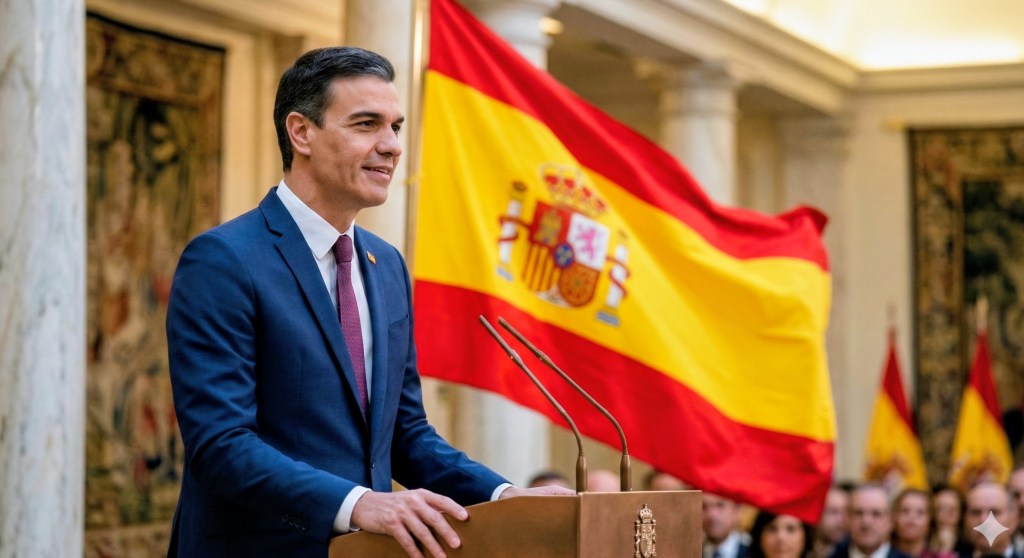
The Geopolitical Architecture of Pedro Sánchez: Resilience, Normative Diplomacy, and the Secular Pluralist Vision
Presented by Zia H Shah MD
Abstract
The political tenure of Pedro Sánchez Pérez-Castejón, Prime Minister of Spain since 2018, represents a paradigm shift in the geopolitical positioning of the Iberian Peninsula within the European Union and the broader Mediterranean basin. This report provides an exhaustive biographical and analytical examination of Sánchez’s ascent, characterized by a unique synthesis of academic rigor in economic diplomacy and an unprecedented capacity for political resilience, as documented in his narrative of the Manual de Resistencia. Central to this analysis is Sánchez’s transformation of Spanish foreign policy into a vehicle for normative advocacy, specifically regarding the recognition of the State of Palestine and the classification of the Gaza conflict as a genocide. By examining his use of just war theory and his vocal opposition to what he terms the “double standards” of the West, the report elucidates how Sánchez has bridged the gap between domestic coalition management and international legal advocacy. Furthermore, the report highlights his commitment to a multi-confessional Spanish identity, defending the religious freedoms of the Muslim community and implementing pragmatic migration reforms that frame demographic diversity as an economic imperative. Through a detailed review of his actions, quotes, and legislative maneuvers, this analysis demonstrates how Sánchez has positioned Spain as the vanguard of a dissenting European bloc that prioritizes international humanitarian law over traditional transatlantic alignments.
The Formative Foundations: Early Life and Academic Preparation
Pedro Sánchez Pérez-Castejón was born on February 29, 1972, in the Tetuán district of Madrid, a neighborhood that reflects the socio-economic diversity of the Spanish capital. His upbringing was rooted in the stability of a middle-class family with deep ties to the Spanish administrative state. His father, Pedro Sánchez Fernández, was a public administrator who dedicated the majority of his career to the Ministry of Culture’s National Institute of the Performing Arts and Music (INAEM) before establishing himself as an entrepreneur in the industrial packing sector. His mother, Magdalena Pérez-Castejón, served as a civil servant within the social security system and later achieved a significant personal and academic milestone by studying law and graduating alongside her son from the same university.
Sánchez’s secondary education at the Ramiro de Maeztu Institute in Madrid was a period defined by the convergence of academic commitment and competitive sports. As an avid basketball player, he was a member of the Estudiantes youth system, eventually reaching the U-21 team. This experience in high-level competitive athletics is frequently cited by political analysts as the origin of his competitive tenacity and his “never-say-die” approach to political survival.
His academic trajectory was marked by a deliberate focus on the economic frameworks of the European Union. After graduating with a degree in Economic Science and Business Studies in 1995 from the María Cristina Royal University College—a center attached to the Complutense University of Madrid—Sánchez pursued postgraduate studies in Brussels. This move to the heart of the European bureaucracy allowed him to earn a Master’s Degree in EU Economics from the Free University of Brussels (ULB) in 1998, followed by a Diploma in Advanced European Economic and Monetary Integration Studies from the Ortega y Gasset University Institute.
Academic Credentials and Technical Expertise
The technical depth of Sánchez’s understanding of economic diplomacy is solidified by his doctoral research. In 2012, he received his Doctorate in Economics from Camilo José Cela University, where he had previously lectured. His dissertation, Innovaciones de la diplomacia económica española: Análisis del sector público (2000–2012), examined how the Spanish state could leverage its public sector to advance national economic interests abroad. This academic focus on the intersection of state power and global markets provided the intellectual blueprint for his later foreign policy, which often uses economic tools—such as arms embargos and port restrictions—as normative signals.
| Degree | Institution | Focus | Year |
| Licentiate in Economic and Business Sciences | María Cristina Royal University College (Complutense) | Economics and Business | 1995 |
| Master’s Degree in EU Economics | Free University of Brussels (ULB) | European Integration | 1998 |
| Diploma in Advanced Studies | Ortega y Gasset University Institute | EU Monetary Integration | 2002 |
| Master’s Degree in Public Leadership | IESE Business School | Strategic Management | 2005 |
| Doctorate in Economics (PhD) | Camilo José Cela University (UCJC) | Economic Diplomacy | 2012 |
Before his rise to national prominence, Sánchez gained vital international exposure that shaped his worldview on conflict and humanitarianism. He served as an adviser at the European Parliament for the Socialist delegation and, most notably, worked in the cabinet of the United Nations High Representative for Bosnia and Herzegovina, Carlos Westendorp. Witnessing the aftermath of ethnic cleansing and the fragility of post-conflict reconstruction in the Balkans instilled in him a profound skepticism regarding the efficacy of military solutions and a deep-seated commitment to the UN framework—themes that would later dominate his rhetoric on the Gaza conflict.
The Manual of Resistance: Political Ascent and the 2017 Comeback
Sánchez joined the Spanish Socialist Workers’ Party (PSOE) in 1993, a year that marked the final electoral victory of Felipe González and a pivotal moment for Spanish social democracy. His political career began at the local level in Madrid, where he ran for the City Council in 2003. Although he initially failed to win a seat, he joined the council in 2004 following the resignation of two colleagues. This early career in municipal politics allowed him to master the intricacies of urban governance and constituent service before his election to the Congress of Deputies in 2009.
His ascent to the leadership of the PSOE in 2014 was initially viewed as a transition toward a more youthful, media-savvy party image. However, Sánchez quickly found himself embroiled in an existential crisis for the Spanish left. The emergence of the anti-austerity party Podemos threatened to cannibalize the PSOE’s base, with polling suggesting that 25% of Socialist supporters were prepared to defect. Sánchez responded by pushing for a federal model for Spain and the further secularization of the education system, seeking to reclaim the progressive mantle.
The 2016 Crisis and the Grassroots Revival
The defining moment of Sánchez’s career—and the source of his “resistance” mythos—occurred between 2015 and 2017. Following two inconclusive general elections, Sánchez maintained a hardline “no” to the investiture of Mariano Rajoy’s conservative government. This stance led to a dramatic internal coup within the PSOE, resulting in his resignation as Secretary-General in October 2016. He subsequently resigned his seat in Parliament to avoid breaking his word to his voters, an act that appeared to signal the end of his political career.
However, Sánchez embarked on an unprecedented grassroots campaign, touring Spain in his own car to meet with rank-and-file party members. This campaign was characterized by its defiance of the party establishment and its focus on democratic regeneration. In June 2017, he staged a stunning comeback, defeating the establishment candidate Susana Díaz with 50.2% of the vote to be re-elected as Secretary-General. This victory transformed him from a party bureaucrat into a leader with a direct mandate from the base, giving him the political independence to pursue the bold foreign policy shifts that would follow his ascension to the premiership in 2018 via a historic vote of no confidence.
The Palestine Paradigm: A History of Actions and Advocacy
Pedro Sánchez has presided over the most significant shift in Spain’s Middle East policy since the establishment of diplomatic relations with Israel in 1986. While Spain has traditionally balanced its ties with both Arab nations and Israel, Sánchez has steered the country toward a position of explicit advocacy for Palestinian sovereignty, often at the cost of severe diplomatic friction with the Netanyahu government.
The Institutional Recognition of May 28, 2024
The cornerstone of Sánchez’s pro-Palestinian policy was the official recognition of the State of Palestine by the Spanish government on May 28, 2024. This move was not an isolated gesture but a coordinated effort with Ireland and Norway to break the inertia within the European Union regarding a two-state solution. In his institutional declaration, Sánchez framed this as a “historic decision with a single objective: to help Israelis and Palestinians reach peace”.
The Spanish vision for the State of Palestine, as articulated by Sánchez, is geographically and politically precise:
- Territorial Integrity: A viable state consisting of the West Bank and Gaza, connected by a corridor.
- Capital: East Jerusalem must be recognized as the capital.
- Governance: The state should be unified under the legitimate rule of the Palestinian National Authority (PNA).
- Borders: Recognition follows the 1967 boundary lines, with changes only accepted if mutually agreed upon.
Sánchez emphasized that this recognition was “not against anyone, least of all against Israel,” but was an “urgent necessity” if a peaceful future was to be secured. He positioned Spain as one of over 140 countries recognizing Palestine, but as a “permanent invitee” to the G20 and a key EU member, Spain’s move carried significant weight in the Western diplomatic sphere.
Escalation of Rhetoric: From “Genuine Doubts” to “Genocide”
Following the outbreak of the Gaza war in October 2023, Sánchez’s rhetorical stance evolved through several distinct phases of criticism. In November 2023, during a visit to the Rafah border crossing, he expressed “genuine doubts” about Israel’s compliance with international humanitarian law. This skepticism eventually hardened into a formal accusation.
By June 2025, Sánchez became the most prominent European leader to utilize the term “genocide” to describe the situation in Gaza. Speaking ahead of an EU summit in Brussels, he stated, “Gaza is in a catastrophic situation of genocide,” and called for the immediate suspension of the EU-Israel Association Agreement on human rights grounds. This terminology was further amplified in a televised address on September 8, 2025, where he accused the Israeli government of “exterminating a defenceless people”.
The Sánchez administration backed this rhetoric with a series of legislative and logistical measures aimed at isolating the Israeli military effort:
| Measure Type | Action Taken | Rationale |
| Arms Embargo | Formal law prohibiting all sales and purchases of military equipment with Israel. | Stop the supply of weapons used in the “massacre.” |
| Port Access | Ban on Spanish ports and airspace for transporting fuel or weapons to the Israeli military. | Prevent logistical support for the offensive. |
| Humanitarian Aid | Increased funding to UNRWA and a total of €150 million in Gaza aid. | Alleviate the “starvation of innocent children.” |
| Entry Bans | Denial of entry for those “directly involved in the genocide.” | Increase personal pressure on military and political leaders. |
| Trade Ban | Prohibition on importing products from illegal settlements. | Combat the “new wave of illegal occupations.” |
These measures represent a “legal and rhetorical leap” that placed Spain at the “vanguard” of international pressure on Israel. Sánchez acknowledged that while Spain is not a decisive actor like the United States—famously stating that “Spain doesn’t have nuclear bombs” to stop the offensive—it has a moral obligation to act within its power.
Just War Theory and the Ethics of Proportionality
Sánchez’s critique of the Israeli offensive is fundamentally an application of “just war” (guerra justa) theory to contemporary conflict. He has consistently distinguished between the right to self-defense (jus ad bellum) and the methods used in the conduct of war (jus in bello).
The Challenge of Proportionality
In April 2024, Sánchez warned that Israel’s “absolutely disproportionate response” risked “destabilizing the Middle East, and as a consequence, the entire world”. He argued that while the October 7 attacks were horrific and deserved condemnation, they did not grant a “blank check” to overturn decades of humanitarian law.
Sánchez’s use of moral framing is characterized by several key arguments:
- Noncombatant Immunity: He has repeatedly cited the deaths of thousands of children as proof that the principle of distinguishing between combatants and civilians has been abandoned.
- Starvation as a Method of Warfare: In his 2025 addresses, he explicitly condemned the “killing of innocent boys and girls with hunger” and the bombing of hospitals as acts that break all rules of humanitarian law.
- Double Standards: Sánchez has hit out at the international community for its “double standards” regarding Ukraine and Gaza. He argues that Western standing is undermined when it defends international law against Russia while remaining “paralysed between indifference and complicity” regarding Israel.
This moral consistency is a central theme of Sánchez’s foreign policy. He has stated that governments are here to “improve people’s lives… not to build missiles” and that “one illegality cannot be met with another”. His stance on Gaza is presented as a reflection of Spain’s own transition from a dictatorship to a democracy, emphasizing that democracies cannot spring from ruins.
A Pro-Muslim Stance: Defending Pluralism in the Iberian Peninsula
The Sánchez government’s advocacy for the Muslim world is not limited to foreign policy; it is a core component of its domestic strategy for social cohesion. With over 2 million Muslims living in Spain, Sánchez has positioned himself as a defender of religious freedom against the rising tide of populist nationalism.
The Jumilla Ban and the Defense of Religious Freedom
A significant flashpoint occurred in July 2025 when the municipality of Jumilla, controlled by the People’s Party (PP) and supported by Vox, banned Islamic religious celebrations like Eid al-Fitr and Eid al-Adha in public spaces. The ban stipulated that municipal facilities could only be used for “athletic activities” and events “organized by local authorities,” which critics viewed as a direct assault on the 27,000 Muslims in the town.
The Sánchez government responded with categorical condemnation. Migration Minister Elma Saiz described the measure as “shameful” and an example of “institutionalized Islamophobia”. The government argued that the decision violated Article 16 of the Spanish Constitution, which guarantees freedom of religion and state neutrality. Sánchez’s administration maintains that:
- Secular Pluralism: Spain has no state religion, and the government is committed to protecting the religious plurality of all citizens.
- Integration: Policies that marginalize Muslim cultural manifestations harm citizens who have been “contributing and perfectly integrated” for decades.
- Constitutional Neutrality: Public authorities must maintain cooperative relations with all denominations, including Muslims, Protestants, and Jews, as enshrined in the 1992 cooperation agreements.
Migration as an Economic and Social Imperative
Sánchez has framed his support for the Muslim community and migrants as a pragmatic necessity for Spain’s future. In contrast to the “fortress Europe” rhetoric of his peers, Sánchez has regularly extolled the financial and social benefits of migration to the eurozone’s fourth-largest economy.
| Demographic Metric | Value/Contribution | Rationale |
| GDP Contribution | 25% of per capita GDP | Contribution of migrants to national wealth. |
| Social Security Revenue | 10% of total revenue | Vital for sustaining the pension system. |
| Public Expenditure | 1% of total expenditure | Migrants use fewer services than they contribute. |
| Regularization Target | 500,000 people | Integration of the undocumented workforce. |
| Labor Need | 25 million over 30 years | Bank of Spain estimate to combat aging. |
In 2024 and 2025, Sánchez implemented a major migration reform that included the regularization of over 500,000 undocumented workers. He has argued that Spain must choose between being an “open and prosperous country or a closed and poor one”. This policy includes “circular migration” agreements with countries like Mauritania, Senegal, and Gambia, which create legal pathways for labor while addressing irregular flows.
Realpolitik in the Maghreb: The Western Sahara Pivot
Despite his normative idealism on Palestine, Sánchez has demonstrated a capacity for cold realpolitik in his dealings with Morocco. In March 2022, he took the surprising decision to back Morocco’s 2007 autonomy proposal for Western Sahara, describing it as the “most serious, realistic and credible basis” for a resolution.
This move was a calculated effort to end a diplomatic crisis that began when Spain allowed the leader of the Polisario Front to receive medical treatment in Spain. The pivot on Western Sahara—a former Spanish colony—alienated Sánchez’s left-wing coalition partners and was viewed by some as a betrayal of the Sahrawi people’s right to self-determination. However, it secured Morocco’s cooperation on migration control and the security of the Spanish enclaves of Ceuta and Melilla. This duality reveals the core of Sánchez’s doctrine: it is a “weathervane” that balances domestic political arithmetic with strategic necessity.
Analytical Synthesis: The “Survivalist” Statesman
The geopolitical profile of Pedro Sánchez is defined by a refusal to adhere to the traditional “bloc” thinking of the Cold War era. His foreign policy is characterized by a “normative divergence” from the United States and Northern Europe, particularly on issues involving the Global South and the Mediterranean.
The Bifurcation of Foreign Policy
Analysts point to a fundamental contradiction in Sánchez’s world-view: he is a hawk on Ukraine and a dove on Gaza. On Ukraine, he aligns with the hardline Brussels consensus, supporting the seizure of Russian assets and the shipment of heavy weaponry. On Gaza, he is the EU’s leading dissenter, calling for an arms embargo and labeling the conflict a genocide.
This bifurcation is not a sign of incoherence but of sophisticated domestic management. His coalition government depends on the support of the radical left (Sumar and previously Podemos), for whom Palestine is a “non-negotiable priority”. Conversely, his alignment on Ukraine secures his standing within the centrist EU mainstream and the transatlantic security architecture.
The Logic of “Manual de Resistencia” in Diplomacy
Sánchez’s willingness to stand alone—as he did during the May 2024 recognition of Palestine—is an extension of the resilience he demonstrated during his 2016-2017 political exile. He has consistently bet on his ability to read “domestic political currents” more accurately than his rivals. By positioning Spain as the “moral conscience” of Europe on Gaza, he has managed to mobilize his progressive base while projecting Spanish influence as a bridge-builder to the Arab and Muslim worlds.
His diplomatic strategy also emphasizes the Mediterranean as a “strategic partnership” area. He has hosted MED9 summits to discuss migration, energy interconnections, and strategic partnerships with North African and Middle Eastern nations. This Mediterranean focus is intended to transform Spain from a peripheral European actor into a central regional power that can mediate between the EU and its southern neighbors.
Thematic Epilogue: The Architect of a New Spanish Identity
The political and diplomatic journey of Pedro Sánchez is a testament to the transformative power of a leader who views crisis as an opportunity for structural reform. From his early days as a basketball player at Estudiantes to his role as the first European leader to label the Gaza offensive a genocide, Sánchez has utilized a “survivalist” logic to redefine the Spanish state’s relationship with the world.
His pro-Palestinian actions and quotes are more than mere rhetoric; they are part of a broader “normative leap” that seeks to restore a sense of justice and consistency to international relations. By challenging the “double standards” of the West, Sánchez has voiced the frustrations of a global community that demands the universal application of humanitarian law, regardless of the aggressor or the victim. His defense of the Muslim community and his pragmatic approach to migration reflect a vision of Spain as a pluralistic, secular, and economically vibrant society that is capable of integrating diversity rather than fearing it.
While his policy toward Morocco shows the limits of his idealism, the overall trajectory of the Sánchez era is one of “Resilience and Recognition.” He has recognized the demographic reality of an aging Spain, the legitimate aspirations of the Palestinian people, and the necessity of a social democracy that is both competitive and compassionate. As the 21st century faces unprecedented episodes of conflict and environmental crisis, the “successful Spanish model” championed by Sánchez offers a provocative alternative to the rise of populist exclusion—a model based on “solidarity, consistency, and the right side of history.” In the judgment of history, Pedro Sánchez may well be remembered as the leader who moved Spain from the “periphery of the West” to the “vanguard of the Mediterranean,” building a geopolitical architecture that values peace over missiles and hospitals over war.


 The Glorious Quran and Science
Leave a comment