
For the suggested Quranic dictionary or concordance, please click here
Presented by Zia H Shah MD with help of ChatGPT
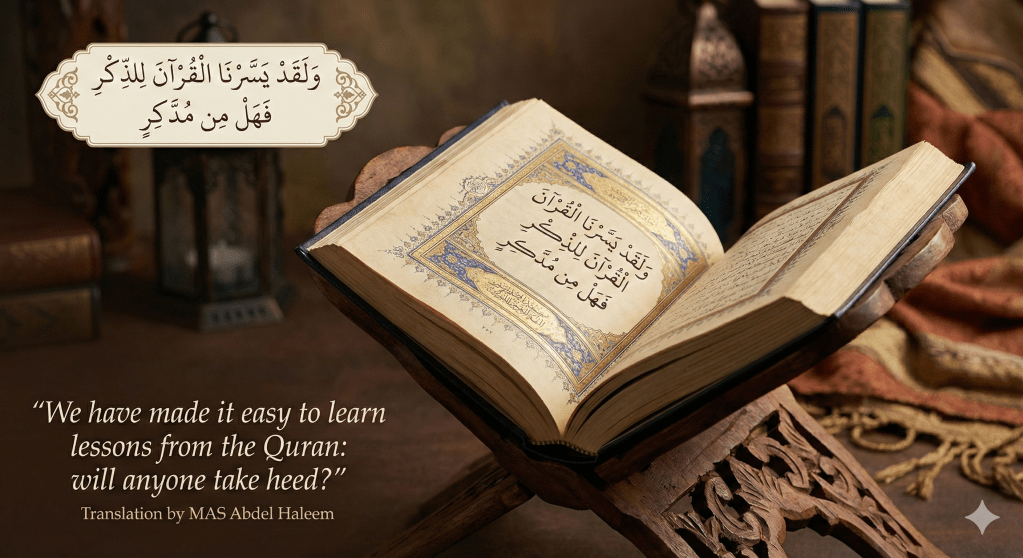
The verse quoted in the title is mentioned four times in Surah Qamar: “And We have certainly made the Quran easy to remember. So is there anyone who will be mindful?” is a repeated verse in Surah Al-Qamar (54:17, 22, 32, 40). It signifies that God has made the Quran easy to memorize, recite, understand, and derive lessons from, urging humanity to take advantage of this.
Root-Based Quranic Vocabulary Learning Through Concordance Study
Executive summary
This report analyzes a pedagogical method for learning Qur’anic Arabic vocabulary by linking each word to its (usually) triliteral root, then studying every occurrence of that root family through a concordance/dictionary—exemplified by the Quranic Arabic Corpus “Quran Dictionary” interface. The audience level is unspecified, so the design below supports both self-learners and instructors via a scaffolded “spiral” curriculum, with optional computational extensions.
The core linguistic claim is that Arabic (like other Semitic languages) uses root-and-pattern (nonconcatenative) morphology, where a small inventory of consonantal roots (often three consonants) combines with templates/patterns (vowels and sometimes extra consonants) to generate many derivationally related words; those words then inflect, producing many surface word-forms. In the v0.4 Quranic Arabic Corpus morphological dataset, the Qur’an contains 77,429 word tokens (per corpus tokenization). In an internal re-count of that same v0.4 dataset (using the formal ROOT tags defined by the corpus documentation), 49,967 tokens (≈64.5%) are “root-bearing” stems, while 27,462 tokens (≈35.5%) are function items (particles, etc.) that the corpus explicitly treats as outside the root-template paradigm. This matters pedagogically: root-based learning provides high leverage, but it does not replace systematic learning of high-frequency particles and other rootless items (e.g., مِنْ, فِي, إِنَّ), which dominate token frequency lists.
Practically, the method can be implemented in two “levels.” A manual level uses the Corpus Quran Dictionary pages (root → derived forms → concordance lines) plus the Morphological Search and Quran Search interfaces to retrieve all occurrences. An analytic level uses the publicly distributed corpus morphology file (GPL terms; verbatim redistribution allowed, modification not allowed) to compute root frequencies, surah distributions, and coverage statistics that inform lesson sequencing and assessment design.
Abstract
Root-based learning treats Qur’anic vocabulary as a network built around consonantal roots and templatic patterns, and it uses concordance study to anchor meaning in actual Quranic usage rather than isolated gloss memorization. The approach draws on the Quranic Arabic Corpus, which provides morphological segmentation, part-of-speech tagging, and root/lemma groupings intended to support an electronic lexicon and concordance-style exploration. The central hypothesis is pedagogical: if learners master a high-frequency “core” of roots and repeatedly encounter their derived lemmas in context (with guided pattern recognition), then lexical acquisition becomes more compressive and transferable—because new words are often interpretable as combinations of a familiar root semantic field plus a familiar morphological template.
To operationalize this hypothesis, the report proposes (i) a defensible linguistic explanation of Semitic root morphology and how a limited root inventory can generate many word tokens, (ii) a reproducible data workflow for extracting root families and mapping them to Qur’anic occurrences using primary sources (Corpus dictionary/search interfaces and licensed downloadable morphology), (iii) a practical instructional framework including sequencing, spaced repetition, exercises, sample lesson plan for high-frequency roots, and assessment design, and (iv) a thematic analysis template for frequency distributions and surah-level patterns. The design explicitly incorporates cognitive load management (scaffolding, worked examples, spiral review) and evidence-based review schedules (distributed practice / spaced repetition). A concluding epilogue frames the root architecture as a sign of profound order in Arabic and the Qur’an, while distinguishing devotional interpretation from empirical linguistics.
Arabic root morphology and Qur’anic lexical economy
Arabic morphology is classically described as root-and-pattern (templatic, nonconcatenative) morphology: consonantal roots (often three radicals, sometimes four) encode a broad semantic field, while vocalic melodies and templates encode grammatical and derivational information, producing word families that are related in form and meaning even when the shared material is discontinuous. In theoretical linguistics, this architecture is foundational to accounts of Semitic nonconcatenative morphology associated with John J. McCarthy and later work, where the root and template are modeled as separate layers that interdigitate (e.g., /k-t-b/ “write” yielding kataba “he wrote”, kitāb “book”, kātib “writer”, maktūb “written”). Grammar-oriented teaching references—for example by Karin C. Ryding—also present the same core idea for learners: roots combine with patterns to generate predictable paradigms and derivational families, supporting educated guessing and vocabulary compression.
The Quranic Arabic Corpus documentation formalizes two closely related grouping concepts:
- Root (ROOT:): typically triliteral/quadriliteral radicals used to group “similar words” in Arabic and other Semitic languages.
- Lemma (LEM:): dictionary-style headword that groups inflectional variants with the same meaning more finely than root groupings.
The corpus further notes a key boundary condition: many particles fall outside the root + template paradigm, so they are represented with lemmas rather than roots.
This boundary helps explain the “how can ~2,000 roots cover ~78,000 words?” intuition. The Qur’an (in this corpus tokenization) contains 77,429 word tokens. Tokens are not unique vocabulary items: they include repeated occurrences and inflected forms. The corpus also shows that the lexical system compresses further:
- The corpus provides a non-verb lemma list of 3,680 entries (split by part of speech) and a separate verb concordance of 1,475 verbs grouped by root and form—indicating that word tokens reduce to far fewer headword-like units.
- Root inventories are smaller still. Depending on counting conventions (normalization of weak radicals, proper-noun treatment, whether particles are included as “rootless families”), root counts cluster in the low thousands; in the v0.4 corpus morphology file, a direct count over root-bearing stems yields 1,642 distinct ROOT tags (computed from the official verbatim dataset; methodology given below).
The deeper reason is generative morphology plus inflection: one root can yield multiple derivational lemmas (verbs across forms, verbal nouns, active/passive participles, concrete nouns, abstract nouns), and each lemma can occur as many inflected word-forms across cases, definiteness, pronominal suffixation, and verb conjugation. The Quran Dictionary pages make this “compression” visible: e.g., root ك ت ب shows seven derived forms totaling 319 occurrences (kitāb alone 260).
Building a root-to-occurrence concordance from primary sources
A rigorous implementation should treat the concordance as a data product with traceable provenance. The recommended primary pipeline centers on the Quranic Arabic Corpus web interfaces plus its licensed morphological dataset, which explicitly builds on the verified Unicode text distributed by the Tanzil Project. The corpus is associated with the Language Research Group at the University of Leeds and is led by Kais Dukes in the project documentation and scholarly publications.
Manual workflow using the Corpus dictionary and search tools
The Corpus supports direct “concordance-style” retrieval using root and lemma queries:
- Select a root family using the Quran Dictionary root page (e.g., q=ktb, q=rHm). Each root page lists the total occurrences and derived forms with counts, then presents concordance lines with brief glosses.
- Expand occurrences via Quran Search and Morphological Search. The Morphological Search explicitly allows root queries in Arabic letters or Buckwalter transliteration and supports lemma and stem queries.
- Classify occurrences: for each concordance line, capture (a) verse reference, (b) surface form, (c) derived lemma/form, (d) gloss, and (e) immediate syntactic role if relevant (word-by-word morphology page).
This workflow is “primary-source aligned” because it uses the corpus’s own morphological analysis and the Quranic context lines rather than free-form secondary summaries.
Computational workflow using the downloadable morphology file
For scalable curriculum design (frequency lists, surah distributions, coverage), the corpus provides a downloadable v0.4 morphology dataset under GNU GPL terms with explicit “verbatim copy allowed; changing not allowed” conditions for the distributed text/annotation file. The corpus documentation specifies the semantics of ROOT and LEM features and explains how words are segmented into prefixes, stems, and suffixes, enabling reproducible parsing.
A reproducible extraction method (conceptual sketch):
Acquire licensed corpus morphology fileParse rows: LOCATION, FORM, TAG, FEATURESFilter STEM segmentsExtract ROOT and LEM featuresAggregate counts: root→derived forms, root→surah, lemma→frequencyGenerate concordance index: root/lemma → verse locationsExport study tables for SRS + assessmentShow code
The methodological soundness of relying on this corpus is supported by the project’s description of its annotation approach (morphological segmentation, POS tagging, and a multi-stage annotation process with manual verification and collaborative correction).
“Similar primary sources” for triangulation
A traditional Arabic concordance such as Al-Mu’jam al-Mufahras li-Alfaz al-Qur’an al-Karim (Muhammad Fu’ād ʿAbd al-Bāqī, 1945) is a historically important reference for locating word occurrences and can be used to cross-check search completeness or orthographic variants in print tradition. The Tanzil project documentation also provides an independent account of producing a highly verified Quran text through automatic extraction, rule-based verification, and manual verification against a standard mushaf—supporting confidence in the underlying text layer used by downstream corpora.
Learning framework and lesson design
The pedagogical aim is to turn root morphology into a manageable, cumulative skill rather than an encyclopedic memorization task. The design below combines (i) root-family chunking, (ii) incremental pattern recognition, (iii) context-first concordance reading, and (iv) spaced review.
Instructional principles and sequencing strategy
The corpus’s own feature design implies a natural sequence: teach segmentation and lemma/root grouping, then use roots/lemmas as indexing keys for repeated contextual encounters. A high-yield sequence is:
- Orientation to the concordance interface: how to move from root → derived forms → occurrences (and how to read the gloss as a “guide,” not a full semantic range).
- Morphological segmentation basics: prefixes vs stems vs suffixes, and what counts as the “stem” that carries ROOT/LEM information.
- High-frequency root families (spiral pass): begin with the most frequent roots, but in a two-layer approach:
- Layer A (fast pass): one anchor meaning + one anchor derived form + 5–10 concordance lines.
- Layer B (deepening pass): additional derived forms, pattern contrasts (e.g., verbal noun vs active participle), and semantic nuance across contexts.
- High-frequency rootless function words: because many of the most frequent lemmas are particles/prepositions (e.g., مِنْ 3226, فِي 1701), a root-only curriculum will stall without a parallel function-word track.
Spaced repetition and cognitive load management
Distributed practice is strongly supported for long-term retention. A large meta-analysis of the spacing effect (distributed practice) documents robust benefits across many experiments and conditions, motivating spaced review schedules rather than massed “root cramming.” Cognitive Load Theory—introduced in a seminal paper by John Sweller—predicts that novices can be overloaded when too many interacting elements (root, pattern, gloss, syntax, context) are introduced simultaneously, so instruction should reduce extraneous load via worked examples, chunking, and staged complexity.
For implementation, spaced-repetition flashcards can be managed with Anki, whose documentation describes its spaced repetition scheduling lineage (SM-2 and newer FSRS options). The key is not the brand but the strategy: frequent retrieval with expanding intervals tied to performance, with cards structured to minimize cognitive overload (see exercise designs below).
Example exercises aligned with the concordance method
A root-based curriculum becomes effective when learners repeatedly do the concordance operations themselves, not merely read lists:
Exercise type: root recognition in context. Provide 8–12 corpus concordance lines for one root; learner highlights the derived form and labels it (verb form / noun / participle) using the corpus headings and morphological tags.
Exercise type: derived-form sorting. For a root like ك ت ب, learners sort occurrences into (kataba / yaktub / kitāb / maktūb / kātib) based on the root page’s derived-form list, reinforcing both pattern sensitivity and semantic clustering.
Exercise type: “semantic range” memo. Learner selects 10 occurrences, writes one-sentence paraphrases of the local meaning (not just the gloss), then identifies which meanings are stable across occurrences and which are context-dependent—directly responding to the corpus warning that glosses are guides and meanings vary by context.
Exercise type: function-word parallel track. Using the lemma frequency list, learners build a “top 30 particles/prepositions” deck and practice translating short phrases, ensuring the root method integrates with actual reading competence.
Sample lesson plan using high-frequency roots
Below is a sample twelve-week plan covering 60 high-frequency roots (selected by overall root-token frequency from the corpus morphology v0.4), with weekly spiral reviews. The roots themselves can be opened in the Quran Dictionary (q=ROOT) for derived forms and concordance lines.
Mar 15Mar 22Mar 29Apr 05Apr 12Apr 19Apr 26May 03May 10May 17May 24May 31Jun 07Concordance skills + segmentationRoot/lemma & Buckwalter basicsRoots block 1 (theology + speech)Roots block 2 (belief + knowledge)Roots block 3 (creation + guidance)Roots block 4 (ethics + law signals)Roots block 5 (community + time)Roots block 6 (review + expansion)Function-words intensiveMidterm assessment + remediationAdvanced concordance projectsFinal assessment + long-term planFoundationsHigh-frequency root blocksIntegrationSample twelve-week root-based syllabusShow code
A concrete “high-frequency root set” for this plan can start with the top roots evidenced in the Verb Concordance and root counts (e.g., q-w-l “to say”, k-w-n “to be”, ʾ-m-n “to believe”), then expand to other high-frequency semantic cores (q-w-m, n-z-l, h-d-y, k-t-b, r-s-l, etc.).
Assessment methods
Assessment should measure not only “gloss recall” but concordance competence:
- Root identification accuracy (given a word in a verse: identify ROOT; verify using corpus word morphology page).
- Derived-form classification (given a root page: map occurrences into the listed derived forms).
- Context-sensitive meaning (short written explanations of meaning-in-context for concordance lines, acknowledging semantic range).
- Coverage-based reading (unseen short passage: highlight known roots/lemmas; measure comprehension gain over time). The rationale aligns with research showing the importance of morphological awareness for Arabic literacy development and processing.
Sample root-to-lemma concordance table
The table below illustrates how a root-based concordance can be summarized for study. “Derived lemmas/forms” and counts are taken from the Quran Dictionary root pages; “key verses” are provided as (a) an early anchoring verse shown on the root page and (b) a high-concentration or thematically salient verse.
| Root (Buckwalter) | Arabic root | Derived lemmas/forms with corpus counts (gloss anchors) | Total occurrences | Key verses (examples) |
|---|---|---|---|---|
| Alh | أ ل ه | ilāh 147 (“god”); allāh 2699 (“Allah”); allāhumma 5 (address form). | 2851 | 2:255 (contains “lā ilāha illā…”); 59:23 (ontology highlights Allah concept). |
| rbb | ر ب ب | rabb 975 (“Lord”); rabāib 1; rabbāniyyīn 3; ribbiyyūn 1. | 980 | 1:2 (رَبِّ الْعَالَمِينَ); 2:286 (multiple “rabb” occurrences in duʿā’ context). |
| rHm | ر ح م | raḥima 28 (“have mercy”); raḥmān 57 (“Most Gracious”); raḥīm 116 (“Most Merciful”); raḥma(t) 114 (“mercy”); arḥām 12 (“wombs/kinship ties”); plus smaller forms. | 339 | 2:286 (وَارْحَمْنَا); 55:1–4 (theme of mercy/teaching; cited as epigraph in modern reflections). |
| qwl | ق و ل | qāla 1618 (“to say”); qawl 92 (“saying/statement”); plus qīl 4, qāʾil 5, etc. | 1722 | 2:8 (“…يَقُولُ…” narratives of speech); 2:259 (dense dialogic narration). |
| kwn | ك و ن | kāna 1358 (“to be”); makān 27 (“place”); makāna(t) 5 (“status/position”). | 1390 | 2:10 (كَانُوا…); 4:11–12 (high “kāna/ yakūn” density in legal discourse). |
| Amn | أ م ن | āmana 537 (“believe”); amina 20 (“feel secure”); īmān 45 (“faith”); muʾmin 202 (“believer”); amāna(t) and related trust/security forms; 17 derived forms total. | 879 | 2:3–4 (yuʾminūna…); 4:92 (dense belief/faith legal-ethical context). |
| Elm | ع ل م | ʿalima 382 (“know”); ʿallama 41 (“teach”); ʿilm 105 (“knowledge”); ʿalīm 163 (“All-Knowing”); plus additional derived nouns/adjectives. | 854 | 2:31–33 (teaching of names; ʿ-l-m prominence); 2:102 (high concentration in discourse on knowledge/testing). |
| ktb | ك ت ب | kataba 49 (“write”); kitāb 260 (“book/scripture”); maktūb 1 (“written”); kātib 6 (“writer”); plus minor forms. | 319 | 2:2 (الْكِتَابُ); 2:282 (strongest concentration: debt-writing verse). |
| hdy | ه د ي | hadā 144 (“guide”); hudan 85 (“guidance”); ih’tadā 40 (“be guided”); plus participles and gift-related nouns; 12 derived forms. | 316 | 1:6 (اهْدِنَا); 6:125 (guidance linked with opening the chest—conceptual clustering). |
| kfr | ك ف ر | kafara 289 (“disbelieve”); kufr 37 (“disbelief”); kāfirūn 129 (“disbelievers”); kaffara 14 (“expiate”); plus other forms; 14 derived forms. | 525 | 2:6 (إِنَّ الَّذِينَ كَفَرُوا…); 35:39 (high concentration in theological argumentation). |
Thematic and quantitative analysis
Root-frequency distribution and coverage
The corpus’s verb list and lemma lists already indicate strong frequency skew (e.g., top verbs qāla 1618, kāna 1358). A full root-frequency count (v0.4 dataset) exhibits a classic “long tail”:
- Only 114 roots occur ≥100 times (high-frequency core), while hundreds of roots occur once or only a few times (rare tail)—consistent with natural language frequency distributions.
- Cumulative coverage (root-bearing tokens): the top 100 roots account for roughly ~60% of root-bearing stems in the corpus (computed from the official dataset), suggesting that a 50–100-root curriculum can deliver meaningful early coverage when paired with function-word mastery.
A simple “coverage pie” for root-bearing stems (top 5 roots vs all others) illustrates just how concentrated the distribution is:
84%6%3%3%2%2%Root-bearing token concentration (QAC v0.4)Alh (Allah-family) [2851]qwl (say) [1722]kwn (be) [1390]rbb (Lord) [980]Amn (faith/security) [879]All other roots [42146]Show code
The pedagogical inference is not that rare roots are unimportant, but that sequencing by frequency reduces early frustration and increases the number of “recognition hits” per hour of study—an effect that spacing research suggests will improve retention because learners will meet the same items repeatedly across varied contexts.
Semantic fields and conceptual clustering
A root-based concordance naturally yields semantic clustering, because roots often anchor families associated with:
- Divinity and attributes (e.g., Alh, rbb, rHm; and derived adjective patterns like ʿalīm from ʿ-l-m).
- Revelation, scripture, and speech (qwl; ktb; nzl “send down/reveal”)—linking discourse acts, text, and guidance.
- Belief vs rejection (Amn vs kfr), often co-present in argumentative and legal-ethical discourse.
A rigorous thematic analysis can be done in two complementary ways: (i) manual semantic field coding of high-frequency roots using the corpus “derived form headings” and concordance contexts, and (ii) computational clustering using co-occurrence across verses or surahs (roots that frequently co-appear in the same verse can be grouped, then interpreted).
Patterns across surahs
Surah-level patterns can be quantified by (a) root-token density and (b) root-type diversity. The corpus release notes emphasize segmented, word-level counts across the Qur’an, enabling surah-level aggregation. In the v0.4 dataset, longer surahs such as al-Baqarah (2) naturally dominate both root tokens and root-type counts, but shorter surahs often show high type-token ratios (lexical variety per word), which is pedagogically useful for designing diverse review passages.
Concrete examples of surah clustering among major roots (illustrative, computed from the corpus v0.4 file) show that the distribution of a root is rarely uniform:
- rHm (mercy family) appears strongly in surahs like 2 and 19 (Maryam), matching the prominence of raḥmān/raḥīm discourse in those contexts.
- qwl (speech) concentrates in narrative-heavy surahs (e.g., 2 and 7), aligning with dialogic storytelling and prophetic discourse.
Recommended visualizations for deeper study
For instructors or developers, the following visualizations are especially informative:
- Bar chart: top 25 roots by token frequency (pedagogical sequencing).
- Pareto curve: cumulative coverage of roots (to choose “50 vs 80 vs 100 roots” thresholds).
- Heatmap: root frequency by surah (rows=roots, columns=surahs) to reveal narrative/legal clustering.
- Network graph: root co-occurrence within verses (semantic field discovery).
- Pie chart: root-bearing vs function-word tokens to keep curricula balanced.
These can be generated from the morphology file (ROOT tags) and verse coordinates provided in LOCATION fields, respecting the corpus licensing conditions.
Benefits, limitations, digital implementation, and thematic epilogue
Pedagogical benefits
Root-based study can strengthen morphological awareness, which is consistently linked to literacy and word processing in Semitic languages, including Arabic. By repeatedly encountering related forms (e.g., verb → verbal noun → participle), learners build structured lexical memory rather than isolated word lists, which aligns with cognitive theories that emphasize schema construction and chunking. The method also naturally promotes transfer: knowing a root and common templates makes unfamiliar derived items more guessable, a point emphasized in both linguistic descriptions of root-template morphology and corpus tooling designed to group words into an electronic lexicon.
Limitations and cognitive load risks
Several limitations are structural, not incidental:
- Function words and particles: a substantial share of tokens are rootless in the corpus treatment, and the most frequent lemmas include prepositions and particles (min, fī, ʾinna…), so a root-only plan will leave major comprehension gaps unless paired with a function-word syllabus.
- Semantic overgeneralization: even when roots group related words, meaning is ultimately contextual; the corpus repeatedly warns that glosses are brief guides and that Arabic words have a range of meanings depending on context.
- Intrinsic load: early learners may face too many interacting elements (script, morphology, semantics, syntax). Cognitive Load Theory predicts performance collapse if instruction does not stage complexity and reduce extraneous load.
Digital tools and app architecture
A practical digital stack (from simplest to most technical):
- Corpus web interface as the “ground truth explorer”: Quran Dictionary root pages + Morphological Search + Quran Search for concordance lines.
- Spaced repetition deck: build cards keyed by ROOT and derived form counts, using Anki’s scheduling options (SM-2 lineage; optional FSRS).
- Corpus-based mobile app: at least one Android app (“Quranic Morphology”) explicitly states it is based on corpus.quran.com dataset downloads, illustrating feasibility of embedding corpus data in learner tooling.
A recommended flashcard schema to reduce cognitive load:
Front: root (Arabic + Buckwalter), one anchor gloss, one derived “flagship” lemma, and 1–2 short concordance lines (verse reference + short phrase).
Back: list of derived forms with counts (from root page), plus a learner-written summary of semantic range after multiple encounters.
Thematic epilogue
There is a devotional way to read this architecture: as one repeatedly observes how Qur’anic meanings radiate through compact roots into families of speech, law, mercy, guidance, and knowledge, the lexicon begins to feel less like a random heap of words and more like a coherent “semantic lattice.” The modern essays of Zia H. Shah explicitly frame Arabic’s triliteral system as “architectural,” comparing it to engineered structure and arguing that such compressive systematicity can be spiritually contemplated as a sign pointing beyond chance.
Even without conflating theology and linguistics, the primary sources already reveal a striking fact: the Qur’anic lexicon is searchable, enumerable, and patternable in a way that makes sustained study possible across a lifetime—root by root, verse by verse—without exhausting the depths. The corpus documentation itself emphasizes that roots and lemmas are used so that words “may be easily grouped together to form an electronic lexicon,” and the concordance view returns the learner again and again to revelation in context, rather than in abstraction. In that sense, the method becomes more than vocabulary acquisition: it becomes a disciplined practice of attentive reading, where linguistic order supports reverent understanding.
Prioritized sources and reproducible data extraction steps
The highest-priority sources for this method are the corpus documentation and data themselves (roots/lemmas definitions; morphological search; licensed dataset), plus the verified Quran text provenance underlying them. Classical concordance tradition provides historical triangulation (e.g., Abd al-Bāqī’s concordance). Linguistics references on nonconcatenative morphology provide the theory background. Evidence-based learning science supports spacing and cognitive load design.
A reproducible data extraction procedure (high level):
- Define the unit of counting (word tokens vs morphological segments) consistent with corpus conventions.
- Acquire the corpus morphology v0.4 file under stated terms (verbatim distribution allowed; no alteration of the file itself).
- Parse rows and filter STEM segments, then extract ROOT and LEM fields as specified in the morphological features documentation.
- Aggregate:
- root → derived lemmas/forms and counts
- lemma → frequency
- root/lemma → verse locations (surah:ayah)
- Validate by spot-checking against Qur’an Dictionary root pages and Quran Search results for selected roots.
- Export study artifacts (CSV tables, flashcard fields, lesson handouts) and implement spaced review schedules.




 The Glorious Quran and Science
Leave a comment