
For the suggested Quranic dictionary or concordance, please click here
Presented by Zia H Shah MD with help of Claude AI
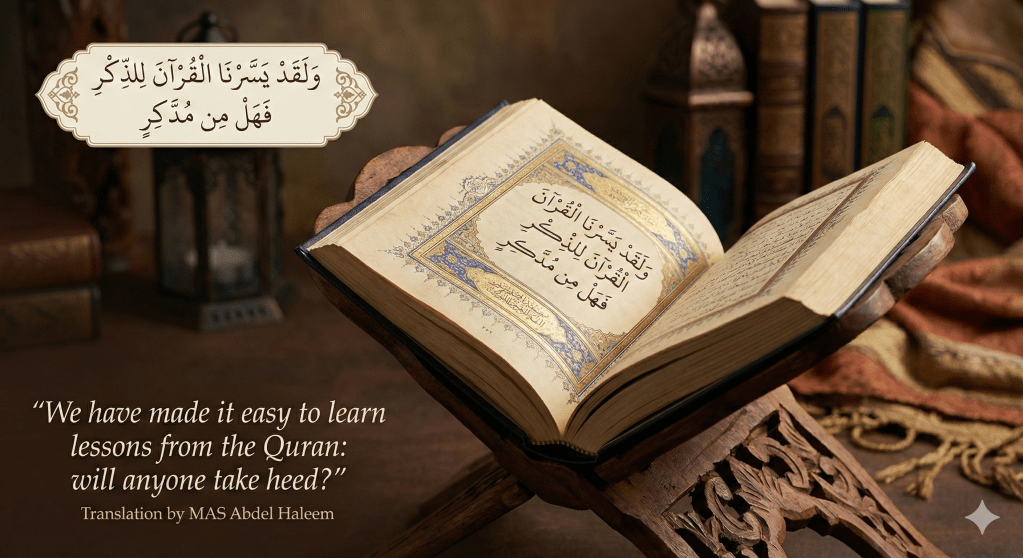
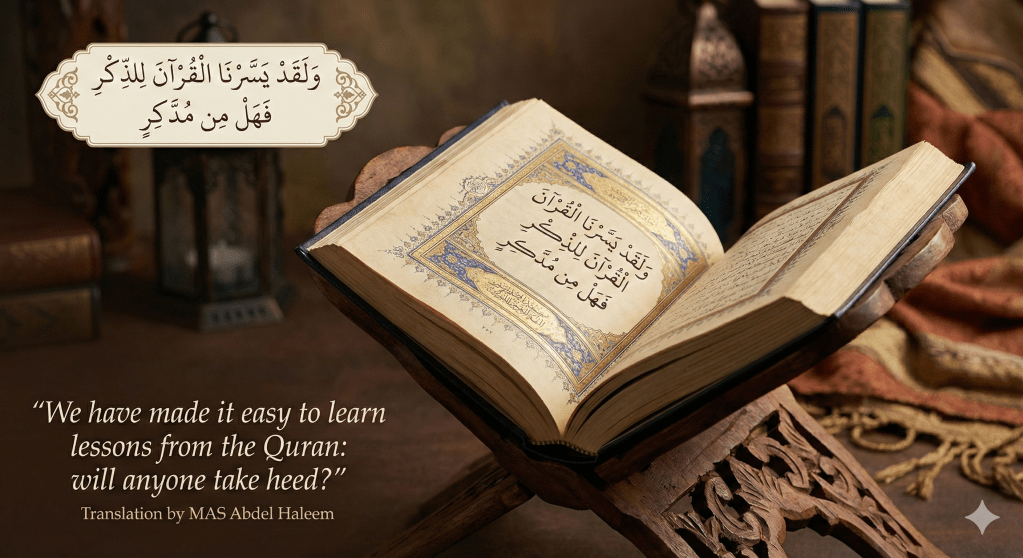
The verse quoted in the title is mentioned four times in Surah Qamar: “And We have certainly made the Quran easy to remember. So is there anyone who will be mindful?” is a repeated refrain in Surah Al-Qamar (54:17, 22, 32, 40). It signifies that God has made the Quran easy to memorize, recite, understand, and derive lessons from, urging humanity to take advantage of this.
Reviewing all the verses together that contain the same root word in a single glance in the above website, triggers thoughts and creates associations that are then easy to recognize, remember and recall.
The triliteral root system of Arabic — roughly 1,685 roots generating the Quran’s entire 77,430-word vocabulary — offers what may be the most efficient and intellectually rewarding pathway to understanding the Quran. A learner who masters just 125 high-frequency words can comprehend approximately 50% of the Quranic text, Mishkah Academy and grasping around 300 words unlocks over 70%. Mishkah Academy This document compiles detailed findings from the Quranic Arabic Corpus, the writings of Zia H Shah MD, and broader scholarship on Arabic morphology, Quran pedagogy, and the doctrine of i’jaz al-Quran, organized to support a four-part article: Abstract, Root-Word Method with Examples, Using corpus.quran.com, and a thematic Epilogue on the linguistic miracle.

Part 1: The Arabic triliteral root system — how three letters encode a universe of meaning
Arabic belongs to the Semitic language family and operates on a morphological principle fundamentally different from Indo-European languages. Nearly every Arabic word traces back to a jadhr (جِذْر) — a foundational set of three consonant letters that encodes an abstract semantic core. Humanities LibreTexts Words are generated by weaving vowels, prefixes, suffixes, and infixes around these root consonants according to specific patterns Ayman Nadeem called awzān (أوزان, singular wazn, literally “weight” or “measure”). This system is studied under the branch of Arabic grammar called ṣarf (صرف, morphology). Arabic with Nichole
Arabic has 28 consonant letters The Last Dialogue and only 3 qualitatively different vowels (a/ā, i/ī, u/ū). The template verb fa’ala (فَعَلَ, “to do”) serves as the paradigmatic model in grammar books, with its three letters (fā’, ‘ayn, lām) standing as placeholders for any root. quran From any given root, Arabic systematically generates words through 10 major verb forms (Forms I–X), each adding a specific semantic layer Nashrah Arabic — intensity, causation, reciprocity, reflexivity, seeking, and more. Beyond verbs, patterns also generate active participles (the doer), passive participles (the thing acted upon), Nashrah Arabic nouns of place, nouns of instrument, verbal nouns, and intensive/hyperbolic forms.
Zia H Shah MD describes this system as “an exceptionally rigorous and mathematically elegant morphological framework” Thequran in which “every noun is anchored to a three-letter core” so that “the primary essence of a concept remains visible regardless of its morphological transformation.” Thequran He calls the triliteral architecture “not merely a feature of grammar but a sophisticated tool of knowledge representation that allows for a condensed yet multi-layered communication of truth.” Thequran
How many roots exist?
The total number of roots in the Arabic language varies by source. Hans Wehr’s dictionary catalogues 2,967 triliteral roots plus 362 quadriliteral roots. The classical Lisān al-‘Arab by Ibn Manzūr records approximately 9,273 roots. Arabic for Nerds Theoretically, with 28 consonants, 21,952 three-letter combinations are possible (28³), MDPI but phonological restrictions reduce the linguistically viable set to roughly 6,332. Arabic for Nerds The Quran itself uses approximately 1,685 unique roots according to the Quranic Arabic Corpus Blogger (Kais Dukes, University of Leeds), Wikipedia with other analyses placing the count at around 1,790. Quran Talk Blog This means mastering fewer than 2,000 roots unlocks the entire vocabulary of the Quran — a remarkably tractable goal.
Bilateral root theory — even deeper layers
Recent linguistic research into “bilateral roots” suggests that many triliteral radicals may have evolved from earlier two-letter cores, where the first two letters provide a general semantic direction and the third letter refines the specific application. Thequran This theory, noted by Shah, adds yet another layer of semantic interconnection beneath the triliteral surface.
The Basra vs. Kufa debate
Classical Arabic grammarians debated whether the verbal noun (maṣdar) or the third-person masculine singular past tense verb was the primary origin of derivation. The Basran school argued for the maṣdar as the root, holding that it represents the pure essence of meaning without the “accidents” of time or person. Thequran This scholarly debate, referenced by Shah, underscores the depth of thought Arabic’s root system has inspired for over a millennium.
Part 2: Compelling root-word examples from the Quran (data from corpus.quran.com)
Example 1 — أ م ن (A-M-N): Faith, belief, and security — 879 occurrences, 17 derived forms
The most frequently occurring root among those examined. The verb āmana (to believe) appears an astonishing 537 times, Thequran making it one of the single most repeated verbs in the entire Quran. From this one root: īmān (إِيمَان, faith) appears 45 times; muʾmin (مُؤمِن, believer) appears 202 times; amīn (أَمِين, trustworthy) appears 14 times; amn (أَمْن, security) appears 5 times. The root links faith with security and trust — suggesting that true belief (īmān) provides both spiritual and existential security (amn), and the believer (muʾmin) is fundamentally one who is trustworthy (amīn). Prophet Muhammad ﷺ was known as “al-Amīn” — the Trustworthy — a title sharing this very root.
Example 2 — ع ل م (‘A-L-M): Knowledge — 854 occurrences, 14 derived forms
One of the most frequent roots in the entire Quran. The verb ‘alima (to know) appears 382 times alone. Thequran ‘Allama (عَلَّمَ, to teach, Form II causative) appears 41 times. The noun ‘ilm (عِلْم, knowledge) appears 105 times. The divine name al-‘Alīm (عَلِيم, All-Knowing) appears 163 times. And remarkably, the word for “worlds” (‘ālamīn, عَالَمِين) — as in “Lord of all the worlds” (Rabb al-‘ālamīn) in the opening verse of the Quran — shares this same root, appearing 73 times. The linguistic implication: the universe itself is connected to knowledge, suggesting creation is a manifestation of divine knowing. The Quran’s first revealed command was iqra’ (Read!), and the second passage revealed (96:4-5) says: “He taught by the pen. He taught man what he did not know” — using the root ‘-L-M.
Example 3 — ر ح م (R-Ḥ-M): Mercy and the womb — 339 occurrences, 9 derived forms
This root beautifully connects raḥmah (رَحْمَة, mercy, 114 times) with arḥām (أَرْحَام, wombs, 12 times). Quranic Arabic Corpus The divine names al-Raḥmān (The Most Gracious) appears 57 times and al-Raḥīm (The Most Merciful) appears 116 times quran — together these names open nearly every chapter of the Quran in the basmala (“In the name of God, the Most Gracious, the Most Merciful”). The root’s semantic architecture encodes a profound theological insight: divine mercy is as primal, encompassing, and life-sustaining as the womb that nurtures new life. As Shah observes, the root r-ḥ-m generates names that illustrate “a compassion that is both all-encompassing and life-sustaining.” Ayman Nadeemthequran
Shah also notes the significance of the grammatical shift between forms: Raḥmān is an intensive form suggesting overwhelming, all-encompassing mercy extended to all creation, while Raḥīm suggests an enduring, personal mercy specifically for believers. This distinction — encoded in the morphological pattern, not the root — demonstrates the system’s precision.
Example 4 — س ل م (S-L-M): Peace, Islam, and submission — 140 occurrences, 16 derived forms
This root produces the most derived forms of all eight roots examined — 16 distinct forms Quranic Arabic Corpus — showcasing extraordinary semantic branching from just three letters. Salām (سَلَام, peace) appears 42 times. Islām (إِسْلَام, the religion/submission) appears 8 times. Muslim (مُسْلِم, one who submits) appears 39 times. Aslama (أَسْلَمَ, to submit to God, Form IV verb) appears 22 times. Taslīm (تَسْلِيم, complete submission) appears 3 times. quran Even salīm (سَلِيم, sound/healthy) appears 2 times, as in qalb salīm — “a sound heart” (26:89).
The root reveals that peace (salām), the religion of Islam, the identity of being Muslim, and soundness of heart are all linguistically interconnected — they share a common essence. Submission to God (islām) leads to peace (salām), and both produce a sound, whole heart (qalb salīm). Qalamquest Arabic The greeting between Muslims — as-salāmu ʿalaykum — and the description of Paradise as Dār al-Salām (Abode of Peace) complete this semantic constellation.
Example 5 — ك ت ب (K-T-B): Writing, scripture, and divine decree — 319 occurrences, 7 derived forms
The noun kitāb (كِتَاب, book/scripture) dominates with 260 occurrences Quranic Arabic Corpus (81% of all uses of this root), reflecting the Quran’s enormous emphasis on scripture and revelation. The verb kataba (كَتَبَ, to write) appears 49 times. The active participle kātib (كَاتِب, scribe/writer) appears 6 times. The passive participle maktūb (مَكْتُوب, written) appears once. quran
Crucially, the verb kataba in the Quran means not only “to write” but also “to prescribe” and “to ordain” — so kutiba ʿalaykum al-ṣiyām means “Fasting is prescribed for you” (2:183), and kataba rabbukum ʿalā nafsihi al-raḥmata means “He has decreed upon Himself mercy” (6:12). Writing and divine decree share the same root — the pen and the divine command are linguistically one. Shah expands this family further: maktabah (library), maktab (office/desk) — all places and acts of writing radiating from three consonants. Humanities LibreTexts
Example 6 — ح م د (Ḥ-M-D): Praise — 63 occurrences, 5 derived forms
The very first verse of the Quran — al-ḥamdu lillāhi rabbi l-‘ālamīn (All praise is due to God, Lord of all worlds) — opens with this root. The noun ḥamd (حَمْد, praise) appears 43 times. The divine name Ḥamīd (حَمِيد, Praiseworthy) appears 17 times. The passive participle maḥmūd (مَّحْمُود, praised) appears once, in reference to the “praised station” (al-maqām al-maḥmūd) promised to the Prophet ﷺ in 17:79. The Prophet Muhammad’s own name derives from this root, meaning “the praised one,” and the name Ahmad (أَحْمَد, “most praiseworthy”), which the Quran attributes to Jesus’s prophecy of a coming messenger (61:6), is its superlative form. The phrase al-ḥamdu lillāh opens five surahs of the Quran.
Example 7 — ق ر أ (Q-R-A): Reading and recitation — 88 occurrences, 4 derived forms
The word Qurʾān (قُرْآن) itself — literally “The Recitation” — derives from this root and appears 70 times. The verb qara’a (قَرَأَ, to read/recite) appears 16 times. The very first word ever revealed to Prophet Muhammad ﷺ was Iqraʾ! (اقْرَأْ) — “Read!” or “Recite!” (96:1). The name of the scripture is thus a verb command embedded in a noun — the Quran is the act of recitation itself, made permanent.
Example 8 — ذ ك ر (DH-K-R): Remembrance — 292 occurrences, 14 derived forms
This root produces dhikr (ذِكْر, remembrance/reminder), tadhkira (reminder), and dhakar (male/masculine), among many others. Allah refers to the Quran itself as al-Dhikr (The Remembrance/The Reminder) in approximately 55 places. Verse 33:41 commands: “O you who believe! Remember Allah with much remembrance.” SoundVision The root connects the act of divine remembrance with the Quran’s very identity as a book of reminding.
Additional root-meaning insight from Shah: the word for “human being”
Shah highlights a striking example: the term insān (إِنْسَان, human being) is “linked to two distinct roots: {a-n-s} (sociability and friendliness) and {n-s-y} (forgetfulness). Ayman Nadeem This morphological ambiguity highlights the Quranic view of man as a social creature prone to forgetting his covenant with the Divine.” thequran Similarly, the noun qalb (قَلْب, heart) derives from the root {q-l-b} meaning “to turn or fluctuate,” capturing the Quranic vision of the heart as dynamic, capable of turning toward or away from truth.
Root frequency rankings — the most common roots in the Quran
| Root | Arabic | Core meaning | Occurrences |
|---|---|---|---|
| A-L-H | الله | God | 2,851 |
| R-B-B | رب | Lord | 980 |
| A-M-N | أمن | Faith/belief | 879 |
| ‘-L-M | علم | Knowledge | 854 |
| Q-W-M | قوم | People/stand | 660 |
| Y-W-M | يوم | Day | 405 |
| S-M-W | سمو | Heaven/sky | 381 |
| R-Ḥ-M | رحم | Mercy | 339 |
| K-T-B | كتب | Write/book | 319 |
| H-D-Y | هدي | Guidance | 316 |
| DH-K-R | ذكر | Remembrance | 292 |
| ‘-B-D | عبد | Worship/servant | 275 |
Part 3: How to use corpus.quran.com — the Quranic Arabic Corpus
Site overview
The Quranic Arabic Corpus (corpus.quran.com) was created by Kais Dukes Quranic Arabic Corpus at the University of Leeds (Language Research Group, School of Computing), Mcgill supervised by Eric Atwell, and has been maintained since 2009. Wikipedia It is now also supported by the quran.com team. Quranic Arabic Corpus The corpus annotates 77,430 words The Mail Archive of Quranic Arabic Wikipedia across 6,236 verses and 114 chapters. The Last Dialoguequran It attracts over 2,500 users per day from 165 different countries. quran It is open-source Quranic Arabic Corpus under the GNU public license.
Three levels of analysis
- Morphological annotation — part-of-speech tagging and morphological features for every single word in the Quran.
- Syntactic treebank — dependency grammar visualization of verse structure (the iʿrāb tradition rendered digitally).
- Semantic ontology Quranic Arabic Corpus — 300 linked concepts with 350 relations, using predicate logic to map Quranic knowledge. Quranic Arabic Corpus
Key tools for learners
- Word by Word — complete grammar analysis and translation for every word in every verse.
- Quran Dictionary (the root-based concordance at qurandictionary.jsp) — the focus tool for root-word learning.
- Verb Concordance — all 1,475 verbs in the Quran grouped by root and form, sorted by frequency. Quranic Arabic Corpus
- Lemma Frequency — 3,680 lemmas split by part-of-speech, allowing learners to prioritize high-frequency words. Quranic Arabic Corpus
- Morphological Search — search by part-of-speech or morphological features. Quranic Arabic Corpus
- English Translations — 7 parallel translations displayed alongside each verse.
- Ontology of Concepts — 300 key Quranic concepts visualized with their interrelations.
How the Quran Dictionary is organized
The dictionary is accessed at corpus.quran.com/qurandictionary.jsp. At the top, a navigation bar displays all 28 Arabic letters using Buckwalter transliteration in the URL. Under each letter, a sidebar lists all roots beginning with that letter (e.g., under kāf: ك أ س, ك ب ب, ك ب ت, ك ب د, ك ب ر … ك ت ب, and dozens more).
Each root entry page displays: the root letters in Arabic and transliteration; the total number of occurrences in the Quran; a breakdown by derived form (verbs by form number I–X, nouns, verbal nouns, active/passive participles, adjectives); and a concordance table for each derived form showing every single occurrence with verse reference in the format (chapter:verse:word), the transliterated word, a brief English gloss, and the full Arabic verse text.
The site provides a crucial disclaimer: “The translations below are brief glosses intended as a guide to meaning. An Arabic word may have a range of meanings depending on context.” quranQuranic Arabic Corpus This teaches learners that Arabic words resist simple one-to-one translation.
How the dictionary helps learners
Root-based organization reveals semantic families — a learner who knows K-T-B means “writing” can immediately understand kitāb (book), kātib (writer), maktūb (written), Qalamquest Arabic kutiba (it was prescribed).
Frequency data enables prioritization — for instance, kitāb appears 260 times versus maktūb only once; learners should master kitāb first.
Derived form tracking teaches the Arabic morphological system itself — S-L-M in Form I means basic peace/safety, in Form IV means to submit (to God) = Islam, and the Form IV participle = Muslim.
Contextual display — every occurrence shows the full Arabic verse alongside the English gloss, allowing learners to see words in their natural Quranic habitat rather than in isolation.
Morphological deep links — clicking any word leads to its full morphological analysis: part-of-speech, root, lemma, gender, number, person, case, mood.
The verb forms system (documented on the site)
The site’s documentation page (corpus.quran.com/documentation/verbforms.jsp) explains: “In the Quran, verbs, and other words that denote related semantic concepts, are formed through a system known as derivation. The idea is that words are derived from a stem or template that is defined by a sequence of letters known as radicals.” quran It further states: “Using this derivation system of roots and patterns, nouns and verbs are derived in an almost mathematical way, leaving little room for confusion as to the desired meaning of the word.” quran
The 10 standard verb forms explained on the site:
- Form I (فَعَلَ): simplest form — kataba = “he wrote” quran
- Form II (فَعَّلَ): intensity/causative — ‘allama = “he taught” (from “to know”) quran
- Form III (فَاعَلَ): mutual/reciprocal action — kātaba = “he corresponded with”
- Form IV (أَفْعَلَ): causative/transformative — aslama = “he submitted” (Islam) quran
- Form V (تَفَعَّلَ): reflexive of Form II — ta’allama = “he learned”
- Form VI–X: further derivations with increasingly specific semantic nuances
- Form X (اِسْتَفْعَلَ): seeking/requesting — istaghfara = “he sought forgiveness” (from gh-f-r, forgiveness)
Site statistics at a glance
| Metric | Count |
|---|---|
| Total words in Quran | 77,430 |
| Unique lemmas | ~3,680 |
| Distinct verbs | 1,475 |
| Unique roots | ~1,685 |
| Verses (āyāt) | 6,236 |
| Chapters (sūrahs) | 114 |
| Ontology concepts | 300 |
| Daily users | 2,500+ |
| Countries represented | 165 |
Part 4: Root-word pedagogy — how this method is used in Quran education
The high-frequency word principle
The Quran’s vocabulary exhibits a strong Pareto-like distribution. According to the Understand Quran Academy (Dr. Abdulazeez Abdulraheem), just 125 words and their variants occur approximately 40,000 times — covering roughly 50% of all words in the Quran. Understand Al Quran Academy The Mishkah Academy estimates that approximately 300 words appear more than 50,000 times and can unlock over 70% of the text. Mishkah Academy Zia H Shah corroborates: “A relatively small set of approximately 500 high-frequency words constitutes nearly 75% of the total Quranic text, highlighting the efficacy of root-based learning for mastering the language of revelation.” Thequran
On the other end of the distribution, of the ~1,790 roots in the Quran, 415 roots occur only once in the entire text (affecting 315 verses). Quran Talk Blog This means a focused learner can achieve deep comprehension with a manageable investment, while rare roots can be looked up as encountered.
Popular resources using the root-word approach
- Understand Quran Academy (understandquran.com) — Dr. Abdulazeez Abdulraheem’s “Understand Quran 50% Words” course teaches 125 words in 9 hours using Total Physical Interaction (TPI) methodology. Understand Al Quran Academy
- Good Tree Institute — “Roots of the Quran” 8-week virtual course covering the first 100 most frequent Arabic roots, taught by Dr. Nadia Katrangi. Also sells flashcards. Goodtreeinstitute
- AnalyzeQuran App — AI-powered Quran study app allowing root-word search with derivatives, frequencies, and occurrences. Analyze Quran
- RootWordsofQuran.com — Links every word in each ayah to its root and to the Arabic-English University Dictionary. Rootwordsofquran
- 80PercentWords blog — focuses on learning the words making up 80% of Quran vocabulary.
- Islam Legacy — offers a 28-Day Quranic Arabic Course and free 57-page PDF with 50 most common Quranic root words.
Why the method works — the multiplicative effect
The root-word method creates a multiplicative learning effect. Knowing ~100 roots × 10 verb forms = potentially understanding ~1,000 verb variations. Add noun patterns (active participle, passive participle, noun of place, noun of instrument, verbal noun) and the number multiplies again. As one educator noted: “The study of roots and patterns (ṣarf) opens up huge possibilities, as the learner can understand words they may have never heard before.” The Arabic Diaries
Shah describes this as a “hyperlinked reading experience“: “When a reader encounters the noun Masjid (mosque), the root {s-j-d} immediately invokes the physical act of prostration and the internal state of submission. This creates a ‘hyperlinked’ reading experience where every word recalls its root cousins, enriching the immediate verse with the broader context of the entire corpus.” Thequran
Part 5: I’jaz al-Quran — the doctrine of miraculous inimitability and its linguistic dimension
Definition and Quranic foundation
I’jāz (الإِعْجَاز) derives from ‘ajaza (عَجَزَ, incapability), referring to the Quran’s quality of being beyond human capacity to replicate. Wikipedia The doctrine rests on the Quran’s own challenge (taḥaddī), yaqeeninstitute expressed in a progressively narrowing series of verses: Thequran
- Q 52:33-34: “Let them produce a recital like it…”
- Q 17:88: “Even if all mankind and jinn came together to produce the equivalent of this Quran, they could not produce its equal.”
- Q 11:13: “Bring ten chapters like it…”
- Q 2:23: “If you are in doubt… then produce one chapter like it.”
The challenge narrows from the entire Quran to 10 chapters to a single chapter — and remains unmet after 14 centuries. yaqeeninstituteThequran
Key scholars in the development of the doctrine
Al-Jāḥiẓ (d. 868 CE) — first to propose the concept of naẓm (composition/arrangement) as the basis of inimitability. His book Naẓm al-Qur’ān has been lost. Propulsiontechjournal
Al-Rummānī (d. 994 CE) — Mu’tazilite theologian who wrote al-Nukat fī I’jāz al-Qur’ān, identifying balāghah (rhetoric/eloquence) as one of seven aspects of the Quran’s miraculous nature. WordPress Among the first systematic treatments.
Al-Khaṭṭābī (d. 998 CE) — wrote Bayān I’jāz al-Qur’ān, one of the earliest direct literary arguments for i’jaz. Yaqeen Institute for Islamic Research
Al-Bāqillānī (d. 1013 CE) — Ash’ari theologian who wrote Kitāb I’jāz al-Qur’ān, WordPress emphasizing that the Quran created an entirely new genre of literary expression — it cannot be classified as poetry or prose, yet maintains superb eloquence throughout. Thequran Shah references his argument that “Al-Bāqillānī wrote I’jāz al-Qur’ān, emphasizing that the Qur’an created an entirely new genre of literary expression.”
Al-Qāḍī ‘Abd al-Jabbār (d. 1025 CE) — argued a multifaceted view: the Quran is inimitable due to (a) its otherworldly eloquence (faṣāḥah), (b) its description of hidden matters (ikhbār ‘an al-ghuyūb), and (c) the absence of errors or contradictions. Yaqeen Institute for Islamic Research
‘Abd al-Qāhir al-Jurjānī (d. 1078 CE) — the culminating figure in i’jaz doctrine, called the “founding father of stylistics” (predating Charles Bally by centuries). ResearchGate Authored two seminal works: Dalā’il al-I’jāz (“The Proofs of Inimitability”), which systematized ‘ilm al-ma’ānī (linguistic pragmatics), and Asrār al-Balāghah (“The Secrets of Eloquence”), which systematized ‘ilm al-bayān (figurative language). WordPress His naẓm theory held that inimitability lies in the specific combination, arrangement, and coordination of words — not in individual words or meanings alone. Thebrpi He demonstrated this through verse analysis (e.g., Q 11:44): “The miracle lies only in the combination of the words, in the inimitable way in which the first joins with the second and the second with the third… The complex linguistic structure of the complete verse is the source of its irresistible excellence.” Ismailignosis
Seven facets of linguistic i’jaz cited as miraculous
- Unique literary genre — the Quran is neither poetry (shi’r) nor prose (nathr) but a form without precedent. Hamilton Gibb wrote: “a production unique to the Arabic literature, having neither forerunners nor successors in its own idiom.”
- Naẓm (composition) — every word placement is deliberate; no word can be substituted without diminishing meaning or aesthetic form.
- Iltifāt (grammatical shifts) — dynamic shifts in person, number, and tense within a single passage, a sophisticated rhetorical device.
- Ījāz (brevity/conciseness) — Ibn Qutaybah defined this as “jam’ al-kathīr min ma’ānih fī al-qalīl min lafẓih” — “collection of many ideas in a few words.” Wikipedia
- Sound-meaning harmony — phonetic structures that echo the meaning being conveyed.
- Consistency over 23 years — despite piecemeal revelation over 23 years in vastly different circumstances, the text maintains remarkable coherence with no contradictions.
- Rhetorical sophistication — metaphor, ellipsis (taqdīr), vivid imagery, and other devices that are integral to meaning rather than ornamental.
The Sarfa doctrine — a minority position
Some scholars (particularly al-Naẓẓām and certain Mu’tazilites) argued that the Quran is not intrinsically beyond imitation; rather, God intervenes to prevent (ṣarafa) people from matching it. This was a minority view; the majority held that the Quran’s literary form is intrinsically inimitable.
Part 6: Zia H Shah MD’s key insights for the Epilogue — the miracle of Arabic and the Quran’s language
The root system as evidence of divine design
Shah consistently argues that Arabic’s triliteral root system creates a self-referencing network where every word recalls related concepts, producing multi-layered meaning he considers impossible in other languages. He writes: “The root system functions as a safeguard for semantic integrity. Because every noun is anchored to a three-letter core, the primary essence of a concept remains visible regardless of its morphological transformation.”
The “hyperlinked” Quran
Shah’s metaphor of a “hyperlinked reading experience” is his most distinctive contribution: every Quranic word, through its root, “recalls its root cousins, enriching the immediate verse with the broader context of the entire corpus.” This transforms reading the Quran from a linear experience into a web of interconnected meaning.
Hyperbolic patterns in divine names
Shah highlights a specific morphological mechanism in the divine names: “The linguistic mechanism behind the attributes of Allah often involves the shift from the active participle fā’il to the hyperbolic fa”āl or fa’ūl. For example, Ghāfir (Forgiver) suggests a single act of forgiveness, whereas Ghaffār and Ghafūr imply a persistent, infinite capacity to forgive.” This pattern precision — encoded in vowel changes around the same root — expresses theological gradations of divine attributes.
The word ‘Allah’ — linguistic analysis
Shah notes: “The noun Allah itself, occurring 2,699 times, is considered by many grammarians to be derived from the root {a-l-h}, signifying the One who is adored and deified. However, other philologists argue it is a unique, non-derived proper noun.” He adds that the root {a-l-h} “denotes not only a deity but the concept of being ‘bewildered’ or ‘turning to another with intense feeling,’ suggesting that a god is that toward which all creation instinctively turns for protection and solace.”
The Quran as origin of Arabic linguistic sciences
A recurring theme in Shah’s work: “The collected written text of the Quran was the first book in the Arabic language. It was the starting point around which the various branches of Arabic language studies were initiated and developed.” He notes Muhammad Abdel Haleem’s observation that “It was in order to ensure correct reading of the Quran, especially when non-Arabs began to accept Islam, that Arabic grammar was first written down and developed.” The irony: “most classical works of Arabic grammar were written by Persians” — non-Arabs mastering Arabic specifically for the Quran.
Key scholarly quotes Shah cites on inimitability
Professor Laura Veccia Vaglieri: “The miracle of Islam par excellence is the Quran… This is a book which cannot be imitated. Each of its expressions is a comprehensive one, and yet it is of proper size, neither too long nor too short. Its style is original. There is no model for this style in Arab literature of the times, preceding it… Depth and sweetness, qualities which generally do not go together, are found together here.”
Reginald Bosworth Smith: “Illiterate himself, scarcely able to read or write, he was yet the author of a book which is a poem, a code of laws, a Book of Common Prayer, and a Bible in one, and is reverenced to this day by a sixth of the whole human race as a miracle of purity of style, of wisdom, and of truth.”
Goethe: “As often as we approach the Quran, it always proves repulsive anew; gradually, however, it attracts, it astonishes, and, in the end forces admiration.”
Seyyed Hossein Nasr: “The substance of the soul of a Muslim… is like a mosaic made up of the imprint of verses of the Qurʾān.”
Sir Zafrulla Khan: The Quran is “literally the Word of God, and possess[ing] the quality of being alive, as the universe is alive.”
Joseph Lumbard: “The vast majority of Muslims do not believe [the Quran’s] language is of this world.”
Ibn Kathīr on i’jaz
Shah quotes Ibn Kathīr: “No one can produce anything similar to the Qurʾān, nor ten sūras or even one sūra like it. The eloquence, clarity, precision and grace of the Qurʾān cannot be but from Allah.”
Al-Qurṭubī on the challenge
Shah cites al-Qurṭubī’s summary: “The inability of the Prophet’s fiercest opponents – the Arab linguists of his time – to meet the Qur’an’s challenge is itself an ongoing testimony to its miracle. They opted for war and polemic rather than composing a rival Quran.”
The Quran’s Arabic as sui generis
Shah quotes the characterization: the Quran’s Arabic is “as though the poverty-stricken [fabric] of mortal language were, under the pressure of the Heavenly Word, broken into a thousand fragments.” And Pickthall’s famous judgment: “The Quran cannot be translated. Translations are viewed only as tafsīr in another language, never the Quran itself.”
Shah on Arabic vs. Indo-European languages
Shah regularly contrasts Arabic with Indo-European languages, noting Arabic’s broader noun category (ism, which encompasses substantives, adjectives, and adverbs), its unique dual number form, its system of broken plurals, and its root-based morphology as distinctive features enabling greater precision and semantic density. He writes: “The architecture of the Arabic noun is distinct from the lexical systems of Indo-European languages.”
Shah on the tawqīf vs. iṣṭilāḥ debate
Shah addresses whether language itself is divinely bestowed or humanly conventional: “Medieval Islamic scholarship explicitly debated this question under the headings of tawqīf (divine bestowal) and iṣṭilāḥ (human convention).” He suggests the root-and-pattern system’s elegance points toward a divinely guided capacity for language.
Shah’s concluding perspective on the Quran as “living miracle”
Shah argues the Quran’s literary style is “a living miracle, combining poetic subtlety with persuasive discourse, and yielding ‘new truths and fresh guidance in every age.’” The text “presents timeless guidance in a way that each person can absorb according to their needs, context, and stage of life.” Its linguistic precision “becomes clearer with time” — the opposite of what one would expect from a 7th-century text.
Additional semantic family examples for the article body
Root ح-س-ن (Ḥ-S-N) — beauty, goodness, perfection: ḥasan (beautiful/good), iḥsān (excellence in worship, doing beautiful deeds), ḥasanah (a good deed and its reward). Moral goodness is linguistically identified with beauty.
Root ن-س-ي (N-S-Y) — forgetting and humanity: insān (human being) connects to nisyān (forgetfulness). To be human is, at the root level, to be one who forgets — encoding a theological anthropology within the language.
Root ق-ل-ب (Q-L-B) — turning and the heart: qalb (heart) derives from “to turn or fluctuate” — the heart is the organ that turns, capable of moving toward or away from truth.
Root س-ج-د (S-J-D) — prostration and the mosque: sajada (to prostrate), sujūd (prostration), masjid (mosque — literally “place of prostration”). The physical architecture of worship is encoded in three letters.
Summary of key statistics for the article
| Item | Figure |
|---|---|
| Total words in the Quran | 77,430 |
| Unique roots in the Quran | ~1,685 |
| Unique lemmas | ~3,680 |
| Distinct verbs | 1,475 |
| Verses | 6,236 |
| Chapters | 114 |
| 125 high-frequency words cover | ~50% of text |
| 300 words cover | ~70%+ of text |
| 500 words cover | ~75% of text |
| Roots occurring only once | 415 |
| Most frequent root (A-M-N) | 879 occurrences |
| Most frequent verb (qāla, “to say”) | 1,618 occurrences |
| ‘Allah’ occurrences | 2,699–2,851 |
| Daily users of corpus.quran.com | 2,500+ |
| Countries represented | 165 |
These notes provide comprehensive source material for all four sections of the planned article: an Abstract establishing the root-word thesis and key statistics; a main body walking through the root-word method with the 8 detailed examples above and pedagogical context; a practical guide to using corpus.quran.com; and a thematic Epilogue weaving Shah’s “hyperlinked reading experience” metaphor, the i’jaz doctrine’s historical development, and the scholarly testimony to the Quran’s linguistic uniqueness into an argument about the miracle of Arabic as the chosen vehicle of divine revelation.

 The Glorious Quran and Science
Leave a comment