
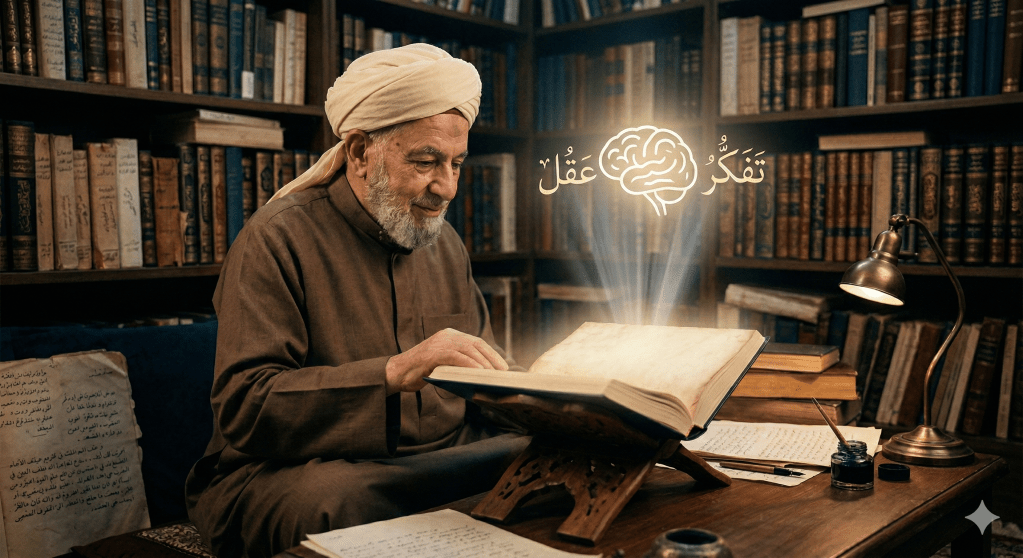
Presented by Zia H Shah MD
Audio summary: Unthinking Humans Are Worse Than Animals
Abstract
This report provides a comprehensive scholarly examination of Surah Al-Anfal, Verse 22, and its broader theological context within the Quranic discourse on rationality. Verse 8:22 serves as a pivotal epistemological declaration, identifying the “worst of moving creatures” as those who abdicate their rational faculties. Through an exhaustive synthesis of classical exegesis—ranging from the foundational traditionalism of Ibn Jarir al-Tabari and Ibn Kathir to the philosophical depth of Fakhr al-Din al-Razi—and contemporary reformist perspectives such as those of Muhammad Asad and Muhammad al-Ghazali, this analysis elucidates the transition from sensory perception to cognitive accountability. The report explores the linguistic nuances of terms such as al-dawab (moving creatures), al-summu (the deaf), and al-bukmu (the dumb), arguing that these are employed as spiritual metaphors for intellectual negligence rather than physical disability. Furthermore, the commentary is embellished by a detailed investigation into parallel verses (including 2:164, 3:190-191, 10:100, and 67:10) that collectively construct a “rational mandate,” positioning ‘aql (intellect) as the primary prerequisite for faith (iman) and moral obligation (taklif). The study concludes with a thematic epilogue on the implications of this rational mandate for contemporary intellectual stagnation and the perennial struggle between blind imitation and critical inquiry.
The Morphological and Ontological Significance of Quran 8:22
The verse states: “Inna sharra al-dawabbi ‘inda Allahi al-summu al-bukmu alladhina la ya‘qilun” (Indeed, the vilest of all creatures in the sight of God are those deaf, those dumb ones who do not use their reason). To understand the depth of this condemnation, a rigorous linguistic deconstruction is required. The verse begins with the emphatic particle Inna (Verily/Indeed), which serves to remove doubt and underscore the absolute nature of the judgment that follows. The term sharra represents the superlative of evil or vileness, suggesting that the condition described is the nadir of existence.
The Taxonomy of al-Dawab
The word al-dawab (singular: dabbah) is derived from the root d-b-b, meaning to crawl, creep, or walk. While it literally encompasses all living, treading creatures—from insects to mammals—the Quranic usage here performs a radical reclassification of human beings who reject rationality. By labeling unreasoning humans as “beasts” or “moving creatures,” the text strips them of the honorary title of Insan (Human), suggesting that humanity is not a static biological category but a status maintained through the active use of the intellect.
| Arabic Term | Root Meaning | Quranic Application in 8:22 | Implications for Moral Status |
| al-Dawab | To crawl or tread | All living creatures; here, unreasoning humans | Loss of human exceptionalism |
| al-Summu | Deafness | Willful refusal to hear or heed the Truth | Input failure of the spiritual heart |
| al-Bukmu | Muteness/Dumbness | Inability to articulate or speak the Truth | Output failure of the intellectual faculty |
| La Ya‘qilun | To not reason | Failure to exercise the faculty of ‘aql | Abdication of moral accountability (taklif) |
The Metaphor of Sensory Deprivation
Classical scholarship, including the works of Al-Tabari and Ibn Kathir, maintains that al-summu and al-bukmu are spiritual metaphors. This distinction is critical for maintaining the Quranic ethical framework. In Surah An-Nahl (16:76), the Quran uses the image of a “powerless dumb man” in a parable about capability, but this is presented neutrally regarding the man’s moral worth. In contrast, the “deaf and dumb” in 8:22 are blamed because their condition is a consequence of willful choice. They are deaf to the Truth (al-Haqq) and dumb concerning its articulation because they have closed their hearts to divine signs (ayat).
Classical Exegesis: Traditionalism and Philosophical Theology
The classical period of Islamic scholarship provides a diverse array of perspectives on 8:22, reflecting the evolving priorities of the community, from historical context to complex metaphysical inquiry.
Traditional Narrative: Al-Tabari and Ibn Kathir
Ibn Jarir al-Tabari and Ibn Kathir focus on the asbab al-nuzul (reasons for revelation) and the comparative status of humans and animals. Historically, the verse is linked to a group from the Bani ‘Abd ad-Dar, a tribe among the Quraysh who were notoriously stubborn in their rejection of the Prophet Muhammad. These individuals claimed to “hear” the message but remained functionally deaf because they did not act upon it.
Ibn Kathir argues that these people are the “most wicked creatures among the Children of Adam”. He draws a profound contrast: every other creature in the universe follows the fitra (innate nature) and the path God created for them. A lion, a bee, or a camel fulfills its purpose perfectly. However, humans were created specifically to recognize and worship God through the exercise of volition and reason. When they fail to do so, they become “worse than animals” because they have neglected a potential that animals never possessed. This is corroborated by the parallel in 7:179, which states that such people “are like cattle—nay, they are even more astray”.
The Intellectualist Peak: Fakhr al-Din al-Razi
Fakhr al-Din al-Razi, in his monumental Mafatih al-Ghayb (The Keys to the Unseen), elevates the discussion to the realm of philosophical theology. Razi argues that the ‘aql is the “inner proof” (al-hujja al-batina) of God, existing in a symbiotic relationship with the “outer proof” (the Prophets). He posits that reason is the primary witness and judge in matters of faith.
For Razi, the “worst of creatures” are those who fail the test of taklif (moral obligation). He notes that Islamic jurisprudence exempts those who lack reason—the child, the sleeper, and the insane—from religious duties because ‘aql is the foundation of accountability. Therefore, the voluntary abandonment of reason is viewed as the most severe form of spiritual suicide. Razi’s rationalism emphasizes that while reason is the basis for accepting revelation, once the Truth is established, reason must submit to the specifics of the divine law.
Contemporary Perspectives: Reformism and Modern Rationality
Contemporary commentators have adapted the message of 8:22 to address the modern crisis of faith and the rise of ideological dogmatism.
Muhammad Asad: The Critique of Blind Imitation
Muhammad Asad, in The Message of the Quran, views 8:22 as a universal condemnation of taqlid (blind imitation of ancestors or traditions). Asad argues that the Quran is a call to “ask questions” and to break the “shell of complacency”. He identifies the “deaf and dumb” not just as the historical pagans of Mecca, but as anyone who fails to use their “God-given power of conceptual thinking”.
Asad’s exegesis is characterized by what some critics call “crass rationalism,” as he often interprets miracles as morality lessons or psychological metaphors. For example, he interprets Jesus’s healing of the blind as a spiritual awakening for those who were “spiritually dead” or “spiritually blind” to the Truth. For Asad, 8:22 is a “theological trump card” against the notion that Islam requires the suspension of reason. He asserts that obtaining knowledge through science and logic is an integral part of one’s submission to God.
Muhammad al-Ghazali and the Spiritual Faculty
Modern scholar Muhammad al-Ghazali emphasizes that reason is the “means to faith,” not something one sets aside to believe. In his commentary, he notes that 8:22 and 67:10 (where the damned regret not “listening or reasoning”) demonstrate that salvation is a cognitive achievement. Ghazali argues that true knowledge is produced through “arguing and listening to the arguments of others,” emphasizing that the Quran often pairs “reasoning” with “listening” to highlight the importance of considering counter-arguments.
The Rational Mandate: Embellishing the Commentary with Parallel Verses
The condemnation in 8:22 does not exist in a vacuum but is supported by a robust network of verses that celebrate the intellectual pursuit of Truth.
The Cosmic Laboratory: Quran 2:164
“Indeed, in the creation of the heavens and the earth, and the alternation of night and day, and the ships which sail through the sea… are signs for a people who use their reason (ya‘qilun)”.
This verse provides the “empirical method” for faith. It invites humanity to observe meteorological, oceanographic, and astronomical phenomena and to treat them as logical premises for the existence of a Wise Creator. The analysis indicates that if a man were to observe the constant operation of the universe “without either stubbornness or bias,” he would find sufficient evidence to convince him of the Divine Reality.
The Intellectual Elite: Quran 3:190-191
“Indeed, in the creation of the heavens and the earth… are signs for those of understanding (Ulul Albab). Those who remember Allah… and contemplate (yatafakkarun) the creation…”.
The Quran introduces the category of Ulul Albab—those who possess the “core” or “pith” of the mind. Unlike the “worst of creatures,” the Ulul Albab combine dhikr (remembrance) with fikr (deep reflection). Contemporary scholars argue that this verse defines the objective of Islamic education: the formation of generations who are adept at “problem-solving” and “critical thinking”.
The Regret of the Fire: Quran 67:10
“And they will say, ‘If only we had listened or reasoned (na‘qilu), we would not be among the companions of the Blaze’”.
This verse highlights the eschatological consequence of the failure in 8:22. The residents of Hell do not blame fate or the lack of prophets; they blame their own failure to engage their rational faculties. This confirms that in the Quranic worldview, irrationality is not a neutral error but a moral failing that leads to ultimate ruin.
The Abomination of Unreason: Quran 10:100
“And He lays abomination (rijs) upon those who do not reason (la ya‘qilun)”.
The term rijs denotes defilement, filth, or a spiritual barrier. The verse suggests that the refusal to reason results in a “stain” on the soul, making it impossible for the individual to perceive the light of guidance. This is the theological corollary to 8:22: if you choose to live as a “beast” by ignoring reason, you will be covered in the spiritual “filth” that results from that regression.
Comparative Analysis of Islamic Rationalism
The role of reason (‘aql) has been a subject of intense debate among various schools of Islamic thought. While all agree on the importance of 8:22, their interpretations of the extent of reason’s power differ.
| School of Thought | View on Reason (‘aql) | Interpretation of 8:22 | Primary Source of Morality |
| Mu‘tazila | Reason can independently know good/evil and God | Encouragement to reasoning as a path to absolute Truth | Pure Reason |
| Ash‘ari/Maturidi | Reason is the tool to validate revelation but must submit to it | Condemnation of those who reject the clear logical proofs of Prophecy | Revelation validated by Reason |
| Philosophers (Falsafa) | Reason is the highest human faculty; can reach the same truths as Prophets | 8:22 is a call to the philosophical life and the study of nature | Syllogistic logic and physics |
| Modernist Reformers | Reason is the “closest friend” of revelation; necessary for modern Ijtihad | Critique of traditional stagnation and blind following of the past | Revelation interpreted via Reason |
Deep Insights into the Nature of ‘Aql (Reason)
The research reveals that the Quranic concept of ‘aql is active rather than static. The Quran never uses the word as a noun but frequently uses its verbal forms (ya‘qilun, ta‘qilun). This suggests that reason is not an object one possesses, but a process of thinking, reflecting, and understanding that must be continuously performed.
The Etymology of Restraint
The root ‘-q-l literally means “to bind” or “to tie,” specifically a camel’s tether. Reason, therefore, is the faculty that “binds” a person to reality and “restrains” them from the “beast-like” pursuit of appetites, passions, and superstitions. When a person stops “binding” themselves to the Truth, they drift into the state of the dabbah (the moving creature), governed only by external stimuli and internal whims.
Knowledge (‘Ilm) vs. Conjecture (Zann)
The Quranic “rational mandate” creates a sharp dichotomy between ‘ilm (certain knowledge based on evidence) and zann (conjecture, guesswork, or popular opinion). Verse 53:28 warns that “conjecture is of no avail against the Truth”. The “worst of beasts” in 8:22 are those who live by zann—following the opinions of the majority or the traditions of their ancestors without seeking the “evidence” (burhan) that the Quran repeatedly demands.
The Heart-Mind Connection
In the Quranic worldview, the locus of reason is often the qalb (heart). Verse 22:46 asks: “What, have they not journeyed in the land so that they have hearts to understand (ya‘qilun) with?”. This indicates that reason is not just a cold, logical calculation (as in some Western philosophies) but a holistic process that involves the spiritual and ethical core of the person. True comprehension is reached when the mind perceives the logic of the universe and the heart finds tranquility in that perception.
Educational and Socio-Political Implications
The declaration that those who do not use reason are the “worst of creatures” serves as a foundational principle for Islamic education and social organization.
The Objective of Islamic Education
The analysis of 3:190-191 suggests that Islamic education should focus on “educating the intellect” to direct intelligence toward the power of God and the wonders of creation. This includes science and technology as tools for discovering the “messages in His verses”. A community that fails to foster critical thinking and empirical analysis is, by the definition of 8:22, regressing toward an animalistic state.
Reason vs. Superstition
Modern commentators like Asad argue that 8:22 is a protection against “mental fear” and “superstition”. Belief in witchcraft, false gods, or irrational taboos is seen as a “waste of mental and spiritual energy”. Only a rational, orderly worldview can protect an individual from the “debilitating” effects of false beliefs.
The “Verse of the Sword” and Rational Context
Asad and other modern scholars apply the rational mandate even to controversial verses like 9:5. By using “intra-Quranic exegesis” (correlating verses with one another), they argue that the commands for war must be understood within the rational framework of self-defense and the prevention of persecution, as established in 2:190-193. A “reasoning” reader sees that the Quran does not command indiscriminate violence but provides a “just and intended” preserving of existence against those who were “killing the Muslims”.
Synthesis: The Hierarchy of Being
The research materials suggest a “hierarchy of being” based on the use of reason:
- The Prophets and Ulul Albab: Those who use reason perfectly to align their lives with Divine Truth.
- The Reasoning Believer: Those who use their intellect to validate revelation and live according to its guidance.
- The Conscious Non-Believer: Those who use reason in worldly matters but have not yet “listened” to the spiritual dimension (a group for whom the Quran invites further questioning).
- The Animal Kingdom: Those who lack reason but follow their fitra and are thus “good” in their own category.
- The “Worst of Creatures” (8:22): Humans who possess the faculty of reason but willfully abandon it for the sake of appetite, pride, or blind imitation.
Thematic Epilogue: The Peril of the Unthinking Life
The commentary on Surah Al-Anfal, Verse 22, serves as more than an academic exercise; it is an ontological warning for all ages. In the Quranic worldview, humanity’s status as the khalifah (vicegerent) of God is not an inherent right of the species, but a conditional state dependent on the active engagement of the mind. The “vilest of beasts” are not those born without the capacity to hear or speak, but those who—possessing the sophisticated hardware of the human brain—refuse to run the software of reflection.
The thematic resonance across the Quran—from the “cosmic laboratory” of 2:164 to the “regret of the fire” in 67:10—presents a unified message: irrationality is the primary cause of spiritual and social decay. When individuals or societies abandon reason for the sake of taqlid (blind imitation), zann (conjecture), or the pursuit of raw appetite, they do not simply become “unintelligent”; they undergo a form of species-level regression. They become deaf to the profound “songs of praise” that all creation offers up to the Divine, and they become dumb to the articulation of Justice and Truth in the public square.
In the contemporary era, where information is abundant but wisdom is scarce, the mandate of 8:22 is a call to intellectual sovereignty. It challenges the believer and the seeker alike to move from the state of the dabbah—the creature that merely reacts to its environment—to the state of the Insan, the one who “binds” themselves to the Truth through the sacred rope of ‘aql. To reason is to affirm one’s humanity; to refuse to reason is to accept a status below the animals, who, at the very least, remain faithful to the natures for which they were created. The epilogue of the Quranic rational mandate is clear: the path to God is paved with the bricks of logic, the mortar of reflection, and the light of understanding. Those who walk this path transcend their biological origins; those who abandon it find themselves among the “vilest of all moving creatures” in the sight of the Infinite.



 The Glorious Quran and Science
Leave a comment