

Presented by Zia H Shah MD
Audio teaser:
The following research report investigates the profound convergence between Islamic metaphysics and the emerging paradigms of physical information theory and the simulation hypothesis. By centering the analysis on two foundational Quranic verses—Surah Fatir (35:41) and Surah Al-An’am (6:59)—this study explores the ontological implications of divine sustenance (Qayyumiyah) and the universal record (Kitabun Mubin) within the context of modern physics. The report synthesizes classical exegetical traditions with contemporary constructs such as Landauer’s Principle, quantum error correction, and the holographic principle, arguing that the Quranic depiction of reality as a “Clear Book” and a “sustained structure” provides a coherent theological framework for the “it from bit” paradigm in physics. Through an exhaustive examination of Al-Ghazali’s occasionalism and its parallels with the discrete rendering cycles of simulated universes, the analysis provides a nuanced perspective on the persistence of spacetime and the preservation of information as fundamental properties of the cosmos.
Abstract
This research report provides a comprehensive scientific, philosophical, and theological commentary on Quran 35:41 and 6:59, mapping their assertions onto the principles of physical information theory and the simulation hypothesis. Surah Fatir 35:41 describes the active, continuous “holding” of the heavens and the earth by the Divine to prevent their collapse, a concept that aligns with the physics of spacetime integrity and quantum error correction. Surah Al-An’am 6:59 posits the existence of an all-encompassing “Clear Record” that preserves the state of every entity, from a falling leaf to a grain in the earth’s darkness, mirroring the physical laws of information conservation and quantum unitarity. The study investigates how the principle that “information is physical” (Landauer’s Principle) bridges the gap between the abstract “word” of the Creator and the thermodynamic behavior of matter. By analyzing the Ash’arite doctrine of occasionalism alongside modern computational models, the report identifies a shared vision of a contingent reality that lacks inherent causal efficacy and depends entirely on an external sustaining agent. The report concludes that the Quranic metaphors of the “Preserved Tablet” and the “Keys of the Unseen” offer a robust conceptual vocabulary for the holographic principle and extra-dimensional physics, suggesting that reality is an information-preserving system maintained by a perpetual, non-local processor.
The Informational Turn in Modern Physics and Theology
The history of physics has traditionally been characterized by the study of matter and energy as the primary constituents of the universe. However, the late twentieth and early twenty-first centuries have witnessed a paradigm shift toward “Information Theory” as the fundamental lens through which reality is understood. This transition, often summarized by John Archibald Wheeler’s aphorism “it from bit,” suggests that every physical “thing” at its bottom originates from bits of information. In this framework, the universe is not merely a collection of objects but a processing system where information is a physical entity governed by the laws of nature [Prompt]. This shift brings physics into an unexpected dialogue with the Quranic worldview, which has for fourteen centuries described the universe as a “Book” and an “Inscribed Record”.
Information theory in physics relies on key pillars that connect abstract logic to physical reality. The first is Landauer’s Principle, which asserts that “information is physical”. This means information cannot exist without a physical medium—whether it be the spin of an electron, the polarization of a photon, or the biological structures of a brain. This principle further establishes that logically irreversible operations, such as erasing a bit of information, have a minimum thermodynamic cost in the form of heat dissipation into the environment. This direct link between logic and thermodynamics implies that the “commands” or “laws” governing the universe are not mere abstractions but involve physical energy and state changes.
The second pillar is the Conservation of Information, rooted in the principle of quantum unitarity. This principle suggests that the evolution of a closed system is reversible and that information is never truly destroyed. Even in the extreme environment of a black hole, the “Black Hole Information Paradox” led to the realization that information falling into the hole must be preserved, perhaps on its two-dimensional surface—a concept known as the holographic principle. These scientific developments provide a robust framework for interpreting Quranic verses regarding divine omniscience and the “Clear Record.”
The Ontology of the Universal Record in Surah Al-An’am 6:59
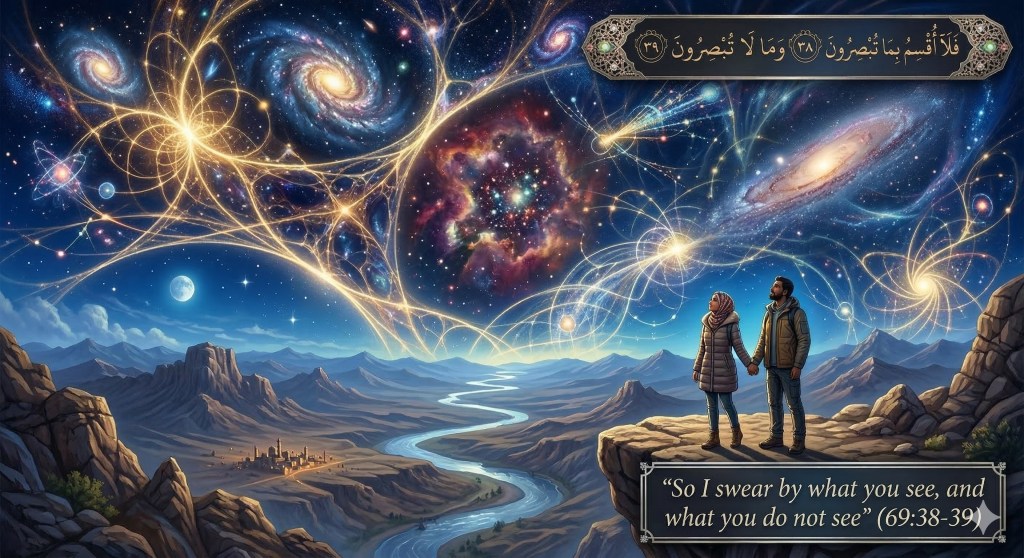
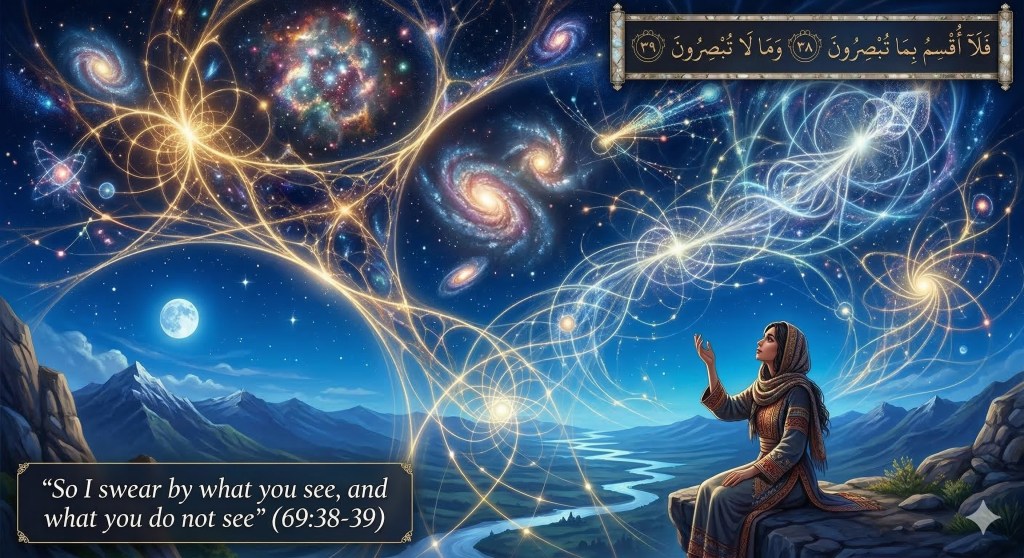
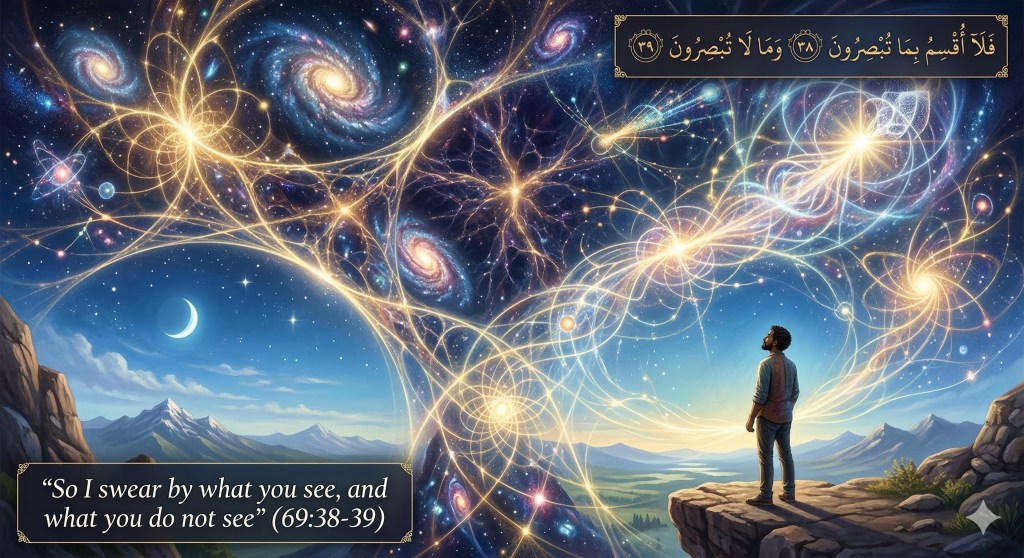
Surah Al-An’am 6:59 provides one of the most explicit scriptural foundations for the concept of total information preservation: “And with Him are the keys of the unseen; none knows them except Him. And He knows what is on the land and in the sea. Not a leaf falls but that He knows it. And no grain is there within the darknesses of the earth and no moist or dry [thing] but that it is [written] in a clear record”. This verse articulates a divine knowledge that is not merely general but exhaustive, penetrating the microscopic and the cosmic with equal precision.
From an information-theoretic perspective, the mention of a “falling leaf” is particularly significant. The trajectory of a single leaf involves an astronomical number of variables: air resistance, wind turbulence, gravitational fluctuations, and thermal interactions with millions of gas molecules. To “know” the fall of a leaf in the way the Quran describes is to possess the complete state-vector of the system. This implies that the “Clear Record” (Kitabun Mubin) is not a metaphorical ledger but a comprehensive data structure that stores the informational imprint of every event in spacetime.
Classical Islamic exegetes, such as Al-Tabari and Ibn Abbas, understood the “Clear Record” as the Lawh al-Mahfuz (Preserved Tablet)—the master register of all that was, is, and will be. In modern terms, this can be viewed as the “Universal Quantum State”. The “Keys of the Unseen” (Mafatih al-Ghaib) refer to information that exists but is inaccessible to human observers, much like the hidden microstates in a thermodynamic system or the unmeasured states in a quantum superposition.
| Quranic Terminology | Scientific/Informational Equivalent | Functional Implication |
| Mafatih al-Ghaib (Keys of the Unseen) | Quantum Superposition / Hidden Data | Information exists but is not yet “collapsed” or accessible. |
| Kitabun Mubin (Clear Record) | Universal Ledger / Quantum Memory | The total history of the universe is preserved and retrievable. |
| Lawh al-Mahfuz (Preserved Tablet) | Holographic Boundary | A secure 2D source where all 3D information is encoded. |
| Ghaib (The Unseen) | Extra Dimensions / Latent Variables | Higher-dimensional data that informs the 4D “seen” world. |
| Shahada (The Seen) | Observable States | The subset of information that has “decohered” into perception. |
The metadata associated with 6:59 suggests that nothing truly disappears without a trace, echoing the scientific principle that the present state of the universe encodes its past completely. This “no information loss” narrative transforms the Quranic concept of accountability from a purely moral doctrine into an ontological reality. Just as black holes are now understood as “vaults” that preserve information rather than destroying it, the Kitabun Mubin serves as a “cosmic memory bank” where the “weight of a dust particle” is accounted for.
The Physics of Divine Sustenance: Surah Fatir 35:41
While 6:59 addresses the storage of information, Surah Fatir 35:41 focuses on the maintenance of the system: “Indeed, Allah ˹alone˺ keeps the heavens and the earth from falling apart. If they were to fall apart, none but Him could hold them up”. The Arabic term yumsiku (holds/keeps) and tazula (falling apart/ceasing to exist/deviating) imply an active, ongoing effort required to prevent the dissolution of the cosmos.
In the context of general relativity, gravity is the curvature of spacetime around mass. However, physicists have long sought a deeper, quantum origin for this “fabric”. Recent research suggests that spacetime is not a fundamental entity but an emergent property of quantum entanglement. John Preskill has described how spacetime achieves its “intrinsic robustness” despite being woven out of fragile quantum parts. This robustness is now modeled as a “quantum error-correcting code”.
An error-correcting code in computation is a mechanism that detects and corrects bit-flips or noise that would otherwise lead to the collapse of data integrity. If we view the universe as a computational projection, 35:41 describes the active “correction” of the system’s “bits” to ensure that the geometry of the heavens and the earth does not “fall apart”. Without this continuous maintenance—this divine “holding”—the structural coherence of reality would succumb to entropy and cease to function.
| Scientific Context | Theological Interpretation of 35:41 | Mechanism |
| Spacetime Geometry | The “Heavens and the Earth” | The emergent fabric of the physical universe. |
| Structural Drift / Entropy | Tazula (Falling Apart/Deviation) | The natural tendency of systems to decay or lose coherence. |
| Quantum Error Correction | Yumsiku (Grasping/Holding) | The active process that preserves the integrity of the manifold. |
| Source of Coherence | Allah (The Sustainer) | The external agent required to maintain an emergent system. |
This theological perspective challenges the Newtonian “clockwork universe,” where the world is seen as a self-sustaining machine. Instead, 35:41 posits a “Source-Centric” reality where the conservation of divine coherence ($\nabla \cdot \Phi D = 0$) is the only thing preventing the immediate vanishing of existence. This resonates with the “it from bit” paradigm: if the bits (the information) stop being processed or “held,” the “it” (the matter/geometry) ceases to be.
Landauer’s Principle and the Energy of Maintenance
A critical intersection between information theory and the theological “holding” of the universe lies in the energy cost of processing information. Landauer’s Principle establishes that computation is a physical process that must obey the laws of thermodynamics. The minimal energy needed to erase one bit of information is proportional to the temperature of the system :
$$E \ge k_B T \ln 2$$
If the universe is an information-preserving system as described in 6:59, and an actively sustained system as described in 35:41, it must possess a mechanism to manage the thermodynamic cost of its own processing. For every “leaf falling” or “grain in the darkness” that is recorded, there is a corresponding state change in the universal ledger.
Theological commentary on 35:41 frequently notes that this “holding” does not weary the Sustainer (Surah Al-Baqarah 2:255). From a thermodynamic perspective, this implies that divine governance is non-rivalrous: the energy required to record, maintain, and sustain the cosmos does not diminish the Source. This distinguishes the Divine Sustainer from any hypothesized finite simulator, who would be limited by the energy resources of their own base reality.
Furthermore, the “Margolus-Levitin-Landauer” limit sets the maximum speed of computation based on available energy. This relationship suggests that the “time” required for the universe to evolve and “hold together” is fundamentally tied to its energy density. The Quranic description of God’s command as “be, and it is” (Kun Fyakun) suggests a system operating at the absolute limit of computational efficiency, where the “word” (information) manifests as reality with zero delay and perfect coherence.
The Simulation Hypothesis and Al-Ghazali’s Occasionalism
The simulation hypothesis, popularized by Nick Bostrom, suggests that if advanced civilizations can create conscious virtual beings, then it is statistically likely that we are such beings. This hypothesis frames the universe as a programmed construct governed by code rather than autonomous laws. While this sounds like modern science fiction, it echoes the 11th-century Islamic doctrine of “Occasionalism” developed by the theologian Al-Ghazali.
Al-Ghazali argued in The Incoherence of the Philosophers that there are no inherent causal powers in created things. Fire does not burn cotton by its own nature; rather, God creates the burning of the cotton at the “occasion” when fire and cotton meet. This doctrine of “continuous creation” (al-khalq al-jadid) posits that the universe is recreated at every discrete moment.
This mirrors the “rendering” process in a computer simulation, where every element of the virtual world is updated frame-by-frame according to a central processor’s commands. Al-Ghazali’s “habit” of nature (Sunnat Allah) corresponds to the “code” or the “physics engine” that ensures consistent behavior within the simulation. The “holding” of the heavens in 35:41 is thus the perpetual execution of this code, without which the “program” of reality would simply cease to run.
| Feature | Simulation Hypothesis | Al-Ghazali’s Occasionalism |
| Causality | Perceived interactions are outcomes of underlying code. | Interactions are sequential events willed directly by God. |
| Continuity | Reality is rendered frame-by-frame (discrete time). | Reality is recreated at every discrete instant (atomistic time). |
| Natural Laws | Flexible rules set by the programmer. | God’s “Habit” (Sunnat Allah); consistent but contingent. |
| Miracles | “Admin” intervention or code editing. | God’s suspension of His habit for specific ends. |
| Sustenance | The simulation vanishes if the “console” is off. | The world perishes if God stops recreating it. |
The Ash’arite theologians, whom Al-Ghazali followed, even envisioned time itself as a series of discrete units, an idea strikingly similar to the clock cycles of a digital computer. This “atomism” of time and matter suggests that the universe is “computed” into existence anew at every step.
Information Preservation and the Holographic Universe
The holographic principle, a concept born from the study of black holes, states that the description of a volume of space can be encoded on a lower-dimensional boundary. Leonard Susskind memorably said that the three-dimensional world of our experience is a hologram—an image of reality coded on a distant two-dimensional surface.
This provides a literal physical structure for the Quranic “Clear Record” and “Preserved Tablet”. In this model:
- The Record (6:59): The information of every leaf and grain is inscribed on the “cosmological horizon” or the boundary of the universe.
- The Sustenance (35:41): The “holding” is the maintenance of the entanglement and the projection from the 2D record into the 3D “bulk”.
- The Unseen (Ghaib): The higher-dimensional informational source that remains “hidden” from the 3D inhabitants but governs their every movement.
The “Clear Record” of 6:59, when viewed through the holographic lens, is not merely a list of events but the very source of the universe’s geometry and dynamics. It is the “Umm-ul-Kitab” (the Mother of the Book) from which reality is executed. This dissolves the distinction between “history” and “physics”: the record of the past and the laws of the present are two sides of the same informational tapestry.
Complexity and the Homeostasis of the Cosmos
A significant challenge to both the simulation hypothesis and the continuous creation model is the accumulation of errors. In any large-scale informational system, entropy leads to “bit rot” or data corruption over time. How does the universe maintain its operational integrity over billions of years without “system failure”?
One speculative but compelling theory is that black holes serve as the universe’s endogenous “waste management” infrastructure. Just as biological systems use mechanisms like autophagy to eliminate damaged components, the cosmos may use black holes to remove entropic or disruptive matter-energy configurations from the system. This selective elimination maintains “cosmic homeostasis,” ensuring that physical laws remain consistent and the universe does not “fall apart” as warned in 35:41.
This provides a functional reason for the “Clear Record” of 6:59 to be “Mubin” (Clear/Manifest) and “Mahfuz” (Protected). For a system to correct errors, it must possess a master copy—an invariant reference point—against which the current state can be measured and adjusted. The Lawh al-Mahfuz functions as this “geometric canary,” providing the structural stability required for the 3D manifold to persist despite the continuous production of entropy.
Epistemology and the “One Reality” Model
Mapping scripture to physics requires a careful distinction between analogy and identity. While the simulation hypothesis suggests the world is an “artificial” construct, the Quranic view asserts that the world is Haqq (Real/Truth) because it is created with purpose by Al-Haqq (The Absolute Truth).
To reconcile these, the “One Reality, Different Hardware” model replaces the hierarchy of “simulation vs. reality” with a single, integrated plane of existence. In this model, the differences between beings—humans, angels, jinn—are not because they live in different simulations, but because they possess different “biological and spiritual hardware” for perceiving the same reality.
- Human Hardware: Confined to the 4D “seen” world (shahada); can only perceive the “macrostate”.
- Angelic Hardware: Capable of perceiving the informational “blueprints” or the “Clear Record” directly.
- The Unseen (6:59): Not a separate place, but the higher-dimensional informational depth of our current reality that our hardware cannot yet “render”.
This model ensures that moral responsibility remains “real.” Actions taken in this world are not “virtual” but have an eternal foundation in the “Clear Record”. The transition to the afterlife is then framed not as a move from a simulation to reality, but as a “hardware upgrade”—the “removal of the covering” (Surah Qaf 50:22) that allows the soul to witness absolute reality directly.
The Universal Imprint and the Retrieval of History
The Quantum Memory Matrix theory suggests that spacetime is essentially “memory cells” that record every interaction. This provides a physical mechanism for the “witnessing” described in the Quran, where the “earth speaks” and the “limbs testify” to a person’s deeds. If every event leaves a “tiny change in the local quantum state of the spacetime cell,” then history is indelibly written into the very geometry of the world.
Surah Al-An’am 6:59’s assertion that even a grain in the darkness is recorded implies that information is not merely “stored” in a distant book but is “imprinted” on the fabric of existence. This “redundancy” of records—where a deed is recorded by angels, inscribed in the Kitabun Mubin, and imprinted on spacetime—increases the “recoverability” of information for the Day of Judgment.
Just as quantum state revival (full-state revival) has been demonstrated in laboratory settings—allowing a system to be recovered to its past state through specific intervention steps—the Quranic “Resurrection” can be viewed as the ultimate information retrieval process. The “Clear Record” serves as the backup from which the “Original State” is restored with perfect fidelity.
The Thermodynamics of Error Correction and Divine Stability
The “holding” in 35:41 is also a defense against the “heat death” or “informational death” of the universe. In computation, the “cost” of maintaining a state can be taken in a conserved quantity such as angular momentum or energy. If the universe is a closed informational system, its “stability” depends on the “Field Equations of Consciousness” ($Q^2S$) that describe the resonance between the sustaining Divine Field and the emergent human field.
The stability of revelation and the stability of spacetime are treated as analogous: both are “self-healing” systems governed by redundancy and invariance. The Quran is described as a “self-verifying architecture of meaning” that mirrors the “self-regulating” nature of the cosmos. This suggests that the same “Information Law” ($\nabla \cdot \Phi D = 0$) that keeps the heavens from falling apart also ensures that the “Clear Record” of 6:59 remains free from distortion or change.
Synthesis: The Meaning-Centric Cosmos
The synthesis of 35:41 and 6:59 through information theory reveals a universe that is fundamentally Semantic. In the “Quantum Quranic Science” ($Q^2S$) framework, revelation is not just data transferred across time but a continuous interaction between consciousness and the Divine Source.
- The Information potential: Meaning is a wavefunction ($\Psi M$) representing the potential of divine information.
- The Measurement (6:59): When consciousness “observes” or “reflects” upon the world, the “Clear Record” collapses into determinate conceptual states.
- The Sustainment (35:41): The constructive interference between the Divine Field and the Human Field results in Nūr (illumination/coherence), while destructive interference results in Zulm (distortion/collapse).
Reality is thus a “standing wave of divine information”. The Quranic “Pen” and “Tablet” are the computational instruments of a Creator who is the absolute “Processor”. This model dissolves the boundary between cosmology and theology: creation is an “executable expression” of a single informational Source.
Ethical and Theological Implications of the Informational Model
The realization that “information is never lost” and that the universe is “actively held” has profound ethical implications. It imbues every moment with cosmic significance. If the “fall of a leaf” is recorded in 6:59, then no human intention or whisper is too small to be unaccounted for. This scientific principle (conservation of information) subtly mirrors the theological principle of moral accountability: “no deed is lost”.
The “Holding” of 35:41 also reminds the observer of their radical dependence. In a simulation, the inhabitants are at the mercy of the programmer; in occasionalism, the creature is utterly dependent on the Sustainer for every breath and heart-beat. This fosters a “theistic science” approach where scientific discovery is seen as the uncovering of the “habit” of the Divine, and physical laws are viewed as the “customs” of a consistent, merciful Creator.
| Ethical Concept | Scientific Grounding | Theological Grounding |
| Accountability | Conservation of Information (Unitarity). | The Clear Record (Kitabun Mubin). |
| Dependence | Contingency of Emergent Spacetime. | The Sustainer (Al-Qayyum) “holding” the heavens. |
| Objective Past | Quantum Memory / Redundant Records. | The Preserved Tablet (Lawh al-Mahfuz). |
| Sincerity | Total transparency in higher dimensions. | Allah knowing the “whispers of the soul.” |
Thematic Epilogue: The Cosmic Memory and the Day of Disclosure
The synthesis of Surah Fatir 35:41 and Surah Al-An’am 6:59 provides a unified vision of a universe that is both Memory and Process. Reality is not a static collection of matter, but a dynamic, actively sustained informational structure. The “holding” of the heavens is the active maintenance of the system’s structural integrity, ensuring that the “bits” of reality continue to cohere into the “it” of our experience. Simultaneously, the “Clear Record” ensures that every fluctuation in the system is eternally preserved, ensuring that the history of every soul and atom is never lost to cosmic forgetfulness.
In this informational cosmos, the Day of Judgment is the final “disclosure” or “play back” of the universal memory. The “Clear Record” is opened, and the “veil” of limited human hardware is lifted, revealing the informational depth of every choice and event. The “holding” that prevented the universe from falling apart in this life reaches its appointed term, leading to a “folding of the heavens” and the transition to a new, higher-dimensional existence. Ultimately, the scientific discovery of information as a physical, conserved entity serves as a profound analogy for the attributes of an All-Knowing, All-Powerful Creator—suggesting that our increasing understanding of the physics of information is not a move away from the spiritual, but a deeper decoding of the “Clear Record” that has been inscribed since the beginning of time. Reality is a coherent, self-verifying architecture of meaning, held together by a Will that “never tires” and a Memory that “never forgets.”

 The Glorious Quran and Science
Leave a comment