

Epigraph
إِنَّ اللَّهَ يُمْسِكُ السَّمَاوَاتِ وَالْأَرْضَ أَن تَزُولَا ۚ وَلَئِن زَالَتَا إِنْ أَمْسَكَهُمَا مِنْ أَحَدٍ مِّن بَعْدِهِ ۚ إِنَّهُ كَانَ حَلِيمًا غَفُورًا
Al Quran 35:41
وَعِندَهُ مَفَاتِحُ الْغَيْبِ لَا يَعْلَمُهَا إِلَّا هُوَ ۚ وَيَعْلَمُ مَا فِي الْبَرِّ وَالْبَحْرِ ۚ وَمَا تَسْقُطُ مِن وَرَقَةٍ إِلَّا يَعْلَمُهَا وَلَا حَبَّةٍ فِي ظُلُمَاتِ الْأَرْضِ وَلَا رَطْبٍ وَلَا يَابِسٍ إِلَّا فِي كِتَابٍ مُّبِينٍ
Al Quran 6:59

Presented by Zia H Shah MD
Abstract
Quran 35:41 and 6:59 can be read together as a paired metaphysical claim about reality: the cosmos is kept from disintegrating by a sustaining agency, and every event within it is exhaustively known and “written” in a perfect register. This report offers a scientific–philosophical–theological commentary that places those two motifs—cosmic stability (imsāk/holding) and total informational comprehensibility (kitāb mubīn/clear record)—into dialogue with modern physical information theory (Shannon entropy, Landauer’s principle, reversible computation, informational interpretations of thermodynamics) and with the simulation hypothesis as a philosophical proposal often framed using computational metaphors. The alignment argued for is structural and analogical, not a claim that the Quran is “secretly doing modern physics.” Classical tafsīr construes these verses as describing divine sustenance and divine omniscience in ways that naturally invite an information-theoretic re-reading: “holding” resembles constraints that preserve coherence of dynamical evolution; “recording” resembles global state-description beyond creaturely access—an asymmetry echoed by modern physics’ sharp limits on what finite observers can store, access, or compute about a universe.
Textual and exegetical grounding
Quran 35:41 states, in a widely used English rendering, that God “keeps the heavens and the earth from falling apart,” and that if they were to “fall apart” no one besides Him could hold them up. The Arabic pivots on يُمْسِكُ (yum’siku, “to hold/retain”) and أَن تَزُولَا (an tazūlā, “lest they zawāl”—depart, slip away, cease from their state). Classical exegesis is explicit that the verse is not primarily a lesson in celestial kinematics but a claim about dependence: al-Ṭabarī glosses “lest they tazūlā” as “lest they move away from their places,” underscoring that there is no other sustaining power “after Him.” Al-Jalalayn likewise reads the “holding” as preventing disappearance/cessation, and underscores exclusivity: none can sustain them but God.
Some tafsīr traditions even treat the verse polemically against speculative cosmographies: in Ibn Kathīr’s transmission, a report is cited in which Ibn Masʿūd rebukes a claim (attributed to Kaʿb al-Aḥbār) about the heavens rotating on an angel’s shoulder, insisting instead on the Quranic statement that God “holds the heavens and the earth” from zawāl. Al-Qurṭubī preserves a related discussion (with stronger claims about rotation), illustrating how readers have long connected this verse to questions of cosmological structure, even when the verse’s theological aim is primary. A modern tafsīr summary (Maʿārif al-Qurʾān) stresses that “holding” should not be forced into a claim that the skies are static; rather it signifies holding them back from deviating away from their established order.
Quran 6:59 intensifies the second motif: epistemic totality. It states (in a common translation) that with God are “the keys of the unseen,” known only to Him; He knows what is in land and sea; not even a leaf falls without His knowledge; and everything—fresh or dry—is “written” in a “perfect record” (kitāb mubīn). Al-Ṭabarī links “keys of the unseen” to a traditional enumeration (via Ibn ʿAbbās) of “five” matters of exclusive divine knowledge (echoed elsewhere in the Quran’s phrasing about knowledge of the Hour and related unseen matters). Al-Qurṭubī reads “keys” as a metaphor: just as keys provide access to what is locked away, so God alone possesses the “paths” to the unseen and grants disclosure selectively. On “kitāb mubīn,” Maʿārif al-Qurʾān explicitly records a classical split: some interpret it as al-Lawḥ al-Maḥfūẓ (the Preserved Tablet), while others interpret it as Divine Knowledge itself—called a “manifest book” because it is preserved from omission, chance, error, or forgetting.
Read together, 35:41 and 6:59 form a coherent dyad: reality is (i) stabilized—kept from cosmic zawāl—and (ii) completely knowable to its source, with creaturely knowledge bounded and derivative.
Physical information theory as a scientific lens
Modern information theory begins with a mathematical definition of information as a property of probabilistic sources and channels: in Claude Shannon’s canonical “A Mathematical Theory of Communication,” information content is quantified via what is now called Shannon entropy (a measure over probability distributions). This mathematical formalism became physically consequential because entropy is also central in statistical mechanics and thermodynamics, where macrostates (temperature, pressure) hide myriad microstates; in that setting, entropy operationalizes the gap between a coarse description and the underlying fine-grained configuration. The conceptual bridge—information measures and physical entropy measures sharing a deep structural kinship—underwrites much of what is now called the thermodynamics/physics of information.
The slogan “information is physical” is most strongly associated with Rolf Landauer of IBM, who argued that information storage and transformation must be implemented in physical degrees of freedom and therefore cannot escape physical constraints. In his 1961 work on irreversibility in computing, he tied logical irreversibility (e.g., erasing or merging computational paths) to thermodynamic cost, motivating what became known as Landauer’s principle: erasing one bit of information in a thermal environment has a minimum heat/entropy cost on the order of (kT\ln2). Landauer later summarized and popularized these ideas in Physics Today as “Information is physical,” emphasizing computation’s embedding in physical law rather than treating it as abstract symbol manipulation floating free of nature.
A closely related set of arguments involves Maxwell’s demon—an imagined agent that seems to reduce thermodynamic entropy by using microscopic information—and the question of whether “information processing” is required to save the Second Law. Major reviews detail how the demon functions as a clarification device for the relation between entropy, measurement, feedback, and the costs of control and memory. Leo Szilard’s 1929 analysis (“Szilard engine”) explicitly framed the demon-like scenario in terms of knowledge and entropy, connecting “intelligent intervention” to thermodynamic bookkeeping. From there, developments in reversible computation—especially by Charles H. Bennett—showed that computation can be performed in logically reversible ways (in principle) and clarified that the thermodynamic “price” attaches to irreversible steps such as erasure rather than to computation as such.
In quantum physics, information-theoretic structure deepens: quantum states encode information in amplitudes, and quantum correlations (entanglement) behave unlike classical correlations. Standard quantum information references formalize this with the von Neumann entropy (S(\rho)=-\mathrm{Tr}(\rho\log\rho)), the quantum analogue of Shannon entropy for density matrices, and treat entanglement as a resource with operational meanings. These frameworks matter for cosmology and gravity because they point to fundamental limits on state description and information flow when quantum theory is combined with gravitational dynamics.
That gravitational turn brings in some of the most explicit “information-like” constraints in physics. Jacob D. Bekenstein argued for a universal upper bound on the entropy-to-energy ratio for bounded systems—often interpreted as a limit on the information that can be stored in a region with given energy and size. This “Bekenstein bound” grew out of black-hole thermodynamics reasoning: if entropy and information were unconstrained in finite regions, processes involving gravitational collapse could violate generalized entropy laws.
The bound connects directly to the holographic principle: in quantum gravity contexts, the maximal information content of a region appears to scale like the area of a boundary rather than the volume of the interior. Gerard ‘t Hooft formulated an influential early argument that reconciling gravity, unitarity, and entropy suggests a kind of dimensional reduction: degrees of freedom may be represented as Boolean variables on a lower-dimensional structure. Leonard Susskind developed and popularized this line in “The World as a Hologram,” presenting holography as a candidate structural feature of quantum gravity. Raphael Bousso later surveyed successes and open challenges in implementing holography in a comprehensive review, emphasizing evidence that surface area can bound information content in adjoining spacetime regions.


Finally, the black hole information paradox dramatizes why “information” became a central physical concern. Stephen Hawking argued in 1976 that gravitational collapse and black-hole evaporation could produce a fundamental “breakdown of predictability,” seemingly mapping pure quantum states to mixed thermal states. That conclusion, if taken at face value, threatens standard quantum unitarity and makes “information loss” a deep problem rather than a mere practical limitation. Subsequent developments—especially gauge/gravity duality—pushed many physicists toward the view that information is not truly destroyed but is encoded in subtle correlations. Juan Maldacena’s AdS/CFT correspondence, for example, provides a concrete framework in which gravitational dynamics in a bulk spacetime are related to a non-gravitational quantum field theory on a boundary, strongly suggesting a unitary description in those settings. Even where final consensus is not trivial, the history of the paradox illustrates the modern attitude: the “bookkeeping” of reality is increasingly framed as the bookkeeping of information under physical law.
Simulation hypothesis in physics-adjacent philosophy
The simulation hypothesis is most influentially framed not as a physics theorem but as a philosophical-probabilistic trilemma. Nick Bostrom’s “Are You Living in a Computer Simulation?” argues that at least one of three propositions is true: (i) civilizations like ours almost never reach a “posthuman” stage capable of high-fidelity ancestor simulations; or (ii) posthuman civilizations almost never run such simulations; or (iii) we are almost certainly living in a simulation. As commonly noted (including in high-level summaries), “simulation argument” does not directly prove we are simulated; it rearranges conditional credences given assumptions about future computation and the number of simulated observers.
Philosophically, the simulation theme is often linked to skepticism scenarios (brain-in-a-vat) and questions about what counts as “real.” David Chalmers’s “The Matrix as Metaphysics,” written in the context of The Matrix, treats simulated-world scenarios as vehicles for arguing that even if one is in a computation-driven environment, many ordinary beliefs and reference relations might still be true (depending on how terms latch onto causes and structures). Chalmers’ later work also advances “virtual realism,” the view that virtual worlds can be genuine realities rather than mere illusions—an idea developed in Reality+ and discussed in subsequent reviews.
Physics intersects with simulation talk in two main ways, and both are relevant to an information-theoretic reading of the Quranic verses:
First, computational metaphors in fundamental physics are not automatically simulation hypotheses, but they make simulation language feel “closer” to physics. The holographic principle’s area-scaling of degrees of freedom can be paraphrased computationally (“the boundary holds the data”), even though holography is a claim about equivalent physical descriptions, not about an external programmer. Likewise, ’t Hooft’s remarks about Boolean variables and discrete lattices are sometimes read as “digital physics” adjacent, but his argument is grounded in quantum-gravity constraints rather than in a claim that our world runs on someone else’s hardware.
Second, physics supplies resource bounds that any simulation-like picture must respect. If “information is physical” in Landauer’s sense, then any computation that perfectly tracks or reproduces a universe requires physical resources (energy, entropy budget, time, memory) somewhere. Bounds from gravity and entropy (Bekenstein bounds; holographic bounds) motivate the idea that finite regions support only finite information content—and thus constrain what can be stored, resolved, or computed without compression, coarse-graining, or loss. In other words, modern physics supplies a vocabulary in which “world-as-information” and “world-as-computation” become coherent questions, even if “we are in a simulation” remains far from a settled empirical hypothesis.
A joint commentary on holding and recording
A scientifically informed reading of 35:41 begins by noticing what the verse does not do: it does not specify a physical mechanism (gravity, rotation, aether) and—per some tafsīr—should not be recruited as a proof-text for static vs. dynamic cosmologies. Instead, it asserts a dependency relation: the heavens and earth have an ongoing condition of persistence (not slipping away, not collapsing into “zawāl”) that is not self-grounding. From an information-theoretic physics standpoint, “persistence” can be redescribed as a regime in which the universe’s state evolves lawfully—i.e., its degrees of freedom remain constrained to a coherent dynamical order rather than devolving into an undefined or inconsistent evolution. This is not a Quranic endorsement of any single modern formalism, but it resonates with the way fundamental physics now treats “law” as a set of constraints on information flow: what transformations of state are possible, which correlations are preserved, what can be erased only at a heat cost, and where information may be hidden (as in black-hole horizons).
In 6:59, the text’s emphasis shifts from stability to complete epistemic reach. The verse speaks not only of big structures (“land and sea”) but also of micro-events (“a leaf falls,” “a grain in the darkness of the earth”), and it closes by asserting that everything is in a “clear record.” Classical tafsīr treats “keys of the unseen” as exclusive divine access routes to realities beyond creaturely perception and inference. When physical information theory describes entropy as missing information relative to an observer’s macro-description, it likewise begins from an asymmetry: the observer has partial access, and the system’s microstate is not fully known. The Quranic claim can be read as radicalizing that asymmetry to the limit: for creatures, the world is a mixture of accessible and inaccessible information; for God, there is no missing information—nothing falls outside knowledge.
This is where the “kitāb mubīn” motif lines up most sharply with information-theoretic imagination. In physics, any complete specification of a system’s microstate (or quantum state) functions like a “record” from which all observable statistics can, in principle, be derived. Shannon’s formalism and von Neumann entropy do not require that any agent actually has such a record; they merely define measures relative to ensembles and states. But the Quran asserts the record’s existence with respect to God, and classical tafsīr explicitly glosses the “manifest book” either as a preserved tablet or as divine knowledge itself—both of which function as a total registry without error or forgetting. In that frame, the verse is not about the metaphysics of “data” as a physical substrate; it is about God’s knowledge not being subject to the limitations that bind embodied knowers. This is compatible—at least as an analogy—with modern physics’ stress that finite physical systems cannot encode arbitrarily large information content (Bekenstein-type bounds; holographic area-scaling). The implied contrast becomes: creatures and their records are bounded; God’s “record” is not of the same ontological kind and so is not threatened by physical finitude.
The pairing of the two verses also suggests a deeper structural unity: to “hold” a world in existence is, in informational language, to sustain the lawful update of its state; and to “know” a world exhaustively is, in informational language, to have (or to be) the total mapping from state to state across all scales and times. This is exactly the conceptual space in which simulation discourse flourishes, because simulations are systems whose “world” is constituted by (i) update rules and (ii) a complete internal state description.
Yet the Quranic text also resists a naive “God = programmer” reduction. Bostrom’s simulation argument imagines an external computational substrate and treats our world as a contained model instantiated in someone else’s physics. Quran 35:41 and 6:59, by contrast, describe God not as a being inside a wider natural world, but as the unique sustainer and knower—“none but Him could hold them” and “none knows [the keys] except Him.” Even when classical tafsīr uses metaphors like “keys,” it does so to mark transcendence and selective disclosure, not to suggest that divine knowledge is a manipulable container that creatures could, in principle, seize.
Philosophical and theological synthesis with careful constraints
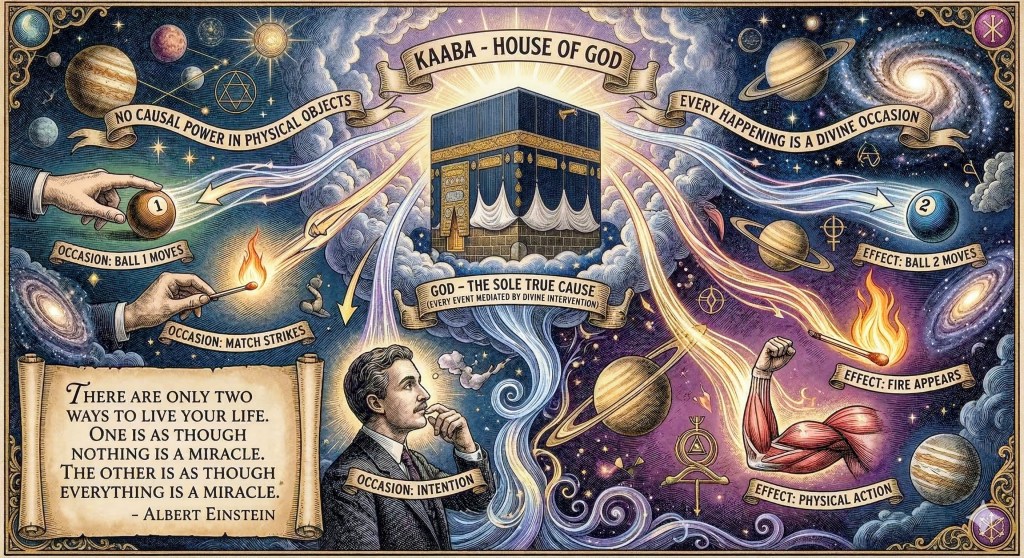
Theologically, 35:41 belongs naturally to a doctrine of continuous dependence: creation is not merely an initial event but an ongoing sustaining relation. That point is common across many theistic traditions, but it has especially explicit articulation in Islamic theological debates about causation and divine action—debates often summarized under “occasionalism” or under discussions of “divine habit” (ʿāda). Philosophical reference works note that Islamic occasionalists argued that what appears as stable natural causation is, at a deeper level, continuous divine creation of events and properties across moments. Without asserting that 35:41 is an occasionalist proof-text, it is consistent with that metaphysical stance: the heavens and earth do not “hold themselves”; their persistence is maintained.
This theological posture maps intriguingly onto information-theoretic physics in two limited ways. First, physics increasingly treats “laws” not as mere descriptions but as constraints that structure the possible transformations of information-bearing degrees of freedom (what can be copied, erased, thermalized, hidden behind horizons, or reconstructed from boundaries). Second, computational models help modern thinkers imagine continuous sustenance as continuous update: a simulation maintains a world by repeatedly applying transition rules to a full state. The “line-up” here is not an identity claim; it is a conceptual analogy: divine sustenance plays, in metaphysical explanation, a role structurally similar to what lawful state-evolution plays in physics and to what update rules play in computation.
For 6:59, the theological center is divine omniscience and the limit of creaturely access. Classical tafsīr frames “keys of the unseen” as exclusive divine possession and “kitāb mubīn” as an infallible registry—often connected to the Preserved Tablet tradition or to divine knowledge itself. Philosophically, this is not merely “God has a lot of data”; it is a claim about an epistemic asymmetry that cannot be closed by finite inquiry. That bears resemblance to the way modern physics sets hard limits on observers: not only practical measurement limits, but principled bounds arising from thermodynamics (Landauer costs), computation (reversibility constraints), and gravity (entropy and holographic bounds). One could say: 6:59 asserts that the ultimate “keys” are not in the creature’s hands; physics, for its part, increasingly suggests that exhaustive global knowledge is not available from within the system under finite-resource conditions.
At the same time, physics complicates any overly simple identification of “the universe” with “a record,” because modern theory strongly distinguishes: (a) information that exists in principle in a state description; (b) information accessible to a local observer; and (c) information recoverable by feasible computation. The black hole information debate illustrates this gap: Hawking’s 1976 argument was not that the universe has no microstate, but that the evaporation process might erase correlations needed for recovery, forcing a mixed description for the outside world. Later developments suggest subtle preservation, but the episode underscores the difference between “in-principle” and “operationally available.” The Quranic expression “written in a clear record,” when read with classical tafsīr, is best understood as a theological claim that for God there is neither ignorance nor forgetting—rather than as a claim that creatures can, by sufficient science, read the ledger.
Finally, with respect to simulation: the Quranic themes can “line up” with simulation discourse insofar as simulations are paradigms of (i) a world whose coherence depends on an external sustaining cause and (ii) a world whose total state is, from the simulator’s vantage, fully specified and trackable. But the theological content of 35:41 and 6:59 pushes beyond simulation in two important ways. First, God’s sustaining is portrayed as unique and unsurpassable—no peer agent could “take over” the task—whereas simulation talk typically allows many possible simulators within a larger natural order. Second, God’s knowledge is depicted as non-competitive: “keys of the unseen” are not merely hidden files but belong to a mode of knowing that is not bound by physical medium, energy budget, or entropy cost in the Landauer sense. In this respect, simulation is best treated as a metaphor that can sharpen certain intuitions (dependence, hidden variables, inaccessible global state), not as an attempt to restate Quranic theology in Silicon Valley vocabulary.
Thematic epilogue
Quran 35:41 speaks in the register of ontological fragility: the heavens and earth do not possess self-subsistence; their persistence is “held” and could, in principle, undergo zawāl were it not sustained. Quran 6:59 speaks in the register of epistemic humility: the “keys” to the unseen are not available to creatures, and the world’s particulars—down to falling leaves—are encompassed in a “clear record.” Physical information theory, working from Shannon through Landauer and beyond, offers a modern scientific language that makes these registers unusually vivid: it portrays the world as a tapestry of information-bearing states constrained by laws that limit storage, erasure, access, and reconstruction. The simulation hypothesis—especially in Bostrom’s form—then functions as a philosophical pressure test: if worlds can be constituted by update rules and internal state, what does it mean to “hold” a world, and what does it mean to “know” it?
In that conversation, the Quranic pairing can be heard as insisting that reality is not merely a brute fact nor merely a computation running “by itself.” It is stabilized, and it is intelligible—yet not exhaustively intelligible from within the system. The deepest “line-up” with information theory is therefore not a one-to-one mapping of verses onto formulas, but a convergence of intuitions: coherence requires constraint, description requires information, and finite embedded knowers confront principled limits—while the theological claim locates ultimate constraint and ultimate intelligibility in a transcendent source, rather than in an external computer sitting elsewhere in the physical multiverse.
For references please go to the Microsoft Word file:


 The Glorious Quran and Science
Leave a comment