
Epigraph
وَمَثَلُ الَّذِينَ يُنفِقُونَ أَمْوَالَهُمُ ابْتِغَاءَ مَرْضَاتِ اللَّهِ وَتَثْبِيتًا مِّنْ أَنفُسِهِمْ كَمَثَلِ جَنَّةٍ بِرَبْوَةٍ أَصَابَهَا وَابِلٌ فَآتَتْ أُكُلَهَا ضِعْفَيْنِ فَإِن لَّمْ يُصِبْهَا وَابِلٌ فَطَلٌّ ۗ وَاللَّهُ بِمَا تَعْمَلُونَ بَصِيرٌ
Al Quran 2:265
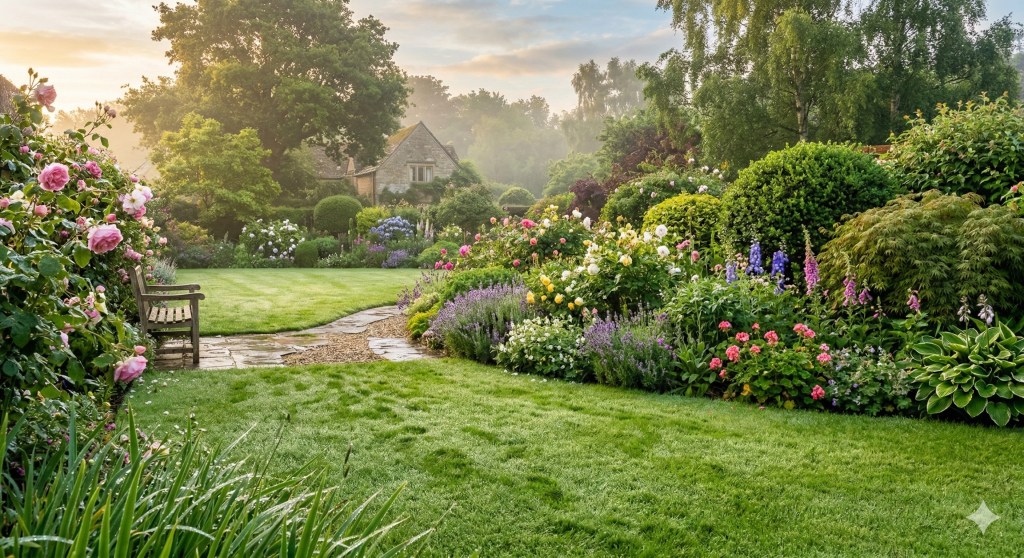
Presented by Zia H Shah MD
Abstract
Quran 2:265 presents a parable (mathal) of sincere giving (inفاق / infāq) “seeking Allah’s pleasure” (ابتغاء مرضات الله / ibtighāʾ marḍāt Allāh) and “inner strengthening/confirmation” (تثبيتًا من أنفسهم / tathbītan min anfusihim). The verse likens such giving to a well-situated garden on elevated ground (جنة بربوة / jannah bi-rabwah) that yields abundantly when struck by heavy rain (وابل / wābil), and still thrives even if only light rain or dew (طلّ / ṭall) reaches it.
This report integrates classical tafsīr (especially al-Ṭabarī, al-Qurṭubī, and Ibn Kathīr), contemporary Sunni-leaning commentary, and modern psychological science to interpret: (a) the verse’s lexical and exegetical architecture, (b) its theology of Providence (qadar/qaḍāʾ, rizq, taʿāwun), (c) psychological mechanisms linking faith, trust, and generosity to cognition, emotion regulation, resilience, and perceived well-being, and (d) the verse’s literary “hydrology” as a map of spiritual states under varying “rainfalls” of life.
Executive Summary
Quran 2:265 sits in a tightly constructed sequence of parables about spending in God’s way: the “grain” that multiplies (2:261), the warning not to nullify charity by reproach or harm (2:262), the depiction of ostentatious giving as dust on rock washed away by rain (2:264), and then—by contrast—the sincere donor as a garden whose yield increases regardless of whether rainfall is abundant or minimal (2:265).
Classical tafsīr converges on two central exegetical claims: (1) tathbītan min anfusihim denotes an inner certainty and steadiness—strengthening resolve and confirming faith in God’s promised recompense—rather than mere calculation or social display; and (2) the “garden on a hill” symbolizes a moral-spiritual substrate so sound that both heavy and light “rain” lead to growth, just as sincere spending is divinely nurtured whether the amount is large or small.
Theologically, the verse articulates Providence as both decree and care: God sets “measure” (qadar) and sufficiency (حسب / ḥasb), expands or restricts provision (rizq), and replaces what is spent, while still holding moral agency meaningful—reward is tied to intention, purity of means, and steadfastness under uncertainty.
Psychologically, contemporary evidence supports a “garden logic”: prosocial spending and kindness interventions show small-to-moderate benefits for well-being (often robust across contexts), and religious/spiritual involvement is, on average, positively associated with life satisfaction—effects that plausibly correlate with internalized meaning, social belonging, and coping resources. The Quranic emphasis on sincerity and inner confirmation aligns strikingly with motivational science distinguishing internalized values from externally pressured behavior.
Exegetical Foundations and Tafsir Synthesis
The verse in Arabic with an anchoring translation
Arabic (2:265):
وَمَثَلُ ٱلَّذِينَ يُنفِقُونَ أَمْوَٰلَهُمُ ٱبْتِغَآءَ مَرْضَاتِ ٱللَّهِ وَتَثْبِيتًۭا مِّنْ أَنفُسِهِمْ كَمَثَلِ جَنَّةٍۭ بِرَبْوَةٍ أَصَابَهَا وَابِلٌۭ فَـَٔاتَتْ أُكُلَهَا ضِعْفَيْنِ فَإِن لَّمْ يُصِبْهَا وَابِلٌۭ فَطَلٌّۭ ۗ وَٱللَّهُ بِمَا تَعْمَلُونَ بَصِيرٌ
A representative English rendering (Quran.com) reads (in essence): those who donate seeking Allah’s pleasure and with inner assurance are like a garden on a fertile hill—heavy rain doubles its yield; if no heavy rain falls, drizzle or even the morning dew suffices; and Allah is Seeing of what you do.
Immediate Qur’anic context: the “parable corridor” of infaq
The verse is best read as the positive counterpart to 2:264: ostentation (رئاء الناس / riʾāʾ al-nās, “showing off”) resembles dust on rock that a downpour strips bare, nullifying reward.
By contrast, the sincere donor in 2:265 is not merely “not destroyed by rain,” but multiplied by it—and even minimal moisture sustains growth.
This follows the earlier multiplication imagery of 2:261 (grain → seven ears → hundred grains).
Key lexemes and what classical tafsir emphasizes
“Inner strengthening / confirmation” (تثبيتًا من أنفسهم / tathbītan min anfusihim)
Al-Ṭabarī reads tathbīt as strengthening resolve, firming intention, and inner certainty—“صدقًا ويقينًا” (truthful confirmation and certitude) in God’s promise of reward—explicitly linking the donor’s inner state to stable action. He reports an alternative view (“they check where to place charity”) but judges it linguistically distant from the Qur’anic wording, returning to the core meaning: inner steadfastness grounded in yaqīn (certainty).
Ibn Kathīr similarly glosses it as being “sure and certain” that Allah will reward the act—an inward confidence that purifies motivation.
In a more “psychology-of-the-heart” register, Abd al-Rahman al-Sa’di explains that charity has two common “diseases”: (a) giving for praise (riyāʾ), and (b) giving reluctantly through inner weakness; the verse portrays donors free of both—giving with an “open, willing self” and stable resolve.
“Garden on elevated ground” (جنة بربوة / jannah bi-rabwah)
Al-Ṭabarī notes rabwah as elevated terrain, semantically linked to rising/increasing (from the root sense “to grow/increase”), and cites early authorities describing it as raised, visible, even ground.
Al-Saʿdī adds an agronomic nuance: elevation exposes the garden to sunlight and airflow, tending toward better fruit—literary realism that doubles as moral symbolism (good “site selection” of the heart).
“Heavy rain” (وابل / wābil) and “dew/light rain” (طلّ / ṭall)
Al-Ṭabarī defines wābil as heavy, large-droplet rain, and ṭall as dew and/or gentle rain; crucially, he draws the moral: God multiplies the charity of the sincere donor—“whether little or much”—just as the garden yields whether rain is plentiful or sparse.
Al-Qurṭubī elaborates lexically: ṭall is “weak rain / fine droplets,” though some interpret it as outright “dew”; either way, it “suffices” such fertile ground. He also records and rejects a proposed syntactic inversion as unnecessary, reinforcing the plain meaning: the garden’s goodness is stable, and so is the growth of sincere charity.
Comparative table of tafsir emphases on Quran 2:265
| Tafsir / approach | Core reading of tathbīt | Image logic (rabwah–rain–yield) | Ethical / spiritual center of gravity |
|---|---|---|---|
| al-Ṭabarī | Strengthening resolve, confirmation through certainty (yaqīn) in God’s promise; rejects “mere checking where to give” as linguistically remote | Rabwah (elevated) + wābil (heavy rain) doubles yield; if no wābil, ṭall (dew/light rain) suffices; analogy: sincere spending grows whether small or large | Interior certainty + unbroken moral causality: charity with purity does not “fail” (no spiritual crop failure) |
| Ibn Kathīr | “Sure and certain” of reward; inward assurance underwrites the act | Garden remains fertile: even light rain suffices; believer’s deeds are accepted and increased | Divine acceptance and multiplication; God’s perfect seeing safeguards justice of recompense |
| al-Qurṭubī | Implicitly: sincerity plus sound intent; stresses lexical precision | ṭall as fine rain or dew; fertile land yields regardless; connects verse to Prophetic reports about God “raising” charity | Integrates legal-ethical lens: promise/threat (waʿd wa waʿīd) in “Allah is Seeing” |
| Abul A’la Maududi | Emphasizes single-minded sincerity in contrast to hypocrisy/ostentation | Heavy rain vs light shower both productive—stable benefit of sincere giving | Moral pedagogy: sincerity produces resilient social good even amid scarcity |
| Muhammad Shafi (Maʿārif al-Qurʾān) | “Believing reward is certain,” reinforcing tathbīt as inner fortification | Parable illustrates acceptable charity: located on raised ground; yield doubles under heavy rain; drizzle still suffices | Practical spirituality: endurance in giving, not mood-dependent benevolence |
| Yasir Qadhi (modern sermon-style reflection) | Stresses sincerity and strategic “investment” in enduring reward; uses parable pedagogically | Treats rainfall as metaphor for varying worldly conditions; good “soil” yields under different scenarios | Contemporary application: cultivate inner sincerity and long-term perspective under uncertainty |
Theological Analysis of Providence in Quran 2:265
Providence as decree and care: qadar, divine agency, human agency
The verse explicitly links spending to an unseen economy of growth: yield is not merely a natural function of rain; it is a sign of God’s nurturing recompense—“Allah is Seeing of what you do.”
This points to a Sunni “both/and”: God’s all-encompassing knowledge and decree (القدر / al-qadar) are real, and moral agency remains meaningful—humans choose acts and intentions that become divinely created “means” (asbāb) through which Providence unfolds.
A useful Qur’anic anchor is 65:3, which pairs tawakkul (reliance) with qadar (measure): “Whoever trusts in Allah—He is sufficient… Allah has set for everything a measure.”
Read back into 2:265, the donor’s tathbīt is not denial of risk; it is willing action undertaken within God’s measured decree, with the heart anchored in sufficiency.
Rizq as provision and replacement: the “economy of barakah”
Providence in the Qur’an frequently frames wealth not as autonomous possession but as a stream God expands or restricts. Quran 34:39 explicitly links spending to replacement (يخلفه / yukhlifuhu): “Whatever you spend, He will compensate [replace] it; He is the Best Provider.”
Quran 2:245 similarly describes God as the One who “contracts and expands” wealth while promising multiplication for the “good loan.”
In scholarly terms, rizq is not only material; it can include non-material benefit (knowledge, faith, stability). A contemporary academic encyclopedia entry summarizes rizq as “everything that is utilized,” including material and spiritual elements, and notes that the Qur’anic concept links divine providence with human effort (kasb).
Within 2:265’s parable, “dew-level” provision can be experienced as subtle openings: sufficiency, contentment, unexpected assistance, or social reciprocity—often overlooked when providence is imagined only as dramatic “downpour.”
Taʿawun and social mercy: Providence has communal “channels”
While 2:265 focuses on personal spending, the Qur’an also frames righteousness as mutual support: “Cooperate with one another in goodness and righteousness” (وتعاونوا على البر والتقوى / wa-taʿāwanū ʿalā al-birr wa al-taqwā).
This matters theologically: Providence often arrives through people—networks of care—so “spending for Allah” is simultaneously worship and social architecture.
Divine justice, mercy, and reward: why the verse ends with “All-Seeing”
The closing clause—“Allah is Seeing of what you do”—functions in classical tafsīr as both promise and warning: the inner truth of giving (sincere vs performative, compassionate vs harmful) is not hidden from God.
This supports divine justice: reward is not merely the visible outcome, but what was intended, and what moral conditions accompanied the act.
Prophetic reports strengthen the same theology of mercy-shaped multiplication:
- “Charity does not decrease wealth” (سahīh Muslim).
- Even a single date from lawful earnings is “accepted” and its reward “grown” by God until it becomes like a mountain (Bukhārī; Muslim).
These narrations resonate with 2:265’s “dew still suffices” claim: what appears small in human accounting can be immense in divine accounting.
Psychological Analysis of Faith, Generosity, and Trust
A psychological translation of tathbīt: internalized motive and stable action
Al-Ṭabarī’s reading of tathbīt as strengthened resolve grounded in certainty (yaqīn) describes a stable motivational state: the donor is not pulled primarily by external applause, nor paralyzed by uncertainty.
In modern motivational science, this resembles internalization—values experienced as self-endorsed rather than externally coerced. Richard M. Ryan and Edward L. Deci describe how autonomy, relatedness, and competence support more integrated motivation and well-being (Self-Determination Theory).
This is not a forced “psychologizing” of tafsīr; rather, it clarifies why ikhlāṣ (sincerity) yields resilience: internally anchored motives fluctuate less with social weather.
Prosocial spending and well-being: “the garden yields” across contexts
Evidence repeatedly finds that giving can benefit the giver’s well-being (not as a moral guarantee, but as a common psychological pattern):
- A widely cited study reports that spending money on others predicted greater happiness in survey and longitudinal designs, and that experimentally instructing participants to spend on others (vs themselves) increased post-spending happiness.
- Cross-cultural evidence using Gallup World Poll data across 136 countries found the giving–well-being link positive in a large majority of countries, suggesting that “hedonic returns” to generosity can appear even in poorer contexts.
- A systematic review and meta-analysis of kindness interventions (27 experimental studies; N≈4045) reports a small-to-medium overall effect of performing kind acts on the actor’s well-being.
The verse’s parable—growth under heavy rain and under dew—has an intriguing empirical echo: generosity’s psychological benefits are often not strictly dependent on abundance (heavy rain), but can emerge under modest conditions (drizzle), especially when giving coheres with identity and values.
Faith, coping, and meaning: how Providence becomes psychologically “legible”
Religion/spirituality can contribute to well-being through multiple pathways: meaning-making frameworks, cognitive reappraisal, community support, and rituals that stabilize identity. Harold G. Koenig reviews research linking religion/spirituality to mental health outcomes and proposes mechanisms, including social connections and opportunities for altruism within religious communities.
Meaning-making is a central mechanism for resilience. Crystal L. Park synthesizes research showing that meaning-making efforts and “meaning made” relate to adjustment after stress, while noting complexities and gaps in empirical testing.
In Qur’anic terms, tawakkul (reliant trust) and yaqīn (certainty) transform ambiguous life events into meaningful tests, opportunities, or mercy—thus reducing chaotic appraisal and supporting endurance.
Control beliefs: locus of control, God-mediated control, and “collaborative trust”
Rather than a simplistic “external locus of control,” many believers operate with collaborative control beliefs: “I act, and God enables/outcomes.” Contemporary research distinguishes locus of control as beliefs about internal vs external causation; a recent review reiterates Rotter’s definition: outcomes perceived as contingent on one’s behavior vs outside forces.
A related construct—God-mediated control—frames God as helping the person influence life outcomes. Longitudinal research examines how such beliefs relate to meaning and optimism and, through them, to self-rated health trajectories. Neal Krause
Interpreted alongside 2:265, “dew-level” providence may be psychologically experienced as strengthened optimism and meaning—quiet inner resources that sustain action when external reinforcement is minimal.
Attachment and trust: “God as secure base” and generosity under scarcity
Attachment-based approaches propose that believers may experience God as a “safe haven” and “secure base,” shaping stress responses and relational behaviors. Empirical work links attachment-to-God styles and God-images to psychological distress patterns under stress.
For Quran 2:265, this suggests a psychological pathway: the more secure the perceived relationship with God (merciful, just, seeing), the more feasible it becomes to give in uncertainty—because the self is less threatened by scarcity.
Islam-specific operationalization: measuring tawakkul
A recent psychometric effort defines tawakkul as belief in God’s sufficiency while exerting positive effort toward goals and accepting outcomes—then develops and validates a tawakkul scale in Muslim samples.
This definition closely parallels the “garden” model: effort is real (cultivation), outcomes are received (rain), and inner acceptance steadies the system when rainfall is light.
Table of selected psychological studies and how they illuminate Quran 2:265
| Study (first author) | Method / sample | Key findings (high-level) | Relevance to 2:265 |
|---|---|---|---|
| Elizabeth W. Dunn (2008) | Survey + longitudinal field design + experiment; experimental participants instructed to spend on others vs self | Prosocial spending predicted higher happiness; experimentally spending on others increased happiness | “Yield doubles” can be psychologically immediate: giving shapes affect and satisfaction even in short windows (a “wābil” moment) |
| Lara B. Aknin (2013 program) | Cross-cultural correlational analyses across 136 countries; additional experimental work in culturally distant contexts | Relationship between donating and subjective well-being positive in most countries; not simply an artifact of national income | Echoes “dew still suffices”: well-being returns to generosity often appear even where external resources are limited |
| Oliver Scott Curry (2018) | Systematic review + meta-analysis of kindness interventions; 27 experimental studies, N≈4045 | Overall effect of kindness on well-being small-to-medium (δ≈0.28) | Suggests a “steady drizzle” effect: repeated small prosocial acts can accumulate modest well-being gains |
| Sean M. Tashjian (2020) | Randomized controlled trial in adolescents (3 conditions: kindness to others, kindness to self, daily report) | Average effects modest; benefits concentrated among youth higher in baseline altruism | Mirrors tafsīr’s focus on inner state: “soil quality” (internal prosocial orientation) moderates yield from the same “rain” |
| David B. Yaden (2022) | Meta-analysis (k=256; N≈666k) of religion/spirituality and life satisfaction | Overall association r≈.18; stronger for spirituality and spiritual experience than mere attendance | Helps differentiate “external rain” (public practice) from “internal moisture” (spiritual experience) in sustaining well-being |
| Julian B. Rotter (framing via later review) | Modern review reiterating locus of control construct (internal vs external) | Control beliefs relate to behavior and health-relevant self-regulation patterns | Clarifies how tawakkul can be “collaborative control,” not helpless fatalism—acting while trusting outcomes to God |
| Muhammad U. Gondal (2022) | Scale development/validation in Muslim adults; defines tawakkul as trust + effort + acceptance | Operationalizes tawakkul as measurable construct in psychological research | Links the verse’s “inner strengthening” to a testable psychological profile conducive to giving under uncertainty |
Literary and Metaphorical Analysis of the Verse’s Imagery
The verse’s “hydrology” and its rhetorical contrast with 2:264
A striking literary feature is that both 2:264 and 2:265 use rain as a decisive agent. In 2:264, the downpour (wābil) strips dust from rock, exposing barrenness—an emblem of performative giving that cannot “hold” reward.
In 2:265, the same natural force increases yield—because the substrate is living, rooted, elevated, and fertile.
Thus, the text implies a principle of spiritual ecology: the same external event can either reveal emptiness or multiply fruit, depending on inner reality—a theme al-Ṭabarī states directly when he links consistent garden yield to consistent acceptance of sincere spending “whether little or much.”
Rabwah, wābil, ṭall: mapping degrees of “rain” to spiritual-psychological states
Classical tafsīr anchors the basic mapping:
- Heavy rain (wābil) = abundant enabling conditions for growth; in spiritual analogy, higher volumes of giving and/or major openings of divine facilitation lead to multiplied yield.
- Light rain/dew (ṭall) = minimal but sufficient nourishment; in spiritual analogy, even smaller giving or smaller external reinforcement yields benefit when the “soil” is sound.
Building on (not replacing) the exegetical baseline, an integrated psychological-theological mapping can be articulated as follows:
Rain as “external reinforcement and visible providence.”
When life gives obvious returns (social gratitude, financial replacement, community support), that resembles wābil. When returns are subtle (quiet contentment, meaning, inner steadiness, one small door opening), that resembles ṭall. The verse teaches that sincerity does not require visible reinforcement to remain generative.
Elevation as “value clarity and inner integration.”
Al-Saʿdī’s agronomic note—sun-exposed elevation yields better fruit—maps well onto the psychological idea of internalized values: clarity of purpose reduces motivational conflict and supports persistence.
A brief rhetorical note on Qur’anic parables
Academic treatments of Qur’anic rhetoric emphasize al-mathal (parable/simile) as a device for concretizing moral realities into sensory images—especially through nature.
Quran 2:265 exemplifies this: the verse does not argue in abstract propositions; it lets the reader see sincerity as elevation, and Providence as rainfall that need not be dramatic to be real.
Practical Implications and Illustrative Vignettes
How inner life and social behavior change when “heavy rain” is absent
Classical tafsīr repeatedly insists that the donor’s “core work” is interior: sincerity (ikhlāṣ), certainty (yaqīn), and freedom from injuring recipients (mann and adhā).
Translating that into practical psychology and social ethics yields several patterns:
Cognitive stance: The believer interprets scarcity not as proof of divine abandonment but as a condition in which reliance and sincerity are tested; Providence may be “dew,” not “downpour.”
Emotional regulation: With tawakkul, anxiety is redirected: one still budgets, plans, and works, yet releases the demand that outcomes appear immediately. (This aligns with modern definitions of tawakkul as trust + effort + acceptance.)
Behavioral consistency: Giving becomes less mood-dependent and less reputation-dependent, resembling “stable irrigation” rather than episodic bursts. Prosocial behavior research suggests this can feed back into well-being via meaning and social connection.
Community-level effects: Even small giving can catalyze taʿāwun: networks of mutual support that become channels through which rizq and mercy flow in both directions.
Illustrative vignettes of Providence with minimal “rain”
The following narratives are embellished illustrations—not historical reports—designed to concretize the verse’s metaphor.
The wābil vignette: the downpour that doubles
A woman donates a significant amount during a fundraising drive, quietly, without announcing it. Within weeks, she receives unexpected work that more than covers what she gave. The “downpour” is not only money returning; it is the sudden easing of fearful rumination—sleep improves, and she becomes more emotionally available to her family. In tafsīr terms, her inner tathbīt held; in psychological terms, her act cohered with values and reduced self-focus, which often predicts improved affect.
The “no heavy rain, only ṭall” vignette: dew that is sufficient
A student with limited funds gives a small, consistent amount weekly—barely noticeable. No dramatic “replacement” arrives; expenses remain tight. Yet he finds that his circle subtly changes: he meets mentors, gains study support, and experiences a steadier sense of meaning. This mirrors the verse’s claim that ṭall suffices a well-situated garden, and parallels evidence that kindness and prosocial habits can yield modest but real well-being benefits, especially through meaning and social connectedness.
The drizzle vignette: intermittent light rain in a long season
A father loses a contract and must cut spending. He still sets aside a modest amount for a neighbor in need, but only “when he can.” The rain is inconsistent; so is his confidence. Over time he notices something: giving becomes a training of the heart. Each act interrupts catastrophic thinking (“we will have nothing”) and replaces it with a more measured appraisal (“Allah has set a measure; I act within it”). Here, drizzle is not romance; it is slow retraining—close to the verse’s tathbīt as strengthened resolve.
The morning-dew vignette: when providence is almost invisible
A volunteer regularly brings food to a shelter yet feels spiritually dry—no emotional uplift, no visible results, little gratitude. One morning, he reads “Allah is Seeing of what you do” and reframes his fatigue: his task is not to manufacture feelings, but to keep the garden alive. The dew is a quiet restoration of intention: he stops scanning for praise and becomes less reactive to being overlooked. This is the verse’s final clause turned into a psychological intervention: the “audience” is God, not people; the sustaining moisture is sincerity itself.
Thematic Epilogue
Quran 2:265 does not promise that every act of giving will be followed by an immediate worldly harvest; rather, it teaches that sincere giving is a living ecology. A garden on a hill is not magically immune to weather; it is positioned, rooted, and receptive—so that whether rain arrives as a storm or as dew, life continues to grow.
Classical tafsīr locates the secret in tathbīt: an inner firmness—certainty, sincerity, and steadiness—that protects the act from the corrosions of ostentation and harm.
Theologically, Providence (qadar and rizq) is not reduced to visible “downpours”: God replaces what is spent and suffices those who rely on Him, often through subtle channels of meaning, community, and unexpected openings.
Psychologically, the verse anticipates what modern research repeatedly suggests: prosocial action and spiritually anchored meaning can cultivate resilience and well-being, though effects are typically modest, context-dependent, and mediated by inner orientation—by the “soil” of the self.
In the end, the verse offers a disciplined hope: do not make your generosity hostage to external signs. When rain is heavy, be grateful and humble; when it is only dew, do not despise it. The garden does not argue with the sky—it opens its leaves to what comes, because it is rooted in a deeper guarantee: Allah is Seeing.
For references go to the Microsoft Word file:



 The Glorious Quran and Science
Leave a comment