
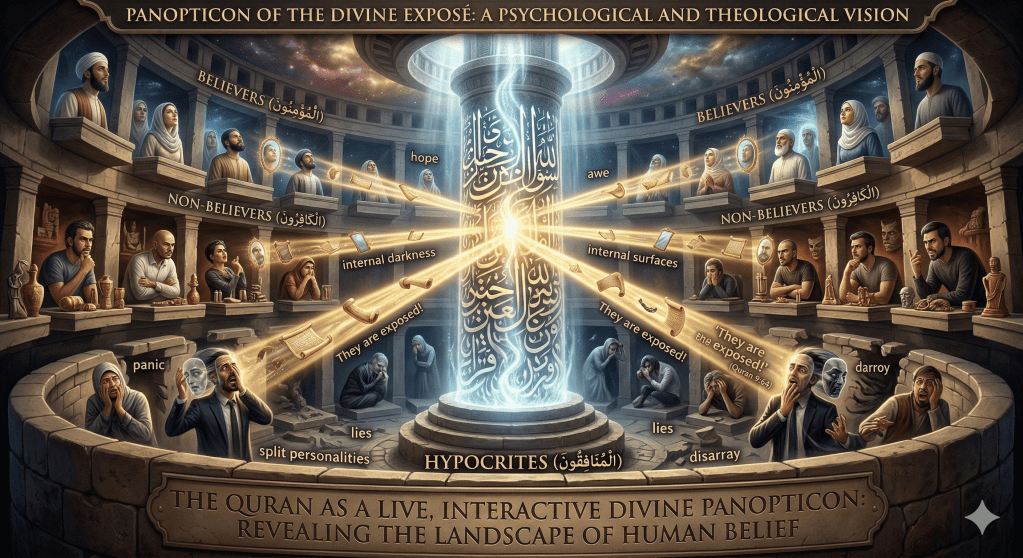
Audio Teaser: The Divine Panopticon of Surah At-Tawbah:
Presented by Zia H Shah MD
Abstract
This research report provides a comprehensive analysis of Quranic verses 9:64-70, situated within the volatile socio-political and psychological climate of the Tabuk expedition (9 AH). Employing a multidimensional framework that integrates classical Islamic exegesis (Tafsir), analytical psychology—specifically the Jungian concept of the persona—and ontological philosophy, the study examines the nature of hypocrisy (nifaq) as both a personal pathology and a communal threat. Central to this analysis is the conceptualization of the Quran not as a static text, but as a “real-time interactive event.” The revelation is shown to have acted as a “divine panopticon,” intimately engaging with the internal states of its immediate audience: the fortified believers, the skeptical non-believers, and the precarious hypocrites. By deconstructing the rhetorical strategies of mockery, the ontological implications of “divine forgetting,” and the macro-historical parallels with civilizations like ‘Ad and Thamud, this report unveils the “mirror effect” of the revelation—a process that forced a radical self-confrontation in the 7th-century Arabian context while offering universal insights into the human condition and the ethics of sincerity.
The Revelatory Event: Surah At-Tawbah as a Real-Time Crucible
The ninth chapter of the Quran, Surah At-Tawbah (The Repentance), stands as a unique monument in the Islamic revelatory corpus, primarily due to the omission of the Basmala (the opening formula of mercy). This absence is not merely a structural anomaly; it is a profound signal of the Surah’s distinct rhetorical atmosphere. Revealed during a period of intense communal strain—the preparations for and aftermath of the Tabuk expedition in 9 AH—these verses function as a surgical intervention into the psyche of a community grappling with internal treachery and external threats. The Surah is characterized by some commentators as Al-Fadihah (The Exposing), because its primary function was to strip away the social masks of those harboring hidden ill-wills.
During the revelation of verses 64-70, the Quran acted as a live participant in the social and psychological landscape of Madinah and the road to the Byzantine frontier. As the Prophet Muhammad (peace be upon him) moved through the city or toward the frontier, the revelation responded instantaneously to the whispers in secret gatherings and the anxieties of those who stayed behind. This interactive quality suggests that the audience did not merely “read” or “hear” the text; they were “read by” it. The believers were fortified, the non-believers were challenged, and the hypocrites were systematically unmasked in a process of “social sifting” (tamhis).
The historical background is critical: one-third of Arabia had come under the sway of Islam, but the rapid expansion brought with it a complex demographic of participants. The Tabuk expedition, occurring during the “hour of difficulty” (sa’at al-‘usrah) characterized by extreme summer heat and drought, served as the ultimate psychological test. It was in this environment that the Quranic discourse 9:64-70 was unleashed, acting as a live mirror that intimately interacted with the fears, hopes, and disbeliefs of every listener.
Psychological Dimensions: The Anatomy of Nifaq and the Fear of Exposure
The Architecture of the Hypocritical Mind (Verse 9:64)
Verse 9:64 initiates this deconstruction with a sharp psychological observation: “The hypocrites fear lest a surah should be revealed concerning them, informing them of what is in their hearts”. This “fear of exposure” constitutes the primary psychological state of the hypocrite (munafiq). Unlike the open disbeliever (kafir), who maintains a coherent, albeit oppositional, identity, the hypocrite lives in a state of perpetual cognitive dissonance.
In the context of 7th-century Madinah, the “hypocrites” were individuals who had outwardly accepted Islam for socio-political or economic advantages but inwardly harbored resentment or doubt. The psychological toll of this double life is immense. They maintained an outward “persona”—a social mask intended to project faith and solidarity—while their inner reality remained tethered to their pre-Islamic allegiances or material anxieties.
The Quranic usage of the term nifaq (from the root nafaqa, meaning a tunnel or an opening) suggests a being that has multiple exits and entrances, never fully present in any single space. This spatial metaphor accurately describes their psychological instability. Despite their intellectual skepticism regarding the Prophet’s divine mission, they had witnessed a decade of revelations that uncannily revealed secret plans and private conversations. Consequently, as the Prophet moved toward Tabuk, their fear was not necessarily of God’s judgment in an abstract hereafter, but of social exposure in the present—the dismantling of the “adaptive mask” they used to navigate the benefits of the Muslim community.
| Psychological Feature | Quranic Manifestation (Nifaq) | Jungian Persona Comparison |
| Source of Identity | Rooted in deceit and strategic bad faith (mala fides). | A necessary psychological tool for social adaptation and role-playing. |
| Integrity Level | Fundamental split between inner intent and outer display. | Potential for split only if over-identified with the mask. |
| Primary Motivation | Fear of social/material loss; survival within a dominant group. | Facilitation of smooth social interactions and professional roles. |
| Effect of Disclosure | Viewed as “The Exposing” (Al-Fadihah), leading to spiritual ruin. | Viewed as a path toward “individuation” or reclaiming the authentic self. |
| Socio-Moral Impact | Morally destructive; corrosive to communal trust and integrity. | Value-neutral unless it eclipses the authentic self. |
The comparative analysis in the table above highlights the divergence between Quranic nifaq and the Jungian “persona.” While Jung recognizes the persona as a functional, often neutral aspect of the healthy psyche—a mediator between the self and society—the Quran treats the hypocritical mask as a “moral-spiritual pathology”. The hypocrite’s mask is not a benign tool for social navigation but a predatory instrument of subversion used to “conceal evil intentions under the guise of virtue”.
Mockery as a Defense Mechanism and Social Sabotage (Verses 9:65-66)
The Quranic response to the hypocrites’ anxiety is a direct challenge: “Say: ‘Mock [as you wish]; indeed, Allah will expose that which you fear’”. This verse identifies mockery (istihza) as the primary defense mechanism of the fragmented psyche. From a psychological perspective, mockery serves to trivialize the sacred and minimize the threat posed by the Truth. By laughing at the Prophet or the “reciters” (qurra, the learned companions), the hypocrites attempted to regain a sense of intellectual and social superiority.
The historical incident surrounding Verse 9:65 provides a vivid example of the Quran’s real-time interaction. During the journey to Tabuk, a man among the hypocrites said in a gathering, “I have never seen anyone with hungrier stomachs, more lying tongues, or more cowardice in battle than these reciters of ours,” referring to the Prophet and his companions. This was not merely an idle joke; it was a targeted psychological strike intended to discourage the believers and sow doubt during a “time of difficulty”.
When the man was informed that his words had been revealed, he rushed to the Prophet, who was already mounted on his camel. The narrator, Abdullah bin Umar, describes a haunting scene: the man was clinging to the saddle-belt of the Prophet’s camel, his legs being battered by stones as he ran, pleading, “O Messenger of Allah! We were only talking idly and joking; we were talking the way riders do to make our traveling easy”. The Prophet did not look at him but simply recited the newly revealed verse: “Was it at Allah, and His Ayat (signs/revelations) and His Messenger that you were mocking?”.
This interaction demonstrates the “live” nature of the revelation. The Quran did not just condemn mockery in the abstract; it intervened in the specific moment of the joke, unmasking the “jesting” (la’ib) as a manifestation of disbelief. The psychological state of “jesting” is here identified as a symptom of a deeper spiritual rot, where the individual is no longer capable of recognizing the gravity of existence or the “Signs of Allah”.
The Point of No Return: Disbelief after Belief
Verse 9:66 issues a final verdict on this defense mechanism: “Make no excuse; you have disbelieved after your [pretense of] belief”. This represents a theological and psychological “point of no return.” The transition from iman (faith) to kufr (disbelief) is shown here to be mediated by the act of mockery. In the Quranic view, the heart is not a static container but a dynamic organ that is “hardened” or “sealed” by habitual lying and deception.
The verse further notes, “If We pardon some of you, We will punish others among you”. This distinction refers to the different levels of culpability within the hypocritical group. Some were “foolish buffoons” who joined in the conversation without deep malice, while others were “criminals” who used mockery as a deliberate tool for social sabotage. This nuanced approach reflects the Quran’s intimate knowledge of the audience’s internal motivations, separating those capable of repentance (tawbah) from those who have fully committed to the “word of disbelief”.
Philosophical Perspectives: Being, Appearing, and the Ontological Void
The Ontology of “Divine Forgetting” (Verse 9:67)
Verse 9:67 presents one of the most striking philosophical propositions in the Quran: “The hypocrites… have forgotten Allah, so He has forgotten them”. This statement demands an ontological investigation. In Islamic philosophy, “forgetfulness” (nisyan) cannot be attributed to the Divine in a literal, cognitive sense, as God is the “Knower of the Unseen” and “All-Aware” (Al-Khabir). Rather, this is a statement of “Divine Abandonment” (I’rad or Tark).
From a philosophical standpoint, God is the “Ground of Being” and the “Ultimate Reality” (Al-Haqq). To “forget” God is to sever one’s connection to the source of objective truth, meaning, and existence. Consequently, for God to “forget” the individual is to leave them in a state of “ontological abandonment,” where they are deprived of divine guidance and mercy, essentially becoming “hollow pieces of timber propped up”.
| Philosophical Concept | Application to the Hypocrite | Resulting Ontological State |
| Nisyan (Forgetting) | Neglect of the Divine commands; obsession with the material “persona.” | Loss of spiritual orientation and internal coherence. |
| I’rad (Abandonment) | Withdrawal of special grace and protection by the Divine. | Abandonment to the consequences of one’s own choices. |
| Fisq (Disobedience) | Departure from the Fitra (natural, intended state). | Existence as a “hollow” form without spiritual substance. |
| Hasb (Sufficiency) | The “Fire” as the only reality left for the soul. | Alignment of the internal state with the external retribution. |
This reciprocal “forgetting” creates a philosophical loop: the more the hypocrite invests in their external, material self, the more they “forget” their spiritual essence. In turn, they are “left” by God to wander blindly in their transgressions, mistaking their material gains for true existence. They exist as physical forms—their bodies may “please” the observer and their speech may be “eloquent”—but they lack the substantial “being” provided by sincere faith.
The Inversion of Values: Ma’ruf and Munkar as Socio-Political Sabotage
The philosophical decadence of the hypocrites is further manifested in their ethical inversion: “They enjoin what is wrong (munkar) and forbid what is right (ma’ruf), and close their hands”. In a healthy society, Ma’ruf (the recognized good) and Munkar (the rejected evil) serve as the anchors of social and spiritual order. The hypocrites, driven by a “shadow self” that resents the success of the believers, actively work to subvert this order.
This is not merely “bad behavior” but a systematic commitment to entropy. By “enjoining what is wrong,” they advocate for social behaviors that weaken the community’s moral fabric. By “forbidding what is right,” they attempt to stifle the growth of the very community that provides them security. Furthermore, by “closing their hands,” they practice economic sabotage, withholding resources from communal obligations like Zakat and Infaq (charity). Philosophically, this represents a commitment to the “void”—a rejection of the generative, creative power of faith in favor of a stagnant, self-centered materialism.
Theological Commentary: Divine Sovereignty and the Lessons of History
The Comparison to Past Civilizations: The Cyclical Burden (Verses 9:69-70)
The theological argument in these verses shifts from the psychological state of the individual to the macro-historical patterns of nations. Verse 9:69 addresses the hypocrites and disbelievers directly: ” like those before you; they were mightier than you in power and more abundant in wealth and children”. This is a challenge to the material arrogance of the Madinan elite, many of whom were wealthy figures like Abd Allah bin Ubayy, who used their status to exert influence.
The Quran introduces the critical concept of the Khalaq (portion or share). The people of the past “enjoyed their portion,” and the current generation is doing the same, following a “hand-span by hand-span” path toward the same destruction. Theologically, this suggests a “cyclical history” where human nature remains constant across eras. The material success of a civilization—its “great buildings,” “huge castles,” and “gardens and springs”—is shown to be no protection against the consequences of moral decay.
Verse 9:70 explicitly lists these predecessors: the people of Noah, ‘Ad, Thamud, the people of Abraham, the dwellers of Madyan, and the “overturned cities”. The inclusion of Thamud is particularly poignant in the context of the Tabuk expedition. As the Muslim army marched toward the Byzantine frontier, they passed through Al-Hijr (Mada’in Salih), where the rock-hewn dwellings and massive tombs of the Thamud still stood.
| Civilization | Material Achievement | Primary Sin | Mode of Destruction |
| People of Noah | Early post-flood survival and growth. | Arrogance and rejection of the Prophet. | The Flood. |
| ‘Ad | Built great structures/castles; masters of power. | Arrogance and rejection of Prophet Hud. | A violent wind/storm. |
| Thamud | Carved houses into mountains; advanced technology. | Social stratification and rejection of Salih. | A thunderous blast. |
| People of Abraham | Established urban social order. | Idolatry and rejection of truth. | Social displacement. |
| Madyan | Thriving commerce and trade centers. | Economic corruption and rejecting Shu’ayb. | An earthquake/blast. |
| Overturned Cities | Urban centers (Sodom and Gomorrah). | Moral transgression and perversion. | Being overturned/shaken. |
The historical record suggests the Prophet commanded the companions to pass through these ruins with weeping and reflection, reinforcing the idea that these stones were a “live” lesson in the transience of worldly power. The “overturned cities” (Al-Mu’tafikat) refer to the cities of Sodom and Gomorrah, further emphasizing that when a society’s moral orientation is “overturned,” its physical reality follows.
Theological justice is reaffirmed in the closing of Verse 9:70: “Allah would never have wronged them, but they were wronging themselves”. This encapsulates the principle of free will. The destruction of these nations was not an act of divine caprice but the inevitable outcome of a “clash of wills”—human greed and arrogance colliding with the immutable moral laws of the Creator.
The Promise of Hell and the Divine Curse (Verse 9:68)
Verse 9:68 promises the hypocrites—men and women alike—and the disbelievers the “fire of Hell,” describing it with the chilling phrase “it is sufficient for them” (hiya hasbuhum). Theologically, “sufficiency” implies a perfect calibration between the crime and the punishment. If the hypocrites’ entire existence was built on the pursuit of the “lowly life” (ad-dunya) and the preservation of a false persona, then the loss of that mask and the confrontation with the “Fire” is the ultimate, inescapable reality.
The “curse” (la’nah) of Allah mentioned in this verse signifies a total expulsion from Divine Mercy. In the “Information Universe of Allah,” where everything is recorded and known, the hypocrite’s attempt to hide their secrets is shown to be fundamentally impossible; the very “information” they feared would be revealed (Verse 9:64) becomes the basis of their eternal retribution.
Real-Time Interaction: The Quran as a Live Mirror for the Audience
The Believers: Fortification through Revelation
For the sincere believers (mu’minun), these verses served as a profound confirmation of their faith and a warning against complacency. Seeing the Quran accurately describe the whispered conversations of the hypocrites reinforced the Prophet’s authority. The Tabuk expedition was a “test of Muslims” to reveal the true intentions of the Prophet’s companions.
The drama of Tabuk tested the believers’ willingness to sacrifice their “wealth and lives” in the heat of summer. For those who hesitated, like the “Three who stayed behind” (Ka’b bin Malik and his companions), the Surah’s interactive nature was agonizing; they were socially boycotted for fifty days until their repentance was accepted by a further revelation (Verse 9:118). This demonstrates that the Quran was not just providing instructions but was actively managing the social and spiritual boundaries of the community in real time.
The Non-Believers and Hypocrites: The Pressure of the Panopticon
For the non-believers and the hypocrites, the revelation created a “Panopticon effect”—the sense of being constantly watched and analyzed by an invisible, all-knowing Observer. The incident of the man “clinging to the saddle-belt” while pleading that he was “only joking” vividily illustrates the physical and psychological pressure these verses exerted.
The Quran’s “binary” style—stating “there is God or there is not God… truth and falsehood, the believer and the unbeliever”—left the audience with no middle ground. It forced the hypocrites to either repent sincerely or double down on their deceit, leading to their eventual “ontological hardening.” The revelation was not just a message; it was a “hot document” that dissected their psychology as the events unfolded.
The Role of Body Language and Kinesthetic Cues
Research into the “kinesthetic interpretation” of the Quran reveals that the text often uses non-verbal communication to convey its message. In the context of 9:64-70, the Quran speaks to the physical manifestations of the audience’s internal states. The “color of face,” “widened eyes with shock and fear,” and the “smile and laughter” of mockery are all addressed.
When Verse 9:64 says “Allah will bring forth what you fear,” it refers to the physiological and social exposure of their secrets. The hypocrites were “handsome men” who “dressed well” and had “fine equipage,” using their exterior to win confidence. The Quranic discourse actively dismantled this aesthetic facade, calling them “worthless hollow pieces of timber”. This linguistic imagery interacted with the audience’s sensory perception of one another, forcing the believers to see the “rotten timber” beneath the “fine exterior”.
| Group | Hope Interacted With | Fear Interacted With | Disbelief Interacted With |
| Believers | Hope for Divine support and eternal gardens (v. 72). | Fear of failure and losing the Prophet’s favor. | Fortified against the whispers of the shirkers. |
| Hypocrites | Hope for material gain (khalaq) and social standing. | Fear of exposure (Al-Fadihah) and social boycott. | Disbelief unmasked as a “word of kufr” through mockery. |
| Non-Believers | Hope for the defeat of the Muslim mission at Tabuk. | Fear of the “ultimatum” and historical retribution. | Challenged by the parallels to ‘Ad and Thamud. |
The Human Factor and Interactional Discourse
The “human factor” is central to this interactive revelation. As noted in contemporary “humanist hermeneutics,” the content of the Quran is ineluctably influenced by the historical context, including the Prophet’s personal feelings and the community’s experiences. The discourse of Surah At-Tawbah is a “series of communicative sequences” where God, through the Messenger, engages in a constant dialogue with the people.
This interaction is not limited to verbal exchange. Every text is an “ongoing activity of dialogue” that touches the “core of affairs and the details of lives”. The Tabuk expedition provided the “reasons and motivations” for this dialogue. The heat, the long road, the ripening dates in Madinah, and the looming threat of the Roman army were all “silent participants” in the revelation of 9:64-70. The Quran’s ability to “settle in life” and remain “dialogically connected” is what allowed it to influence the audience’s will to speak or to remain silent.
The practice of “Quran journaling” or tadabbur (contemplation) in contemporary times is a continuation of this interactive process. Just as the 7th-century audience “filled in the gaps” through their life experiences, modern readers interact with the text’s “binary” choices, seeking to align their “authentic self” with the Divine. The “Information Universe” of the Quran remains open, inviting each generation to a “deeper contemplation” of the signs of the Creator.
Thematic Epilogue: The Eternal Mirror
The commentary on Quran 9:64-70 reveals a document that is fundamentally “alive.” Its power during the Tabuk expedition lay in its ability to penetrate the “persona” and address the “authentic self”—or the lack thereof—within each individual. It acted as a divine mirror, reflecting the internal conflicts of a community at its most critical juncture.
The theological themes of divine omniscience and justice, the psychological insights into hypocrisy and mockery, and the philosophical inquiries into cyclical history and ontological abandonment coalesce to form a coherent warning: the “lowly life” of material success and social masks is a transient illusion. The “portion” (khalaq) enjoyed by ‘Ad and Thamud ended in the dust, just as the “idle talk” of the Madinan hypocrites ended in spiritual ruin.
For the contemporary reader, the “interaction” continues. The Quran still poses the same questions to its audience: Are you enjoining the good or the evil? Are you “forgetting” the Divine in favor of the material? The “Exposing Surah” remains an active force, unmasking the hypocrisies of every age and inviting the “clash of hearts” toward a final reconciliation with the Truth. In the end, as it was in Tabuk, the only refuge from the “exposure” of the Divine is the “mercy” of the Divine. The “Divine Panopticon” does not merely watch; it invites the soul to strip away its masks and embrace the “pleasant dwellings” of sincerity.


 The Glorious Quran and Science
Leave a comment