
Presented by Zia H Shah MD
Audio teaser:
Abstract
This research report evaluates the structural and ontological parallels between the biological mechanisms of life and the linguistic architecture of the Arabic language as a primary exhibit for the paradigm of “Guided Evolution.” By synthesizing the extensive writings of Zia H. Shah MD with contemporary molecular biology, generative linguistics, and classical philology, the analysis demonstrates that the universe is governed by two interconnected and functionally analogous codes: a four-lettered chemical code (DNA) used to construct the biological hardware of approximately 9 million extant species, and a three-lettered trilateral root system (Arabic) that serves as a sophisticated linguistic software for divine guidance. The report explores the concept of “Guided Evolution” as proposed by Shah, arguing that the transition from blind, random processes to purposive design is evident in the universality of the genetic code and the mathematical precision of Semitic morphology. Through a detailed examination of Quranic verses, specifically Surah Ar-Rum 30:22, the study illustrates how the diversity of tongues and colors serves as a divine sign for those with knowledge. Ultimately, the report posits that the Arabic language is not a product of random linguistic drift but a premeditated tool for guidance, optimized for human cognition and resistant to the entropy of time. Incorporating the perspectives of prominent linguists like Noam Chomsky, Steven Pinker, and Guy Deutscher, the analysis highlights the “mystery” of language origins as a point of convergence where scientific inquiry meets theological reflection.
The Convergence of Biological Hardware and Linguistic Software
The fundamental premise of Zia H. Shah MD’s work is that the “Book of Nature” and the “Book of Scripture” are two emanations of the same unified Truth. Since the same God authored both the cosmos and the Quran, there can be no genuine contradiction between established scientific reality and divine revelation. Shah revitalizes the classical “Two Books” paradigm by suggesting that modern discoveries in genomics and linguistics are not merely secular data points but āyāt (signs) that demand deep theological reflection.
Central to this discourse is the distinction between biological “hardware”—the physical substrate of life encoded in DNA—and linguistic “software”—the cognitive faculty of language that allows humans to process abstract thought and receive divine guidance. While standard evolutionary narratives characterize these systems as products of blind, unguided selection, Shah argues that the sheer mathematical elegance and functional optimization of these codes suggest a “Guiding Hand”. This report evaluates the evidence for this guidance by looking at the specific architectures of the genome and the Arabic language.
The Genomic Hardware: Deconstructing the Script of Life
The foundation of all biological existence rests upon a remarkably compact and universal information system. Modern molecular biology has revealed that the DNA code of life is virtually universal, sharing a profound family connection written in the molecules of every organism. This commonality is not merely a shared blueprint but a common language that defines the very essence of biological hardware.
The Four-Letter Alphabet of Existence
The hereditary material for virtually all organisms, deoxyribonucleic acid (DNA), is composed of the same four chemical bases: Adenine ($A$), Thymine ($T$), Cytosine ($C$), and Guanine ($G$). This four-letter code serves as the fundamental alphabet of life. Zia H. Shah MD observes that there is no separate DNA for dogs and a different DNA for daisies; life’s blueprint is written in a common language. The complexity of the biological world, spanning approximately 9 million extant species, is generated through the varied arrangements of these four nucleotides.
The universality of this code is a primary exhibit for common ancestry. For instance, the DNA sequence $ATG$ encodes the amino acid methionine across the biological spectrum, whether in a human, a mushroom, or a blue whale. This suggests that life did not emerge through multiple, disparate origins but through a singular, guided process that utilized a unified coding system to generate the vast diversity observed today.
The Three-Letter Codon: Biological Semantics
While the DNA alphabet consists of four letters, the “words” of the genetic code are composed of three-letter sequences known as codons. Zia H. Shah MD emphasizes that these three-letter words are the same in every creature: for example, $CGA$ consistently translates to arginine and $GCG$ to alanine in bats, beetles, beech trees, and bacteria. This three-letter structure represents the most efficient method for encoding the twenty amino acids necessary for life, as a two-letter system would only provide $4^2 = 16$ combinations, whereas the three-letter system provides $4^3 = 64$ combinations, allowing for redundancy and error-correction.
The existence of this three-letter coding unit in the biological hardware of all species serves as a striking precursor to the three-letter root system found in the linguistic software of the Arabic language. Shah argues that wherever you go in the world, whatever animal, plant, or microbe you look at, if it is alive, it will use the same dictionary and know the same code; all life is one.
| Molecular Exhibit | Description and Significance | Zia H. Shah MD Perspective |
| Universality of Genetic Code | The same 64 codons translate to the same 20 amino acids across all domains. | Suggests a single origin and a unified Creator. |
| Cytochrome C Sequences | Essential protein for respiration with minimal variation between humans and chimps. | Reflects deep evolutionary connections among diverse forms. |
| Pseudogenes | “Genetic fossils” present in similar locations in the genomes of different species. | Definitive proof of common ancestry through shared “scars.” |
| Endogenous Retroviruses (ERVs) | Ancient viral integrations co-opted for functions like the placenta and brain. | Evidence of purposive direction (“Guided Evolution”). |
| Molecular Clocks | DNA mutation rates used to estimate divergence times. | Provides insights into the historical “Habit of God.” |
Molecular Evidence for Guided Evolution
Zia H. Shah MD asserts that the most compelling evidence for evolution does not reside in the fossil record—which can be fragmentary and subject to interpretation—but in the definitive data of molecular biology and genomic mapping. He highlights several “smoking guns” that indicate common ancestry is a “fool-proof” reality, but one that is directed by divine providence rather than blind chance.
Genomic Scars and the Evidence of Descent
The human genome contains millions of sequences that do not code for proteins, once termed “junk DNA.” Among these are pseudogenes—genetic sequences that resemble functional genes but have been inactivated by mutations. Shah points to the GULO gene, responsible for Vitamin C synthesis, as a prime example. In most mammals, this gene is functional. However, in humans and chimpanzees, the gene is present but carries the same “genetic scar”—the same disabling mutation in the same location. This shared error can only be logically explained by descent from a common ancestor who first incurred the mutation.
Creativity from Viruses: The Role of HERVs
A major component of Shah’s “Guided Evolution” framework involves Human Endogenous Retroviruses (HERVs). These are remnants of ancient viral infections that became integrated into the germ cells of ancestors and were passed down through generations. Approximately 8% to 10% of the human genome consists of these viral remnants.
Rather than being useless debris, Shah highlights how these viruses acted as “architects” for the human placenta and brain. For example, the protein Syncytin-1, essential for the formation of the placental barrier, is encoded by a gene captured from a retroviral envelope. Similarly, the Arc gene, which is critical for long-term memory in the human brain, utilizes a viral-like capsid structure to transport neural messages. Shah argues that such “co-option” of external genetic material for complex biological innovation is highly suggestive of purposive direction rather than accidental mutation.
The Mystery of Language: Linguists and the Case for Discontinuity
While biological evolution provides a framework for the physical “hardware,” the origin of human language—the “software” of cognition—remains what Robert Berwick and Noam Chomsky call a “mystery” and a “whodunnit”. Standard Darwinian gradualism often fails to account for the sudden emergence of a faculty that distinguishes humans from all other animals.
The Chomskyan Revolution and the “Merge” Operation
Noam Chomsky, arguably the world’s most influential linguist, argues that language is an innate biological capacity shared by all humans, characterized by “discrete infinity”—the ability to combine a finite set of rules and words into an infinite number of complex structures. Chomsky and Berwick propose that a single, simple computational operation they call “Merge” appeared suddenly in our ancestors roughly 100,000 years ago.
In Why Only Us, Berwick and Chomsky state:
“The human language faculty is a species-specific property, with no known group differences and little variation. There are no significant analogues or homologues to the human language faculty in other species.”
This “discontinuity theory” suggests that language did not evolve by “creeps” but rather by “jerks”—a rapid mutation that endowed a small group with a completely new cognitive architecture. Shah frames this “Great Leap Forward” as a divine intervention, where the biological vessel was finally prepared to receive the “software” of language.
The Language Instinct and the Hard-Wiring of the Mind
Steven Pinker, in The Language Instinct, popularizes the idea that humans are “hard-wired” for language. Pinker argues:
“Humans are so innately hardwired for language that they can no more suppress their ability to learn and use language than they can suppress the instinct to pull a hand back from a hot surface.”
Pinker highlights the “astronomical precision” of linguistic rules, noting that infants master complex sound systems and syntax within a few years without formal instruction. He describes language as “one of the wonders of the natural world,” allowing humans to “shape events in each other’s brains with exquisite precision”. Shah interprets this “hard-wiring” as evidence of a premeditated design, where the “software” of communication was installed into the biological “hardware” of the brain at a specific point in evolutionary history.
The Linguistic Software: Arabic as a Revealed Blueprint
If the universal genetic code is the hardware script of life, Zia H. Shah MD argues that the Arabic language represents the pinnacle of linguistic “software”—a system characterized by mathematical regularity and semantic efficiency that suggests it was revealed as a complete tool for guidance.
The Trilateral Root (Jidhr) Architecture
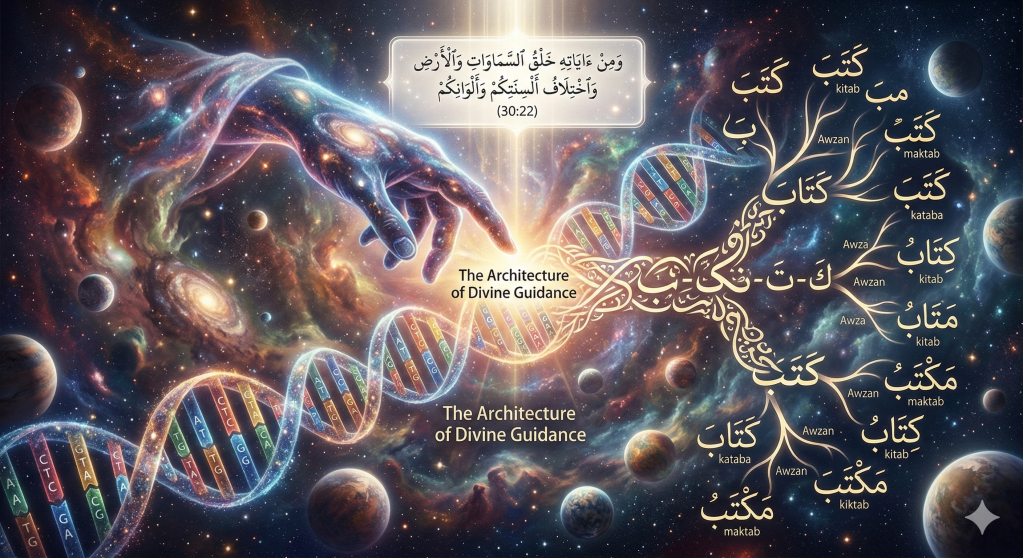
At the core of the Arabic language is the triconsonantal root system, a method of organization that Shah describes as a “verbal miracle” and a “genetic blueprint”. Every Arabic word is derived from a three-letter root (the jidhr) that carries a fundamental, abstract meaning. For example, the root $K-T-B$ carries the core concept of “writing.” From this single root, a vast family of words is generated through predictable templates:
- Kataba: He wrote (Form I – Basic action)
- Kattaba: He made someone write (Form II – Causative)
- Kitāb: A book (The object of writing)
- Maktūb: Written / Destiny (The passive state)
- Maktab: An office / Desk (The place of writing)
This system ensures that even complex theological and legal terms remain tethered to their original logical foundation, preventing semantic drift over centuries. Shah notes that this three-consonant structure mirrors the three-letter codons in the genetic code, suggesting a unified architectural intent.
Mathematical Nuance and the 10 Verb Forms
The Arabic language utilizes a system of “patterns” or “templates” (awzān) into which the roots are placed. By applying a specific pattern, a speaker can alter the meaning of a root in a way that is mathematically predictable and logically consistent across the entire language.
Computational analysis models this as a system of linear functions:
$$f(x) = ax + b$$
where the root $x$ is the constant, and the template (the added vowels and prefixes) acts as the functional operator.
| Form | Template | Meaning Nuance | Example (Root: K-T-B) |
| I | Fa’ala | Basic or default action | Kataba (He wrote) |
| II | Fa’’ala | Intensive / Causative | Kattaba (He taught / made to write) |
| III | Fā’ala | Reciprocity / Direction | Kātaba (He corresponded with) |
| IV | Af’ala | Causative / Transitive | Aktaba (He dictated) |
| VI | Tafā’ala | Mutuality / Reciprocity | Takātabū (They corresponded with each other) |
| X | Istaf’ala | Seeking or Estimation | Istaktaba (He asked someone to write) |
Shah argues that such a system of “astronomical precision” is unlikely to have emerged through random linguistic drift. If language had evolved purely through blind cultural adaptation, we would expect a high degree of entropy—irregular verb forms, disconnected nominal categories, and a lack of systematic semantic continuity. Instead, Classical Arabic demonstrates a “sudden perfection” that challenges secular models of linear evolution.
Arabic as a Revealed Sign: The Case for Sudden Perfection
The history of languages typically shows a trajectory from complexity to simplification—a process of “morphological decay” or “devolution”. Zia H. Shah MD, referencing the views of early orientalists and Muslim scholars, argues that Classical Arabic is unique in its resistance to this entropy.
The Testimonials of Renan and Massignon
French orientalist Ernest Renan, in his History of Semitic Languages, remarked on the “miraculous” appearance of Arabic:
“The Arabic language is unknown at first, but it suddenly appeared so perfectly that it has not undergone the slightest modification to this day, as it has neither a childhood nor old age.”
Renan observed that unlike other languages that undergo various developmental stages, Arabic emerged “mature from the outset,” fluid, rich, and complete. Similarly, Louis Massignon described Arabic’s brevity as a “linguistic miracle,” noting that its “concise linguistic structure allowed focus and control” in fields ranging from physics and mathematics to the secrets of the human soul.
Shah posits that this “sudden perfection” is a primary logical indicator of premeditation. If languages naturally lose complexity over time, the most organized and complex language must be the progenitor—the “mother of all languages” revealed to humanity at the peak of their cognitive readiness.
The Structural Preservation of the Quranic Text
The Arabic root system acts as a “hard-wired” safeguard for the preservation of divine revelation. Because every derivative is tethered to a triconsonantal root, the semantic core of a word remains stable across generations. Zia H. Shah MD argues that this makes Arabic the ideal vehicle for a final guidance meant to resist the “entropy of time”.
As the Quran states:
“An Arabic Quran, without any crookedness, that they might be righteous.” (Az-Zumar 39:28)
The “lack of crookedness” is interpreted by Shah not only as a theological claim but as a linguistic fact: the system of I’rab (case inflection) and trilateral roots ensures a level of clarity that prevents the ambiguity common in human conventions.
Quranic Foundations: Languages as a Sign of Guided Evolution
Zia H. Shah MD places the study of linguistics and genomics directly within the Quranic mandate to reflect upon the āyāt (signs) of God.
The Diversity of Tongues and Colors (30:22)
One of the most profound verses in this regard is found in Surah Ar-Rum:
وَمِنْ ءَايَـٰتِهِۦ خَلْقُ ٱلسَّمَـٰوَٰتِ وَٱلْأَرْضِ وَٱخْتِلَـٰفُ أَلْسِنَتِكُمْ وَأَلْوَٰنِكُمْ ۚ إِنَّ فِى ذَٰلِكَ لَـَٔايَـٰتٍۢ لِّلْعَـٰلِمِينَ “And of His signs is the creation of the heavens and the earth, and the diversity of your languages and colours. Surely in this are signs for those of sound knowledge.” (30:22)
Shah notes the striking linkage between “tongues” (languages) and “colors” (physical/genetic traits). Modern genetics and historical linguistics have shown that the same historical divisions and geographical isolations that caused genetic diversification are the same processes that caused linguistic diversification.
The term ikhtilaf (diversity) implies a process of variation from a common origin. For Shah, this verse is a Quranic endorsement of common ancestry, framing the divergence of human populations—both biologically and linguistically—as a divinely orchestrated dispersion.
The Gift of Bayan: Revelation as Cognitive Software
In Surah Al-Rahman, the Quran describes the endowment of language:
الرَّحْمَٰنُ عَلَّمَ الْقُرْآنَ خَلَقَ الْإِنسَانَ عَلَّمَهُ الْبَيَانَ “The Lord of Mercy taught the Qur’an. He created man and taught him plain speech.” (55:1-4)
Zia H. Shah MD highlights that the capacity for Bayan (plain speech) is framed as a divine gift that followed the physical creation of the species. This aligns with the “sudden emergence” of the language faculty noted by Berwick and Chomsky. Language is not merely a social convention but a divinely bestowed “software” that enables humans to navigate abstract concepts and recognize their Creator.
Comparative Synthesis: Genomic Hardware vs. Linguistic Software
To visualize the architectural parallels between biological life and human communication, we can compare the underlying codes of DNA and Arabic as presented in Shah’s research.
| Attribute | Genomic Hardware (DNA) | Linguistic Software (Arabic) |
| Basic Units | 4 Chemical Bases ($A, T, C, G$) | 28 Phonetic Consonants |
| Functional “Word” | 3-Letter Codon | 3-Letter Trilateral Root (Jidhr) |
| System Logic | Universal Genetic Code | Mathematical templates (Awzān) |
| Optimization | Redundancy for error-correction | Roots for semantic stability |
| Evolutionary Path | Guided co-option (ERVs/Pseudogenes) | Sudden perfection (Renan’s mystery) |
| Role in Life | Building the biological vessel | Conveying abstract divine guidance |
| Source of Intent | Premeditated biological script | Premeditated linguistic software |
This synthesis suggests a unified architectural intent. The same Source that optimized the DNA codon to generate 9 million species with just four chemical bases also optimized the Arabic root system to generate an infinite world of meaning with just twenty-eight letters. Both systems utilize discrete, digital-like units organized into three-letter functional units, ensuring maximum efficiency and minimal entropy.
The Epistemological Status of Guided Evolution
Zia H. Shah MD distinguishes his model of “Guided Evolution” from both atheistic Darwinism and traditional creationism. While figures like Zakir Naik reject common ancestry as an “unproven hypothesis,” Shah argues that such a position is a “strategic failure” that ignores the overwhelming molecular evidence. He emphasizes that the genetic similarity between humans and primates is evidenced by shared “genetic scars” and “broken genes” that only common descent can explain.
However, Shah diverges from standard Neo-Darwinism by rejecting the “blind watchmaker” thesis. He argues that the emergence of complex life, consciousness, and the sophisticated linguistic organs of the human body cannot be attributed to accidental mutations alone. Instead, he proposes that the evolutionary process is “guided” through the inherent laws of nature and the integration of information into the genome—a process he terms the “Habit of God”.
Quantum Physics and the Interface of Guidance
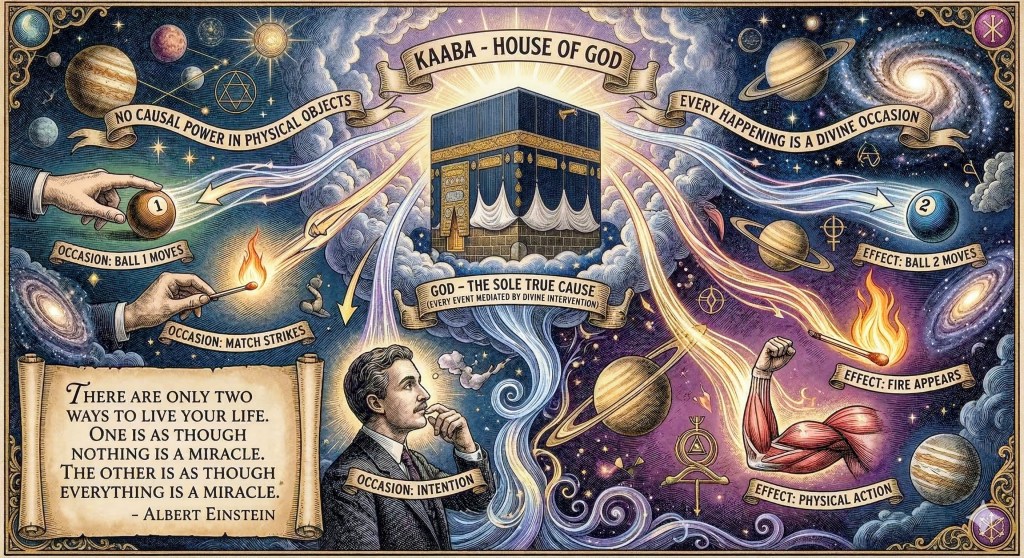
In a more speculative dimension of his work, Shah explores how divine guidance might interface with the material world without breaking the laws of physics. He suggests that quantum indeterminacy provides the necessary “interface” for occasionalism. Since physics can only predict probabilities at the quantum level, Shah posits that theology identifies what we call “randomness” as the sovereign choice of God. Thus, God determines the outcome of specific quantum events—such as a single mutation—to guide the trajectory of evolution over billions of years.
Thematic Epilogue: A Comprehensive Vision of Harmony
The evaluation of the Arabic language and the universal genetic code reveals a system of “astronomical precision” that mirrors the unity and order found in the physical heavens. From the trilateral root to the mathematical templates of its verbs, every facet of Arabic points toward a premeditated design intended to facilitate human understanding. This design is not an end in itself but a means to achieve the Quran’s primary goal: “that you might understand” (12:2).
By providing a “clear Arabic language” that is “without any deviance” (39:28), the Creator provided humanity with a medium for guidance that is resistant to the “entropy of time” and the “ambiguity of human convention”. Arabic stands as a confirming sign—a linguistic miracle that serves as the ultimate proof that the Source of the message is also the Architect of the tongue.
The “Guided Evolution” paradigm offered by Zia H. Shah MD bridges the gap between science and faith. It accepts the biological facts of common ancestry and genomic history while maintaining a strictly theistic framework. It views the molecular evidence—from HERVs in the placenta to the shared GULO pseudogene—not as accidents of nature, but as the molecular signature of the Creator.
Ultimately, this research suggests that human existence is not a product of a mindless scramble for survival, but a purposeful journey guided by Providence. The beauty of the butterfly, the twinkling of the firefly, and the exquisite precision of the Arabic verb all serve as signs (āyāt) for “those of sound knowledge”. For the believer who embraces this harmonious vision, the study of a cell under a microscope becomes a form of worship, and the analysis of a triliteral root becomes a path to recognizing the Infinite Wisdom of the Lord of the Worlds.
As we look to the future, the convergence of genomic “hardware” and linguistic “software” provides a robust intellectual framework for the modern age—one that honors the rigors of scientific inquiry while celebrating the depth of spiritual revelation. It affirms that we are a species created through a process that is “guided,” not “blind,” and that our capacity for language is the ultimate bridge between the biological earth and the divine heaven.



 The Glorious Quran and Science
Leave a comment