
Presented by Zia H Shah MD
Audio teaser: DNA Codons Mirror Arabic Roots
Abstract
The origin of human language remains the most significant unresolved challenge in evolutionary biology and linguistics, characterized by a profound “poverty of evidence” that complicates any narrative of blind, incremental development. This research report evaluates the structural and ontological parallels between the biological mechanisms of life and the linguistic architecture of the Arabic language, presenting a comprehensive case for “Guided Evolution” as proposed by Zia H Shah MD. By synthesizing molecular biology—specifically the universality of the genetic code and the role of endogenous retroviruses—with the mathematical precision of the Arabic trilateral root system, the analysis demonstrates that both systems function as premeditated codes engineered by a prior consciousness. The report provides an unapologetic defense of Arabic as a divinely revealed language, whether as the primordial tongue or a refined Semitic descendant, citing its resistance to linguistic entropy and its unique “textural efficiency”. Through a comparative analysis, the disconnect between nouns and verbs in analytic languages like English is contrasted with the morphological cohesion of Arabic, where the ten primary verb forms represent a sophisticated “operating system” for human thought. Furthermore, the report asserts that empirical linguistic data reveals only devolution—the loss of structural complexity over time—rather than the blind evolution toward higher organization. Ultimately, the analysis invites both Arab and non-Arab Muslims to experience the Quranic text through linguistic tools as a means of grasping the divine origin of communication.
The Enigma of Language Origins and the Poverty of Evidence
The inquiry into the origins of language has historically been fraught with such speculation that the Société de Linguistique de Paris famously banned its discussion in 1866. In the modern era, despite an explosion of research, the fundamental questions regarding how and why human linguistic computations evolved remain “as mysterious as ever”. Secular models of incremental, blind evolution struggle to account for the “Continuity Paradox”—the total absence of an identifiable bridge between animal communication systems and the recursive, abstract faculty of human language.
Current biological and archaeological evidence fails to inform our understanding of the linguistic representations of our earliest ancestors. Studies of nonhuman animals, including primates and birds, provide virtually no relevant parallels to the underlying human biological capacity for language. This “poverty of evidence” suggests that the faculty of language did not emerge through a series of random, accidental mutations but rather as a distinct, purposeful leap in the human lineage. Zia H Shah MD argues that this cognitive singularity points toward a “Guided Evolution,” where the transition from simple signaling to complex symbolic language was divinely orchestrated.
Guided Evolution: A Synthesis of Science and Revelation
The concept of “Guided Evolution” represents a middle path in contemporary Muslim discourse, reconciling the scientific consensus on common ancestry with the core tenets of Islamic monotheism. This model, championed by Zia H Shah MD, posits that evolution is the “method by which a wise Creator unfolds life’s tapestry”—gradually, majestically, and with purpose. Rather than viewing natural selection as a blind process, Shah frames it as the “Habit of God” (Sunnat Allah), where the laws of nature act as instruments of divine will.
Biological Precedents for Guidance
The strongest evidence for this guided process is found in the “definitive data” of molecular biology. Shah highlights the role of Human Endogenous Retroviruses (ERVs) as architects of the human genome. Once considered “junk DNA,” these viral sequences were co-opted to play essential roles in the development of the human placenta and brain. Such “viral co-option” and the resulting complexity are suggestive of purposive direction rather than random drift. This biological “hardware” setup provides a template for understanding the “software” of human language.
The Two Books Paradigm
The “Guided Evolution” framework operates on a “Two Books” paradigm—the harmony of Scripture and Nature. Scientific inquiry is viewed as a form of exegesis, a systematic “reading” of the divine signs present in the structure of an atom, the expansion of the universe, or the complexity of the genetic code. In this view, the Arabic language is not merely a vehicle for communication but a primary exhibit of divine guidance, optimized for human cognition and resistant to the entropy of time.
| Feature | Secular Evolution | Guided Evolution (Shah) |
| Primary Driver | Random mutation/Natural selection | Divine volition/Laws of biology as “Habits” |
| Information Source | Blind genetic drift | Premeditated blueprint/Divine software |
| Teleology | No inherent purpose or goal | Unfolding toward consciousness and guidance |
| Language Origin | Social convention/incremental drift | Divinely taught/Revealed faculty |
| Complexity Trend | Blindly increasing (theoretical) | Deviating toward entropy/devolution (empirical) |
Table 1: Comparative Analysis of Evolutionary Models.
Genomic Hardware vs. Linguistic Software
The universe is governed by two interconnected codes: a four-lettered chemical code (DNA) and the highly organized code of human language. Zia H Shah MD observes a profound parallel between these two systems, suggesting that the Architect of the genome is also the Architect of the tongue.
The Universal Alphabet of Life
All living organisms, from simple microbes to humans, share a family connection written in their molecules. The DNA code consists of four chemical bases—Adenine (A), Thymine (T), Cytosine (C), and Guanine (G)—which serve as the fundamental alphabet of existence. There is no separate DNA for different kingdoms of life; life’s blueprint is written in a common language.
Biological “words,” or codons, are composed of three letters from this four-letter alphabet. This three-letter system is mathematically optimal. A two-letter system would yield only $4^2 = 16$ combinations, which is insufficient to code for the 20 primary amino acids. A three-letter system yields $4^3 = 64$ combinations, providing the necessary complexity and redundancy for life to thrive. For example, the codon CGA consistently translates to arginine in bats, beetles, and bacteria.
Parallelism in Arabic Morphology
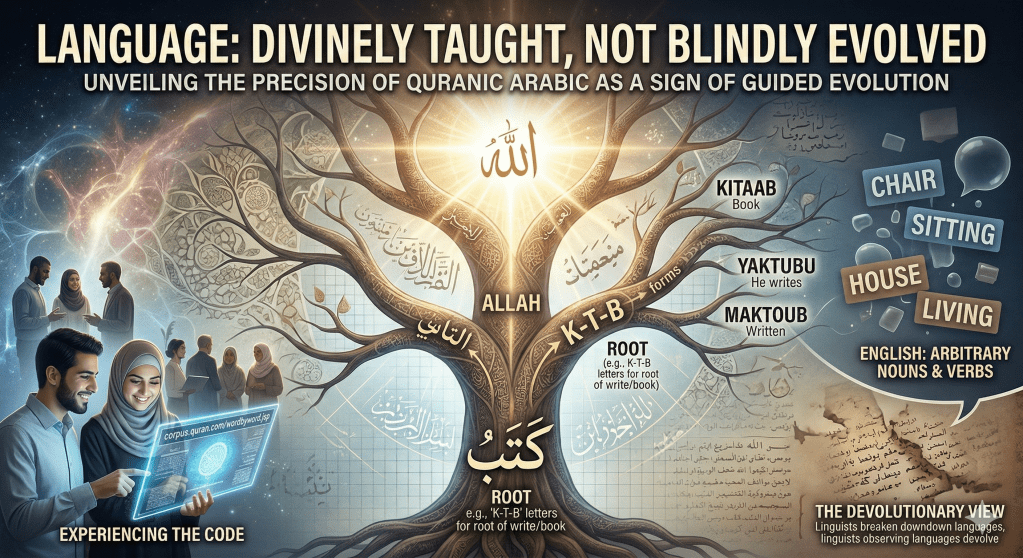
This biological “hardware” find its linguistic equivalent in the “software” of the Arabic language. Arabic utilizes a triconsonantal root system (jidhr), where nearly the entirety of the lexicon is derived from a finite set of three-letter cores. Just as the three-letter codon stores the “instruction” for an amino acid, the three-letter Arabic root stores the “generic semantics” for an entire family of words.
| Component | Biological Hardware (DNA) | Linguistic Software (Arabic) |
| Basic Alphabet | 4 Chemical Bases (A, T, C, G) | 28 Consonants (Alif to Ya) |
| Atomic Unit | 3-Letter Codon | 3-Letter Triliteral Root |
| Instructional Capacity | 64 Combinations ($4^3$) | 21,952 Potential Roots ($28^3$) |
| Functional Result | Proteins/Amino Acids | Derived Nouns/Verbs/Patterns |
| Stability Mechanism | Genetic Repair/Redundancy | I’rab (Case system)/Mathematical Awzan |
Table 2: Ontological Parallels between Genetics and Arabic Morphology.
The Mathematical Precision of the Triliteral Root System
The Arabic language is characterized by a structural depth and systematic organization that challenges conventional models of random linguistic evolution. Its morphology is “non-concatenative,” meaning words are formed by interweaving roots with specific patterns rather than simply adding prefixes or suffixes.
The Root as a Linguistic Gene
The triliteral root acts much like a biological gene, preserving semantic integrity across an expansive lexical matrix. For example, the root K-T-B (ك-ت-ب) encapsulates the abstract concept of “writing”. This root is the “atomic core” of phonology and semantics. From this single “seed,” the language generates a diverse range of words through predictable mathematical templates (awzan).
The process of derivation can be modeled as a system of linear functions where the root serves as the constant and the added vowels or letters act as independent variables. The “intersection law” of set theory reveals that every word derived from a specific root belongs to a set defined by those core consonants. The common intersection of these sets invariably reveals the primary root meaning.
Precognition and the Operating System of Meaning
The intricate and extensive relationships within the Arabic lexicon speak of “precognition” and a “prior consciousness”. A random, blind evolutionary process would likely result in high entropy, irregularity, and semantic drift. However, Classical Arabic exhibits a resistance to these forces, maintaining its core morphological and syntactic rules for over 1,400 years. This stability suggests a system that was “engineered with a specific purpose,” mirroring the Quranic claim that Allah taught Adam “the names of all things”.
| Root (K-T-B) | Derived Word | Meaning | Functional Category |
| ك-ت-ب | Kataba | He wrote | Form I Verb (Base) |
| ك-ت-ب | Kitāb | Book | Noun (Object) |
| ك-ت-ب | Kātib | Writer/Scribe | Active Participle (Doer) |
| ك-ت-ب | Maktūb | Written/Destiny | Passive Participle (Target) |
| ك-ت-ب | Maktaba | Library/Office | Noun of Place |
| ك-ت-ب | Istaktaba | He asked to write | Form X Verb (Seeking) |
Table 3: The Generative Power of the Root K-T-B.
The Ten Verb Forms: A Code for Guidance
One of the most fascinating aspects of Arabic structure is the verb form system, which allows for the derivation of a wide range of nuances from a single root. These ten common forms (أوزان) function as templates that modify the core meaning in mathematically predictable ways.
Semantic Logic of the Templates
- Form I (Fa’ala): The foundation, conveying the standard or basic meaning of the root (e.g., ‘Alima – to know).
- Form II (Fa’ala): Often intensive or causative. To know (‘Alima) becomes to teach (‘Allama)—causing another to know.
- Form III (Fa’ala): Typically denotes a mutual or reciprocal action done “with” or “to one another” (e.g., Kātaba – to correspond with someone).
- Form IV (Af’ala): A powerful tool for expressing causation; “to cause something to happen” (e.g., Akhraja – to expel or cause to go out).
- Form V (Tafa’ala): The reflexive counterpart to Form II, indicating the subject does the action for itself or gradually (e.g., Ta’allama – to learn/teach oneself).
- Form VI (Tafa’ala): The reflexive counterpart to Form III, indicating mutual action among multiple parties (e.g., Ta’āmala – to deal with each other).
- Form VII (Infa’ala): Primarily reflexive-passive in meaning, indicating the result of an action (e.g., Inqata’a – to be cut off).
- Form VIII (Ifta’ala): Suggests a strong, deliberate action, often reflexive or done with detail (e.g., Ijtama’a – to meet/gather).
- Form IX (If’alla): A rare form used almost exclusively for colors or physical defects (e.g., Ihmarr – to turn red).
- Form X (Istaf’ala): Conveys the meaning of seeking, requesting, or considering something to be a certain way (e.g., Istaghfara – to seek forgiveness).
This systematic grid of verbal “forms” derives families of meanings with “astronomical precision”. The fact that these patterns are consistent across thousands of different roots speaks to a “prior consciousness” that provided humanity with an elaborate code for communication.
Comparative Linguistics: The Disconnect in English vs. The Cohesion in Arabic
To grasp the divinely guided nature of language, it is instructive to contrast Arabic with analytic languages like English. In English, nouns are very seldom related to the verbs describing their primary function, a disconnect that highlights the random, incremental drift of Indo-European languages.
The English Etymological Void
In English, many essential concepts are expressed through unrelated words, requiring rote memorization rather than logical derivation.
- Noun: Chair / Verb: Sitting. There is no morphological or etymological relationship between “chair” and “sitting.”
- Noun: House / Verb: Living. The word “house” shares no root with “living” or “residing.”
- Noun: Water / Verb: Drinking. While one “drinks water,” the words themselves are etymologically distinct.
This fragmentation is typical of languages that have evolved through blind cultural evolution and social convention. English speakers must memorize “isolated terms” rather than an interconnected system.
The Arabic Semantic Chain
In Arabic, the lexicon functions as an interconnected system where nouns, verbs, and adverbs are tethered to a meaningful core.
- Root: Q-‘-D (ق-ع-د) relates to sitting. The verb is Qa’ada (he sat), and the noun for a chair/seat is Maq’ad—literally, the “place of sitting”.
- Root: S-K-N (س-ك-ن) relates to peace/tranquility. The verb is Sakana (he lived/resided), and the noun for a house is Maskan—literally, the “place of tranquility”.
- Root: Sh-R-B (ش-ر-ب) relates to drinking. The verb is Shariba (he drank), the noun for a drink is Shurb, and a water-fountain is Mashrab.
This “morphological awareness” allows speakers to decode how words are built and interconnected through their smallest meaningful units. The cohesion of the Arabic model suggests a “premeditated blueprint” bestowed by a divine consciousness, upon which humans have incrementally built or rediscovered the taxonomies of the world.
Linguistic Devolution: The Real-Time Empirical Evidence
Contrary to the secular evolutionary premise that things naturally become more organized over time, empirical linguistics shows that languages tend to devolve. Linguists have observed languages lose structural complexity, simplify their morphology, and decay in their systematic organization.
The Erosion of Word Endings
The process of “degression” is evident in the history of the Indo-European family. Proto-Indo-European (PIE) is reconstructed as a highly complex language with eight or nine cases and a very elaborate system of inflection.
- Modern English has devolved from its relatively ancient predecessors, losing its case system and dual number.
- Classical Greek and Latin were far more complex than their modern descendants.
- Anglo-Saxon (Old English) had a rich system of syntactic variation that has been lost in the transition to Present-Day English.
Counter-Entropic Stability of Classical Arabic
In real time, linguists have seen languages “devolve rather than evolve in their structure”. The fact that Classical Arabic has resisted this “linguistic entropy” for over fourteen centuries is a primary exhibit for its premeditated design as a tool for guidance. While other languages simplify and fragment, Classical Arabic has preserved its grammatical cases (I’rab) and its mathematical regularity, serving as a stable “linguistic checksum” across generations.
| Language | Progenitor State | Modern/Devolved State | Empirical Observation |
| Indo-European | PIE (8-9 Cases) | English (0-2 Cases) | Loss of Inflection/Complexity |
| Old English | Complex Affixes | Strict Word Order | Morphological Simplification |
| Classical Arabic | Highly Organized | Dialects (Simplified) | Standard remains stable/Revealed |
| Hebrew | Ancient (Complex) | Modern (Standardized) | Growth/friction/fitting |
Table 4: Empirical Evidence of Linguistic Devolution.
An Unapologetic Case for Revealed Language
The complexity and mathematical rigor of Arabic provide a compelling case for its role as the “mother of all languages” and a divinely revealed foundation. Zia H Shah MD asserts that the origin of language is a fertile area for demonstrating “Guided Evolution” because invoking a specific language case implies “revelation from an Omniscient God”.
The Progenitor of Semitic Languages
Arabic is a Central Semitic language, preserving the most conservative features of the Afroasiatic family. It preserves 28 out of 29 Proto-Semitic contrastive sounds and the complete three grammatical case system. While secular linguistics classifies it as one branch among many, its structural purity and “textural efficiency” suggest it may be the primordial revealed language from which others have drifted or “devolved”.
The word “Allah” itself has a Semitic root that predates the emergence of monotheistic Islam, tracing back to Akkadian (Ilu), Hebrew (Elohim), and Aramaic (Allaha). This linguistic continuity suggests that the fundamental “names” were bestowed upon humanity from the very beginning. Whether Arabic was the very first language or a divinely refined version of a prior Semitic tongue, its use in the Quran was not an accident; it was the “medium chosen” for the final message due to its inherent superiority and grammatical complexity.
The Experience of Grasping the Divine Software
For Muslims to truly “experience” how language was taught by Allah, they must engage with the text at a structural level. The community is divided into two camps for this journey.
- Arabs (Speakers of the Tongue): Those who already know Arabic are challenged to look past their fluency to the “engineered code” beneath. They must reflect on how every noun they use—from Miftah (key) to Maskan (house)—is tethered to a verbal root, a level of cohesion absent in other human tongues.
- Non-Arabs (Learners of the Message): Those who do not know Arabic can begin their experience through word-by-word translation tools like
corpus.quran.com. By analyzing the relationship of each word with its three-letter root in the Quranic Dictionary, they can witness the “semantic engine” in real-time.
This engagement reveals that the Quran is a “living scripture” and a “divinely guided” instrument, where the Source of the message is clearly the Architect of the tongue.
The Epilogue: A Thematic Synthesis of Guidance
The evaluation of the Arabic language and the biological hardware of life reveals a universe governed by “astronomical precision” and “premeditated design”. From the four chemical bases of DNA to the 28 consonants of the Arabic alphabet, the tapestry of existence is written in a unified code. Zia H Shah MD provides a scientifically rigorous synthesis that marriages scientific understanding with spiritual insight, showing that evolution is not a blind, random process but the method by which a Wise Creator unfolds life.
The Arabic trilateral root system functions as a linguistic “checksum,” ensuring the preservation of conceptual purity across generations. While human-led naming systems in chemistry and psychiatry are the product of “tortuous human consensus,” the fundamental architecture of the Arabic model suggests an initial language bestowed by a divine consciousness. Arabic stands as a “confirming sign”—a linguistic miracle that serves as the ultimate proof that nature and scripture are two parts of the same revelation.
The “clear Arabic language” provided by the Creator is resistant to the entropy of time and the ambiguity of human convention. It is a system optimized for human cognition, designed “that you might understand” [Quran 12:2]. In a world of breathtaking biological diversity, the diversity of tongues and colors serves as a divine sign for those with knowledge, pointing toward a single, guided origin. Ultimately, the experience of grasping the structural depth of the Arabic language leads to the inescapable conclusion that the faculty of communication was taught by the Lord of Mercy, who created man and taught him Al-Bayan—the ability to articulate and communicate the truth.


 The Glorious Quran and Science
Leave a comment