

Epigraph:
هَٰذَا خَلْقُ اللَّهِ فَأَرُونِي مَاذَا خَلَقَ الَّذِينَ مِن دُونِهِ ۚ بَلِ الظَّالِمُونَ فِي ضَلَالٍ مُّبِينٍ
This is the creation of Allah. Now show me what others beside Him have created. Nay, but the wrongdoers are in manifest error. (Al Quran 31:11)
قُلْ أَرَأَيْتُم مَّا تَدْعُونَ مِن دُونِ اللَّهِ أَرُونِي مَاذَا خَلَقُوا مِنَ الْأَرْضِ أَمْ لَهُمْ شِرْكٌ فِي السَّمَاوَاتِ ۖ ائْتُونِي بِكِتَابٍ مِّن قَبْلِ هَٰذَا أَوْ أَثَارَةٍ مِّنْ عِلْمٍ إِن كُنتُمْ صَادِقِينَ
Say, ‘Do you know what it is you call on beside Allah? Show me what they have created of the earth. Or have they a share in the creation of the heavens? Bring me a Book revealed before this or some vestige of knowledge in your support, if you indeed speak the truth.’ (Al Quran 46:4)
Presented by Zia H Shah MD
Audio teaser:
The Singularity of Divine Sustenance: A Scientific, Philosophical, and Theological Commentary on Quran 35:40-41
Abstract
This report presents an exhaustive interdisciplinary commentary on Quran 35:40-41, synthesizing classical Islamic exegesis (Tafsir) with modern theoretical physics, molecular biology, and Hellenistic-Islamic philosophy. The analysis focuses on the transition from the epistemological refutation of ontological plurality in verse 40 to the metaphysical demonstration of continuous divine sustenance in verse 41. By examining the biological “Biochemical Singularity” manifested in the Last Universal Common Ancestor (LUCA) and the “Physical Singularity” inherent in the fine-tuning of universal constants, the study demonstrates how the structural reality of the cosmos aligns with the Quranic paradigm of Tawhid (Absolute Monism). The report further utilizes Al-Kindi’s philosophical critique of composition to refute Trinitarian plurality, arguing that a composite deity necessitates a prior cause, thereby violating the principle of Aseity. The “grip” described in the Quran is identified as the delicate balance between gravitational and expansionary forces, suggesting a universe that is contingent upon a necessary, non-compositional Sustainer. The study concludes with a thematic epilogue on the “Horizon of Unity,” viewing the laws of nature as the “Divine Habit” that ensures cosmic stability through the attributes of Forbearance and Forgiveness.
The Epistemological Challenge: The Critique of Ontological Plurality
The Quranic discourse in Surah Fatir (35:40) initiates a rigorous epistemological interrogation of polytheistic and pluralistic ontologies. The verse demands a demonstration of creative agency from any entity invoked alongside or instead of the Absolute, framing the right to worship as a direct corollary of the power to originate existence.
The Mandate for Creative Proof and the “Aruni” Challenge
The command “Say: Have you considered your ‘partners’ whom you invoke besides Allah? Show me (Aruni) what they have created from the earth” serves as a foundational inquiry into the nature of sovereignty. This is not merely a rhetorical device but a demand for an empirical audit of the cosmos. In the Islamic worldview, the legitimacy of a deity is contingent upon its ability to bring matter into being ex nihilo or to exercise independent governance over a portion of reality. Classical commentators such as Ibn Kathir and Al-Jalalayn highlight that the address is directed at the “idols and rivals” that humanity elevates to divine status, exposing their absolute helplessness.
The theological implication of the “Aruni” challenge is that the universe is a closed system of divine action. If any other being possessed a share in the heavens or had created even a single atom of the earth, the resulting “ontological friction” would manifest as inconsistency in the laws of physics. However, as the verse notes, these associates possess “nothing at all… not even the membrane covering the stone of a date”. This radical lack of creative agency renders the act of invocation (dua) toward them a logical absurdity. The verse further probes the possibility of a “written sanction” or “Book” (Kitab) that might authorize such a partnership, asserting that no such revelation exists. Consequently, the pluralistic worldview is classified as “ghurur” (delusion), where followers and leaders deceive one another with false promises of intercession or power.
Burhan al-Tamanu: The Logical Proof of Unity
The philosophical underpinnings of verse 40 are best understood through the Burhan al-Tamanu (the argument from mutual hindrance), a central pillar of Islamic scholastic theology (Kalam). This argument, derived from Quranic verses such as 21:22 and 35:41, posits that the existence of more than one omnipotent will is a logical impossibility.
| Logical Scenario of Plurality | Consequence for the Cosmos | Metaphysical Conclusion |
| Both deities wish for opposite states (e.g., life and death for the same object). | Both wishes are realized: a logical contradiction (A and non-A). | Impossible: Violation of the law of non-contradiction. |
| Neither deity’s wish is realized. | Both deities are proven weak and limited in power. | Impossible: A weak being cannot be divine. |
| One deity’s wish is realized over the other. | The deity whose wish failed is weak; the status of “equal” is lost. | Proof of a single, dominant, and unique God. |
The “perfect order and unerring system” observed from the subatomic to the galactic level serves as the empirical refutation of cosmic plurality. If multiple independent wills governed the universe, the delicate balance of forces would be subject to the whims of competing legislative intents, leading to a “dissolution in chaos”. Instead, the universe exhibits a “singular author” style, where the laws of nature are consistent across the entire observable horizon. This consistency reflects the “uniqueness and independence” of the Absolute Sovereign.
The Philosophical Refutation of Trinitarian Plurality
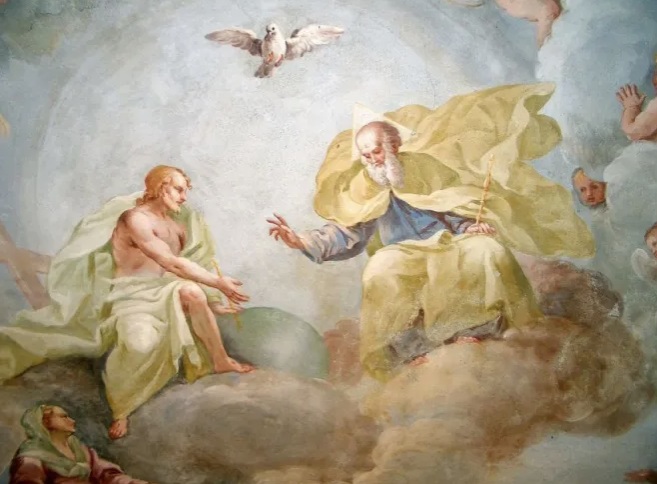
While verse 35:40 addresses general polytheism, its logic applies with equal force to more sophisticated triadic models, such as the Christian Trinity. Islamic philosophy, particularly in the tradition of Al-Kindi and later the Mutakallimun, utilizes the concept of divine simplicity to demonstrate that any form of “internal plurality” or “composition” within the Godhead is incompatible with the definition of a Necessary Being (Wajib al-Wujud).
Al-Kindi and the “True One” vs. the “Metaphorical One”
In his seminal work On First Philosophy, Al-Kindi argues that the “True One” must be entirely free from composition (tarkib). He distinguishes between the “Metaphorical One”—any created entity that is called “one” but is actually a composite of parts, such as a human being made of limbs or a substance made of matter and form—and the “True One” who is simple and indivisible.
Al-Kindi’s refutation of plurality rests on the principle that any composite entity requires a “composer” or a cause to bring its disparate parts into a unified whole. If the Trinity consists of three “persons” (hypostases) who share a single essence but are distinguished by unique properties (e.g., Paternity, Filiation, Procession), then the resulting Godhead is, by definition, a composite being.
- The Argument from Composition: Anything composed of parts depends on those parts for its existence.
- The Argument from Causality: A composite being requires a prior cause to arrange the parts. If God were composite, He would be “caused” and therefore not the “First Cause”.
- The Argument from Distinction: For the persons of the Trinity to be distinct, they must possess “distinctive characteristics” that the others do not have. This implies that each person is a combination of the “shared essence” and a “particularizing trait,” which is a form of composition.
From this perspective, the Trinitarian model is viewed as a “bastardized doctrine” that attempts to combine monotheism with a “loving troika” of divine agents. Al-Kindi concludes that the True One possesses no matter, form, quantity, quality, or relation, as all these categories imply multiplicity. God is “pure unity” and nothing other than unity itself.
The Arbitrariness of the Triad
Theological critique also addresses the specific number “three.” If the ground for plurality within God is based on His diverse attributes (e.g., Life, Knowledge, Power), then selecting only three attributes to elevate to the status of “Persons” is viewed as an arbitrary move. Since God possesses an infinity of perfections (as reflected in the 99 Names of Allah), there is no logical or scriptural basis for limiting this “relational plurality” to a triad. In contrast, Quranic Monism asserts that God’s attributes are identical with His essence; He is not a being possessing knowledge, but is Knowledge itself in an unpartitioned and supremely simple unity.
The Biological Singularity: The Signature of the One in Life
The most profound scientific confirmation of the Quranic insistence on a singular creator (35:40) comes from the field of molecular biology. The biological record presents a “Singularity” that is categorically incompatible with the expectation of a triadic or pluralistic foundation for life.
The Last Universal Common Ancestor (LUCA)
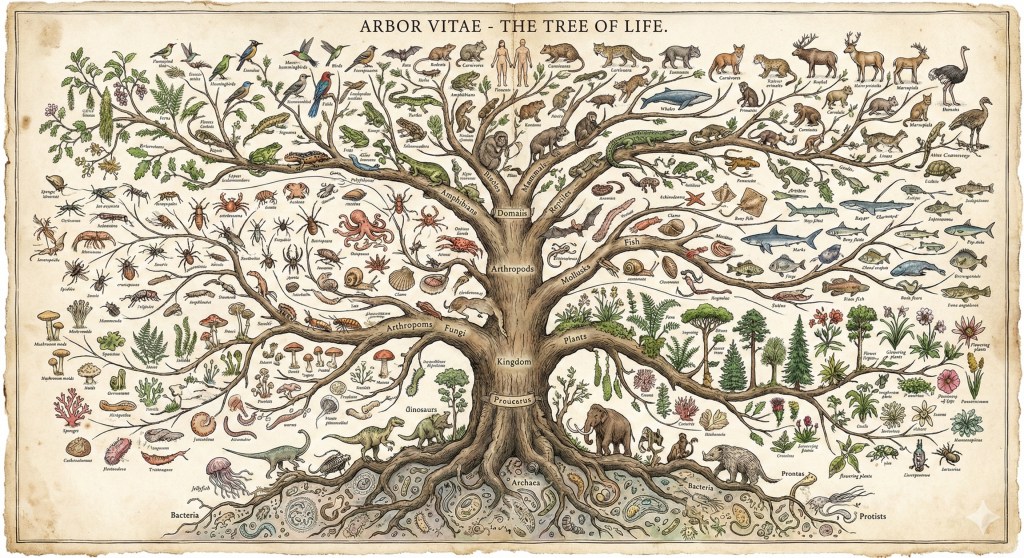
The discovery that all known life forms on Earth—ranging from anaerobic bacteria to complex multicellular humans—trace their lineage back to a single population of organisms known as the Last Universal Common Ancestor (LUCA) reflects the “Signature of the One” in the organic world. LUCA, which likely inhabited hydrothermal vents 3.5 to 4.3 billion years ago, represents the “biochemical singularity” from which all diversity sprang.
| Biological Marker | Consistency across Life Domains | Theological Significance |
| Genetic Material | Double-stranded DNA | Reflects a single informational source. |
| Protein Synthesis | Ribosomes and 20 specific amino acids | A unified manufacturing process for all life. |
| Energy Metabolism | ATP-driven reactions | A single standardized “currency” for existence. |
| Cellular Membrane | Lipid bilayer | A shared physical boundary for all living units. |
The existence of LUCA is inferred from the “detailed biochemical similarity” of all current life across the three domains: Bacteria, Archaea, and Eukarya. While trillion of alternative metabolic paths and genetic structures are theoretically possible, life on Earth uses a single, unified blueprint. The identification of 355 protein clusters common to all life suggests a “primordial metabolic monogram” that precludes the idea of multiple competing creators or a “relational committee” of designers.
The “Frozen” Universal Genetic Code
Further evidence for biological monism is found in the “Universal Genetic Code.” The mapping of 64 codons to 20 amino acids is nearly identical in every organism on the planet. This code is described by biologists as a “frozen accident”—a system so foundational that it has remained unchanged for billions of years.
From a theological perspective, if the ultimate ground of reality were a “relational Trinity,” one might expect the foundational building blocks of life to reflect this plurality, perhaps through a “triadic code” or multiple competing genetic systems. Instead, the “One Code” of DNA suggests a singular legislative command. This aligns with the Quranic concept of “Kun fa-yakun” (Be, and it is), which reframes creation not as a physical assembly of parts, but as a “top-down informational initiation”. In this paradigm, information is primary, and matter is secondary—a conclusion that modern science is increasingly approaching.
The Physical Singularity: Divine Sustenance in Verse 35:41
Transitioning from the origin of creation in verse 40, the Quran addresses its ongoing preservation in verse 41: “Indeed, Allah holds (yumsiku) the heavens and the earth, lest they cease (tazula)…”. This verse introduces the metaphysics of “Continuous Creation,” asserting that the universe is not a self-sustaining machine but is dependent on an external Sustainer for its existence at every moment.
Linguistic Analysis: Yumsiku and Tazula
The term “yumsiku” (from the root M-S-K) implies an active, intentional, and ongoing “grip” or “grasping”. It suggests that if this divine attention were withdrawn even for an instant, the cosmos would collapse. The term “tazula” (from the root Z-W-L) is variously translated as “cease,” “vanish,” “deviate,” or “be displaced”.
Classical scholars understood this to mean that Allah prevents the heavens and earth from “falling apart” or “moving from their actual place”. In modern terms, this “holding” can be interpreted as the maintenance of the physical laws and constants that prevent the universe from either collapsing into a singularity or dissipating into a sterile void. If the heavens and earth were to “vanish,” the verse notes, “there is not one that could grasp them after Him”. This highlights the absolute contingency of the universe; it lacks the inherent power to sustain its own existence.
Fine-Tuning: The Physics of the “Divine Grip”
The “holding” described in Quran 35:41 finds a striking empirical parallel in the “Fine-Tuning” of the universe. Contemporary cosmology has identified a series of dimensionless constants and initial conditions that must fall within an extraordinarily narrow range to permit the existence of stars, planets, and life.
| Physical Constant / Parameter | Degree of Precision | Consequence of Deviation |
| Cosmological Constant ($\Lambda$) | 1 part in $10^{120}$ | Universe expands too fast or collapses instantly. |
| Strong Nuclear Force | Within 0.5% – 5% | No stable carbon or oxygen atoms; life impossible. |
| Gravitational Constant ($G$) | 1 part in $10^{34}$ | Stars burn out too quickly or fail to ignite. |
| Ratio of Gravity to Electromagnetism | 1 part in $10^{36}$ | Unstable star formation and lack of heavy elements. |
| Expansion Rate of the Big Bang | $\rho \approx \rho_c$ | Immediate “Big Crunch” or sterile over-expansion. |
The Cosmological Constant ($\Lambda$), representing the energy density of empty space, is the most extreme example of this “holding.” If it were slightly more positive, the repulsive force would have driven matter apart before galaxies could form. If it were slightly more negative, the universe would have collapsed back into itself within the first fraction of a second. This “razor’s edge” balance is exactly what the Quran describes as Allah “holding” the heavens and earth lest they “cease”.
The metaphor of a ruler stretching across the entire observable universe (15 billion light years) is often used to illustrate this precision. If we increased the strength of gravity by just one inch on that ruler, the resulting universe would be uninhabitable. This physical reality underscores the theological claim that the cosmos is not “necessary” in itself but is “held” by a volitional agent.
The Zero-Energy Universe and Aseity
A provocative concept in modern physics that aligns with the Quranic “Kun fa-yakun” and the attribute of As-Samad (The Self-Sufficient) is the “Zero-Energy Universe” hypothesis. This theory posits that the total energy of the universe is exactly zero, because the positive energy of matter and light is perfectly balanced by the negative potential energy of gravitational attraction.
$$E_{total} = E_{matter} + E_{gravitation} = 0$$
If the net energy of the universe is zero, it suggests that the creation of the universe did not require the “expenditure” of any pre-existing energy. It reflects the absolute independence (Aseity) of God, who can bring an entire cosmos into being through a mere “informational command” without being part of the system or losing anything from His essence. This provides a philosophical rebuttal to the idea that God “needs” a relational Trinity to express His nature; a Zero-Energy universe reflects a Creator who is entirely self-sufficient and whose will is the sole cause of existence.
Unified Field Theory: The Search for the One Force
The intellectual trajectory of physics is moving toward a “Unified Field Theory,” which seeks to describe the four fundamental forces of nature—gravity, electromagnetism, the strong nuclear force, and the weak nuclear force—as manifestations of a single, primordial interaction.
- Electroweak Unification: Physics has already unified electromagnetism and the weak nuclear force into the “electroweak” force at high energy levels.
- Grand Unified Theories (GUTs): Scientists are working to include the strong nuclear force in this unification.
- Theory of Everything (ToE): The ultimate goal is to incorporate gravity, potentially through String Theory or Quantum Gravity.
This scientific convergence reflects the “Physical Singularity” of the One. If all forces in the universe are low-energy “broken symmetries” of a single original force, it serves as an empirical shadow of the Quranic monism (Tawhid). The “Signature of the One” is written into the very fabric of spacetime, where the multiplicity of interactions we observe is merely a mask for a deep, underlying unity.
The Metaphysics of Divine Habit: Occasionalism and Stability
The Quranic claim that “Allah holds the heavens and the earth” (35:41) implies that the “laws of nature” are not autonomous entities but are the “customary practice” of God (Sunnat Allah). This view, known as Occasionalism, was famously articulated by Al-Ghazali, who argued that there is no inherent causal power in created things; instead, God creates the cause and the effect simultaneously at every moment.
The Simulation Metaphor and Quantum Indeterminacy
In contemporary discourse, this metaphysics finds a resonance in the Simulation Hypothesis. If the universe is akin to a digital construct or a “programmed illusion,” it requires a continuous “processor” or a “Programmer” to run. Without the “power supply” of divine sustenance, the simulation would simply vanish. This provides a mental model for how a transcendent God can be “closer to man than his jugular vein” without being part of the physical world.
Furthermore, the indeterminacy found in quantum mechanics suggests that at the most fundamental level, the universe does not follow rigid, clockwork laws, but is open to continuous divine input. The “grip” of Allah is the force that collapses the wave function of the universe into a stable reality, preventing it from remaining in a state of chaotic potentiality.
Stability without Stasis
The tafsir of verse 41 also addresses the role of mountains and the stability of the earth. Some critics have argued that these verses imply a flat, non-moving earth. However, scholars like Ibn Hazm and Al-Raghib al-Isfahani have clarified that “stability” (karar) does not mean the absence of motion, but the absence of “shaking or trembling” that would make life impossible. Just as a person can hold a vibrating object steady, Allah “holds” the earth in its orbit and rotation, ensuring a calm and habitable environment despite its rapid movement through space.
The Theology of Forbearance: Halim and Ghafur
Verse 35:41 concludes by noting that Allah is “Halim” (Forbearing) and “Ghafur” (Forgiving). This is a profound theological insight into the nature of cosmic maintenance. The enormity of human “shirk” (the claim of partners or sons for God) is described in other verses (e.g., 19:88-91) as being so great that it almost causes the heavens to burst asunder and the mountains to crumble.
The Patience of the Sustainer
The attribute of Al-Halim signifies that God does not hasten to punish. It is His “Clemency and Forbearance” that prevents the cosmic “grip” from being released, even as humanity denies the One who is sustaining them. The fact that the sun continues to shine, the DNA continues to replicate, and the gravitational constant remains stable for both the believer and the disbeliever is a manifestation of this divine patience.
| Attribute | Function in Cosmic Governance | Result for Humanity |
| Al-Halim (The Forbearing) | Delays the “Big Crunch” or the consequences of shirk. | Provides a “grace period” for repentance and discovery. |
| Al-Ghafur (The Forgiving) | Conceals the imperfections of the contingent world. | Sustains life despite human rebellion. |
This forbearance allows for the “Law of Universal Submission” (Sajda) to operate. While a disbeliever may verbally deny God, their heart, their cells, and the atoms of their body “submit compulsorily” to the laws of physics—laws that are “held” by the very Being they deny.
The Cosmic Finale: Big Crunch vs. Big Freeze
The Quranic “holding” of the heavens and earth (35:41) also has implications for the end of the universe. Current astrophysical models propose several scenarios: the “Big Freeze” (exponential expansion leads to heat death), the “Big Rip” (dark energy destroys all matter), and the “Big Crunch” (gravity overcomes expansion and pulls everything back into a singularity).
“Rolling up the Heavens”
The “Big Crunch” theory is often seen as most in line with Quranic descriptions of the end of time, such as 21:104: “The Day when We shall roll up the heavens like the rolling up of written scrolls… As We initiated the first creation, so We shall bring it forth anew”. This suggests that the “holding” described in 35:41 is a temporary state. Eventually, the expansionary force will be withdrawn, or gravity will be intensified, leading to a return to the primordial singularity.
This “rolling up” serves as the final proof of the “Aruni” challenge in verse 40. When the entire cosmic architecture is collapsed by the same hand that held it, the helplessness of all “associate-gods” will be made manifest. The recurrence of creation—”as We began the first creation, so shall We repeat it”—reinforces the idea of a single, volitional Creator who is the “First and the Last”.
Thematic Epilogue: The Horizon of Unity
The synthesis of Quran 35:40-41 provides a panoramic view of a universe that is radically monistic. The “Singularity of Creation” is not merely a point in time (the Big Bang) or a point in biology (LUCA), but an ever-present metaphysical reality. The biological record, through its “One Code” and “One Ancestor,” acts as a molecular refutation of Trinitarian and polytheistic plurality, demonstrating that the foundation of life is non-compositional and singular.
Philosophically, the “True One” described by Al-Kindi stands as the necessary anchor for a contingent cosmos. The argument from mutual hindrance (Burhan al-Tamanu) ensures that the “grip” which sustains the heavens and earth is not a committee of wills, but a singular legislative command. This command is reflected in the fine-tuning of the constants—those “invisible pillars” of gravity and nuclear force that prevent reality from vanishing into non-existence.
The existential consequence of this theology is a state of “Radical Proximity.” A believer is never alone because the very atoms of their existence are being “held” by the Sustainer at every picosecond. Nature is not a destination (as in pantheism) but a “sign” (ayat) pointing toward the Creator, much like an artist’s signature scrawled across a canvas. The scientific quest for a “Unified Field Theory” is, in essence, a spiritual journey toward the “Signature of the One.”
In conclusion, the “holding” of the heavens and earth is the ultimate expression of divine Mercy. It is the forbearance (Halim) of the One that allows a world of plurality and free will to exist within a framework of absolute unity. As science continues to uncover the deep underlying symmetries of the cosmos, it increasingly arrives at the same conclusion proclaimed by the Quran: that the universe is a singular, intentional thought in the Mind of an Indivisible, Necessary Being, whose “grip” is the only thing standing between reality and the abyss of non-existence.



 The Glorious Quran and Science
Leave a comment