
Epigraph
إِنَّ اللَّهَ يُمْسِكُ السَّمَاوَاتِ وَالْأَرْضَ أَن تَزُولَا ۚ وَلَئِن زَالَتَا إِنْ أَمْسَكَهُمَا مِنْ أَحَدٍ مِّن بَعْدِهِ ۚ إِنَّهُ كَانَ حَلِيمًا غَفُورًا
God keeps the heavens and earth from vanishing; if they did vanish, no one else could stop them. God is most forbearing, most forgiving. (Al Quran 35:41)
The Ontological Foundations of Divine Creation: A Metaphysical and Cosmological Analysis of Closer to Truth Episode 506
Presented by Zia H Shah MD
Audio teaser: The Universe Has No Inertia:
Abstract
The concept of God as “Creator” serves as the foundational premise of monotheistic metaphysics, yet the precise nature of this creative act remains a subject of intense philosophical and scientific scrutiny. This report provides an exhaustive analytical transcript and critical assessment of the “Closer To Truth” inquiry into the mechanics and implications of divine creation. By synthesizing perspectives from prominent philosophers of religion and physicists, the study distinguishes between the initial act of creatio ex nihilo (creation out of nothing) and the continuous process of divine conservation. Key investigations include the relationship between the scientific Big Bang singularity (T=0) and the theological notion of ontological dependence, the anthropic necessity of a vast and seemingly “profligate” universe, and the challenge posed by abstract objects—such as mathematical truths and logical laws—to the absolute sovereignty of a creator. The analysis concludes that a robust definition of a creator must account not only for the temporal beginning of the physical cosmos but also for the underlying rational structures of reality. The report maintains that for the concept of God to remain coherent as an ultimate source, even the most fundamental necessities, such as 2+2=4, must be viewed as contingent upon the divine nature rather than existing as independent constraints.
The Framing of the Creative Act: Robert Lawrence Kuhn’s Prolegomena
The inquiry is initiated by Robert Lawrence Kuhn, whose introductory reflections establish the parameters of the metaphysical investigation. The central tension identified is the transition from non-existence to existence and the degree to which a divine agent is responsible for the totality of reality. Kuhn challenges the colloquial understanding of creation by questioning whether the act requires a discrete beginning in time or if an eternal, cyclical universe could still be characterized as “created”. This distinction is critical because it separates the chronological question of “when” from the ontological question of “why”.
Kuhn further complicates the inquiry by introducing the problem of abstract objects. While the creation of physical matter, energy, and biological life is a standard theological claim, the status of the laws of logic and the truths of mathematics remains ambiguous. If these laws exist by an inherent necessity that God cannot alter, the scope of the “Creator” title is significantly diminished. Kuhn’s mission is to move beyond the superficial label of a “divine starter” toward a comprehensive definition that addresses the factual beginning of nothingness, the ongoing maintenance of existence, and the potential sovereignty of the divine over the abstract realm.
The Doctrine of Creatio ex Nihilo: The Analysis of William Lane Craig
The first major segment of the investigation features philosopher and apologist William Lane Craig, who provides a rigorous defense of the traditional monotheistic view that God is the source of all reality external to Himself. This perspective, rooted in the Judeo-Christian-Islamic tradition, posits a radical dependency of all things upon a singular divine will.
The Categorical Scope of Created Reality
Craig’s definition of creation is all-encompassing. He asserts that if a reality exists and is not God, it must be a product of God’s creative activity. This includes diverse ontological categories that are often treated separately in secular philosophy.
| Category of Reality | Included Entities and Dimensions | Ontological Status |
| Physical/Concrete | Matter, energy, celestial bodies, and biological life. | Created and contingent. |
| Spatiotemporal | The fabric of time and space (space-time). | A direct product of the divine act. |
| Metaphysical/Spiritual | Spiritual beings (angels) and non-physical realms. | Contingent upon divine will. |
| Abstract (Debated) | Numbers, sets, logical propositions, and universals. | Created if they possess real existence. |
Craig emphasizes that creatio ex nihilo is not the reorganization of pre-existing “stuff,” as seen in many ancient cosmogonies, but the absolute bringing into being of something where there was previously nothing. He argues that this concept is historically unique to monotheism, distinguishing it from the pantheism and polytheism of Eastern and Greek traditions, which frequently conceptualize the world as either eternal or as a necessary emanation of the divine.
Creation Versus Divine Conservation
A profound nuance in Craig’s presentation is the distinction between the “initial act” of creation and the “sustaining act” of conservation. While many modern observers focus on the Big Bang as the singular event of creation, Craig argues that the universe’s continued existence is just as reliant on divine power as its first moment.
Craig describes conservation as the continuous exercise of God’s power to prevent the universe from vanishing. He posits that the universe possesses no inherent “inertia” of existence; it does not remain in being simply because it existed a moment ago. Instead, reality is held in place by an active, ongoing will. If this will were to be withdrawn, the result would not be a slow decay or a physical collapse, but a total disappearance of reality—it would “vanish in the blink of an eye”. This leads to a unique theological interpretation of “annihilation.” In Craig’s view, God does not need to actively destroy the world with a “blast”; He merely needs to cease the act of sustaining it.
The Implications of a Temporal Beginning
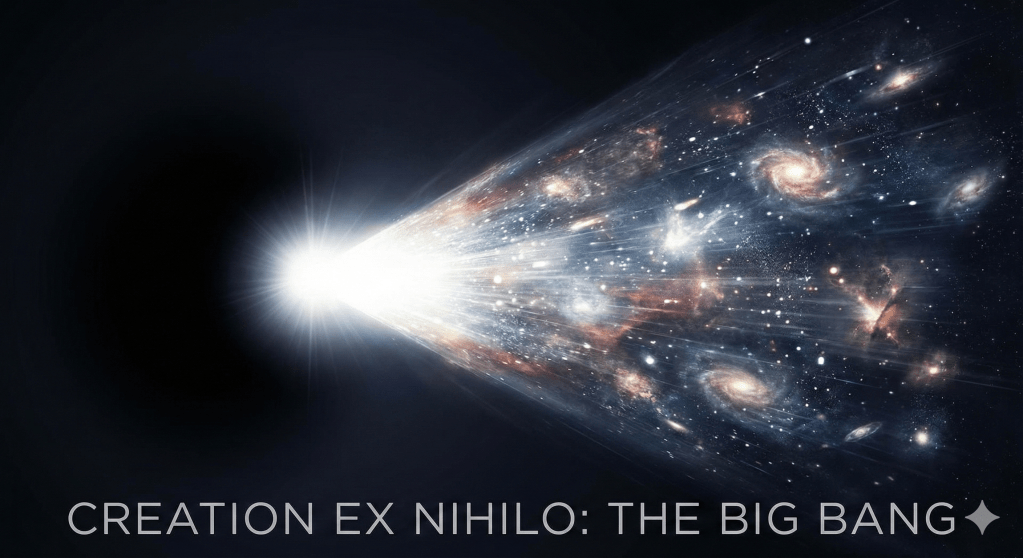
Craig bridges the metaphysical claim with cosmological science by arguing that the evidence for a beginning of the universe—specifically the Big Bang—provides strong support for a supernatural cause. He notes that historically, atheists relied on the assumption of an eternal universe to avoid the necessity of a first cause. By demonstrating that the universe is not eternal in the past, theology gains a powerful empirical “character witness” in modern physics. This beginning, or “T=0,” serves as the point of intersection where the theological doctrine of creatio ex nihilo and scientific cosmogony align.
The Interface of Physics and Theology: Robert John Russell
Physicist and theologian Robert John Russell deepens the inquiry by examining the relationship between scientific singularities and theological contingency. Russell cautions against a simplistic identification of the Big Bang with the act of creation, suggesting instead that the theological core of the concept is “ontological dependence”.
Science as a Witness to Contingency
Russell proposes that the role of science in this dialogue is not to prove God in a mathematical sense, but to act as a “character witness”. Science describes the universe’s history, its laws, and its apparent beginning, and in doing so, it paints a picture of a reality that is fundamentally contingent—meaning it does not have to exist.
| Concept | Scientific Description | Theological Interpretation |
| Singularity (T=0) | The mathematical limit of space-time density. | The chronological boundary of creation. |
| Physical Laws | The mathematical regularities of the universe. | Evidence of a rational, divine ordering. |
| Fine-Tuning | The precision of cosmic constants. | Indicators of purposive creation. |
For Russell, the theological doctrine of creation is valid regardless of whether the universe has a specific temporal starting point or is part of a multi-cycle model. The essential claim is that the universe is not self-explanatory; it requires an external “Ground of Being” to account for the fact that it exists at all.
The Significance of Ontological Dependence
The shift from a chronological to an ontological focus allows theology to engage with science without being threatened by potential changes in cosmological models. Russell argues that even if science eventually discovers a “before” to the Big Bang (such as in a bouncing universe or multiverse scenario), the philosophical question of why there is something rather than nothing remains untouched. Creation, in this sense, is the relationship of dependence that the entire cosmos has on God at every moment of its history, rather than just a “push” at the beginning.
The Sustaining Creator and the Ground of Being: John Polkinghorne
John Polkinghorne, a quantum physicist and Anglican priest, provides a perspective that prioritizes the “why” of existence over the “how” of the mechanics. Polkinghorne argues that viewing God solely as the one who “started the fire” of the Big Bang is a limited and potentially misleading concept of a creator.
Beyond the Mechanics of the Beginning
Polkinghorne suggests that the “mind of the creator” is reflected in the entirety of cosmic history, not just in the initial singularity. He is critical of perspectives—such as those popularized by Stephen Hawking—that suggest a universe without a temporal beginning has no need for a creator. For Polkinghorne, God’s role as the “Ground of Being” means He is the reason why anything exists at any time. This role is active and continuous; if God were to stop willing the world’s existence, the world would cease to be.
Divine Interaction: Transcendence and Immanence
Polkinghorne distinguishes between two modes of divine creative action. First, God acts as the transcendent “Ground of Being,” providing the very possibility of existence and the laws of nature. Second, God acts through active providence—an immanent interaction within the history of the universe. This dual role allows for a creator who is both the architect of the cosmic laws and a participant in the unfolding narrative of the world.
The Anthropic Necessity of a Vast Universe
One of the most compelling insights provided by Polkinghorne concerns the “profligate” scale of the universe. Kuhn notes that a universe containing trillions of stars across billions of galaxies seems like “overkill” if the primary goal is the creation of self-conscious life on a single planet. Polkinghorne uses the constraints of physics to explain that this vastness is actually a necessity.
| Physical Requirement | Temporal/Spatial Consequence | Theological Insight |
| Production of Heavy Elements | Requires billions of years of stellar fusion. | Life cannot emerge in a young universe. |
| Cosmic Expansion | Space expands over the time life takes to evolve. | A 13.7 billion-year-old universe must be vast. |
| Anthropic Scale | Trillions of stars are needed to produce carbon. | Mass and volume are tools for biological ends. |
Polkinghorne concludes that the stars are not redundant “waste” but are a necessary part of the biological and physical “scaffolding” required for humans to exist. This argument shifts the focus from physical size to significance. Drawing on Blaise Pascal, he observes that while humans are physically “reeds” in a massive cosmos, we are “thinking reeds”. Because humans possess the capacity for self-consciousness and can know the stars, while the stars know nothing, our significance outweighs the sheer physical volume of the non-conscious universe.
The Possibility of Extraterrestrial Life
At the 15:34 mark of the inquiry, the discussion turns to the potential for other self-conscious beings. Polkinghorne asserts that there is no “theological stake” in humans being the only self-conscious or “God-conscious” beings in the universe. He suggests that a creator would have the “generosity” to fulfill multiple purposes across the vastness of space. This view maintains that the presence of other life-forms would not diminish the significance of the human relationship with the divine, but rather would illustrate a more expansive and prolific creative intent.
The Sovereignty Challenge: Brian Leftow on Abstract Objects
The final and most abstract phase of the investigation involves Brian Leftow, who addresses the “strong” concept of God as the ultimate source of everything. Leftow identifies a major philosophical hurdle: the existence of abstract objects like numbers, the laws of logic, and universal properties.
The Independence of the Abstract Realm
In traditional Platonism, abstract objects—such as the number “two” or the law of non-contradiction—are seen as existing necessarily and independently of any mind. Leftow argues that if these concepts are truly independent of God, then God’s sovereignty is compromised. If the property of “divinity” or “goodness” exists as an external standard, then God “derives” His nature from that standard rather than being the source of it.
The “Pawn” Analogy and Metaphysical Constraints
Leftow utilizes a striking analogy to describe the problem of independent abstracta: if these concepts exist prior to or alongside God, then God becomes a “pawn” to these concepts. He explains that independent abstract objects would put “grooves in reality,” and God would be forced to “roll down” these pre-established paths. For example, if “perfect goodness” is a rule that exists independently of God, then God is constrained by an external rule that He did not create. This would imply that God is not truly free or sovereign in the “strong” sense.
The Dependency of Mathematics and Logic
To resolve this, Leftow proposes a radical model of dependency where even the most fundamental truths are rooted in God. Kuhn challenges this by asking whether 2+2=4 would still be true even if God did not exist. Leftow’s response is that if God—the necessary ground of all reality—did not exist, “nothing” would exist, including the truth of mathematics.
| Logical Proposition | Status in Independence Model | Status in Leftow’s Dependency Model |
| 2+2=4 | Necessarily true regardless of God’s existence. | True because it is rooted in the divine mind. |
| Law of Non-Contradiction | A constraint that God must obey. | A reflection of God’s own rational nature. |
| Property of Divinity | An external standard God must meet. | A reality created or sustained by God’s will. |
Leftow argues that for the equation 2+2=4 to be true, there must be a reality for the “number two” to refer to. Without God as the source of all reality, there is no such reference. Therefore, while these truths are “necessary,” their necessity is not independent; it is “rooted in the necessity of God’s existence”. This “strong” source model is essential for the internal coherence of the concept of an ultimate creator.
Synthesis: Defining the Architecture of Divine Creation
The synthesized findings from these diverse perspectives suggest that “Creation” is not a singular act, but a multi-layered ontological relationship. The inquiry reveals that a comprehensive understanding of God as Creator must operate across three primary dimensions:
- Temporal Origin (The “Big Bang” Dimension): The factual initiation of the universe ex nihilo, providing a chronological boundary between the non-existence and existence of time-space.
- Continuous Conservation (The “Ground of Being” Dimension): The ongoing exercise of divine will that preserves the universe against the inherent tendency of contingent things to lapse into non-existence.
- Ontological Foundation (The “Abstract” Dimension): The establishment of the very laws of logic and mathematics as expressions of the divine nature, ensuring that no facet of reality—even necessity itself—is independent of the creator.
Comparative Thematic Matrix
| Speaker | Core Ontological Focus | Mechanism of Action | Relationship to Necessity |
| Craig | Ex Nihilo | Volitional act in time | Distinguishes between God and world. |
| Russell | Ontological Dependence | Sustaining presence | Connects science and metaphysics. |
| Polkinghorne | Teleological Mind | Ground of being | Explains cosmic vastness as necessity. |
| Leftow | Divine Sovereignty | Source of all abstracta | Roots logical necessity in God. |
The Narrative Flow of the Inquiry: Chronological Transcript Summary
The investigation follows a clear intellectual trajectory, starting with the historical/temporal and moving toward the abstract/ontological.
- The Introduction (00:00–02:15): Robert Lawrence Kuhn frames the question by asking if creation is about a beginning from nothing or the sustaining of a cycle. He highlights the “pesky” problem of abstract objects like logic.
- Segment 1: William Lane Craig (02:15–08:00): Focuses on the definition of ex nihilo and the radical contingency of the world. Craig establishes that without divine conservation, the world would “vanish”.
- Segment 2: Robert John Russell (08:00–12:00): Addresses the scientific interface, arguing that T=0 is a “character witness” to a deeper philosophical dependence.
- Segment 3: John Polkinghorne (12:00–17:00): Moves the discussion to purpose and scale. He argues that a 13.7 billion-year-old universe is required for “thinking reeds” like humans to emerge.
- Segment 4: Brian Leftow (19:00–24:00): Tackles the “sovereignty” problem. He posits that if God is not the source of 2+2=4, God is a “pawn” of mathematics.
- Conclusion (24:20–End): Kuhn summarizes the different facets of creation: factual beginning, continuous sustaining, and the foundation of logic.
Analytical Synthesis of Second-Order Insights
Beyond the direct dialogue, the inquiry suggests several deeper trends regarding the relationship between the divine and the mundane. One underlying theme is the rejection of “inertia” in both physical and logical terms. In the domain of physics, the experts argue that matter does not have the “inertia” to remain in existence on its own. In the domain of logic, Leftow suggests that truths do not have the “inertia” to be true without a grounding source. This creates a unified “Strong Dependency” model of the universe.
Furthermore, the causal relationship between the vastness of the universe and the existence of life—as described by Polkinghorne—illustrates a “Physical Anthropic Constraint”. This suggests that the “generosity” of the creator is not just a theological whim, but a mathematically and physically calculated necessity to achieve a specific end: self-conscious life. The implication is that a smaller universe would have been a “dead” universe, unable to produce the complex heavy elements required for biological evolution.
Finally, the discussion of extraterrestrial life around the 15:34 mark implies a shift away from human-centric theology. By decoupling “significance” from “uniqueness,” Polkinghorne allows for a universe where the creator interacts with multiple conscious species. This expands the “Creator” role from being a local deity of Earth to being the universal architect of consciousness across the entire spatiotemporal manifold.
Thematic Epilogue: The Coherence of the Ultimate Source
The exhaustive inquiry into the nature of God as Creator reveals a central philosophical imperative: the need for coherence in the concept of an ultimate source. If God is to be truly “the Creator,” the scope of that creation cannot be limited to the physical realm or the temporal beginning of the cosmos. Instead, the creative act must be understood as an all-encompassing ontological grounding that includes the very fabric of possibility and the laws of reason.
The investigation highlights that the factual question of the Big Bang, while important for providing a point of contact between science and faith, is secondary to the metaphysical question of sustaining existence. The universe is presented not as a self-operating machine that was once “wound up” by a divine clockmaker, but as a continuous manifestation of a divine mind. This mind is seen as the “Ground of Being” that holds the stars in their courses and the truths of mathematics in their certainty.
The challenge of abstract objects remains the most profound boundary of this inquiry. If we accept the “Strong Source” model, we are forced to view logic and mathematics not as independent constraints, but as the “language” of the creator’s nature. This resolves the “pawn” dilemma by ensuring that God is not rolling down “grooves in reality” created by an external force, but is acting according to His own inherent rationality.
Ultimately, the exploration of “How God is the Creator” informs the larger existential question of whether such a being exists. By defining the mechanics of creation as a combination of initial act, continuous sustenance, and ontological grounding, the inquiry provides a robust framework for evaluating the coherence of the divine. The universe that emerges from this analysis is one of radical contingency and profound significance—a “thinking reed” in a vast, necessary, and purposive cosmos.

 The Glorious Quran and Science
Leave a comment