
For the website to explore the Quranic concordance to experience the miracle of the language and the literal word of God: click here
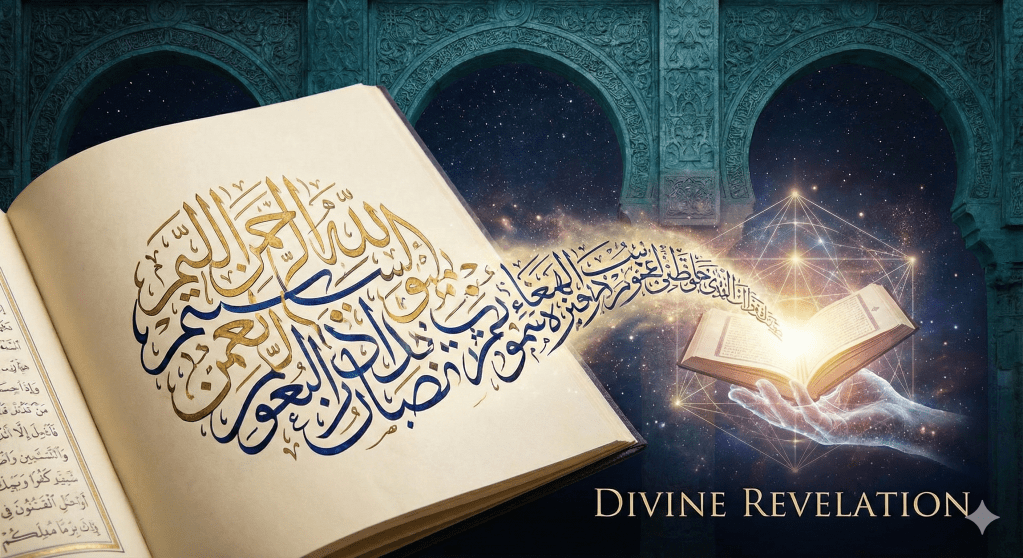
Presented by Zia H Shah MD
Audio teaser:
Abstract
The Arabic language occupies a unique position in the field of linguistics, characterized by a structural depth and systematic organization that challenges the conventional models of gradual, random linguistic evolution. This report conducts a comprehensive evaluation of the Arabic linguistic system, focusing on its non-concatenative morphology, the mathematical precision of its trilateral root system, and the logical rigor of its syntax (nahw) and case inflection (i’rab). By synthesizing evidence from classical philology—specifically the theories of tawqif (divine origin) and al-ishtiqaq al-akbar (the greater derivation)—with modern computational linguistics and psycholinguistic data, the analysis demonstrates that the complexity of Arabic suggests a premeditated and planned architecture rather than a blind process of phonetic drift. The report explores how the triconsonantal root functions as a “linguistic gene,” preserving semantic integrity across an expansive lexical matrix, and how the interrelatedness of nouns and verbs speaks to a unified design. Ultimately, the evidence supports the Quranic proposition that the faculty of language, and the Arabic tongue in particular, is a divinely bestowed gift, designed with the specific objective of serving as a medium for the final, universal revelation to humanity.
The Philosophical Nexus: Random Evolution versus Premeditated Design
The study of linguistic origins has traditionally been divided between two primary paradigms: the evolutionary model, which views language as a product of slow, accidental social conventions, and the design model, which posits a primordial source of organized meaning. In the Islamic tradition, this debate is encapsulated in the tension between istilah (human convention) and tawqif (divine instruction). While modern secular linguistics largely adopts an evolutionary worldview, the specific structural properties of Arabic—its mathematical regularity, semantic density, and aesthetic symmetry—provide a compelling case for the latter.
The complexity of Arabic grammar is not merely a matter of decorative elaboration but is foundational to its functional utility. Unlike many world languages that develop new words through irregular compounding or external borrowing, Arabic builds its entire universe of meanings from a compact set of triconsonantal roots. This “verbal miracle” allows for an extraordinary level of interconnectedness between nouns, verbs, and adjectives, all stemming from a single semantic seed. This report argues that such a high degree of internal logic and systemic cohesion is indicative of a system that was engineered with a specific purpose, echoing the Quranic claim that Allah taught the first human, Adam, “the names of all things”.
The implications of this design are vast. If a language is the result of random processes, one would expect to find a high degree of entropy, irregularity, and semantic drift. However, Classical Arabic exhibits a resistance to these forces, maintaining its core morphological and syntactic rules over fourteen centuries. This stability is facilitated by a mathematical framework that governs word formation, ensuring that even as the language expands to encompass new concepts, it remains tethered to its original logical foundations.
The Trilateral Root: The Genetic Blueprint of Arabic
At the heart of the Arabic language lies the triconsonantal root system, a feature described by philologists as one of the great wonders of human speech. A triliteral or triconsonantal root (jidhr) is a sequence of three consonants that carries a fundamental, abstract meaning. This root serves as the atomic core of phonology and semantics, shaping every lexical word derived from it.
The trilateral root acts much like a biological gene, storing the “generic semantics” of the entire derived word forms while possessing the capacity to generate an almost infinite variety of derivatives. For example, the root K-T-B (ك-ت-ب) carries the abstract concept of “writing”. From this single sequence of three letters, the language generates a massive array of terms, all of which remain semantically linked to the core idea.
| Root (K-T-B) | Derived Word | Meaning | Grammatical Category |
| K-T-B | Kataba | He wrote | Verb (Past Tense) |
| K-T-B | Yaktubu | He writes | Verb (Present Tense) |
| K-T-B | Kitāb | Book | Noun (The Written) |
| K-T-B | Kātib | Writer | Noun (The Doer) |
| K-T-B | Maktūb | Written / Letter | Passive Participle |
| K-T-B | Maktaba | Library / Bookstore | Noun of Place |
| K-T-B | Maktab | Office / Desk | Noun of Place |
| K-T-B | Kitābah | Inscription / Writing | Masdar (Verbal Noun) |
| K-T-B | Kutayyib | Booklet | Diminutive Noun |
| K-T-B | Istaktaba | He asked to write | Verb (Form X) |
The mathematical potential for word generation from this system is staggering. Based on the 28 letters of the Arabic alphabet, the number of possible pure triliteral roots is approximately 28×27×27 (excluding certain phonetic impossibilities), yielding over 20,000 potential roots. In practice, traditional Arabic dictionaries document between 5,000 and 11,347 lexical roots. This structural dominance of the triliteral form (accounting for over 7,000 of the total) over biliteral or quadriliteral forms suggests an optimized design aimed at balancing semantic density with phonetic flexibility.
The Mathematical Rigor of Root Reproduction
Modern computational analysis reveals that the Arabic root is not an infinite value but a finite one, typically restricted between two and five letters. This finite nature allows the language to be modeled as a system of linear functions where the root (r) serves as the constant and the added letters (l) act as independent variables. The process of derivation follows a consistent mathematical standard:
f(x)=ax+b
In this equation, the derived word is the dependent result, where the root provides the base value and the morphological patterns provide the rate of change. The “principle of word construction” dictates that if a root were to reach six letters, the process of derivation would structurally fail, indicating a built-in logical limit that preserves the stability of the language’s “mental lexicon”.
This mathematical precision extends to the “intersection law” of set theory. Every word derived from a specific root belongs to a set defined by those core consonants. The common intersection of all these sets is the root itself:
Seta4∩Seta3∩Seta2=Seta1
where Seta1 represents the primary root. This ensures that despite the extreme complexity of Arabic grammar, the language remains “easily recognizable” and semantically transparent to its speakers. A speaker who encounters an unfamiliar word can immediately isolate its root and grasp its general meaning, a feature that points toward a system designed for maximum communicative efficiency.
Sarf: The Calculus of Morphological Templates
The transformation of a root into its various parts of speech is governed by Sarf (morphology), which utilizes a set of rhythmic templates known as awzan (singular: wazn). These templates are not merely stylistic; they are logical operators that add specific nuances—such as causation, intensity, reciprocity, or seeking—to the core meaning of the root.
There are ten primary verbal forms commonly used in Arabic, each numbered from I to X. By applying a specific wazn to a root, a speaker can alter the meaning in a way that is mathematically predictable and logically consistent across the entire language.
The Ten Primary Verb Forms and Their Logical Nuances
The systematic nature of Arabic is most evident when examining how these ten forms modify a single root to express different shades of intent and action.
| Form | Template (Past) | General Meaning Nuance | Example (K-T-B) | Meaning of Example |
| I | Fa’ala | Basic or default action | Kataba | He wrote |
| II | Fa”ala | Causative or intensive | Kattaba | He made someone write |
| III | Fā’ala | Reciprocal or associative | Kātaba | He corresponded with |
| IV | Af’ala | Causative or transitive | Aktaba | He dictated / made write |
| V | Tafa”ala | Reflexive of Form II | Takattaba | He became written / set himself to write |
| VI | Tafā’ala | Reciprocal of Form III | Takātaba | They corresponded with each other |
| VII | Infa’ala | Passive or reflexive | Inkataba | It was written / became enrolled |
| VIII | Ifta’ala | Intentional or reflexive | Iktataba | He subscribed / copied / registered |
| IX | If’alla | Relates to colors / defects | Ihmara | To turn red (from root H-M-R) |
| X | Istaf’ala | Seeking or asking for | Istaktaba | He asked someone to write |
This system demonstrates a level of “premeditation and planning” because the meaning change is inherent in the structure itself. For instance, moving from Form I (to know – ‘alima) to Form II (to teach – ‘allama) consistently indicates the act of causing another to perform the root action. This allows the Arabic language to sustain an immense vocabulary with fewer base words, as each root can be expanded into dozens of precise semantic states.
The interrelatedness of nouns and verbs in this system is also profound. For every verb form, there is a corresponding active participle (the doer), a passive participle (the object), and a verbal noun (masdar). These derivations are formed according to equally rigid templates, ensuring that the entire linguistic architecture is mutually reinforcing.
The Architecture of Derived Nouns (Root: K-T-B)
| Form | Active Participle (Pattern: Mu-) | Passive Participle (Pattern: Mu-) | Masdar (Verbal Noun) |
| I | Kātib (Writer) | Maktūb (Written) | Kitāba (Writing) |
| II | Mukattib (One making write) | Mukattab (One made to write) | Taktiib (Process of writing) |
| III | Mukaatib (Correspondent) | Mukaatab (One corresponded with) | Mukaataba (Correspondence) |
| IV | Muktib (One dictating) | Muktab (Dictated to) | Iktaab (Dictation) |
| X | Mustaktib (One seeking to write) | Mustaktab (One asked to write) | Istiktaab (Seeking to write) |
The patterns for the active and passive participles from Forms II to X are nearly identical, differing only by a single vowel: an “i” for the doer and an “a” for the object. This binary phonetic switch is a clear example of a logical “switch” built into the language, allowing for instantaneous grammatical differentiation with minimal phonetic effort. Such a streamlined, effective, and perfectly consistent mechanism is a hallmark of intelligent design rather than the messy, irregular shifts found in evolved languages.
Ibn Jinni and Al-Ishtiqaq al-Akbar: The Phonetic Meaning Matrix
One of the most compelling arguments for the premeditated nature of Arabic is the theory of Al-Ishtiqaq al-Akbar (The Greater Derivation), pioneered by the 10th-century linguist Abu al-Fath ‘Uthman Ibn Jinni. While standard morphology deals with words derived from a fixed sequence of root letters, Ibn Jinni observed that the three letters of a triliteral root carry an overarching semantic theme regardless of their order—meaning that all six possible permutations of a root share a common essence.
Ibn Jinni’s analysis of the root J-B-R is a classic case study in this phonetic-semantic symbiosis. He argued that the combinations of Jim, Ba, and Ra consistently revolve around the concepts of “strength,” “force,” or “restoration”:
- J-B-R: Jabara (to force, or to set a broken bone to restore its strength).
- B-R-J: Burj (tower—a structure of great height and strength).
- R-B-J: Rabaj (to be great or self-important, a form of perceived strength).
- B-J-R: Bajir (a strong or large matter).
This suggests that the very sounds of the Arabic alphabet were selected and grouped into roots with a premeditated understanding of their acoustic properties. Ibn Jinni also considered the physical aspect of speech, comparing the occurrence of sounds in the throat and mouth to musical instruments, suggesting that the language was tuned to the human vocal apparatus to maximize both phonetic beauty and semantic clarity.
This level of organization across the entire phonetic spectrum of the language—where even the sequence of letters is subordinate to a higher-order semantic design—is a powerful indicator of a system that was engineered from the top down. It supports the view that the language did not emerge through the random association of sounds and objects but was constructed as a cohesive, multi-layered matrix of meaning.
Nahw and I’rab: The Logic of Synthetic Structure
The complexity of Arabic is not limited to its internal word structure; it extends to the way words are organized into sentences through Nahw (syntax) and I’rab (case inflection). I’rab is the system of changing the vowel marks at the end of words to indicate their grammatical role—whether a word is the subject, the object, or the possessor—independently of its position in the sentence.
In a randomly evolved language, word order usually becomes the primary carrier of grammatical meaning (e.g., in English, “The man saw the lion” is distinct from “The lion saw the man” only by order). In Classical Arabic, however, the meaning is preserved through a rigid system of terminal vowels:
- Rafa’ (Nominative): Indicated by a damma (u), usually marking the subject (Mubtada’).
- Nasb (Accusative): Indicated by a fatha (a), marking the object (Maf’ūl).
- Jarr (Genitive): Indicated by a kasra (i), marking the possessive or object of a preposition.
This creates what linguists call a “symmetric relation” between words, ensuring that the connection between a subject and its predicate is not random but follows a defined mathematical law. The “Theory of the Governor” (al-‘Amil) in Arabic grammar posits that every change in a word’s ending is caused by a preceding functional word or “governor,” creating a chain of causality that mirrors a mathematical proof.
The Mathematical Rigor of I’rab
Modern research into the “mathematical grammar” of Arabic suggests that the language can be analyzed through the lens of symmetric, reflexive, and transitive relations. This mathematical framework ensures that every sentence is a “correct construction” governed by rules that are as precise as computer programming.
| Grammatical State | Vowel Mark | Common Function | Mathematical Property |
| Rafa’ | Damma (u) | Subject / Predicate | Symmetric Relation |
| Nasb | Fatha (a) | Direct Object / Adverb | Dependency Function |
| Jarr | Kasra (i) | Possession / Prepositional Object | Set Membership |
| Jazm | Sukuun (Ø) | Jussive Verb state | Termination Rule |
This level of syntactic rigor is what allowed Classical Arabic to remain a stable medium for law and theology for over a millennium. Because the grammar is built on a logical foundation that is resistant to the ambiguity of word-order shifts, the meanings of the Quranic text remain as precise today as they were in the 7th century.
Psycholinguistic Evidence: The Brain’s Native Recognition of Design
The argument for a premeditated linguistic structure is further bolstered by modern psycholinguistic and cognitive research. Studies using priming techniques have established that native Arabic speakers process their language in a way that is fundamentally different from speakers of non-root-based languages.
Experimental research shows that “roots and word patterns” are processed as independent units in the mental lexicon. When a speaker hears a word, their brain does not merely recognize it as a whole form; it simultaneously activates a fronto-central network that decodes the root and the pattern as separate “files”. This morphological awareness is present from the earliest stages of language acquisition, as children are taught—and intuitively grasp—that roots and patterns are the building blocks of their reality.
Furthermore, brain response studies using electroencephalography have found that roots are supported by a bi-hemispheric network, indicating that the trilateral system is deeply embedded in the cognitive architecture of the human mind. The fact that the human brain is uniquely optimized to process the non-concatenative morphology of Arabic suggests a deep-seated alignment between the “hardware” of the human intellect and the “software” of the Arabic language. This “quasi-systematic occurrence of the root/pattern structure” encourages the exploitation of morphological composition, helping readers recover information even when the short vowels (diacritics) are absent. This suggests that the language was designed to be resilient, allowing for communication even under conditions of limited phonetic information.
The Quranic Matrix: Mathematical Balance as Ultimate Proof
The claim that Allah taught human beings language reaches its zenith in the evaluation of the Quranic text, which is viewed not just as a religious scripture but as a “literary masterpiece” and a “unique and matchless perfection of language”. The Quran challenge—to produce even a single surah like it—rests on the observation that its linguistic architecture is so complex and mathematically balanced that it could not be the product of human genius alone.
The Mathematical Balance of the Quran
The Quran exhibits intricate numerical relationships and word patterns that create a “mathematical matrix” throughout the text. This dimension of the language provides evidence of divine authorship, as such complex relationships could not result from random linguistic evolution.
- Symmetry of Keywords: Many terms are mentioned in the Quran in perfect numerical balance with their opposites (e.g., life and death, world and hereafter).
- Surah Structure: Surah Al-Muddaththir (Chapter 74) has been identified as a key component in a numerical coding system based on the number 19. The Basmala itself, the opening formula of nearly every surah, consists of exactly 19 letters.
- Linguistic Balance in Surah Al-Ikhlas: This short chapter exhibits a perfect balance of words, with seven words at the beginning and seven at the end, centered around a middle word that distinguishes between divine attributes and human characteristics. The middle letter of the surah is Lam, the 23rd letter of the alphabet, mirroring the 23 pairs of human chromosomes—a symbolic link between revelation and biological creation.
This “astronomical precision” inspired Islamic mathematicians during the Golden Age to recognize mathematics as the language through which the divine design of the cosmos becomes comprehensible to human intellect. The fact that the same mathematical precision is found in the grammar of the Arabic language and the structure of the Quran suggests they are two expressions of the same premeditated plan.
The Tawqif vs. Istilah Debate: Philological Reflections
The historical scholars who championed the theory of tawqif (divine origin) did so based on the observation that Arabic is a “system of signs” that is too perfectly aligned with its meanings to be arbitrary. Ibn Faris (d. 395 AH), a prominent proponent of this view, argued that language must be a gift from God because human beings, in their primitive state, would not have had the cognitive or communicative tools to invent a system as complex as Arabic.
Ibn Hazm (d. 456 AH) added a logical layer to this, noting that God provided human beings with the physical organs of speech—the throat, lungs, teeth, and lips—precisely because they were intended to be used for the high-level articulation found in the Arabic tongue. He argued that language is the primary tool through which we understand the speech of God, and therefore, the language itself must be part of the divine provision.
| Scholar | Primary Work | View on Origin | Core Argument |
| Ibn Jinni | Al-Khasa’is | Intermediate / Dialectical | Language is defined by sounds; uses permutations to find deep semantic roots. |
| Al-Suyuti | Al-Muzhir | Tawqif (Divine) | Arabic is essential for Law; it is a religious obligation to study its divine architecture. |
| Ibn Hazm | Al-Ihkam | Tawqif (Divine) | Logical impossibility of convention; human anatomy is designed for speech. |
| Ibn Faris | Al-Sahibi | Tawqif (Divine) | Scripture explicitly states Allah taught Adam the names. |
While some later scholars accepted that a process of istilah (convention) might have played a role in the development of certain dialects, the foundational “mother” of the language—the Classical Arabic of the Quran—was consistently viewed as a divinely protected and premeditated system. The transition from Classical Arabic to Modern Standard Arabic highlights how the language has naturally “lost” half of its trilateral roots over time as it shifted from a divine-centric to a utility-centric application, further emphasizing that the original Classical form represented a peak of linguistic complexity that has only degraded through human usage.
Thematic Epilogue: The Language Built for Eternity
The evaluation of the Arabic language—from its trilateral genetic blueprint and the mathematical calculus of its morphology to the logical rigor of its syntax and the phonetic-semantic symbiosis described by Ibn Jinni—presents a portrait of a system that is fundamentally non-random. The sheer complexity and systematic organization of Arabic do not resemble the chaotic and irregular drift associated with blind evolutionary processes. Instead, they speak of a premeditated plan, a “linguistic geometry” that mirrors the unity and order found in the Islamic worldview.
Arabic offers a compelling model of a linguistic structure rooted in meaning rather than mere utility. Its non-concatenative morphology functions as a preservative mechanism, ensuring that even as the language adapts to new ages, its core meanings remain anchored in a divine matrix. This “verbal miracle” is perfectly suited for its role as the medium of the final revelation, a message intended for all people and all times.
Ultimately, the study of Arabic supports the Quranic claim that language is a gift from Allah—a faculty bestowed upon humanity to allow for the comprehension of the Divine will. The mathematical balance of its structure, the psycholinguistic evidence of its unique cognitive processing, and the historical preservation of its grammar all point to a single conclusion: Arabic is a language built for eternity, an engineered miracle of sound and meaning that could only have originated from the Source of all Knowledge. As the “language of Paradise,” it remains the ultimate expression of human potential in the realm of speech, a testament to the premeditation and planning of the Creator who taught humanity that which they knew not.


 The Glorious Quran and Science
Leave a comment