
For the website to explore the Quranic concordance to experience the miracle of the language and the literal word of God: click here
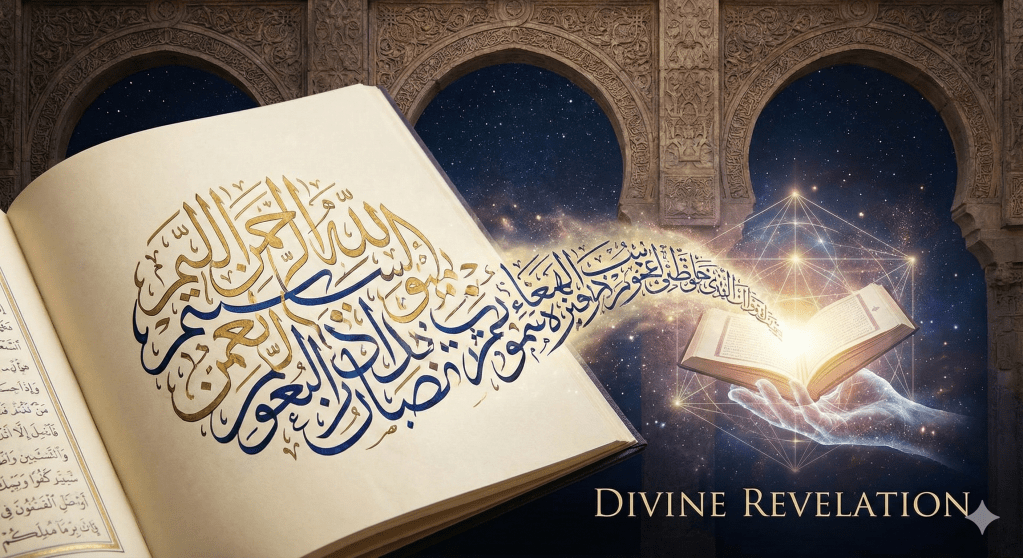
Presented by Zia H Shah MD
Abstract
The Arabic language is not merely a vehicle for communication but a “clear Arabic language” (lisānun ‘arabiyyun mubīn) designed for profound understanding [16:103]. This report evaluates the structural depth of Arabic, arguing that its systematic organization challenges the models of random linguistic evolution. By examining the mathematical precision of the trilateral root system, the logical rigor of i’rab (case inflection), and the specific Quranic claims regarding linguistic clarity, the analysis demonstrates that Arabic serves as a premeditated tool for guidance. Incorporating the diverse signs of human speech and the necessity of messengers speaking the language of their people [14:4], this study posits that the complexity of Arabic is a divinely bestowed faculty designed to ensure the message remains “without any deviance”.
The Divine Nexus: Diversity and Clarity as Signs
The Quran frames the existence of diverse human languages as one of the primary “signs” (ayat) for those who possess knowledge. Surah Ar-Rum states, “And of His signs is the creation of the heavens and the earth, and the diversity of your languages and your colors”. This diversity is not a product of accidental drift but a purposeful creation of the Divine.
Within this spectrum of linguistic diversity, Classical Arabic was selected as the medium for the final revelation specifically for its clarity. The Quran asserts that it was sent down as an “Arabic Qur’an that you might understand” [12:2] and as a “Book whereof the verses are explained in detail… for people who know” [41:3]. This suggests that the internal logic of the language is optimized for human cognition, allowing for complex theological and legal concepts to be explained with unparalleled precision.
The principle of “Messenger-Language Congruence” outlined in Surah Ibrahim—”And We did not send any messenger but with the language of his people, so that he might explain to them clearly” [14:4]—highlights that language is a tool for clarity. In the case of Arabic, this clarity is achieved through a structural architecture that is unique in its “textural efficiency,” conveying maximum power with minimal linguistic input.
The Trilateral Root: A Blueprint for Guidance
The Arabic language builds its universe of meanings from a compact set of triconsonantal roots, a system so logical it has been described as a “verbal miracle”. This root system acts as a genetic blueprint, preserving the core semantics of a word even as it undergoes complex transformations. This inherent organization supports the Quranic description of the text being “without any deviance”, as the root system prevents semantic drift by keeping every derivative tethered to its original logical foundation.
| Root (K-T-B) | Derived Word | Meaning | Quranic/Linguistic Nuance |
| K-T-B | Kataba | He wrote | Basic act of recording/prescribing |
| K-T-B | Kitāb | Book | A “confirming Book” |
| K-T-B | Kātib | Writer | The doer/recorder |
| K-T-B | Maktūb | Written | That which is decreed or inscribed |
| K-T-B | Maktaba | Library | A place of collected knowledge |
| K-T-B | Istaktaba | He asked to write | Seeking the act of preservation |
The mathematical potential of this system is vast. With 28 letters, over 20,000 potential trilateral roots can be formed, though the language utilizes a finite set (approx. 5,000 to 11,347) to maintain stability and ease of recognition. This finite yet expansive nature reflects a system designed for a “people who know” [41:3], providing them with a medium that is both mathematically rigorous and semantically transparent.
Sarf: The Logic of Detailed Explanation
The transformation of roots into specific templates (awzan) is the mechanism by which the Quran “diversifies… the warnings” [20:113] and explains verses “in detail” [41:3]. Sarf (morphology) allows a single root to express nuanced shades of intent—such as causation, reciprocity, or seeking—in a way that is perfectly predictable.
The 10 Primary Verb Forms: Mapping Clarity and Intent
The systematic nature of Arabic is most evident in how these forms modify a root to ensure that the message is explained “clearly” [14:4].
| Form | Pattern | General Nuance | Example (K-T-B) | Meaning in Context |
| I | Fa’ala | Basic action | Kataba | He wrote |
| II | Fa”ala | Intensive/Causative | Kattaba | He made to write (Taught) |
| III | Fā’ala | Reciprocal | Kātaba | He corresponded with |
| IV | Af’ala | Causative | Aktaba | He dictated |
| V | Tafa”ala | Reflexive of II | Takattaba | He set himself to write |
| VI | Tafā’ala | Reciprocal of III | Takātaba | They corresponded mutually |
| VII | Infa’ala | Passive | Inkataba | It was written (Enrolled) |
| VIII | Ifta’ala | Intentional | Iktataba | He subscribed/copied |
| IX | If’alla | Rare (Colors) | Ihmara | To turn red |
| X | Istaf’ala | Seeking | Istaktaba | He asked for a writing |
Note: The Form IX verb of kataba (كَتَبَ – to write) is theoretically اِكْتَبَّ (iktabba). However, in practical Arabic usage, Form IX is used almost exclusively for colors and physical defects (e.g., iḥmarra – to turn red), so iktabba is considered a rare or non-existent construct in standard, everyday Arabic.
This structural consistency ensures that even the most complex verbal modifications remain “clear” (mubīn). In Form X, for example, the addition of the prefix ista- consistently denotes “seeking,” turning the root for “forgiveness” into “seeking forgiveness.” Such logical “switches” point toward a language engineered for the “guidance and good news” mentioned in Surah Al-Ahqaf.
Nahw and I’rab: Consistency Without Deviance
The logic of Arabic extends to its syntax (Nahw) and case inflection (I’rab). The Quran describes itself as being “without any deviance that they might become righteous”. In linguistic terms, this “lack of deviance” is manifested in a rigid system of terminal vowels that preserve the grammatical role of words regardless of their position in a sentence.
- Rafa’ (Nominative): Marks the subject, indicating the source of action.
- Nasb (Accusative): Marks the object, indicating the recipient.
- Jarr (Genitive): Marks the possessive or prepositional relationship.
This creates a “symmetric relation” between words, where the connection is governed by a defined mathematical law rather than random word order. Modern computational studies have even compared the precision of Arabic syntax to computer programming, noting its reliance on the “Theory of the Governor” (al-‘Amil), where every change is the result of a logical cause.
Table: The Grammatical Safeguards of Arabic
| Feature | Function | Quranic Implication | Linguistic Property |
| I’rab | Vowel mark endings | Prevents ambiguity | Synthetic Precision |
| Ishtiqaq | Root derivation | Semantic integrity | Logical Consistency |
| Mubīn | Clear language | Direct understanding | Cognitive Optimization |
| Ghayra dhi ‘iwaj | No deviance | Reliability of Law | Structural Stability |
Divine Origin and the Faculty of Speech
The classical debate between tawqif (divine origin) and istilah (convention) is resolved in the Quranic assertion that Allah “taught Adam the names of all things”. This suggests that the faculty of speech is a purely gifted power. Ibn Hazm (d. 456 AH) argued that the physical organs of speech—the throat, tongue, and lips—were specifically designed to articulate the sounds of a language as complex as Arabic.
Modern psycholinguistic research supports this by showing that the human brain is uniquely optimized to process the “root-and-pattern” structure of Arabic. Brain response studies indicate that roots are decoded in the mental lexicon as independent units, suggesting a bi-hemispheric alignment between the mind’s hardware and the language’s software. This “morphological awareness” allows speakers to recover information even when diacritics are absent, ensuring that the “clear Arabic language” remains functional across centuries of use.
Thematic Epilogue: The Tool for Clarity and Guidance
The evaluation of the Arabic language reveals a system of “astronomical precision” that mirrors the unity and order found in the heavens and the earth. From the genetic-like trilateral root to the mathematical templates of its verbs and the rigid logic of its case markings, every facet of Arabic points toward a premeditated design.
This design is not an end in itself but a means to achieve the Quran’s primary goal: “that you might understand” [12:2]. By providing a “clear Arabic language” [16:103] that is “without any deviance”, the Creator provided humanity with a medium for guidance that is resistant to the entropy of time and the ambiguity of human convention. Arabic stands as a confirming sign—a linguistic miracle that serves as the ultimate proof that the Source of the message is also the Architect of the tongue.



 The Glorious Quran and Science
Leave a comment