
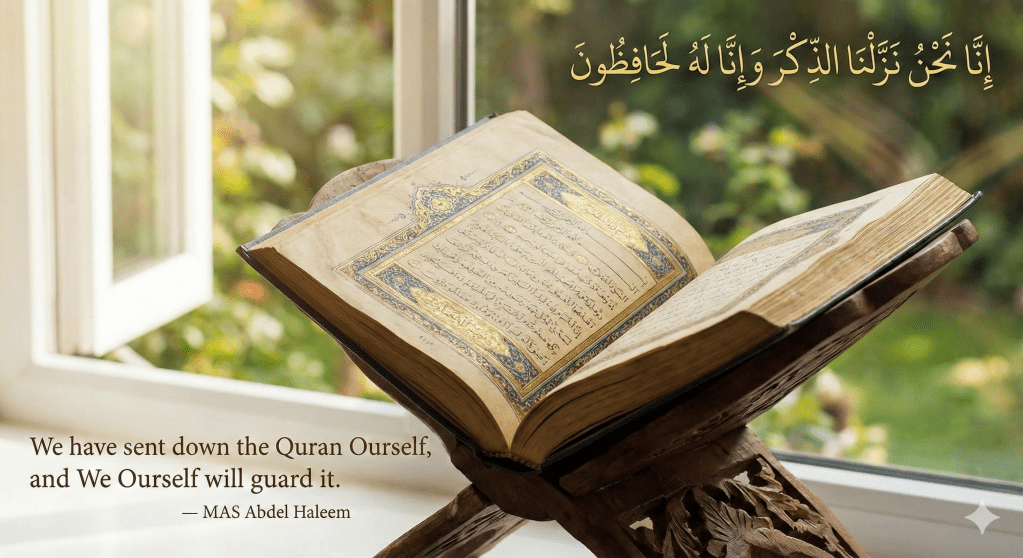
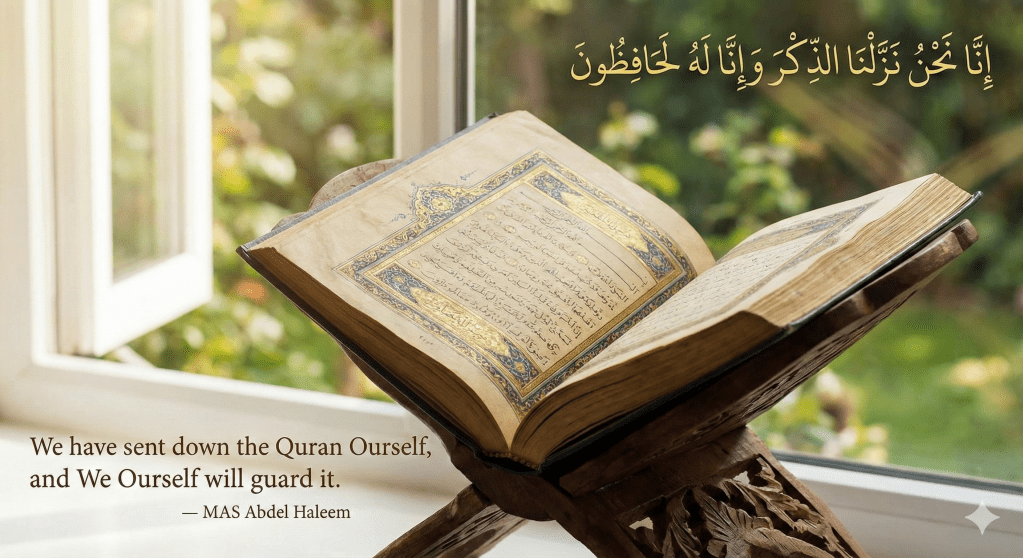
Presented by Zia H Shah MD
Science and History Verify the Quran’s Text
Audio teaser:
Abstract
This research report provides an exhaustive commentary on Quran 15:9, a pivotal verse that serves as the scriptural foundation for the Islamic doctrine of textual integrity and divine preservation. Known as Ayat al-Hifz (the Verse of Protection), the passage declares, “Indeed, it is We who sent down the Reminder, and indeed, We will be its guardian.” The report deconstructs the verse through a multifaceted lens, beginning with a rigorous linguistic analysis of its emphatic Arabic syntax, which utilizes multiple layers of rhetorical reinforcement to assert divine exclusivity in the protection of the message. Central to this investigation is the intersection of classical Islamic exegesis—incorporating the views of authorities such as Ibn Kathir, Al-Tabari, and contemporary scholars—with the critical assessments of non-Muslim Orientalists and historians. A primary focus is accorded to the testimonies of non-Muslim writers, most notably Sir William Muir, whose 19th-century scholarship, despite its polemical undercurrents, famously conceded the unrivaled textual purity of the Quranic recension. The report further examines the “vertical” and “horizontal” dimensions of preservation, the role of oral tradition (memorization) as a primary safeguard, and the corroboration provided by modern carbon-dated manuscripts such as the Birmingham and Topkapi codices. By synthesizing theological claims with historical-critical evidence, the analysis demonstrates how the Quranic concept of Dhikr (the Reminder) has maintained an unprecedented level of consistency across fourteen centuries, distinguishing its textual history from that of other world scriptures. The report concludes with a thematic epilogue reflecting on the implications of a “living text” for the historical and religious consciousness of humanity.
Linguistic and Rhetorical Foundations of the Divine Promise
The Arabic phrasing of Surah Al-Hijr 15:9 is characterized by a density of emphasis and rhetorical sophistication that signifies absolute certainty within the linguistic framework of the Quran. The verse reads: Inna nahnu nazzalna al-dhikra wa inna lahu la-hafizun. To a professional grammarian or a scholar of Balagha (rhetoric), the sentence structure is designed to leave no room for doubt, employing multiple linguistic “stressors” to reinforce the claim of divine guardianship.
The verse begins with the particle Inna, an intensive tool of confirmation (ta’kid) that establishes the indisputable nature of the following statement. This is immediately followed by the independent plural pronoun nahnu (We), creating a semantic doubling that underscores the agency of the Speaker. In Arabic syntax, the presence of both the particle Inna (which already contains a pronominal suffix) and the separate pronoun nahnu serves to isolate the subject and provide a high degree of intensification. This “Plural of Majesty” does not denote number but rather the grandeur, power, and sovereign authority of the Creator who has taken the task of preservation upon Himself.
The verb used, nazzalna (We have revealed/sent down), is in the fa’ ‘ala intensive form, which in the Quranic lexicon typically signifies a gradual, step-by-step revelation over a period of time. This term is applied to the Quran specifically as the Dhikr—a term meaning “the Reminder,” “the Mention,” or “the Admonition”. By defining the Quran as Dhikr, the verse implies that the revelation is an active, living process of reminding humanity, rather than a mere static archive.
| Linguistic Component | Grammatical Category | Rhetorical Function | Theological Implication |
| Inna | Particle of Emphasis | Establishes primordial certainty | Removes the possibility of doubt (shakk). |
| Nahnu | Separate Pronoun | Subject intensification | Asserts divine exclusivity and grandeur. |
| Nazzalna | Intensive Verb (Taf’eel) | Denotes gradual descent | Indicates a purposeful, protected timeline of revelation. |
| Al-Dhikr | Definite Noun | Direct object identification | Identifies the Quran as the ultimate Reminder. |
| La- | Emphatic Lam | Predicate reinforcement | Provides an insurmountable layer of certainty. |
| Hafizun | Active Participle (Plural) | Describes the state of being | Constant, unceasing guardianship. |
The concluding segment of the verse, wa inna lahu la-hafizun, mirrors the emphasis of the first. The use of the prepositional phrase lahu (for it) before the active participle hafizun (guardians) functions as a mechanism of restriction (hasr), signaling that Allah is the primary and sole ultimate guardian of this specific revelation. Finally, the Lam attached to hafizun is the Lam al-mazlaqa (the sliding Lam), used in Arabic rhetoric to provide the final, absolute confirmation of the predicate. This syntactic architecture suggests that the preservation is not an accidental byproduct of history but an intentional, divinely managed outcome.
Classical Exegesis and the Comparative Scriptural Framework
The commentary on Surah Al-Hijr 15:9 within the Islamic tradition, particularly by figures such as Ibn Kathir and Al-Tabari, establishes a sharp theological contrast between the Quran and previous revealed scriptures. This distinction is central to understanding why Muslims believe the Quran has remained intact while they view other texts as having suffered from Tahrif (textual or semantic alteration).
Imam Al-Qurtubi and other classical exegetes cite a compelling narrative from the court of the Abbasid Caliph Al-Ma’mun to illustrate this point. The story involves an elegant and eloquent Jewish man who participated in a courtly debate and was subsequently invited by the Caliph to embrace Islam. The man declined, wishing to remain on the religion of his forefathers. To test the integrity of different scriptures, the man carefully transcribed three copies of the Torah, making subtle but intentional additions and deletions in each, and presented them to a synagogue, where they were accepted without question. He repeated this with the Gospel, and again, the corrupted versions were accepted by the ecclesiastical authorities. Finally, he transcribed the Quran, making similar alterations, but every mosque and scholar he presented them to immediately identified the errors, as the text was memorized in their hearts. The man subsequently embraced Islam, realizing that the Quran was uniquely protected by a mechanism beyond human intervention.
This anecdote underscores the theological interpretation of Quran 5:44, where the Quran notes that the Jews and Christians “were entrusted with the responsibility of protecting” their books (bima istuhfizu min kitab Allah). The classical view posits that because the protection of the Torah and Gospel was a human duty, it was subject to human failure. In contrast, in Quran 15:9, Allah takes the guardianship upon Himself: “And We are there to protect it”.
The exegetical tradition also grapples with the object of the protection. While the majority of scholars, including Allama Tabataba’i and Ibn Kathir, maintain that the pronoun “it” (lahu) refers to the Dhikr (the Quran), a minority view suggested it might refer to the Prophet Muhammad himself, implying he would be protected from his enemies. However, mainstream scholarship rejects this narrow interpretation, noting that the context of the surrounding verses—where the disbelievers mock the “Reminder” being sent down—clearly points to the text of the revelation as the subject of the divine safeguard.
Furthermore, modern analysis by scholars like Albayrak identifies two distinct routes of preservation implied by the verse: the “vertical” and the “horizontal”. The vertical route represents the perfect transmission from God to the Prophet via the Angel Gabriel, a process guaranteed by divine power to ensure the Prophet’s perfect memorization and initial delivery. The horizontal route refers to the transmission of the text across time and space, from the Prophet’s companions to subsequent generations. While the horizontal process involves human agency, the divine promise of 15:9 acts as an over-arching guarantee that ensures the community’s consensus (ijma) and the institution of Hifz (memorization) remain effective barriers against corruption.
The Historical Testimony of Sir William Muir
Sir William Muir (1819–1905), a Scottish Orientalist and historian of Islam, provides some of the most frequently cited non-Muslim testimonies regarding the integrity of the Quranic text. Muir’s scholarship is particularly significant because he was a committed Christian missionary and a high-ranking British colonial official who was often overtly critical of Islamic theology and the character of the Prophet Muhammad. His willingness to affirm the purity of the Quranic text, therefore, is viewed by many as an objective historical concession that transcends his personal biases.
In his monumental four-volume work, The Life of Mahomet, Muir examined the process by which the Quran was recorded and compiled. He described the state of the Quran during the Prophet’s lifetime as a collection of “multitudinous revelations” that were preserved through a dual mode of faithful memorization and sporadic writing on primitive materials such as date-leaves, tablets of white stone, and the “breasts of men”. Despite the lack of a single bound volume during the Prophet’s life, Muir acknowledged that a basic structure of Surahs (chapters) existed and was used for daily prayers and private recitation.
Muir’s most definitive statement on the subject appeared in his discussion of the Uthmanic recension—the standardization of the text under the third Caliph, Uthman ibn Affan. Muir observed that the recension of Uthman had been handed down to subsequent generations unaltered, noting that there are “no variations of importance—we might almost say no variations at all—among the innumerable copies of the Koran scattered throughout the vast bounds of the empire of Islam”. He famously concluded: “There is probably in the world no other work which has remained twelve centuries with so pure a text”.
Muir’s assessment of the Quranic text’s purity was not a theological endorsement but a historical observation based on the “consensus” of the Muslim world across geographical and sectarian divides. He pointed out that even embittered factions, such as those that arose within a quarter of a century of the Prophet’s death following the murder of Uthman, continued to use the exact same Quran. This “consentaneous use” by all groups, despite their political and theological rivalries, served as “irrefragable proof” that the text in use was identical to the one prepared under the Caliph Uthman.
| Work by Sir William Muir | Key Subject | Central Historical Conclusion |
| The Life of Mahomet | Quranic Compilation | The Uthmanic text has been preserved with scrupulous precision. |
| The Life of Mahomet | Textual Integrity | No other work in the world has remained 1,200 years with such a pure text. |
| The Life of Mahomet | Comparative History | The Quran’s consistency is unique among world scriptures. |
| The Life of Mahomet | Sectarian Evidence | All Islamic sects, despite deep divisions, utilize only one Quran. |
Muir’s insights highlight that the divine promise of 15:9 was realized through a robust historical mechanism. The fact that the Quran was the “corner-stone of Islam” and that its daily repetition was a religious duty ensured that any attempt at alteration would have been immediately detected by a community that held the text as its supreme law and guide.
Broader Western Scholarly Consents and Modern Historical Criticism
The perspective shared by Sir William Muir is echoed by a broad spectrum of Western scholars, many of whom have expressed amazement at the historical consistency of the Quranic text. These scholars, writing from a variety of academic and religious backgrounds, have provided a “chorus of testimony” that corroborates the traditional Islamic narrative of preservation.
Hamilton A.R. Gibb, one of the leading Orientalists of the 20th century, affirmed that it is “reasonably well established that no material changes were introduced” to the Quranic text and that the original contents of the Prophet’s discourses were preserved with “scrupulous precision”. Similarly, the British Orientalist Stanley Lane Poole, a Professor of Arabic studies at Dublin University, remarked on the “immense merit” of the Quran in that “there is no doubt as to its genuineness,” allowing the modern reader to encounter the very words of the Prophet with full confidence.
Philip Hitti, a Maronite Christian historian and a pioneer in Arabic Studies in the United States, drew a sharp contrast between the Quran and the Bible. Hitti noted that “modern critics agree that the copies current today are almost exact replicas of the original mother-text” and cited a Semitic scholar’s observation that “there are probably more variations in the reading of one chapter of Genesis in Hebrew than there are in the entire Koran”. This statistical comparison highlights the anomaly of the Quran’s stability when placed alongside the textual history of other major religious traditions.
While mainstream scholarship largely accepts the integrity of the Uthmanic recension, a sub-discipline of “revisionist” historical criticism arose in the late 20th century, led by figures such as Theodor Nöldeke and Arthur Jeffery. These researchers applied the “historical-critical method”—originally developed for biblical studies—to the Quran, questioning the traditional accounts of its compilation.
Nöldeke, in his foundational work Geschichte des Qorans (History of the Quran), was critical of certain aspects of the Uthmanic standardization, suggesting that Uthman’s policies were partly motivated by political consolidation. Yet, even Nöldeke conceded that the Uthmanic text was as “complete and loyal” to the original as could realistically be expected. He acknowledged that “everything speaks in favor of the fact that the text of the Othmanic Quran was so complete and faithful as one could only expect”.
Arthur Jeffery’s work focused on “rival codices”—variant versions of the Quran purportedly held by companions such as Ibn Mas’ud and Ubayy bin Ka’b. Jeffery argued that the Quranic text was in a “fluid state” before Uthman and that many verses may have been lost when their memorizers died in battle. However, the variants Jeffery collected were largely synonymous substitutions (e.g., using a different Arabic word for “king”) or explanatory additions that did not alter the fundamental message or legal rulings of the Quran. Furthermore, Jeffery himself noted that “not sufficient [material] has survived to enable us to get a real picture of the text of any one of them,” admitting that his “reconstructions” were largely speculative and based on late reports rather than physical manuscripts.
Manuscript Corroboration and Scientific Validation
The divine promise of preservation in 15:9 has received significant empirical support through the scientific analysis of early Quranic manuscripts. The emergence of radiocarbon dating technology has allowed researchers to verify the age of parchment and ink, providing a material timeline that aligns remarkably with the traditional Islamic history of the text.
The Birmingham Quran Folios
One of the most significant breakthroughs in modern Quranic studies occurred in 2015 with the discovery and dating of the Birmingham Quran manuscript. Radiocarbon analysis conducted by the University of Oxford placed the parchment between 568 and 645 CE with 95.4% accuracy. This result is extraordinary, as it indicates the manuscript could have been written during the life of the Prophet Muhammad or within two decades of his death.
The Birmingham folios contain portions of Surahs 18 (Al-Kahf), 19 (Maryam), and 20 (Ta-Ha), written in an early Hijazi script. Crucially, the text found on these leaves is identical in wording and sequence to the standard Quran read today. This suggests that the text of these specific surahs was already fixed in its modern form while the Prophet was still alive or shortly thereafter, providing a physical link to the very dawn of Islam.
The Topkapi and Sanaa Discoveries
The Topkapi manuscript in Istanbul and the Samarkand (Tashkent) codex have long been tradition-attributed to the era of Caliph Uthman. While some modern paleographers date these specific copies to the late 1st or early 2nd century of the Hijra, they demonstrate a complete Quranic corpus that matches the modern text with nearly 100% precision.
The Sanaa manuscript, discovered in 1972 in the Great Mosque of Sanaa, Yemen, offered a more complex textual history. The manuscript is a palimpsest—a parchment where the original text (the “lower text”) was erased to make room for a new one (the “upper text”). While the upper text is a standard Uthmanic Quran from the late 7th century, the lower text contains variations in surah order and some minor lexical variants. Revisionists initially touted this as proof of a “competing” Quran. However, more nuanced research by scholars like Behnam Sadeghi and Asma Hilali suggests that the lower text likely represents the private codex of a companion that was later corrected to match the official standardization—a process that actually confirms the historical reports of Uthman’s codification.
| Manuscript | Estimated Date (Radiocarbon/Paleographic) | Coverage | Textual Consistency |
| Birmingham | 568–645 CE (95.4% accuracy) | Surahs 18, 19, 20 (fragments) | Identical to modern standard text. |
| Topkapi | Late 7th – Early 8th Century CE | ~97% of the Quran | Near-perfect consistency with modern text. |
| Sanaa (Upper) | Late 7th Century CE | Various fragments | Fully conforms to Uthmanic standard. |
| Sanaa (Lower) | 578–669 CE (95% accuracy) | Various fragments | Contains minor lexical variants; surah order differs. |
These material findings demonstrate that the “Remembrance” mentioned in 15:9 achieved a high degree of stability almost immediately. The “gray zone” between oral revelation and a fixed written text, which often spans centuries in other religions, was in the case of the Quran reduced to a single generation.
Mechanisms of Preservation: The Orality and the Script
The fulfillment of the promise in Quran 15:9 is not viewed by Islamic tradition as a magical intervention that occurs in a vacuum, but as a result of a sophisticated socio-religious infrastructure. This infrastructure is built on two primary pillars: mass memorization (Hifz) and the standardization of orthography.
The Primacy of Orality
The word Quran itself means “Recitation,” and the text was primarily an oral phenomenon for its first decades. The preservation of the Quran differs from the Western bibliographic model in that the written page was always intended as a secondary aid to the human memory. The Prophet Muhammad was known to be Ummi (unlettered), and he received the revelation orally from Gabriel. He then recited it to his followers, many of whom were poets and masters of the Arabic language, accustomed to memorizing thousands of lines of poetry.
The institution of Hifz created a “living text”. In every generation, thousands—and eventually millions—of individuals memorized the entire Quran from start to finish. This created a system of Tawatur (mass-parallel transmission), where it became statistically impossible for a change to be introduced without being immediately detected. As Mufti Taqi Usmani and other scholars have noted, even if every physical copy of the Quran were to vanish today, the book could be reconstructed with total accuracy by gathering a group of Huffaz (memorizers) from different parts of the world.
The Evolution of the Mushaf
While the oral tradition was the primary safeguard, the written text underwent a carefully managed evolution to ensure that the “Remembrance” was not lost as the empire expanded to non-Arab lands. The early Uthmanic codices were written in a Rasm—a consonantal skeleton without dots (diacritics) or vowel marks. While this might seem “defective” to a modern reader, it was a precise representation for the 7th-century Arabs who already had the text memorized.
Over time, dots were added to distinguish similar-looking letters (e.g., Ba, Ta, Tha), and vowel marks (Harakaat) were introduced to ensure the correct grammatical reading. Western critics like Arthur Jeffery sometimes label this “tampering”. However, Islamic scholarship views these as necessary tools to preserve the original oral pronunciation, much like adding punctuation or pronunciation guides to a text. The consensus of the community (Ijma) was required for these orthographic changes, ensuring that the “consonantal skeleton” remained unchanged while the external markings ensured that even non-Arabs could recite the text exactly as the Prophet had.
Thematic Epilogue: The Living Reminder and the Architecture of Truth
The analysis of Surah Al-Hijr 15:9 reveals a remarkable synthesis of linguistic precision, theological conviction, and historical evidence. The verse stands as a sentinel at the heart of the Quran, making a claim that is at once simple and profound: that God Himself has guaranteed the survival of His message. For the believer, this is a miracle that confirms the divine origin of the text. For the historian, it is a unique case study in textual stability and the power of communal memory.
The linguistic deconstruction of the verse—with its triple emphasis and its use of the intensive particle Inna and the plural of majesty Nahnu—reflects the architecture of a truth that is intended to be unshakeable. It is a “Reminder” that does not merely point toward the past but lives in the present through the unceasing recitation of millions. The distinction between the human stewardship of previous scriptures and the divine guardianship of the Quran remains a central pillar of Islamic self-understanding, framing the Quran as the final, immutable criterion (Al-Furqan) for all prior revelations.
The testimonies of non-Muslim writers, most strikingly Sir William Muir, provide an external validation that is difficult to dismiss. That a man of Muir’s background and purpose—a man who dedicated his life to advancing the Christian missionary cause and who was often a harsh critic of Islam—could state that the Quran is perhaps the only work in the world to remain so pure over twelve centuries is a testament to the sheer weight of the historical evidence. Muir’s “unaltered recension” and Hitti’s comparison with the variants of Genesis underscore the statistical anomaly of the Quranic text’s preservation.
Modern scientific methods, including the radiocarbon dating of the Birmingham folios, have added a new dimension to this inquiry. They have shown that the “Remembrance” mentioned in 15:9 was not a late creation of an established empire, but a message that was fixed and recorded while the dust of the first conquests was still settling. These physical artifacts serve as a bridge between the spiritual claim of revelation and the mundane world of parchment and ink, confirming that the Quran used today is indeed the same version that emerged from the Arabian Peninsula fourteen hundred years ago.
Ultimately, the preservation of the Quran as promised in 15:9 is a phenomenon of “Living History.” It is preserved not just in museums or libraries, but in the “breasts of men” and women across every continent. The oral and the written, the vertical and the horizontal, the divine and the human—all these forces have converged to create a scriptural integrity that is unrivaled in the annals of human literature. Surah Al-Hijr 15:9 is thus not just a verse; it is the seal of a promise that has shaped the history of millions and continues to stand as a unique monument to the concept of a preserved divine word.


 The Glorious Quran and Science
Leave a comment