
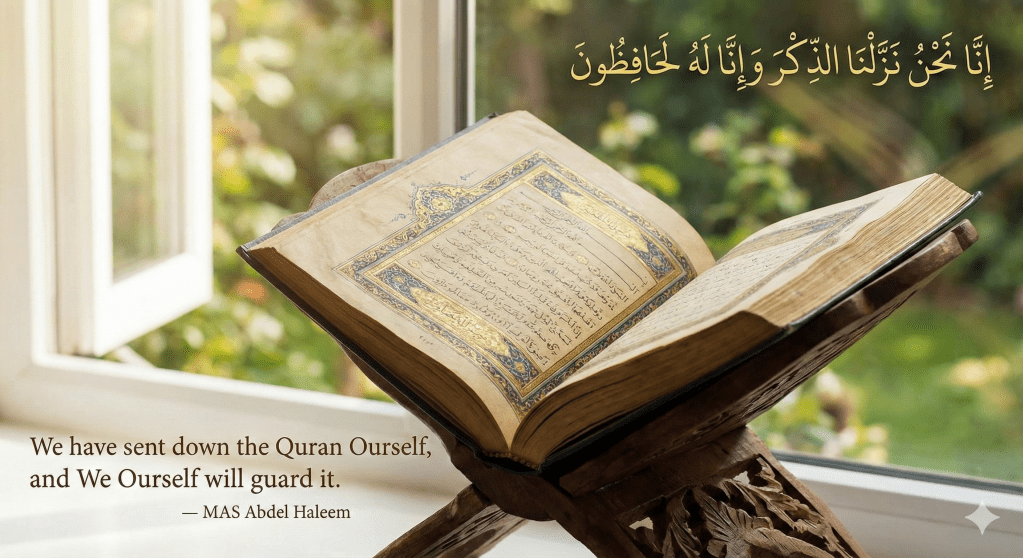
Presented by Zia H Shah MD
Executive abstract
Quran 15:9—“Indeed, We sent down the Reminder, and indeed We are its guardian”—is among the most frequently cited scriptural bases for the Islamic claim that the Qur’an is divinely protected from corruption. The verse’s force depends on three interlocking layers: (a) its rhetorical–linguistic structure (divine “We,” emphasis particles, and a future-oriented promise of guarding), (b) its classical exegetical construal (what “the Reminder” denotes and what “guarding” practically entails), and (c) the historical–material record (early codex standardization narratives, manuscript witnesses, radiocarbon dating, and controlled variation through readings/qirāʾāt).
Across major Sunni tafsīr traditions, the dominant interpretation is that “the Reminder” (al-dhikr) here means the Qur’an itself, and that God’s “guarding” prevents substantive loss or interpolation—often glossed as protection against satanic/sectarian tampering. Some exegetes also record a minority view that the pronoun “it” refers to the Prophet (i.e., divine protection of the Messenger), but they generally judge the Qur’an-referent to be the stronger reading in context.
On textual history, early Islamic tradition foregrounds a two-stage process: compiling written/remembered materials after the Battle of Yamāmah (under Abū Bakr) and later producing standardized exemplars and suppressing divergent codices during ʿUthmān’s caliphate. Modern manuscript scholarship complicates simple slogans (“letter-perfect from day one”) while still supplying substantial support for early stabilization of a consonantal archetype: early ḥijāzī manuscripts show consistent alignment with an ʿUthmānic-type consonantal skeleton (rasm) despite fluid orthography, sparse diacritics, and some verse-division variability. The Ṣanʿāʾ palimpsest, in particular, provides evidence of textual plurality in an undertext beside a later upper text conforming to the standard tradition, making it pivotal both for critical arguments and for nuanced defenses of “preservation.”
Non-Muslim observers have sometimes acknowledged the Qur’an’s striking textual uniformity across centuries—even while interpreting its origin differently. This report documents a required case (Sir William Muir) and several additional witnesses, and then evaluates how such testimonies can be responsibly used in apologetics and interfaith dialogue without overstating what they prove.
Verse text and authoritative translations
Arabic text
15:9 (Arabic): إِنَّا نَحْنُ نَزَّلْنَا الذِّكْرَ وَإِنَّا لَهُ لَحَافِظُونَ
Translation comparison
The table below highlights how translators render (i) al-dhikr (“Reminder / Message / Remembrance”) and (ii) la-ḥāfiẓūn (“guardian / guard / watch over / preserve”), reflecting interpretive choices about whether “preservation” is primarily textual, semantic, or providential.
| Translator | Translation of 15:9 | Notable lexical choices |
|---|---|---|
| Sahih International | “Indeed, it is We who sent down the message [i.e., the Qur’ān], and indeed, We will be its guardian.” | Adds bracketed identification; “guardian” foregrounds protection. |
| Muhammad Marmaduke Pickthall | “Lo! We, even We, reveal the Reminder, and lo! We verily are its Guardian.” | “Reminder” keeps semantic openness; emphatic style mirrors Arabic emphasis. |
| Abdullah Yusuf Ali | “We have, without doubt, sent down the Message; and We will assuredly guard it (from corruption).” | Parenthetical “from corruption” makes preservation explicit. |
| Mohammad Habib Shakir | “Surely We have revealed the Reminder and We will most surely be its guardian.” | Minimal interpolation; “guardian” retained. |
| Arthur John Arberry | “It is We who have sent down the Remembrance, and We watch over it.” | “watch over” highlights providential oversight rather than a technical textual claim. |
| Mustafa Khattab | “It is certainly We Who have revealed the Reminder, and it is certainly We Who will preserve it.” | “preserve” strongly textualizes the promise. |
Linguistic note on emphasis (why the verse “sounds” like a guarantee)
The verse uses stacked emphasis: inna (“indeed”), the explicit pronoun naḥnu (“We [ourselves]”), and the emphatic lām in la-ḥāfiẓūn—a structure readily read as a solemn commitment rather than a mere description.
Classical tafsir analysis
Classical tafsīr treats 15:9 not as an abstract slogan but as part of a polemical exchange: immediately preceding verses report mockery—“O you upon whom the Reminder has been sent…”—and 15:9 responds by affirming divine agency in revelation and divine control over the text’s integrity (or, on a minority view, over the Messenger’s protection).
Synthesis table of four major exegetes
| Tafsīr authority | What “al-dhikr” denotes | What “guarding/preserving” means | Linguistic / legal / theological emphases |
|---|---|---|---|
| Muhammad ibn Jarir al-Tabari | Explicitly: “it is the Qur’an.” | Protection from addition of falsehood or subtraction of rulings (“aḥkām,” “ḥudūd,” “farāʾiḍ”); includes a report that some interpret pronoun as referring to the Prophet, but frames Qur’an-reading as primary. | Strongly textual–normative: safeguarding content includes legal obligations; also links preservation to inability of Satan to inject “bāṭil.” |
| Al-Qurtubi | “al-dhikr” = Qur’an. | Guarded from increase/decrease; contrasts with earlier scriptures described as entrusted to their communities (alluding to 5:44 “bimā-stuḥfiẓū”), implying a theological distinction: God directly guarantees the Qur’an’s protection. | Adds an anecdotal “proof-text” narrative linking 15:9 to why other scriptures suffered alteration; records alternate referent (Prophet) and parallels it with 5:67 (“God will protect you from people”). |
| Ismail ibn Kathir | “al-dhikr” = Qur’an. | God protects it from alteration and substitution; notes minority view that pronoun refers to the Prophet but judges Qur’an-referent “more apparent” from context. | Theological primacy of Qur’an’s integrity; contextual reading (siyāq) used as interpretive criterion. |
| Fakhr al-Din al-Razi | “al-dhikr” = revelation claimed by the Prophet; verse is framed as divine verification of that claim. | Surveys mechanisms: (1) iʿjāz (inimitability) blocks undetectable addition/subtraction; (2) providentially raising memorizers, teachers, and public correction (“even children correct a shaykh’s slip”); (3) social diffusion as a barrier to stealth corruption. | Legal-theological “spin-offs”: uses the promise to argue for Qur’anic completeness and—controversially—derives support for basmalah being a verse at the start of each sūrah (since otherwise “addition” would be conceivable); also notes polemical use against claims of Qur’anic alteration, while acknowledging a skeptical rejoinder (“a disputant can deny the verse’s authenticity”). |
Commentary on juridical and theological stakes
In Fakhr al-Din al-Razi, 15:9 is not only a promise but also a premise in legal epistemology: if the Qur’an could be plausibly suspected of addition or subtraction, its authority as ḥujjah (binding proof) would be undermined, so preservation underwrites normativity. Al-Qurtubi similarly frames preservation as a contrastive marker between the Qur’an and earlier scriptures—yet does so by invoking another Qur’anic verse about “entrustment,” revealing that classical “preservation” discourse is already intra-scriptural and comparative, not only historical.
Preservation and textual history evidence
Quran 15:9 is a theological claim; textual history asks how (and how early) a stable wording was produced, transmitted, and policed. The strongest modern discussion treats “preservation” as a family of claims with different evidentiary standards: (1) stability of a consonantal skeleton (rasm), (2) stability of vocalization/reading traditions, (3) stability of sūrah order and verse segmentation, and (4) claims about miraculous prevention of corruption.
Early compilation narratives: what the primary reports actually say
Two highly-cited reports in Sahih al-Bukhari describe:
- Abū Bakr’s compilation: Abu Bakr commissions Zayd ibn Thabit to collect Qur’anic material after heavy casualties among reciters at Yamāmah; Zayd describes collecting from “parchment, scapula, leaf-stalks, and memories,” under stringent evidentiary conditions.
- ʿUthmān’s standardization: Uthman ibn Affan orders a committee (including Zayd) to produce standardized copies and send them to regions; if disagreement arises, they are to write in the dialect of Quraysh; other materials/codices are ordered destroyed to prevent disputes.
These reports matter because they frame “preservation” as achieved through a socio-institutional intervention (committee work, exemplars, and suppression of rivalry), not solely through passive copying.
Manuscripts and the material record: what can and cannot be inferred
A common mistake in popular argument is to treat any early manuscript as “a photo of the Prophet’s recitation.” In reality, early Qur’anic manuscripts are evidence about (a) how early written exemplars existed, (b) how early a dominant consonantal form stabilized, and (c) what kinds of variation were tolerated (orthographic, diacritical, verse-divisional, and occasionally lexical).


Manuscript evidence table
| Evidence stream | What it is | What it supports | Major limitations / cautions |
|---|---|---|---|
| ʿUthmānic recension narrative | Literary reports of standardization and dissemination under Uthman ibn Affan, preceded by collection under Abu Bakr and Umar ibn al-Khattab, with custody linked to Hafsa bint Umar in the ʿUthmānic report. | Early intent to unify wording and prevent regional divergence; a plausible historical mechanism for stability. | Reports are retrospective and the exact scale of “burning” and the status of “companion codices” are debated; does not itself prove perfect uniformity at every linguistic layer. |
| University of Birmingham radiocarbon-dated folios | Two parchment leaves (Mingana Islamic Arabic 1572a) tested by University of Oxford’s radiocarbon facility; reported calibrated range 568–645 CE (95.4% probability) for the parchment. | Demonstrates that very early parchment Qur’anic witnesses exist and plausibly sit near the first Islamic century; supports the plausibility of early codex production. | Radiocarbon dates the parchment, not necessarily the ink event; early parchment could be written later; scientific dating can yield inconsistent results across tests, complicating “silver bullet” claims. |
| Ṣanʿāʾ palimpsest (DAM 01-27.1) analysis | Palimpsest with an “upper text” aligned with the standard tradition and an erased “lower text” reflecting a nonstandard textual tradition. | Strong evidence that early Qur’anic textual transmission included some plurality before (or alongside) standardization; simultaneously, the upper text’s conformity supports the reach of the standard tradition. | The dataset is fragmentary; “variants” range from orthographic to lexical; interpretive stakes depend on how one defines “preservation” (rasm vs full reading vs every jot). |
| Early ḥijāzī codex tradition (e.g., CPP-type witnesses) | Early manuscripts show “somewhat fluid” orthography and verse division, yet substantial coherence with an ʿUthmānic-type rasm. | Supports a model of early stabilization of a consonantal archetype with controlled surface-level variability (spelling/diacritics/verse markers). | Fluidity shows that “preservation” cannot be naively equated with modern print conventions (especially punctuation, verse numbering, and full diacritics). |
| “Shared orthographic idiosyncrasies” argument | Comparative manuscript argument that consistent rare spellings across multiple early witnesses point to a common written archetype (an early “text type”). | A rigorous manuscript-based case for a written archetype behind many early Qur’anic copies; pushes against radical late-canonization theories. | Still compatible with controlled early editorial activity and does not by itself adjudicate theological claims of miraculous protection. |
Controlled variation: variant readings and what “preservation” can mean materially
Even if a consonantal skeleton stabilized early, early Arabic manuscripts were often written with minimal dotting and without full vowel signs. This creates an interpretive space in which multiple oral readings can be mapped onto the same written rasm, later systematized through the canonical reading traditions (qirāʾāt). Scholarship on the transmission and canonization of variant readings highlights that “variants” can function as (i) authorized phonological/morphological options, (ii) legally consequential differences in some cases, and (iii) markers of regional recitational authority—without necessarily implying uncontrolled corruption.
Mermaid timeline of key milestones
610Begin of Qur'anicproclamation(traditional dating)632Death of the Prophet(traditional dating)633Post-Yamāmahcollection initiativeunder Abu Bakr(Bukhari report)650Standardization anddissemination underUthman (Bukharireport)691Dome of the Rockinscriptions (earlyepigraphic Qur'aniccitations)700Early Hijazi codicescirculate;orthography andverse division stillfluid1972Sana'a mosquemanuscript cachediscovered (includesDAM 01-27.1)2015Birmingham foliospublicized;radiocarbon rangereported2018Oxford AMS datelistpublication ofradiocarbondeterminations (incl.Qur'anic samples)Qur'anic textual history milestones relevant to 15:9Show code
The collection/standardization steps and the rationale for unification derive from the Sahih al-Bukhari reports. Early manuscript “fluidity with coherence” and the intuitions behind “text type” arguments are supported by manuscript scholarship. The Ṣanʿāʾ palimpsest’s relevance comes from its dual-layer structure and demonstrated nonstandard undertext. Radiocarbon range reporting is from the University of Birmingham and discussion of the method’s limits is developed in modern scholarship.
Non-Muslim testimonies and assessments
The user request explicitly requires inclusion of Sir William Muir with exact quotation and context. The following table distinguishes (a) what the author concedes (textual uniformity/stability) and (b) what the author does not concede (theological implication or divine causation). These are evidence about perceived textual stability, not direct proof of any theological claim.
| Author | Work and passage | What is being affirmed | Contextual caveat |
|---|---|---|---|
| William Muir | The Life of Mahomet: “There is probably in the world no other work which has remained twelve centuries with so pure a text.” | Exceptional stability of the transmitted text relative to other ancient corpora. | Muir is not endorsing Islamic theology; he is making a historical-textual observation while discussing how the Qur’an was transmitted and why variants appear limited. |
| Reginald Bosworth Smith | “In the Koran we have, beyond all doubt, the exact words of Mohammed without subtraction and without addition.” | High confidence in the text’s stability. | The affirmation is paired with the author’s own theory of origin (the words are Muhammad’s), which differs from Muslim doctrine. |
| Charles Cutler Torrey | The Jewish Foundation of Islam: “…the Koran, was his own creation; and it lies before us practically unchanged from the form which he himself gave it.” | Practical unchangedness of the textual form available to modern readers. | The statement appears in a project emphasizing Judaic background; “unchanged” is used in service of historical reconstruction, not apologetic endorsement. |
| Christiaan Snouck Hurgronje | Mohammedanism: “All sects and parties have the same text of the Qorân.” | Remarkable uniformity across sectarian lines. | Hurgronje explicitly allows for “errors and defects” while denying intentional large-scale mutilations, indicating a nuanced (not absolute) claim. |
Scholarly critiques and counterarguments
Critical perspectives typically do not deny that the Qur’an achieved a high degree of stability; rather, they contest how early, by what means, and what counts as “the text” (rasm vs reading vs verse division). The most serious counterarguments relevant to 15:9 can be grouped into five clusters.
Textual plurality before (or alongside) standardization
The Ṣanʿāʾ palimpsest’s undertext demonstrates that at least one early Qur’anic textual tradition existed alongside the tradition that later became dominant, including differences that are not reducible to mere vowel pointing. This complicates any claim that the Qur’an was transmitted without meaningful variation at every stage.
Common response: Some Muslim and manuscript-focused responses distinguish between (a) early draft/companion materials and (b) the stabilized community text (ʿUthmānic-type), arguing that “preservation” refers to safeguarding the authoritative community text from eventual loss, not denying that pre-standardization plurality existed. This distinction coheres with the very existence of a standardization program in the earliest narratives and with manuscript scholarship that sees early control amid some copyist freedom.
Orthographic and verse-division fluidity
Early ḥijāzī manuscripts can show fluid spelling and variable verse division, indicating that early written transmission was not identical to later “print-style” conventions.
Common response: Fluid orthography is not equivalent to divergent content; a stable rasm can coexist with spelling conventions still evolving. This is precisely the kind of controlled variability that manuscript scholars identify in early codices.
Radiocarbon dating and its interpretive limits
Radiocarbon testing can powerfully constrain earliest possible dates but can also be misleading if interpreted uncritically: it dates organic material (parchment), not necessarily the moment of inscription, and repeated tests can yield divergent results in some manuscript corpora.
Common response: Even if radiocarbon dating does not directly date the writing event, the convergence of multiple lines of evidence (paleography, codicology, shared orthography, and the broad early manuscript corpus) still supports an early written archetype and early dissemination.
The “committee and burning” problem
The very fact of ʿUthmānic standardization—and reports of destroying other codices—can be read as evidence that significant divergence existed and that unity was achieved through political authority rather than miracle.
Common response: The committee/burning narrative can be interpreted as an anti-fragmentation policy aimed at preserving unity in recitation and codex form; moreover, the existence of a robust standardization mechanism is compatible with a theological claim that God preserves by means of human institutions (a point Fakhr al-Din al-Razi explicitly makes).
Readings (qirāʾāt) and “which Qur’an?” questions
Canonical reading traditions show controlled differences across transmissions; critics sometimes treat these as “multiple Qur’ans,” while defenders treat them as authorized oral realizations within a stable written framework. Scholarly treatments emphasize canonization processes and the legal/ritual significance of readings.
Common response: A stable consonantal archetype can allow multiple readings; the key question is whether those differences are understood as corruption or as authorized variation. Classical exegetes already conceptualize guarding in terms of preventing bāṭil addition or ḥaqq subtraction, not necessarily eliminating all phonological diversity.
Linguistic analysis and implications for dialogue
Key terms in 15:9
al-dhikr (ٱلذِّكْر)
In Quranic usage, the root ذ–ك–ر has a broad semantic field involving remembering, mentioning, reminding, and “reminder/message.” The Qur’anic Arabic Corpus counts extensive occurrence across derived forms and classifies ذِكْر (dhikr) as a frequent verbal noun. Classical exegetes in this verse narrow the meaning: “al-dhikr” here is “the Qur’an.”
nazzalnā (نَزَّلْنَا)
Morphologically, it is a Form II perfect verb from ن–ز–ل (“to send down”), with a first-person plural suffix (“We”). A common interpretive move (explicit in some modern notes) is that Form II can imply a staged or gradual revelation.
la-ḥāfiẓūn (لَحَافِظُونَ) from ḥ-f-ẓ (ح–ف–ظ)
Classical Arabic lexicography glosses ḥ-f-ẓ with senses of guarding, preserving, keeping, and attentively maintaining—especially in contexts of protection and custody. This aligns with tafsīr readings that define “guarding” as preventing meaningful textual change (addition/subtraction), sometimes with a moral-theological agent (Satan) as the threat model.
kitāb (كِتَاب) (not in 15:9, but relevant to the discourse)
Although 15:9 uses “dhikr,” the surrounding sūrah context and Qur’anic self-description frequently use “kitāb.” The Qur’anic dictionary notes k–t–b as producing the noun kitāb at very high frequency in the Qur’an. This matters because “preservation” debates often hinge on whether the promise is about a recitation (qurʾān), a written codex (kitāb), or the revelatory message/reminder (dhikr). Classical tafsīr typically collapses these layers by treating “dhikr” here as the Qur’an-as-revelation whose written and recited forms are publicly stabilized.
Implications for Muslim apologetics
Apologetic use of 15:9 often adopts a maximal reading: (i) the verse promises textual protection, and (ii) the manuscript record confirms near-perfect continuity. The research synthesis here supports a qualified version of that: there is strong evidence for early stabilization of a written archetype and broad, cross-regional uniformity, but also credible evidence of early plurality, fluid orthography, and controlled variation in readings—meaning that “preservation” must be specified (rasm? reading? full orthography? verse numbering?).
A historically careful apologetic argument therefore tends to be strongest when it claims: (a) early and widespread stabilization of the consonantal text type, (b) unusually strong cross-sectarian uniformity in the received text, and (c) a coherent mechanism (institutional + oral diffusion) consistent with classical tafsīr’s idea that God preserves through causes.
Implications for interfaith dialogue
In interfaith contexts, 15:9 functions as more than a factual assertion; it is also a claim about divine providence and communal identity. Dialogue tends to improve when participants:
- Distinguish theological meaning (“God guarantees this discourse”) from historical claims (how codices formed and stabilized).
- Acknowledge how other traditions also maintain complex models of transmission (scribal culture, canon formation, oral–written interplay), thereby reducing “gotcha” comparisons.
- Use non-Muslim testimonies (Muir, Torrey, Hurgronje, Bosworth Smith) as limited evidence of perceived stability—without turning them into unwarranted endorsements of doctrine.
Thematic epilogue
Quran 15:9 endures because it compresses a theology of scripture into a single, rhetorically emphatic promise: revelation is not only given but guarded. Classical tafsīr reads the verse as a guarantee against substantive corruption of the Qur’an—often contrasting it with earlier scriptures entrusted to communities—while still recording interpretive nuance about pronoun reference and the means by which divine safeguarding operates.
The material record both sharpens and disciplines modern use of the verse. It strengthens claims that an ʿUthmānic-type consonantal archetype stabilized early and spread widely—supported by manuscript-comparative arguments such as shared orthographic idiosyncrasies—yet it also reveals that “preservation” is not a single empirical variable. Palimpsests, orthographic fluidity, and reading traditions imply an early ecology of transmission in which unity was negotiated and enforced, not merely inherited.
Further research that would most directly illuminate the promise of 15:9 (as historically interpreted) would include: (a) more transparent publication of radiocarbon and material analyses across multiple early codices rather than isolated headline pieces; (b) broader, open, manuscript-level collation projects that separate rasm stability from later vocalization/verse-marking systems; and (c) more rigorous comparative work on how “divine preservation” is conceptualized across scriptural traditions, so that apologetics and dialogue can move from slogans to analytically testable claims and intellectually honest theological reflection.
If you would rather read in Microsoft Word file:



 The Glorious Quran and Science
Leave a comment