
Presented by Zia H Shah MD
Abstract
A familiar contemporary “package” in metaphysics is atheism + metaphysical (ontological) naturalism + physicalism: no divine realities, no spooky causal intrusions into nature, and an expectation that whatever exists is ultimately physical or constituted by the physical. Philosophically, however, this package faces a distinctive stress test: phenomenal consciousness—the felt “what-it’s-like” dimension of experience (qualia). Some high-profile naturalists and physicalists respond to that stress test by moving toward illusionism (the view that phenomenal consciousness does not exist but merely seems to) or toward eliminativism (the view that central categories of ordinary “folk psychology,” and sometimes even phenomenal categories, will be displaced by mature neuroscience). Illusionism’s notoriety is not just that it is counterintuitive; it is that critics argue it becomes self-undermining: if experience is denied, what could it mean to say that experience “seems” a certain way? Conversely, illusionists insist that they deny only a theory-laden conception of inner “special properties,” not the reality of brains producing reportable states and dispositions.
This report examines (i) why illusionism and related eliminativisms arise inside strong naturalist/physicalist programs, (ii) why opponents charge them with incoherence, and (iii) whether the slide from naturalism to “consciousness denial” is logically forced—or instead a discretionary, philosophically expensive choice.
Naturalism, physicalism, atheism, and the “data” of consciousness
Physicalism is, in its most common slogan, “the thesis that everything is physical,” meant as a metaphysical claim about what the world is ultimately like (even if many things—minds, morals, mathematics—do not seem physical on first pass). Contemporary discussions emphasize that physicalism comes in multiple formulations (identity, supervenience, realization, grounding, and more), and the central interpretive problem is what “physical” is supposed to mean.
Ontological (metaphysical) naturalism, as characterized in standard reference work, is often driven by a causal motivation: if mental, biological, and social entities have physical effects, then (the naturalist thinks) they must be either identical to, or constituted by, physical entities—otherwise we invite non-natural causal influences that collide with the scientific picture of causal explanation. This makes it unsurprising that many ontological naturalists adopt a physicalist “attitude” toward the mental domain.
Atheism, by contrast, is not (in philosophical usage) simply interchangeable with naturalism. A standard philosophical definition treats atheism as a proposition—roughly, that there are no divine realities—precisely because that makes atheism the sort of claim that can be argued for and evaluated as true/false. Importantly for the present theme, a major reason given for this approach is that defining atheism as “naturalism” creates awkward classifications (e.g., views on which God is not supernatural). The upshot is that “atheism → naturalism → physicalism” is not a conceptual entailment; it is a frequent ideological alignment, not a strict definition chain.
Where does consciousness enter? Philosophers often use “qualia” for the introspectively accessible, phenomenal aspects of mental life. In the broad sense of “qualia as phenomenal character,” a leading reference notes that it is “difficult to deny” that there are qualia—disputes typically concern which states have them, whether they are intrinsic, and how they relate to the physical. That is why attempts to deny phenomenal consciousness attract the charge that something has gone conceptually off the rails: the denial seems to strike at what looks like the most immediate “datum” we have.
Illusionism and eliminativism: why some conclude consciousness is “only” a user-illusion
Illusionism and eliminativism are not one doctrine but a family of deflationary strategies. They share a common impulse: treat the “hard problem” framing as a mistake, and replace “explain phenomenal consciousness” with “explain why we judge there is phenomenal consciousness.”
A central move in this family is a shift in target. In “Quining Qualia,” Dennett begins from the familiar idea that “qualia” names “the ways things seem to us,” and then explicitly frames his project as trying to “quine” (deny) qualia in the philosophically loaded sense—arguing that once one grants conscious experiences have properties, those properties are “so unlike” the traditional “special” properties ascribed to qualia that continuing to talk in the old way is misleading. He tries to make “qualia talk” as suspicious as appeals to outdated theoretical posits (his analogy is to historically discarded entities).
Frankish systematizes the position with unusual clarity: illusionism is presented as an alternative to theories that accept phenomenal consciousness as real and then attempt to explain how it arises. Illusionism instead holds that phenomenal consciousness is illusory and aims to explain why it seems to exist—what he explicitly calls the illusion problem. He distinguishes strong illusionism (denying phenomenal properties altogether) from weak illusionism (allowing that experiences have real physical properties but claiming that introspection misrepresents them as ineffable, intrinsic, private, etc.). He also introduces “quasi-phenomenal” properties—non-phenomenal physical properties that trigger introspective representations as if they were phenomenal.
Graziano’s neuroscientific contribution—often grouped with illusionist approaches—argues that what we call “subjective awareness” is the brain’s internal model of attention. The model is simplified (a “cartoon sketch”), omitting mechanistic details; as a result, the content available to the brain depicts something that can look “physically impossible,” thereby helping explain why a brain would conclude it has a mysterious inner property. In this view, reports like “I am aware of X” are reports of what the internal model represents.
Eliminativism enters by broadening the deflationary attitude beyond qualia. In the Churchland tradition, folk psychology (beliefs, desires, and familiar intentional states) is treated as an empirical theory that may be deeply false. The 1981 statement of eliminative materialism explicitly predicts that folk-psychological principles and ontology will be displaced rather than smoothly reduced by completed neuroscience, with “propositional attitudes” as a central target.
Blackmore’s “illusion” language is important because it illustrates a moderated usage: she distinguishes an illusion from something nonexistent (a “phantom”) and instead defines it as something that is not what it appears to be; on this framing she can say “consciousness is an illusion” while explicitly rejecting the claim that consciousness does not exist. Her target is often the stream-like picture—rich, continuous contents and a stable inner observer—which she argues is a misleading introspective story, and she recommends shifting attention from the traditional hard-problem framing to explaining why these delusive assumptions are so compelling.
The philosophical shockwave arrives when one asks what these views imply for value, suffering, and moral motivation. Kammerer formulates this as a “normative challenge”: if illusionists deny phenomenal consciousness but many find it intuitive that value is linked to phenomenality (e.g., situations are bad in virtue of conscious experiences), illusionists must say what they think the phenomenality–value link amounts to under their ontology.
Finally, contemporary “precision” eliminativism can turn the critique inward on language itself. Anthis’s “consciousness semanticism” argues that eliminativism can be supported by formal considerations about the vagueness and inconsistent semantics of common definitions (e.g., “what it is like”) when paired with crisp yes/no questions (“Is this entity conscious?”); and he explicitly notes that this semantic strategy “naturally extends” to erode realist notions in other domains such as morality and free will.


Incoherence charges: self-refutation, Moorean certainty, and the “illusion” regress
Calling a worldview “incoherent” can mean different things, and illusionism creates openings for several. One is semantic or self-referential incoherence: a view seems to undermine the meaningfulness or assertability of its own central claim. A related one is epistemic self-defeat: the view undercuts the grounds for believing it (e.g., it erodes the reliability of the very evidence base relied on by science or argument). A third is phenomenological incoherence: the view seems to deny what appears most immediate and undeniable. Eliminativists have long been confronted by self-referential objections of this general shape, and eliminativists reply by challenging the folk-psychological premises used in the objection.
In the specific case of illusionism, a standard modern formulation of the anti-illusionist “certainty” objection is associated with a Moorean style of argument (roughly: “Here is a hand” → “So an external world exists”). G. E. Moore The contemporary analogue is: “People sometimes feel pain; if illusionism implies that nobody is phenomenally conscious, then illusionism is false.” A closely related summary appears in David J. Chalmers’s discussion of strong illusionism: he characterizes strong illusionism as the thesis that nobody is phenomenally conscious, and he argues that the strongest argument against it is Moorean in spirit—captured by the blunt idea that if illusionism were true “we would be phenomenologically blank,” but we are not.
Illusionists respond that this objection often begs the question by building phenomenal realism into the premise “pain exists” (understood phenomenally). Frankish anticipates the complaint in a particularly telling way: if the illusion is explained by introspective representations, those representations cannot themselves be phenomenally conscious without becoming “self-defeating”—one would be explaining illusory phenomenality in terms of real phenomenality. This shows that illusionism must thread a delicate needle: it must explain “seeming” without importing the kind of seeming it repudiates.
That needle-threading is what drives a regress-style objection. Chalmers summarizes versions of a regress worry: if a first-order state seems to have what-it’s-like properties only because of a second-order introspective state, why doesn’t the second-order state itself need a third-order state to account for its seeming, and so on? He suggests ways an illusionist might treat the regress as potential rather than actual, but the dialectic clarifies why critics see an internal instability here: “misrepresentation” talk can appear to demand the very phenomenology it denies.
Another layer of the dispute concerns whether the parties are even denying the same target. Dennett’s exchange with Galen Strawson is instructive: Strawson argues that denying consciousness is absurd and morally dangerous, while Dennett replies that he does not deny that consciousness exists, but rejects a particular (Strawson-style) conception involving special inner properties or privileged acquaintance. Dennett also directly rejects the move “any illusion of consciousness is already consciousness” by insisting the illusion is not about the existence of experience in general, but about a specific philosophical construal of what consciousness essentially is.
This suggests a diagnosis: some of the “incoherence” charge may reflect an equivocation between (i) denying that there are any felt experiences, and (ii) denying that experiences have certain special features (ineffability, intrinsicness, privateness, incorrigibility). Frankish explicitly builds this distinction into his “strong vs weak” framework, and the standard reference on qualia likewise warns that the term is used in different ways; under broad usage (phenomenal character), denial looks almost impossible, while under narrower usage (special intrinsic properties), denial is more coherent—though still controversial.
Yet the deepest anti-illusionist arguments do not rest only on Moorean certainty; they aim to show that something is left out even by a complete third-person account. Thomas Nagel famously argues that consciousness is what makes the mind–body problem “really intractable,” and he grounds this in the claim that an organism has conscious states iff “there is something it is like” to be that organism—something not captured by functional or intentional analyses that remain compatible with its absence. Frank Jackson’s knowledge argument contends that one can possess all physical information and still lack information about “raw feels” (what it is like), suggesting that qualia are “left out of the physicalist story.” And Joseph Levine’s “explanatory gap” argument reframes a Kripkean worry into an epistemic one: even if psychophysical identities are true, there remains a significant explanatory gap that blocks us from seeing why a given physical story is the story of this conscious experience rather than none.
These arguments also interact with an influential conceptual distinction. Ned Block argues that “consciousness” is a mongrel concept and distinguishes phenomenal consciousness (experience, what-it’s-like) from access consciousness (availability for reasoning, report, and rational control of action). He warns that conflating these notions generates theoretical trouble—exactly the sort of trouble illusionists are sometimes accused of exploiting by re-describing phenomenal consciousness in access/report terms.
Extreme conclusions and their costs: morality, suffering, rationality, and meaning
The complaint motivating your theme is not merely “illusionism is odd.” It is: if a worldview is pushed to save itself by declaring consciousness illusory, something has gone wrong deep in the worldview. That complaint becomes sharper when we trace downstream consequences.
First, there is a value problem. Kammerer’s “normative challenge” captures a widely felt intuition: pain, pleasure, and other conscious episodes seem centrally connected to value—some situations are good/bad in virtue of the experiences they involve. If illusionists deny phenomenal consciousness, they must say what they think this intuitive link amounts to. This is not a minor side issue: it goes to the heart of why consciousness matters to ethics in the first place.
Second, there is a rationality and social-practice problem for eliminativism about propositional attitudes. Churchland’s statement of eliminative materialism explicitly targets beliefs and desires and anticipates that rationality itself, as commonly understood, may need reconceptualization in a post–folk psychology framework. A leading overview notes that eliminative materialism has “unsettling consequences” not just for mind talk but for morality, action, legal and social conventions, and broad human practices; it even quotes the worry (from Fodor) that the collapse of commonsense psychology would be an incomparable intellectual catastrophe. Even when eliminativists treat such rhetoric as conservative anxiety, the point remains: eliminativism is not a local tweak; it is a program with potentially global conceptual fallout.
Third, contemporary eliminativists sometimes embrace the spillover. Anthis explicitly argues that his eliminativist semantic strategy extends beyond consciousness to “erode realist notions” of morality and free will by exposing them as pseudo-problems arising from imprecise semantics. Whether one finds this liberating or alarming, it exemplifies why critics see “extreme conclusions” not as accidental but as structurally encouraged by a certain deflationary temperament.
Fourth, in applied contexts (notably moral uncertainty about animals and future AI), eliminativist rhetoric can be motivated pragmatically: uncertainty about what consciousness is can lead some to recommend replacing “conscious/unconscious” talk with finer-grained descriptions of what systems do. Tomasik, for instance, recommends “stop thinking in terms of ‘conscious’ and ‘unconscious’” and instead examine physical systems in terms of capacities and sub-processes, while also warning that eliminativism may need to be combined with more intuitive understandings to keep moral applications “on the right track.” This illustrates a recurring pattern: deflationary metaphysics tends to reappear as deflationary ethics unless carefully constrained.
From the standpoint of the “incoherence” theme, these pressures look like a dilemma: either (a) retain phenomenal consciousness as real and accept some explanatory leftover (an explanatory gap, or a limit of current theory), or (b) remove the leftover by declaring the target illusory, at the risk of destabilizing the very phenomena (experience, value, reason) that give the worldview its human significance. Frankish himself registers the internal pressure here: he notes that many physicalists adopt weak illusionism (stripping away features like ineffability and privacy), and he suggests that those who wish to avoid accepting an explanatory gap may “prefer an explicable illusion to an inexplicable reality.”
Is the slide to “consciousness is an illusion” inevitable?
If atheism, physicalism, and naturalism are logically incoherent, then we should expect a tight entailment: adopting them would force one into self-defeating claims. The research record suggests a subtler picture.
First, atheism does not entail naturalism by definition, and naturalism does not entail physicalism in only one fixed form; even within physicalism there are many formulations and open interpretive disputes about what counts as “physical.” This undercuts the idea that atheism as such “leads to” illusionism.
Second, even within a broadly naturalist framework, illusionism is best described as an option under pressure, not an automatic consequence. Frankish explicitly presents three broad strategies: (i) “radical realism” (accept anomalousness and pursue radical theoretical innovation), (ii) “conservative realism” (accept reality of phenomenality but reject radical ontology), and (iii) illusionism (combine anti-radical metaphysics with the claim that phenomenal properties are illusory). That taxonomy itself implies contingency: one can remain a naturalist/physicalist while resisting illusionism by accepting some form of realism about experience.
Third, some philosophers argue that the right lesson is not “deny experience,” but “stop projecting exotic properties into experience.” That is the spirit of many weak illusionist or deflationary realist positions: they deny that phenomenal properties are ineffable/private/infallible in the strongest Cartesian sense, yet do not deny that there is something it is like. Frankish distinguishes this explicitly from strong illusionism, and the qualia reference work likewise emphasizes that denials of qualia can be denials of restricted senses while leaving broad phenomenal character intact.
Fourth, the “incoherence” charge often depends on adding an extra thesis not identical with naturalism: a kind of scientistic verificationism about reality, where only third-person measurable structures count as real. Naturalism as a philosophical program does not automatically commit to that thesis; indeed, naturalism’s motivating picture is frequently causal and explanatory rather than verificationist. The debate then becomes: is phenomenal consciousness a legitimate part of what demands explanation, or is it a misleading conceptual posit that should be replaced by a theory of judgments, attention models, and reportability?
A fair bottom line, on the sources surveyed, is this: the package “atheism + naturalism + physicalism” is not straightforwardly self-contradictory. But a particular construal of that package—one that demands complete reductive transparency and treats any explanatory remainder as intolerable—can generate a strong temptation toward illusionism. Critics claim that this temptation reveals a fracture: the worldview is buying ontological tidiness at the cost of the very phenomenon that makes inquiry possible (conscious experience) and that anchors moral seriousness (suffering and joy). Illusionists reply that the fracture is on the critic’s side: critics mistake a powerful introspective model for an inner ontological glow.
Epilogue
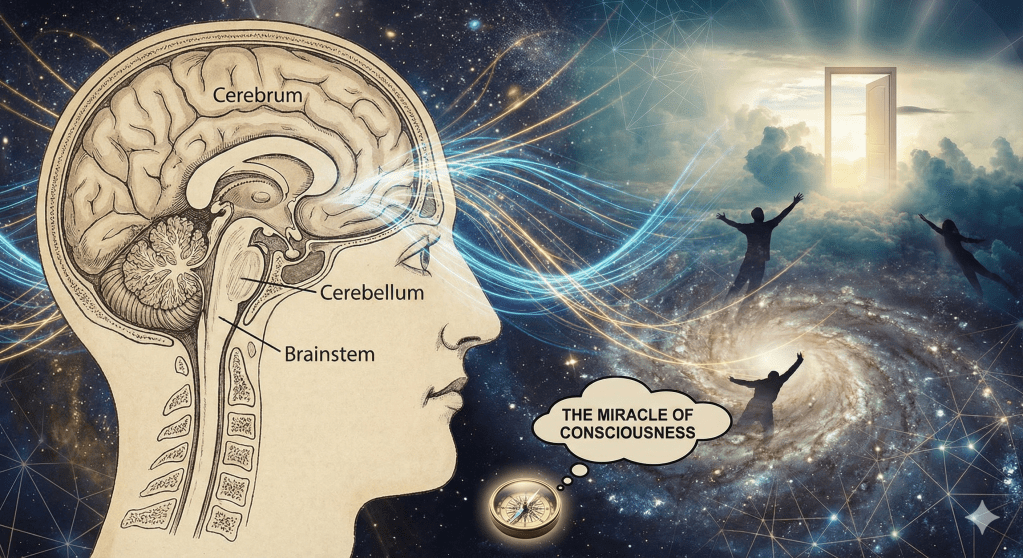
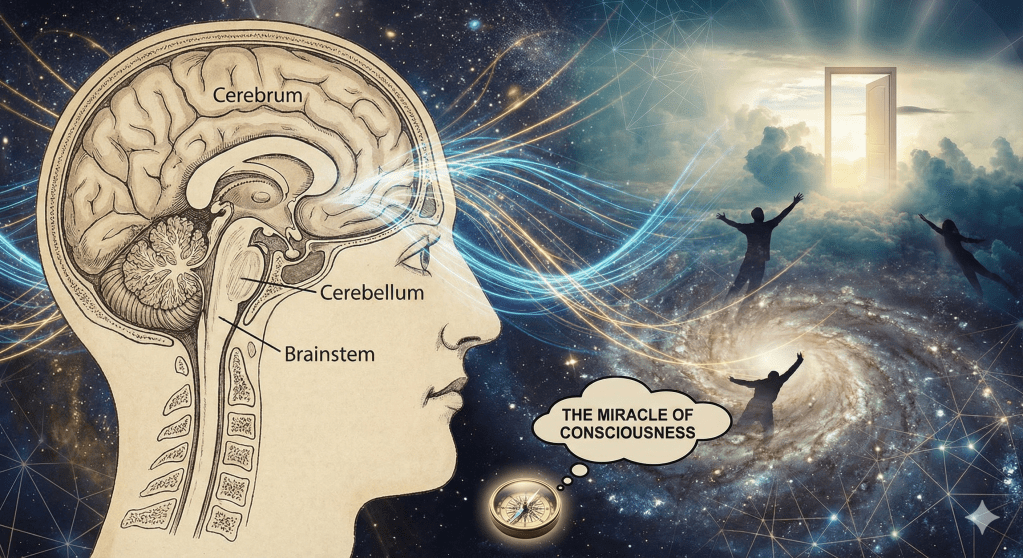
The rhetoric of “miracle” and “illusion” marks a real philosophical boundary. If consciousness is treated as a mere mirage, then the worldview risks resembling a map that erases the very terrain from which it was drawn: every experiment, every observation, every inference arrives through lived experience—even if that experience is mediated, fallible, and theory-shaped. Yet if consciousness is treated as a metaphysical jewel wholly outside nature, naturalism’s causal ambitions fracture and the mental threatens to become an explanatory exile.
The deepest tension in the literature is not a clash between science and soul, but a clash between two conceptions of naturalism: one that tries to keep nature metaphysically austere by explaining away whatever does not fit third-person structure, and another that insists that a truly naturalistic ontology must begin with what nature most certainly includes—experience—and then expand its physical categories (or its explanatory expectations) accordingly. The “incoherence” charge, at its strongest, is therefore a warning: a philosophy that must deny consciousness to save itself may have mistaken elegance for truth, and clarity for comprehension. The illusionist counterwarning is equally sharp: a philosophy that treats introspective appearance as metaphysical essence may have mistaken a compelling user-interface for the machine.
Between these warnings lies the enduring task: not to choose, in advance, whether consciousness is miracle or mirage, but to build a picture of nature robust enough that the fact of experience is neither denied nor deified—only, at last, understood.
To see the references please go to the Microsoft Word file:




 The Glorious Quran and Science
Leave a comment