
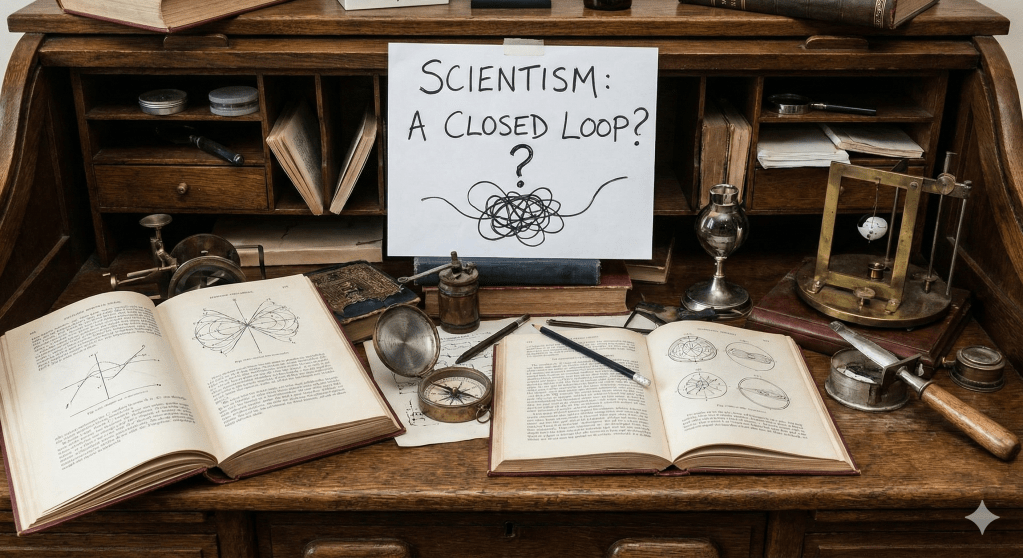
Presented by Zia H Shah MD
Scientism Fails To Explain The Fine-Tuned Universe
Audio teaser:
Abstract
The contemporary intellectual paradigm is increasingly defined by a profound tension between the staggering precision of scientific measurement and an escalating inability to articulate the fundamental nature of the reality being measured. This report investigates the internal contradictions of scientism and the atheistic metaphysic, asserting that the reduction of reality to purely empirical observation is a self-refuting enterprise. By examining the elusive essences of gravity and light—phenomena whose behaviors are mathematically mapped with “mind-boggling” accuracy yet whose ontological origins remain shrouded—the analysis exposes a widening “ontological gap.” Furthermore, the report explores the fine-tuning of the cosmos, specifically the delicate calibration of physical constants necessary for life, arguing that the atheistic dismissal of these “cosmic coincidences” as mere accidents requires a leap of faith into unobservable multiverses that contradicts the foundational principles of scientific empiricism. Through an examination of quantum non-locality, the non-computability of consciousness, and the logical failures of logical positivism, this study demonstrates that scientism functions not as a neutral methodology, but as an ad hoc dogmatic framework that amputates human reason and ignores the “rational transparency” of the universe. The report concludes that the coherence of the scientific enterprise itself presupposes a transcendent intelligibility that cannot be accounted for within a naturalist or accidentalist framework.
The Epistemological Wall: The Self-Refuting Nature of Scientism
The rise of modernity has been characterized by the transition from “Natural Philosophy”—where science was viewed as the investigation of a divinely ordered cosmos—to a professionalized “Scientism” that asserts the natural sciences as the sole arbiter of truth. Scientism is defined as the belief that the methods and categories of the natural sciences form the only proper elements for any inquiry, effectively eliminating all non-empirical perspectives as subjective or meaningless. However, a rigorous logical analysis reveals that this foundational premise is fundamentally incoherent and self-refuting.
The central claim of strong scientism—that “only what can be empirically verified or scientifically proven is true”—cannot itself be empirically verified or scientifically proven. It is not a discovery of physics, chemistry, or biology; rather, it is a metaphysical assertion about the nature of knowledge. Therefore, if the claim is true, it fails its own test of truth and must be dismissed as false or meaningless. This logical loop demonstrates that scientism is not a scientific conclusion but a “pathology of post-Enlightenment reasoning” that attempts to use the prestige of science as a “trump-card” in philosophical debate.
Furthermore, the scientific method itself rests upon a bedrock of philosophical assumptions that it cannot justify through its own procedures. These include the existence of a physical world independent of the human mind, the objective regularity of nature, and the reliability of human cognitive faculties and senses. As noted by various scholars, science presupposes these metaphysical truths; for science to attempt to defend them using scientific data would be to engage in circular reasoning. Consequently, the very enterprise that atheistic scientism uses to deny the metaphysical actually depends upon it.
| Category | Empirical Science | Scientism (Metaphysical Commitment) |
| Object of Study | Observable physical phenomena. | The boundaries of all possible knowledge. |
| Methodology | Induction, hypothesis testing, experiment. | Prescriptive exclusion of non-empirical data. |
| Foundational Claim | Specific laws (e.g., F=ma). | “Science is the only game in town”. |
| Logical Status | Falsifiable and revisable. | Self-refuting and dogmatic. |
The “amputation of reason” performed by scientism limits the human capacity to ask “why” questions, reducing the search for truth to a mere cataloging of “how” things behave. This reductionism is particularly evident in the current scientific struggle to grasp the “essence” of the most fundamental forces of the universe: gravity and light.
The Ontological Mystery of Gravity: Geometry Without Essence
Gravity remains the most intuitive yet elusive force in the history of physics. While scientists can predict the movements of celestial bodies with “exquisite precision,” the “essence of gravity”—its fundamental cause and origin—remains entirely hidden. This represents a profound contradiction in the scientistic worldview: a total reliance on mathematical description coupled with a complete ignorance of the underlying being.
The historical trajectory of gravitational theory illustrates a shift in mathematical “maps” rather than an uncovering of the “territory.” Isaac Newton provided a rigorous formula for gravity as an attractive force acting over distance, yet he famously “feigned no hypotheses” as to its ultimate cause. Albert Einstein revolutionized this view, proposing that gravity is not a force but a property of the “smooth geometry” of spacetime. In the Einsteinian model, matter tells space how to curve, and space tells matter how to move.
However, even this “geometric revolution” fails to reach the ontological heart of gravity. Gravity is described as the “cosmic introvert” because it refuses to reconcile with the quantum world. While electromagnetism and nuclear forces are governed by the quivering uncertainty of quantum probabilities, gravity adheres to a serene, continuous geometry that appears fundamentally incompatible with the jitter of the subatomic realm. This creates what physicists call a “silent rift” or a “contradiction at the foundation of reality,” where the laws of the very large (General Relativity) and the very small (Quantum Mechanics) cannot be unified.
The Quantitative Precision and Qualitative Ignorance of Gravity
The “mind-boggling” details of gravitational physics often obscure the lack of ontological understanding. For instance, the “redshift factor” derived from Einstein’s principles demonstrates that the charge of an electron and its mass are “ontologically reduced” in gravitational fields, a result that challenges centuries-old conservation laws. Yet, why this happens—why spacetime should possess such an “elasticity or plasticity”—remains a matter of “scholastic” mathematical exploration rather than empirical seeing.
| Physical Model | Mathematical Description | Ontological Essence |
| Newtonian | Inverse Square Law: F=Gr2m1m2. | An “attractive force” between masses. |
| Einsteinian | Field Equations: Rμν−21Rgμν=c48πGTμν. | A “curvative property” of spacetime. |
| Quantum Gravity | Loop Quantum Gravity / String Theory. | “Spacetime atoms” or “vibrating strings” (Unproven). |
The scientist’s insistence on believing only in what can be “seen” is thwarted by gravity itself. We do not “see” gravity; we see the effects of a curvature that we represent mathematically. As Roger Penrose has noted, the mathematical fabric of spacetime is a reality we “cannot detect or measure” directly in its singular state; we only infer its presence through the behavior of light and matter. To insist that this hidden structure is “merely an accident” while possessing such profound mathematical beauty is to engage in a form of intellectual cognitive dissonance.
The Enigma of Light: The “Central Mystery” of the Photon
Light serves as the primary medium through which humans “empirically observe” the world, yet light itself is perhaps the most paradoxical entity in the universe. Richard Feynman described the behavior of light as the “central mystery” of quantum mechanics, famously stating that we cannot “make the mystery go away by explaining how it works”. This admission strikes at the heart of scientism’s claim to comprehensive knowledge.
The Failure of Visualizing the Photon
Scientists can describe photons in terms of frequency, power, and polarization, but no theory can provide a “concrete image” of a single photon. We do not know if a photon has a volume or a specific geometric size; it exists as a “non-local particle” that differs significantly from ordinary matter. In fact, the “indistinguishability” of photons is so radical that it erases the very notion of discrete existence; you cannot label “photon A” and “photon B” as separate individuals in a collective.
This “ontological reduction” of light to abstract parameters creates a crisis for the empiricist. If the very thing that allows us to see is itself “invisible” in its essence and “veiled” in its structure, then the insistence that “seeing is believing” is fundamentally flawed. The “wave-particle duality”—where light behaves as a continuous wave until it is measured, at which point it collapses into a particle—is “self-contradictory” under the terms of classical materialism.
The “Magic Number” of Light
The coupling of light and matter is governed by what Feynman called “one of the greatest damn mysteries of physics”: the fine-structure constant (approximately 1/137). This “magic number” appears in our equations with “no understanding by man”; it is a number we know “how He pushed his pencil” to write, but we have no idea why it is that specific value. The atheistic insistence that this number is an “accident” ignores the fact that if this constant were even slightly different, the chemistry of life would be impossible.
| Phenomenon | Mathematical Status | Ontological Mystery |
| Wave-Particle Duality | Superposition/Probability Wave. | How can a single entity be two things at once?. |
| Photon Individuality | Indistinguishable/Symmetric. | Do photons actually “exist” as discrete entities?. |
| Speed of Light (c) | Absolute Constant (299,792,458 m/s). | Why this specific limit? Is it space’s “elasticity”?. |
The scientist who dismisses these details as “accidents” while relying on their “absolute” and “deterministic” nature to conduct research is living in a state of “profound contradiction”. They long for a “unity” and “immortality” in the laws of nature while fervently denying the existence of anything “unchanging and permanent” beyond the material.
The Mind-Boggling Reality of Fine-Tuning: An “Accidental” Impossibility
The most significant challenge to the atheistic metaphysic is the evidence of the “fine-tuned universe.” Physicists and cosmologists have reached a “broad agreement” that the fundamental constants of nature are “balanced on a razor’s edge” to permit the development of life. This fine-tuning is not merely a subjective observation but a rigorous calculation of probabilities that are “astronomically low”.
The “Razor’s Edge” of Physical Constants
The level of precision required for the existence of life is, in the words of many scholars, “mind-boggling.” A few specific examples highlight the magnitude of this reality:
- The Cosmological Constant: The energy density of empty space must be “profoundly small,” tuned to approximately 1 part in 10120. A slightly larger value would have caused the universe to expand so rapidly that stars and galaxies could never have formed.
- The Big Bang Expansion: If the initial explosion had differed in strength by as little as 1 part in 1060, the universe would have either collapsed back on itself within seconds or expanded too quickly for stars to aggregate. This level of accuracy is equivalent to firing a bullet at a one-inch target on the other side of the observable universe—20 billion light-years away—and hitting it.
- The Strong Nuclear Force: If the force that binds protons and neutrons together had been 2% to 5% stronger or weaker, stars would not be able to fuse hydrogen into heavier elements, or they would consume all their fuel in a few minutes, precluding the existence of stable planets and life.
- The Penrose Number: Roger Penrose calculated that the “originality” or low-entropy state of the early universe required a precision of 1 part in 1010123. This number is so large that there are not enough atoms in the observable universe to write out the zeros.
| Parameter | Function | Required Precision | Result of Deviation |
| Gravity (G) | Star Formation | 1 part in 1040. | No life-sustaining stars like the sun. |
| Neutron Mass | Atomic Stability | 1.001× Proton Mass. | Total proton decay or lack of neutrons. |
| Expansion Rate | Large Scale Structure | 1 part in 1060. | Cosmic collapse or sterile void. |
| Strong Force | Nucleosynthesis | ±2−5%. | Absence of oxygen/carbon/water. |
The “Accident” as a Statistical Debt
The atheistic insistence that these values are “merely an accident” or a “brute fact” requires a rejection of the standard principles of probability and confirmation. According to the “Prime Principle of Confirmation,” an observation counts as evidence for the hypothesis under which that observation is most probable. Fine-tuning is “extremely improbable” under the atheistic single-universe hypothesis but “quite probable” under theism, as an intelligent designer would have a reason to create a life-permitting world.
To avoid the “statistical debt” of their worldview, many atheists have turned to the “Multiverse” or “Many-Universes” hypothesis. This theory suggests that there are trillions of unobservable universes with different physical constants, and we simply happen to be in the one that permits life. However, the multiverse is not a scientific discovery but a “mathematical ghost” that cannot be observed, tested, or proven. By retreating to the multiverse, atheism has “lost the evidence high ground” and become a “dogmatic faith” in the unobservable, which is the very thing it accuses religion of being.
The Quantum Collapse of Materialism: Entanglement and Non-Locality
The “mind-boggling” details of quantum mechanics further exacerbate the incoherence of a purely materialist or reductionist worldview. Classical materialism relies on “local realism”—the idea that objects have definite properties independent of observation and that influences cannot travel faster than light. However, the experimental validation of Bell’s Inequality and the phenomenon of “quantum entanglement” have effectively “excluded local realism” from the scientific lexicon.
The Non-Local Network of Reality
Quantum entanglement demonstrates that two particles can be “connected through a deeper, non-local network” where a change in one is reflected in the other instantaneously, regardless of the distance separating them. This challenges the “concept of object independence” and suggests that the universe is not a collection of discrete “accidental” bits of matter but a “unified, subtle structure” that we can understand but not fully visualize.
The atheistic attempt to reduce consciousness to a “wet collection of atoms” (the brain) fails to account for this quantum reality. If reality at its most fundamental level is “non-local” and “superpositioned,” then the “flat ontologies” that treat humans, rocks, and black holes as being on the same ontological level are fundamentally flawed. This “Conscious Deficit” in atheism is highlighted by the “Measurement Problem”: why does the act of observation cause a probability wave to collapse into a definite state?. If “consciousness” is required to resolve the state of the universe, then consciousness cannot be a mere accidental byproduct of the physical world.
Non-Computability and the Human Mind
Roger Penrose has argued extensively that the human mind possesses a “non-computable” quality that no computer or material algorithm can replicate. He uses Gödel’s Incompleteness Theorems to show that “mathematical understanding is something that lies beyond computation”. This implies that there is a “ghost in the machine”—a transcendent dimension of the self that can access “eternal truth” and “virtue,” which are categories that atheistic materialism “plagiarizes” while denying their source.
| Metaphysical Aspect | Materialist Interpretation | Quantum/Ontological Reality |
| Objecthood | Discrete, independent matter. | Non-local, entangled network. |
| Causality | Local and deterministic. | Stochastic and non-local. |
| Consciousness | Accidental neuron firings. | Non-computable, possibly active in collapse. |
| Reality | External and independent. | Veiled and possibly observer-dependent. |
The Moral and Ontological Deficit of Atheism
Beyond the physical and mathematical, the incoherence of atheism manifests in its inability to ground morality and existence itself. This is what scholars call the “Ontological Deficit”: atheism cannot account for “something rather than nothing” without resorting to the intellectual surrender of calling the universe a “brute fact”.
The “Nothing” That Isn’t
Some modern atheists, such as Lawrence Krauss, have attempted to redefine “nothing” as a “quantum vacuum” from which particles pop in and out. However, a quantum vacuum is not “nothing”; it is a complex physical entity governed by laws, fields, and energy. To say the universe arose from this is to admit that the “laws of physics” preceded the material universe. If these laws are “immutable and eternal,” where do they reside?. The atheistic insistence on an “accidental” universe requires these laws to be “floating in a Platonic ether,” which is a metaphysical claim that contradicts the “strict empiricism” they profess.
The Plagiarism of the “Ought”
Atheism struggles to ground “moral facts.” If humans are “accidental animals” in a “brute-fact universe,” then morality is merely an evolutionary herd instinct with no objective “Good” or “Evil”. Yet, “New Atheists” are often “intensely moralistic,” condemning religious beliefs as “evil” and demanding intellectual honesty. This “ought” has no source in a purely materialist world. As noted by various philosophers, the ability of a “conscious mind to access truth and virtue” is a theistic concept that atheism “plagiarizes” to maintain a semblance of societal order.
If our thoughts are “mere secretions of the brain,” then we have no assurance that our belief in atheism—or science—is true. This is the “Argument from Reason”: if reason is a result of mindless forces, it is not directed toward truth but toward survival. Therefore, a strictly atheistic worldview “amputates” the very reason it claims to exalt, leaving the scientist in a state of existential vertigo where they can calculate the mass of a galaxy but cannot justify the validity of their own thought.
The Convergence of Intelligence and Intelligibility
The “rational transparency” of the universe is a fact that most scientists take for granted but which “could have been otherwise”. The universe “might have been a disorderly chaos” rather than an orderly cosmos, or its rationality “might have been inaccessible to us”. The fact that there is a “congruence between our minds and the universe”—between the “rationality experienced within and the rationality observed without”—cries out for a deeper explanation than “accident”.
John Polkinghorne points out that the “mathematical key which turns the lock of the physical universe” is an Achievement that demonstrates the “transcendence of the human mind”. If the universe were truly an accident, the success of mathematics would be “unreasonably effective” and inexplicable. Instead, the beauty and transparency of the laws of nature “conspire to plant the idea” that the universe did not “just happen,” but that there is a “purpose behind it”.
The “Clever” Creator and the Self-Making World
Rather than a “ready-made world,” modern physics and theology together suggest a Creator who has done something “cleverer”—making a “world able to make itself” through fine-tuned laws. This “unity of knowledge” recognizes that science and religion are “friends, not foes,” each investigating what is from different vantage points. The scientist who insists on staying within the “bunker of scientism” is missing out on the “fun of figuring everything out from first principles,” precisely because those principles point beyond the material.
Conclusion: The Collapse of the Accidentalist Paradigm
The investigation into the incoherence of atheism and scientism reveals a worldview that is struggling to maintain its own internal logic against the overwhelming weight of modern scientific discovery. The scientist who “knows a few details” about gravity and light but insists on a “merely accidental” universe is forced to ignore the “mind-boggling” precision of the fine-tuning that makes their own research possible. They rely on the “deterministic” and “absolute” nature of the laws of physics while denying the existence of an “Absolute” source.
Scientism’s failure is twofold: it is “self-refuting” as an epistemology and “ontologically bankrupt” as a metaphysic. It “amputates reason” by restricting it to the empirical, yet it cannot justify the “faith” it places in unobservable multiverses or the “validity” of a human mind evolved for survival rather than truth. The “ontological mystery” of light and gravity remains a “veiled” structure that we can map mathematically but never fully “visualize” or “see” with the senses alone.
Ultimately, the coherence of the cosmos and the human mind suggests that we are not “accidental” winners of a cosmic lottery, but participants in a “ordered field of meaning”. The “statistical debt” of the atheistic worldview is too high, and the “Conscious Deficit” too deep. As we move deeper into the 21st century, the “default intellectual climate” of atheism is “shattering,” replaced by a realization that the “rational transparency” of the world is a signature of a higher intelligence that we are only just beginning to “think after Him”.
Thematic Epilogue: The Whisper of the Transcendent
In the silence between the stars and the quivering uncertainty of the quantum world, there is a “resonance” that speaks of a unity beyond the reach of the laboratory. We are like pilots flying through a cosmic night, our “incomplete mental instruments” guiding us through a reality we cannot fully see but can “reason from deductions”. The “mind-boggling” details of the universe—the 1060 precision of the Big Bang, the “magic number” of the photon, the “smooth geometry” of gravity—are not the marks of a random accident, but the “music of the cosmos”.
To believe that all of this “just happened” is to “make a heaven of hell or a hell of heaven” within the confines of our own neurons. It is a “profound contradiction” to long for “immortality” and “permanence” while standing on a platform of “accidental” decay. Yet, the “transcendence of the human mind” allows us to bridge the gap between the “window display” of appearances and the “mysterious back room” of being. We are “haunted by the suspicion” that what we see is only a “tiny piece of the whole,” a “layered light” manifesting a “transcendent divine command”.
In the final analysis, the “incoherence” of atheistic scientism is the incoherence of a man who looks at a bridge and calculates the load weights but denies the existence of the engineer. It is a worldview that “seeks truth” while “denying the source of truth”. But the universe is not “empty of inherent meaning”; it is “charged with latent potentiality”. As we “feel after Him and find Him,” we realize that the “rationality experienced within” is the same “rationality observed without,” and in that congruence, the “accidental universe” finally falls away to reveal the “majestic architecture” of a created one.



 The Glorious Quran and Science
Leave a comment