

Epigraph
أَفَلَمْ يَنظُرُوا إِلَى السَّمَاءِ فَوْقَهُمْ كَيْفَ بَنَيْنَاهَا وَزَيَّنَّاهَا وَمَا لَهَا مِن فُرُوجٍ

Presented by Zia H Shah MD
Audio teaser:
The intersection of celestial observation and metaphysical inquiry represents one of the most enduring themes in the intellectual history of humanity. Within the Quranic corpus, the heavens are not merely a backdrop for the human drama but are presented as a primary source of evidential data for the existence, power, and wisdom of a singular Creator. Quran 50:6 poses a definitive rhetorical and empirical challenge to the observer: “Have they not looked at the heaven above them – how We built it and adorned it, and [how] it has no rifts?” This verse, situated within Surah Qaf, serves as a foundational link between the physical macrocosm and the theological doctrine of the afterlife, utilizing the perfection of the “first creation” as an inductive proof for the possibility of a “second creation”. The interdisciplinary work of Zia H. Shah, MD, provides a rigorous contemporary framework for understanding this verse, synthesizing 7th-century linguistic cues with the findings of 21st-century astrophysics, mathematical Platonism, and the aesthetic arguments for theism.
Linguistic Precision and the Exegetical Framework
The rhetorical strategy of Surah Qaf begins by addressing the bewilderment and mockery of the Meccan polytheists regarding the concept of bodily resurrection. Their skepticism was rooted in a materialist reductionism that viewed death as the final dissolution of the self into dust. The Quranic response is to redirect their limited terrestrial gaze toward the vast, ordered architecture of the heavens. This redirection is not merely a poetic flourish but a call to nazar—a term that signifies not only ocular sight but also rational perception, pondering, and critical reflection.
The verse employs three critical descriptors for the heaven: “built” (banaynāhā), “adorned” (zayyannāhā), and “no rifts” (mā lahā min furūj). Classical commentators like Imam al-Tabari and Ibn Kathir understood these terms within the cosmological paradigms of their time, yet the linguistic roots of these words possess a semantic elasticity that accommodates the dynamic universe revealed by modern science.
| Term (Arabic) | Classical Interpretation | Modern Scientific Parallel |
| Banaynāhā (Built) | A roof or canopy without supports | Spacetime manifold and structure formation |
| Zayyannāhā (Adorned) | Decorated with stars and planets | Cosmic web, galaxies, and fine-tuning |
| Furūj (Rifts/Cracks) | Gaps or splits in a solid dome | Uniformity of laws and fine-tuned constants |
Classical exegetes unanimously viewed the absence of furūj as a sign of God’s “flawless craftsmanship,” where no discrepancy or disproportion could be detected even after repeated scrutiny. Imām al-Rāzī, in his philosophical commentary Mafātīḥ al-Ghayb, noted that the lack of tafāwut (inconsistency) in the heavens illustrates an order that reinforces the necessity of an All-Wise Creator. This “consistency” is what modern science identifies as the universal applicability of the laws of physics, a concept that underpins the entire scientific enterprise.
The Architecture of “Building”: General Relativity and Structural Emergence
The Quranic depiction of the sky as “built” suggests an intentional, structured cosmos rather than a chaotic expanse. Modern cosmology describes the universe’s construction as a multi-stage process beginning with the Big Bang, followed by a period of rapid inflation and the gradual clumping of matter under the influence of gravity. This scientific narrative of structural development aligns with the Quranic concept of a “built” environment. Zia H. Shah observes that the universe is not just a location but an object—a spacetime manifold that is dynamic and constructed.
Spacetime as a physical manifold
In the framework of General Relativity, space and time are inextricably interwoven into a four-dimensional fabric. This fabric is not an empty void but a dynamic entity that warps and bends in the presence of mass and energy. The “building” of the heavens in 50:6 can be understood as the establishment of this manifold, which serves as the “stage” for all physical events. The structural integrity of this manifold is sustained by gravity, which acts as the “invisible pillars” mentioned in Quran 13:2 and 31:10.
The consistency of this spacetime structure is particularly striking in its lack of “rifts.” In a mathematical sense, spacetime is described as a “manifold” that appears locally flat and continuous at every point. To an observer, the universe appears as a seamless whole. While theories of quantum gravity sometimes hypothesize discrete or “grainy” space at the Planck scale, on the macro-cosmic scale described in 50:6, the architecture remains remarkably smooth and coherent.
The Expanding Universe and Hubble’s Law
The Quranic verse 51:47—”We built the universe with might, and We are certainly expanding it”—provides a direct scientific commentary on the dynamic nature of this celestial building. The discovery of the cosmological redshift and Hubble’s Law confirmed that the very fabric of space is stretching outward, carrying galaxies with it. This expansion is not a “normal explosion” inside a pre-existing space but the continuous creation of new space itself.
| Cosmological Property | Scientific Data Point | Quranic Correlation |
| Expansion Rate | H0≈70 km/s/Mpc | Wa innā la-mūsi’ūn (We are expanding it) |
| Initial Temperature | 1032 K at 10−43 s | Primordial Dukhan (smoke/plasma) |
| Geometry | Ω≈1 (Flat) | Mā lahā min furūj (No rifts/flaws) |
| Background Noise | 2.725 K (CMB) | Remnant of the initial “splitting” |
The “building” process described in 50:6 therefore encompasses the entire evolution of the cosmos. Zia H. Shah argues that thedetected light from distant sources, such as rays traveling four billion light-years to reach Earth, expressly points to the fact that the entire universe is made of the same substance and governed by the same forces. The continuity of the universe between the source galaxy and the terrestrial observer must remain “unbroken” for this light to be detectable, a physical confirmation of the “no rifts” claim.
The Aesthetics of “Adornment”: Celestial Splendor and Divine Design
The term zayyannāhā (We adorned it) introduces an aesthetic dimension to the argument from creation. The Quran presents the beauty of the stars and the night sky as a deliberate “adornment” (zinah) rather than an accidental byproduct of thermal processes. Zia H. Shah utilizes this to build a modern “Aesthetic Argument” for God’s existence, positing that the pervasive beauty in the universe is “superfluous” or “unreasonable” from a strictly functionalist standpoint.
Unreasonable Beauty and Intentionality
A strictly blind and random universe should, by all logical metrics, be “tasteless”—it might be functional and gray, like a factory, but it would have no need for the breathtaking colors of a nebula or the mathematical elegance of a galactic spiral. The fact that we inhabit a “gallery” saturated with beauty at all levels suggests the work of a “Master Artist” (Al-Musawwir) who delights in form and symmetry.
Shah argues that our ability to perceive and delight in this beauty is itself a sign of design. The neural circuits and sense organs that allow humans to experience awe at a starry sky did not evolve solely for survival; they suggest that humans were intended to be “observers” of the cosmic spectacle. This aligns with the Quranic description of “Men of Understanding” (ulu al-albab) who reflect on the creation of the heavens and conclude: “Our Lord, You have not created all this in vain!”.
The Mirror of Nature: Divine Attributes in the Cosmos
In Islamic theology, beauty (jamāl) is a divine quality. The Prophetic tradition states that “God is beautiful and He loves beauty,” implying that true beauty is a reflection of the Creator’s own perfection. The “adornment” of the heavens acts as a mirror, held up to God’s Names, particularly Al-Jamīl (The Most Beautiful One) and Al-Musawwir (The Fashioner of Forms).
| Divine Attribute | Cosmic Manifestation | Philosophical Inference |
| Al-Jamīl (Beautiful) | Splendor of the night sky | Beauty as a path to God |
| Al-Musawwir (Fashioner) | Intricacy of galactic shapes | Order as evidence of Mind |
| Al-Haqq (Truth/Reality) | Mathematical laws and haqq | Nature as an objective truth |
| Al-Wahid (The One) | Unity of physical law | Singularity of origin and governance |
This aesthetic transcendence serves as an “antidote” to the atheistic fixation on suffering. While skeptics focus on the “shadows” of existence, Shah argues that they ignore the “splendor” that saturates the background. The recognition of “evil” or “disorder” itself implies an objective standard of “Good” and “Order” (Haqq), which points back to a transcendent source.
Scientific Dimensions of “No Rifts”: Fine-Tuning and Cosmic Precision
The assertion that the heaven has “no rifts” or “no flaws” finds its most profound scientific resonance in the concept of cosmic fine-tuning. Scientists have observed that the fundamental parameters of the universe—from the strengths of physical forces to the initial conditions of the Big Bang—lie within extremely narrow ranges that permit the existence of stars, planets, and life.
The Knife-Edge of Physical Constants
If any of the basic numbers that define our cosmos were altered even slightly, the universe would suffer from “flaws” that would render it a chaotic and lifeless void. Zia H. Shah highlights several key examples of this delicate calibration:
1. The strength of gravity (G)
Gravity governs the large-scale structure of the cosmos. If gravity were significantly stronger, stars would burn through their fuel too quickly, living fast and dying young before life could evolve on surrounding planets. If gravity were slightly weaker, stars might never ignite their nuclear fuel at all, leaving a cold, dark universe devoid of starlight and heavy elements. The “habitability” of the universe depends on gravity’s strength being balanced within a range of one part in 1036 relative to electromagnetic forces.
2. The Strong Nuclear Force
This force binds protons and neutrons within the atomic nucleus. If it were slightly stronger, almost all hydrogen in the early universe would have fused into helium, leaving no fuel for stars like our Sun and no leftover hydrogen for the formation of water. Conversely, if the strong force were a bit weaker, atomic nuclei would not hold together effectively, resulting in a universe containing only hydrogen and helium, incapable of forming the carbon and oxygen necessary for complex life.
3. The Initial Expansion Rate
The rate at which the universe expanded one second after the Big Bang had to be accurate to within one part in a quadrillion (1015). If the expansion were faster, matter would have dispersed too quickly for galaxies and stars to coalesce; if it were slower, the universe would have undergone a premature “Big Crunch” collapse long before life could emerge.
4. The Cosmological Constant (Λ)
The energy of empty space, or dark energy, represents what some call the “most extreme example of fine-tuning”. Quantum field theory predicts a vacuum energy that is 120 orders of magnitude higher than the observed value. Yet, the actual value of Λ is positive but astoundingly small. This specific “Goldilocks” value prevents space from expanding too violently for stars to form, while also preventing a rapid recollapse.
The Mathematical Improbability of Order
The “lack of flaw” also extends to the initial entropy of the universe. Mathematician Roger Penrose calculated the odds of the universe beginning in an incredibly ordered, low-entropy state to be 1 in 1010123. This number is so astronomically small that Zia H. Shah argues it is “tantamount to impossibility by random processes”. From a theological perspective, this implies that the Creator “aimed” the initial conditions with extreme deliberation to ensure a cosmos capable of hosting life.
The absence of “rifts” in 50:6 is therefore not just a visual claim about the night sky but a statement about the underlying order of reality. The universe’s fundamental constants and laws are “dialed in” with breathtaking exactitude, leaving no room for the structural “cracks” or “gaps” that random chance would likely produce.
Philosophical Dimensions: Mathematical Heaven and Unified Truth
A central component of Zia H. Shah’s interdisciplinary synthesis is the relationship between the Quranic concept of Haqq (Truth/Reality) and the philosophy of mathematical Platonism. Shah argues that the “perfect truth” described in Quran 15:85 is synonymous with the mathematical laws that govern the universe.
The Mathematical Architecture of Existence
Mathematical Platonism posits that mathematical entities—numbers, sets, and equations—exist in an eternal, abstract realm independent of human minds. Shah points out a striking paradox: while elite mathematicians are often atheistic, three-quarters of them identify as Platonists who believe in an “invisible mathematical heaven”. He argues that this trust in an unseen realm populated by necessary and timeless truths is a “backdoor to God”.
If mathematical truths are objective and necessary, they must reside somewhere. Shah suggests the provocative idea that these abstract truths are actually “thoughts in the mind of an ultimate consciousness”—the God of the Abrahamic faiths. The “unreasonable effectiveness of mathematics” in the natural sciences (as famously dubbed by Eugene Wigner) thus serves as a divine sign. The physical world behaves mathematically because it is an instantiation of these pre-existing, perfect mathematical forms.
The “Two Books” Paradigm
Shah’s methodology is rooted in the classical “Two Books” theory: God has revealed Himself through the “Book of Scripture” (the Quran) and the “Book of Nature” (the universe). Since both books have the same divine author, there can be no genuine contradiction between them. Any perceived conflict is a result of human error in interpretation, either of the sacred text or the scientific data.
This epistemology rejects the “God of the Gaps” approach, which finds God only in what science cannot yet explain. Instead, Shah advocates for a theism that is “rationally robust,” finding God in the very consistency and laws that science uncovers. The “lack of rifts” mentioned in 50:6 represents the seamless continuity between the Word of God and the Work of God.
Cosmic Architecture: The Cosmic Web and Galactic Anchors
Modern astrophysics provides a physical manifestation of the “pathways” and structural coherence described in the Quran. Zia H. Shah connects verse 50:6 with 51:7—”By the sky full of pathways (hubuk)”—to provide a detailed commentary on large-scale cosmic structure.
Woven Filaments and Invisible Highways
Modern galaxy surveys, such as the Sloan Digital Sky Survey, have revealed that galaxies are not scattered randomly across the void. Instead, they form sheets and filaments arrayed in a vast “cosmic web”. Matter follows “invisible highways” along these threadlike structures, connected at massive clusters and separated by gigantic dark voids.
The term hubuk linguistically refers to something woven or knit, such as the streaks in fabric. This discovery resonantly mirrors the Quranic imagery of a “woven” sky full of pathways. This interconnected network provides a literal structure to the “building” of the heavens, ensuring that the universe remains a coherent, law-governed tapestry rather than a chaotic scatter of matter.
Galactic Anchors and Black Holes
Shah also explores the intersection of Quranic cosmology with the discovery of supermassive black holes. At the center of our home galaxy, the Milky Way, lies Sagittarius A*, a black hole with a mass of 4.3 million solar masses. While dark matter provide the bulk of the “glue” for galactic rotation, these central black holes act as gravitational anchors for the inner galactic core.
| Galactic Feature | Scientific Profile | Theological Analogy |
| Sagittarius A* | 4.3 million M⊙; 24 million km diameter | “Invisible pillars” / Anchors |
| Event Horizon | Inescapable boundary; information storage | Sijjin (Prison) / Recorded deeds |
| Singularity | Infinite curvature; “puncturing” spacetime | Ath-Thaqib (Piercing object) |
| Dark Matter | 85% of cosmic matter; unseen “glue” | Sustaining power of the Creator |
The function of these black holes—sustaining galactic structure “without pillars you can see”—correlates with the Quranic description of the divine maintenance of the heavens. According to General Relativity, a singularity represents a “puncture” or a “hole” in the fabric of the universe. Some scholars argue that the description of the Najm Ath-Thaqib (the Piercing Star) in Surah At-Tariq refers to the capacity of black holes to “bore a hole” in spacetime.
Resurrection and Information Theory: The theological conclusion of 50:6
The rhetorical challenge of Quran 50:6 is ultimately aimed at establishing the possibility of the resurrection. The Surah argues that the One who could build and maintain a macrocosm as vast and flawless as the sky can surely bring the dead back to life. Zia H. Shah expands this argument by linking it to modern information theory and the physics of the soul.
Total Information Awareness and the Preserved Record
The Quranic response to the disbelievers’ claim that bodies become “dust” is the assertion of divine omniscience: “We certainly know what the earth consumes of them, and with us is a well-preserved Record” (50:4). Shah links this “Record” to the concept of Total Information Awareness. Just as a simulation logs every particle state, God’s “Record” (Kitab Mubeen) tracks the history of every soul and every word spoken.
This idea mirrors the “Hard Problem” of physics regarding where information goes when it disappears, such as into a black hole or through wavefunction collapse. Some string theorists, such as Samir Mathur, propose the “Fuzzball” hypothesis, where information is not lost but is inscribed on the surface of a black hole. Shah extends this speculative bridge to the Quranic “Book of Deeds,” suggesting that each human act might be a permanent, physical modification of the cosmic horizon—a record robust against disruption.
The Daily Resurrection: Sleep, Death, and Consciousness
Shah also addresses the “Hard Problem” of consciousness, arguing that the soul (Ruh) has a non-material, transcendent origin. He uses the analogy of the brain as a “receiver” of consciousness rather than a “generator,” akin to a radio receiving a signal. This perspective allows for the theoretical survival of consciousness after the destruction of the biological substrate.
The daily phenomenon of sleep is presented in the Quran (39:42, 25:47) as a “minor resurrection”. Shah reflects on this as an “empirical laboratory” for the hereafter: if consciousness can be withdrawn and returned daily during sleep, the grand resurrection at the end of time is simply a larger-scale iteration of a process already observed. The “lack of rifts” in the cosmic system ensures that the information of the self remains preserved and retrievable by the Creator.
Scientific Realism and the Refutation of Atheism
Zia H. Shah uses the perfection of the universe to directly engage with and refute contemporary atheistic contentions, particularly those of figures like Lawrence Krauss and Sean Carroll. He argues that claims of a “universe from nothing” often redefine “nothing” as the laws of physics or a quantum vacuum, which are themselves “something” that requires explanation.
The “Magical Jacket” and Occam’s Razor
To illustrate the probability of design over chance, Shah employs the “Magical Jacket” analogy. Imagine finding a jacket in a store that fits you perfectly. An atheist might argue that there must be millions of jackets in a back room (the Multiverse) with different sizes, and you just happened to find the one that fits. Shah argues that without evidence of the back room, the “perfect fit” of our universe’s laws implies a “Tailor” or Designer.
Furthermore, he argues that the Multiverse hypothesis does not remove the need for God. Even an ensemble of universes would require a generator—a set of meta-laws and a physical mechanism to produce them. This generator itself would need fine-tuning, thus pushing the design argument up a level rather than solving it. Following Occam’s Razor, a single purposeful Mind is a simpler and more coherent explanation than an infinite number of unobservable universes.
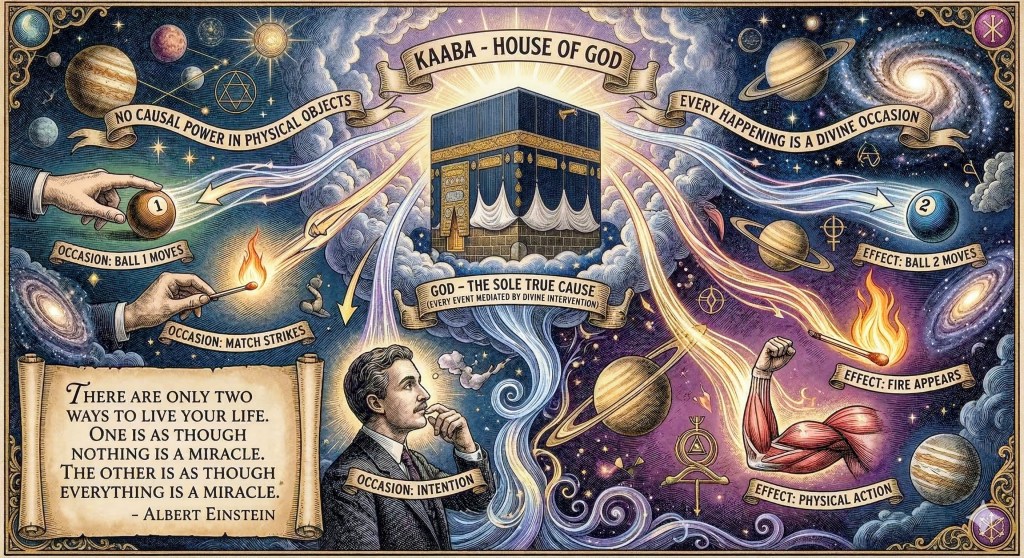
The Sustaining Code and Occasionalism
Shah utilizes the “Simulation Hypothesis”—the idea that our reality is a programmed simulation—not to prove we are inside a computer, but to illustrate the radical contingency of existence. In this view, the material world, despite its apparent solidity, relies on an external power to maintain its ontological status. This is a modern scientific framing of the doctrine of Tawhid al-Rububiyyah (Oneness of Lordship).
| Concept | Simulation Analogy | Quranic Equivalence |
| Creator | Absolute Programmer | Al-Khaliq (The Creator) |
| Physical Laws | Source Code / Ruleset | Qadar (Measure/Decree) |
| Continuous Sustenance | System RAM / Process Power | Qayyum (Self-Subsisting) |
| Record of Actions | System Log / State Vector | Kitab Mubeen (Clear Record) |
The “lack of rifts” in the sky represents the infallible maintenance of this “Sustaining Code” by the Divine Consciousness. If the Creator were to “look away,” the universe would vanish, as it has no intrinsic existence of its own. The stability we observe is a manifestation of God’s names Al-Halim (The Forbearing) and Al-Ghafur (The Forgiving), who holds the heavens from vanishing despite human corruption.
The Aqueous Design: Biological Perfection and the “Flawless” Earth
While 50:6 focuses on the macrocosm of the heavens, the following verse (50:7) directs the attention to the earth: “And the earth! We have spread it out, and set thereon Rawasi standing firm, and We planted in it every lovely (Bahij) pair”. Shah expands his interdisciplinary commentary to include the biological and geological fine-tuning of our planet as a necessary extension of the celestial argument.
Water as a Masterpiece of Engineering
In his treatise “The Aqueous Design,” Shah explores the unique anthropic properties of water. Water’s specific heat capacity buffers the Earth’s climate and allows organisms to regulate their internal temperature, acting as a biological “flawless” mechanism. Crucially, the anomaly of ice expanding upon freezing prevents oceans from freezing from the bottom up, which would kill all marine life. These physico-chemical facts provide a scientific exegesis of the Quranic statement: “We made from water every living thing” (21:30).
Biological Fine-Tuning and Guided Evolution
Shah identifies bilateral symmetry in animals and radial symmetry in flowers as evidence that natural processes are “oriented toward order” rather than chaos. He proposes “Guided Evolution” as a paradigm where God works through evolutionary mechanisms to fulfill a divine design. This view sees no conflict between common ancestry and purposeful creation, interpreting the “creation from clay” as abiogenesis from inorganic matter billions of years ago.
| Biological Feature | Fine-Tuning Observation | Quranic Sign |
| DNA Structure | Golden ratio (34Å by 21Å) | Al-Musawwir (The Fashioner) |
| Protein Symmetry | Startling bias toward simple symmetry | Nature “prefers” beauty |
| Earth’s Crust | Exact thickness for plate tectonics | Mountains as Rawasi (anchors) |
| Atmospheric Layers | Protective mix of gases (O2/N2) | Saqfan Mahfūẓan (Protected ceiling) |
The “flawlessness” of the sky is matched by the “lovely pairs” of the earth. The symmetry of the double helix and the molecular choreography revealed by cryo-electron microscopy display beauty at scales invisible to the naked eye, yet strikingly consistent with the aesthetic order proclaimed in the Quran.
Conclusion: The Unified Paradigm of Quran 50:6
The multidisciplinary analysis of Quran 50:6 reveals a profound convergence between the 7th-century revelatory text and the frontiers of modern knowledge. The verse’s description of a “built” and “adorned” heaven with “no rifts” is not a scientifically inaccurate relic of the past, but an “eloquent choice” of words that accommodates the vast, law-governed reality revealed by 21st-century astrophysics.
Scientific discovery, from the Big Bang to the cosmic web, does not diminish the “miraculous” nature of the heavens; rather, it provides a “majestic commentary” on the Quranic attributes of God. The extreme fine-tuning of the cosmological constant, the uniformity of physical law across billions of light-years, and the “unreasonable effectiveness” of mathematical truth all point toward a purposeful Mind behind the “tapestry of existence”.
For the modern thinker, Quran 50:6 serves as a permanent invitation to engage in “cognitive exploration” of the universe. It erases any hard line between religious and secular truth, presenting the “Work of God” and the “Word of God” as mutual verifiers of the ultimate Reality (Al-Haqq). As Zia H. Shah concludes, the “implausible success” of our universe’s structure—epitomized by its beauty and flawless order—makes the existence of God a profoundly credible answer to the ultimate question of existence. The Truth, as promised in Quran 41:53, continues to manifest on the horizons and within ourselves, humbling the intellect and leading the penitent servant back to the Creator.



 The Glorious Quran and Science
Leave a comment