
Epigraph
إِنَّ أَوَّلَ بَيْتٍ وُضِعَ لِلنَّاسِ لَلَّذِي بِبَكَّةَ مُبَارَكًا وَهُدًى لِّلْعَالَمِينَ
The first House [of worship] to be established for people was the one at Mecca. It is a blessed place; a source of guidance for all people. (Al Quran 3:96)
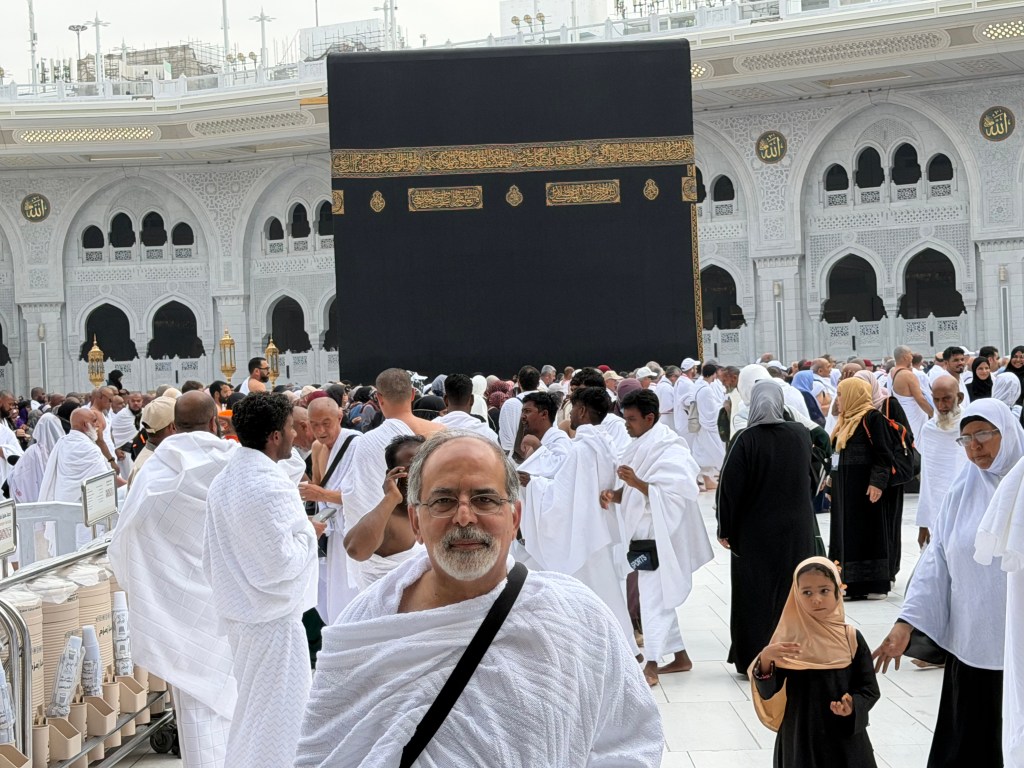
Presented by Zia H Shah MD
Abstract
The Kaaba, located within the Masjid al-Haram in Mecca, stands as the most significant site in the Islamic world. This report traces its history from its foundational origins attributed to Adam and its reconstruction by Ibrahim and Ismail to its eventual purification by the Prophet Muhammad. It further details the architectural transformations of the sanctuary over the last 1,400 years, highlighting the massive Saudi expansions and the recent integration of high-tech management systems. A key focus is placed on the shifting demographics of Hajj and Umrah pilgrims from 2000 to 2025, particularly the recovery and technological adaptation following the COVID-19 pandemic. By contrasting the Kaaba’s enduring presence with the historical and theological barriers preventing the reconstruction of Solomon’s Temple in Jerusalem, this report illustrates the sanctuary’s unique status as a “place of security” (2:125) that has successfully persisted through centuries of regional Middle Eastern conflict.
Foundations: The Era of Adam and the “First House”
In the Islamic tradition, the history of the Kaaba is intrinsically linked to the dawn of humanity. The Quran identifies Mecca (referred to as Bakkah) as the site of the first house of worship established for mankind: “The first House [of worship] to be established for people was the one at Mecca. It is a blessed place; a source of guidance for all people” (3:96).
Islamic historical accounts suggest that the foundation of the Kaaba was first laid by Adam, the first man. While archaeological evidence directly linking the structure to this era is naturally limited by the site’s sanctity and restrictions on excavation, the tradition maintains that Adam established the site as a focal point for monotheistic devotion after his arrival on Earth. Over the millennia that followed, the original structure is said to have fallen into ruin or been obscured by natural forces, such as the great flood described in the era of Nuh (Noah), leaving only the foundations beneath the desert sands.
The Abrahamic Restoration and the Establishment of Pilgrimage
The most historically documented phase of the Kaaba’s early history is its reconstruction by the Prophet Ibrahim (Abraham) and his son Ismail (Ishmael). According to the Quran, Ibrahim was guided to the specific site of the “Ancient House” to raise its foundations: “And [remember] when Abraham raised the foundation of the House with Ishmael, [both praying], ‘Our Lord! Accept this from us. You are indeed the All-Hearing, All-Knowing’” (2:127).
This era established the primary rituals of the site. Ibrahim settled his wife Hajra (Hagar) and Ismail in the then-barren valley of Mecca, which was transformed into an inhabitable location by the discovery of the Zamzam well. During the construction, Ibrahim utilized a stone known as the Maqam Ibrahim (the Station of Abraham) to stand upon while laying the upper courses of the masonry. The Quran commands believers to recognize this spot: “take the spot where Abraham stood as your place of prayer” (2:125). Upon completion, Ibrahim was commanded to proclaim the pilgrimage to all humanity, establishing Mecca as a global center for those coming “on foot and on every lean camel from every distant path” (22:27).
Dimensions of the Abrahamic Structure
Historical sources provide specific measurements for this phase of construction:
- Eastern Wall: 48 feet 6 inches
- Western Wall: 46 feet 6 inches
- Hateem Side Wall: 33 feet
- Height: Estimated between 7 and 9 cubits
- Features: The structure originally had no roof and featured two doors at ground level.
The Inter-Prophetic Period and the Ministry of Muhammad
Between the time of Ibrahim and the 7th century CE, custodianship of the Kaaba passed through various tribes, including the Jurhum and the Khuza’a, before the Quraysh took control. During this period, the monotheistic purity of the sanctuary was compromised as tribes introduced idols into the precinct, eventually numbering 360. Despite this, the site remained a “standard for mankind” and a place where tribal feuds were suspended during sacred months.
The Prophet Muhammad’s mission was centered on the restoration of the Kaaba’s original purpose. Before his prophethood, at age 35, he famously resolved a tribal dispute during a reconstruction necessitated by flood damage, ensuring the peaceful placement of the Black Stone (Hajar al-Aswad). Following his 23-year ministry, which included the change of the direction of prayer (Qibla) from Jerusalem to Mecca, he returned to the city in 630 CE to purify the Kaaba, destroying the idols and rededicating the House to the worship of the One God.
Fourteen Centuries of Continuity and Reconstruction
Since the death of the Prophet, the Kaaba has undergone several major reconstructions driven by political events and natural disasters.
- The Umayyad Era (683–693 CE): During a siege, the Kaaba was damaged by fire. Abdullah ibn al-Zubayr rebuilt it on the Abrahamic foundations, including the Hateem within the structure and adding a second door. Shortly after, Al-Hajjaj ibn Yusuf restored the building to its cubic form as favored by the Quraysh.
- The Ottoman Renovations (1571–1630 CE): Sultan Selim II and the architect Sinan replaced the flat roofs with domes. After a catastrophic flood in 1630, Sultan Murad IV rebuilt the walls using granite blocks from the Meccan hills, forming the core of the structure that exists today.
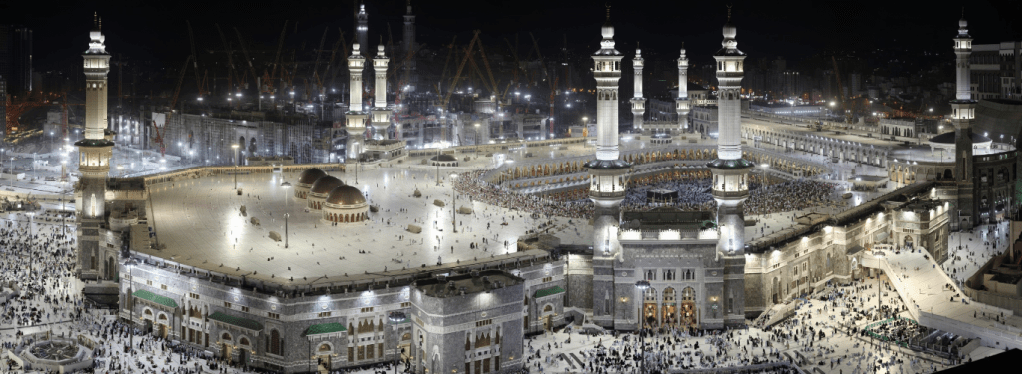
- The Saudi Era (1955–Present): The modern era has seen three massive expansions of the Masjid al-Haram to accommodate the rising numbers of global pilgrims. The first Saudi expansion (1955–1973) integrated the Mas’a into the mosque. The third expansion, initiated in 2011, aimed to increase the mosque’s capacity to over 2.5 million worshippers.
Demographic Shifts and Post-COVID Recovery (2000–2025)
The management of the Kaaba has transformed in response to a dramatic increase in pilgrim numbers over the last 25 years.
Statistics of Hajj and Umrah
| Year | Hajj Pilgrims | Umrah Performers (Foreign) |
| 2012 (Peak) | 3,161,573 | ~6 million |
| 2021 (COVID-19) | 60,000 (Domestic only) | 0.01 million |
| 2024 | 1,833,164 | 16.8 million |
| 2025 | 1,673,230 | 19.5 million |
The recovery since the pandemic has been rapid. In the first quarter of 2025 alone, Umrah performers exceeded 15 million. Demographically, international pilgrims consistently make up the vast majority (approximately 88–90%) of Hajj attendees, with significant numbers originating from Indonesia, Pakistan, Bangladesh, and India.
The Integration of High-Tech Management
To manage these numbers safely, Saudi authorities have implemented advanced technologies under Vision 2030:
- AI Crowd Control: Smart cameras and sensor readers at the Grand Mosque’s gates track real-time entry and exit to prevent congestion.
- Robotics: AI-powered “Manarat Al-Haramain” robots provide religious guidance and video calls with muftis in multiple languages.
- Spatial Guidance: A “Smart Haram” project uses 3D informational mapping and 52 large electronic screens (spanning 279 square meters) to offer personalized guidance to pilgrims.
Historical Contrast: The Temple of Solomon
A notable contrast exists between the Kaaba’s continuity and the status of Solomon’s Temple in Jerusalem. The First Temple, built by King Solomon around 957 BCE, was destroyed by the Babylonians in 586 BCE. A Second Temple was later rebuilt but destroyed by the Romans in 70 CE.
Despite the military presence and administrative control of Israel over the last seven decades, the Temple has not been rebuilt due to several religious and geopolitical factors:
- Halakhic Barriers: Many Orthodox Jewish traditions maintain that the Third Temple can only be built by the Messiah.
- Ritual Purity: Biblical law requires the ashes of a “red heifer” to achieve the ritual purity necessary to enter the Temple site, a requirement that has not been met in nearly 2,000 years.
- The “Status Quo”: The site is currently occupied by the Dome of the Rock and Al-Aqsa Mosque, and is administered by the Islamic Waqf under an arrangement that prohibits non-Muslim prayer on the Mount.
The Miracle of Peace: Sanctuary Amidst Regional Hostilities
The Quran describes the Kaaba as “a resort and a sanctuary for people” (2:125). This promise of security has manifested as a “miracle of peace” during modern regional conflicts. While the Middle East has faced devastating wars—including those in Iraq, Syria, Yemen, and the Gaza Strip—the Kaaba and the city of Mecca have remained largely insulated from military spillover.
Pilgrims from nations involved in these hostilities often find themselves praying side-by-side, as access to the sanctuary typically transcends political and diplomatic ruptures. This resilience is rooted in the “manifest victory” of non-violent resistance exemplified by the Prophet at the Treaty of Hudaybiya, which prioritized the sanctity of the pilgrimage over military confrontation.
Quranic Verses Regarding the Kaaba (M.A.S. Abdel Haleem)
- The First House (3:96): “The first House [of worship] to be established for people was the one at Mecca. It is a blessed place; a source of guidance for all people”.
- A Place of Security (2:125): “We made the House a resort and a sanctuary for people, saying, ‘Take the spot where Abraham stood as your place of prayer.’ We commanded Abraham and Ishmael: ‘Purify My House…’”.
- Sanctity and Support (5:97): “God has made the Ka’ba—the Sacred House—a means of support for people, and the Sacred Month and the animals for sacrifice…”.
- Command to Build (22:26): “We showed Abraham the site of the House, saying, ‘Do not assign partners to Me. Purify My House for those who circle around it…’”.
- Mecca’s Protection (48:24): “And it is He who withheld their hands from you and your hands from them within [the area of] Makkah…”.
Thematic Epilogue: An Anchor of Continuity
The history of the Kaaba is a narrative of remarkable persistence. From its early foundations to its modern role as a hub for millions of technology-assisted pilgrims, the structure has served as the fixed spiritual anchor of the Islamic faith. Unlike the Great Temples of antiquity that remain as archaeological ruins, the Kaaba has been continuously maintained and expanded. Its ability to remain a sanctuary of peace amidst regional instability and global health crises is seen by many as a fulfillment of its primordial mandate. As the “Mother of Cities” looks toward a future of hosting 30 million visitors annually, the Kaaba remains what it was in the time of Ibrahim: a source of guidance and a “Sacred House” standing for all people.
 The Glorious Quran and Science
Leave a comment