
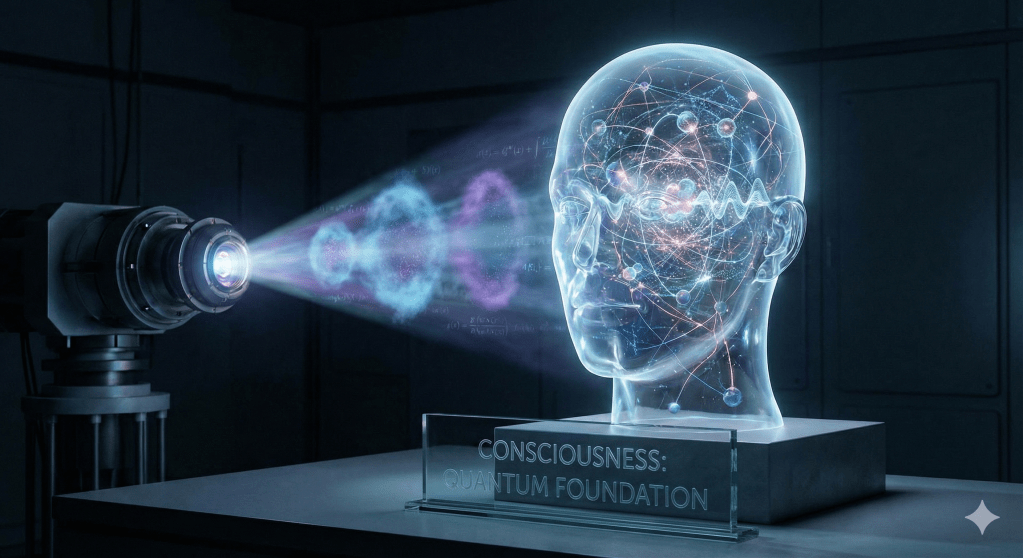
Presented by Zia H Shah MD
Audio teaser:
Abstract
This research report presents an exhaustive multidisciplinary commentary on the eighty-fifth verse of Surah Al-Isra (17:85), which addresses the fundamental mystery of the Ruh (Spirit). By synthesizing traditional Islamic exegesis (Tafsir), classical philosophy, and modern neuroscientific inquiry—specifically the “Romantic Reductionism” and Integrated Information Theory (IIT) of Christof Koch as presented in contemporary discourse—the analysis establishes a bridge between seventh-century revelation and twenty-first-century consciousness studies. The report investigates the historical context of the verse’s revelation as a response to learned skeptics, evaluating the linguistic nuances of the term “Ruh” and its semantic diversity across the Quranic corpus. Centrally, it addresses the “Hard Problem” of consciousness, proposing that the explanatory gap between physical brain states and subjective experience (qualia) serves as an ontological signpost pointing toward the Alam al-Amr (World of Command).
The scientific commentary examines competing theories of awareness, contrasting the materialist “generator” model with the “receiver” or “transceiver” paradigm, utilizing insights from quantum biology and Orchestrated Objective Reduction (Orch OR). The report further explores the distinction between Alam al-Khalq (the World of Creation) and Alam al-Amr, arguing that the “little knowledge” vouchsafed to humanity represents an epistemic boundary that safeguards the sacred nature of the self. Through a rigorous analysis of terminal lucidity, philosophical zombies, and the limitations of artificial intelligence, the investigation concludes that the spirit remains an irreproachable sign of the Creator, inviting a synthesis of intellectual humility and empirical rigor. The report culminates in a thematic epilogue that reconciles the vertical dimension of spiritual reality with the horizontal expansion of scientific knowledge.
The Ontological Context of Surah Al-Isra and the Question of the Spirit
The eighty-fifth verse of Surah Al-Isra, also known as Surah Bani Isra’il (The Children of Israel), occupies a singular position in the Quranic discourse on the nature of existence. The verse states: “And they ask you, [O Muhammad], about the soul. Say, ‘The soul is of the affair of my Lord. And mankind have not been given of knowledge except a little’”. This declaration emerges in the context of a chapter that begins with the Isra (the night journey from Makkah to Jerusalem), an event that itself challenges the conventional boundaries of time, space, and physical law. The placement of the inquiry regarding the Ruh (Spirit) within this specific Surah is significant, as much of the chapter deals with the tension between the seen and unseen worlds, the miracles of revelation, and the inherent limitations of human perception.
The verse is structured as a direct response to an inquiry—Wayas’alunaka (“And they ask you”). Historical accounts preserved in the Sahih of al-Bukhari and Muslim clarify that the questioners were often learned members of the Jewish community in Madinah or Makkan pagans acting on Jewish advice. These skeptics sought to test the Prophet Muhammad’s access to divine knowledge by posing a riddle concerning a subject that was understood in their own traditions as a profound mystery. The Prophet’s initial silence upon being questioned, followed by the descent of revelation, indicates that the answer was not to be found in human speculation but was a matter of divine disclosure.
The theological significance of the response lies in its redirection. Rather than providing a biological, physiological, or even a detailed metaphysical description of the Ruh, the revelation assigns its essence to the Amr (Command or Affair) of God. This redirection establishes an epistemological boundary, asserting that while humans may observe the effects and manifestations of the spirit, its true nature remains a “reserved knowledge” held by the Divine. This creates a framework for understanding consciousness that respects the utility of scientific investigation while acknowledging a transcendent origin that escapes material reductionism.
Theological Exegesis: Classical Interpretations and Linguistic Nuance
Classical Islamic scholarship has devoted extensive analysis to the meaning of Ruh in 17:85, grappling with its ontological status and its relationship to the human body. The term itself is semantically rich, appearing 24 times in the Quran across 19 different Surahs with a variety of meanings. Scholars have debated whether the Ruh in this specific verse refers to the animating life force in humans, the Angel Gabriel, or the Quranic revelation itself.
Semantic Diversity of the Term Ruh
The lexical flexibility of Ruh has led to several distinct interpretations within the tradition of Tafsir (exegesis).
| Meaning of Ruh | Contextual Application | Quranic Reference |
| The Human Spirit | The animating essence breathed into Adam and his descendants. | 15:29, 32:9, 17:85 |
| Angel Gabriel | The “Faithful Spirit” who brings the message to the Prophets. | 26:193, 2:87, 16:102 |
| Divine Revelation | The Quran as a source of spiritual life and guidance. | 42:52, 16:2 |
| Jesus (Isa) | Described as a “Spirit from Him” (Allah). | 4:171 |
| Divine Assistance | The support granted to believers (Ruhun-minhu). | 58:22 |
Ibn Kathir and Al-Tabari explored both the human soul and the angel of revelation as possibilities for 17:85. However, the majority of commentators, including those citing the narration of Ibn Mas’ud, conclude that the direct question concerned the nature of the human soul—the mysterious force that makes the body come alive and differentiates a sentient human from a mere lump of matter.
The Nature of the Divine Command (Amr)
The verse’s claim that “the soul is of the command (Amr) of my Lord” introduces a fundamental dualism in Islamic ontology. This distinction between Alam al-Khalq (the World of Creation) and Alam al-Amr (the World of Command) is central to the thought of scholars like Al-Ghazali and Fakhr al-Din al-Razi.
The World of Creation is the realm of gradual processes, causality, and physical dimensions. It is the universe of “measurement” (Qadr), where things grow, evolve, and are subject to the laws of time and space. The brain and the physical body belong to this realm. Conversely, the World of Command is the realm of immediate divine will, characterized by the command “Kun!” (“Be!”). It is timeless, spaceless, and non-material. By stating that the Ruh is from the Amr, the Quran situates consciousness outside the standard materialist framework of gradual evolution or physical assembly.
This distinction implies that the spirit is not a “thing” that can be dissected or localized in the same way one might find a heart or a lung. Instead, it is an immaterial substance (Jauhar) that originates in a higher order of reality and “intervenes” or “interfaces” with the material body. This provides a theological basis for the “Hard Problem” of consciousness, as it suggests that the qualitative aspect of being is not a product of the physical but a guest within it.
The Philosophical Impasse: Qualia and the Hard Problem
Modern philosophy of mind has arrived at a crisis point that remarkably mirrors the epistemic boundary established in Quran 17:85. This crisis is encapsulated in the “Hard Problem of Consciousness,” a term popularized by David Chalmers in 1995. The problem posits that even if we had a complete map of every neuron and synapse in the human brain, we would still fail to explain why these physical processes are accompanied by a subjective, internal experience.
Qualia and Subjective Experience
The core of the Hard Problem is the existence of qualia—the individual instances of subjective, conscious experience. For example, a scientist might understand the exact wavelength of light that corresponds to the color red, the biological mechanism of the retina, and the neural path to the visual cortex. However, none of this physical information explains the “redness” of red—the actual feeling or experience of the color.
| Level of Consciousness | Description | Scientific Status |
| Easy Problems | Mechanism of wakefulness, focus, stimuli discrimination. | Potentially solvable via Neuroscience. |
| Hard Problem | Why any physical state is conscious; the subjective “feeling.” | Conceptually mysterious; “Little Knowledge.” |
The “Philosophical Zombie” thought experiment further illuminates this gap. A philosopher might imagine a creature that is physically and behaviorally identical to a human but lacks any inner life. Such a being would react to pain and discuss colors perfectly, but there would be “nobody home” inside. If such a zombie is logically possible, it implies that consciousness is not logically entailed by physical arrangement alone, suggesting that the spirit involves “further facts” beyond the reach of standard physics.
Materialism, Dualism, and the Explanatory Gap
Materialist philosophy (physicalism) asserts that consciousness must be an emergent property of matter. However, this view faces the “Explanatory Gap”—the inability to bridge the chasm between objective matter and subjective mind. Some materialists, like Daniel Dennett, attempt to solve this by dismissing consciousness as an “illusion” created by complex computation. Yet, this denial of the only thing we know with absolute certainty (our own awareness) is increasingly viewed as an unsatisfactory “theology of gaps” for atheistic naturalism.
Dualism, on the other hand, aligns more closely with the Quranic perspective of 17:85, positing that the spirit is a distinct ontological category from the body. Traditional Islamic philosophy, such as the “Flying Man” experiment of Ibn Sina, anticipated these debates by arguing that the soul’s self-awareness is independent of sensory input. The current philosophical deadlock over the Hard Problem serves as a modern realization of the Quranic warning that humanity has been granted “but a little knowledge” concerning the essential nature of the Ruh.
Scientific Commentary: Christof Koch and Romantic Reductionism
The video discourse by Christof Koch, a preeminent neuroscientist, provides a contemporary empirical lens through which to view the mystery of 17:85. Koch’s position, which he terms “Romantic Reductionism,” represents a shift from traditional materialist views. He acknowledges that while we can map the “neural correlates” of consciousness, standard reductionism has failed to explain why consciousness exists at all.
Integrated Information Theory (IIT) and Phi ($\Phi$)
Koch is a prominent advocate of Integrated Information Theory (IIT), developed by Giulio Tononi. IIT proposes that consciousness corresponds to a system’s capacity to integrate information. The theory defines a mathematical measure, $\Phi$ (Phi), representing the degree of integration. According to IIT, consciousness is not restricted to biological brains but is a fundamental property of any system with a high enough level of integrated information.
While IIT offers a rigorous mathematical framework, it remains controversial. Critics argue that even a high-$\Phi$ system might simply be a “dark” data processor without an inner life. Dr. Zia H. Shah, in his scientific commentary on 17:85, notes that while IIT brings science closer to recognizing consciousness as a fundamental reality, it still attempts to find the Ruh within the Alam al-Khalq (the world of physical structure).
Simulation versus Feeling: The Silicon Barrier
One of the most profound insights from Koch’s discourse is the distinction between simulating a behavior and actually having an experience. He argues that a computer simulation of a brain, even if it behaved exactly like a human, would likely be a “zombie” in silicon—it would lack the “hardware” of consciousness. This aligns with the Quranic concept that the Ruh is a “divine breath” or a specific command from God, rather than a mere byproduct of logical operations or binary code.
Koch’s admission that consciousness is a “fundamental property of the universe” moves neuroscience away from strict materialism and toward a form of panpsychism. However, from the perspective of Quranic exegesis, this “fundamental property” is not inherent in the atoms themselves but is the result of the Divine Command (Amr) that sustains all levels of existence.
Quantum Neurobiology: The Mechanism of the Divine Interstice
The intersection of quantum physics and consciousness offers a potential mechanism for how the Alam al-Amr might interface with the Alam al-Khalq. If the Ruh is a non-local, transcendent reality, its interaction with the physical brain must occur at the quantum limit—the boundary where classical laws break down.
Orchestrated Objective Reduction (Orch OR)
The Orchestrated Objective Reduction (Orch OR) theory, proposed by Roger Penrose and Stuart Hameroff, suggests that consciousness originates from quantum vibrations within microtubules—protein structures inside neurons. Penrose argues that consciousness is “non-computable” and results from a specific physical process called “Objective Reduction” (OR), which he links to the fine-scale structure of spacetime geometry.
In this framework, the wave function collapse is not a random event but a “moment of proto-consciousness”. The formula for the timescale of this collapse is given by Penrose’s indeterminacy principle:
$$\tau \approx \frac{\hbar}{E_g}$$
where $\tau$ is the time until objective reduction occurs, $\hbar$ is the reduced Planck constant, and $E_g$ is the gravitational self-energy of the superimposed mass.
The Brain as a “Biological Receiver”
Drawing on these quantum insights, Dr. Zia H. Shah and other contemporary scholars propose a “Receiver” or “Transceiver” model of the brain. In this model, the brain does not generate consciousness; rather, it functions like a radio or a television that resonates with and filters a “signal” from a higher dimension (the Ruh).
| Model | Source of Consciousness | Role of the Brain | Philosophical Alignment |
| Generator Model | Biological activity | Producer of consciousness | Materialism / Physicalism |
| Receiver Model | Transcendent (Alam al-Amr) | Filter/Resonator | Dualism / Quranic Ontology |
This model explains terminal lucidity and near-death experiences (NDEs) more effectively than the generator model. If the “radio” (the brain) is damaged, the music (consciousness) may be distorted or silenced, but the “signal” (the Ruh) remains intact and returns to its source upon the death of the body. The “little knowledge” we have refers to our understanding of the “tuning” mechanism of the radio, while the “signal” itself remains an enigma of the Lord’s Command.
The Epistemological Boundary: “Little Knowledge” and Cognitive Closure
The conclusion of 17:85—”And mankind have not been given of knowledge except a little”—is not a dismissal of inquiry but a definition of its limits. Scholars like Sayyid Qutb have argued that this verse directs the human intellect to function within its proper domain (the material and social world) while acknowledging that some realities transcend human perception entirely.
Cognitive Closure and the Limits of Finite Reason
The concept of “Cognitive Closure,” as discussed by philosophers like Colin McGinn, suggests that human minds may be biologically incapable of solving the mystery of consciousness. Just as a squirrel lacks the cognitive hardware to understand calculus, the human brain—evolved for survival in the Alam al-Khalq—may be structurally barred from comprehending the Ruh of the Alam al-Amr.
This limitation is a “vertical” limit rather than a “horizontal” one. Science can expand horizontally by building better telescopes and microscopes, but no matter how wide we scan the electromagnetic spectrum, we are still detecting physical interactions. The Ruh, being of the Amr (Command), does not have a “radar cross-section” in the physical world.
The Ethics of Humility in the Age of AI
As humanity approaches the threshold of creating Artificial General Intelligence (AGI), the mystery of 17:85 becomes a critical ethical and ontological guide. If consciousness is a divine gift from the World of Command, then no amount of silicon complexity will ever “produce” a soul. AI may simulate the “Easy Problems” of intelligence, but it will remain a “zombie” in terms of the “Hard Problem” of the Ruh.
This realization encourages intellectual humility. It suggests that the human self is not a “thing” to be owned or completely decoded, but a “relation” to the Divine. The “little knowledge” we are given is sufficient for our role as stewards of the earth, but insufficient to allow us to play God by manufacturing consciousness.
Terminal Lucidity and the Persistence of the Spirit
Terminal lucidity—the unexpected return of mental clarity and memory in patients suffering from severe brain damage just before death—provides a striking empirical anomaly that supports the dualistic, Quranic view of the soul.
Case Studies in Paradoxical Clarity
Medical literature records instances of patients with advanced Alzheimer’s or massive brain tumors, whose brains have been physically destroyed to the point where speech and recognition should be impossible. Yet, in their final hours, these patients often become perfectly lucid, conversing with relatives and demonstrating a full sense of self.
| Perspective | Explanation of Terminal Lucidity | Challenges |
| Materialist | Unknown chemical surge or neural reorganization. | Fails to explain clarity despite physical destruction. |
| Quranic/Receiver | The Ruh temporarily detaches from the “broken hardware.” | Requires acceptance of non-material substance. |
From the perspective of 17:85, terminal lucidity suggests that the Ruh is the “light of the projector,” and the brain is the “screen”. If the screen is torn, the movie (the Nafs or personality) appears fragmented. But the light itself (the Ruh) is never torn. In the moments before death, the light shines through the gaps, revealing the persistence of the spirit even as the body fails.
Comparative Metaphysics: Nasr, Iqbal, and the Quantum Soul
Contemporary Islamic thinkers have attempted to reconcile the “little knowledge” of 17:85 with the staggering advances in modern physics. Seyyed Hossein Nasr and Muhammad Iqbal provide two influential frameworks for this synthesis.
Seyyed Hossein Nasr and the Critique of Modern Psychology
Nasr argues that modern psychology is in disarray because it has forgotten the “vertical dimension” of existence. By reducing the “science of the soul” to the study of the brain and behavior, it has rendered the Ruh null and void. Nasr insists that everything in the field of quantum mechanics issues from the “unmanifested to the manifested”—a scientific echo of the Quranic move from the Amr to the Khalq.
Muhammad Iqbal and the Ego as Creative Action
In his Reconstruction of Religious Thought in Islam, Muhammad Iqbal viewed the human ego (Khudi) not as a static substance but as a dynamic spiritual entity. He saw 17:85 not as a barrier to knowledge but as an invitation to creative growth. For Iqbal, the “little knowledge” is the starting point for a humanity that must “perfect” its spirit through creative activity and moral struggle.
Iqbal’s vision aligns with the modern understanding of “Self-Organized Criticality” in the brain—the idea that the brain operates at the edge of chaos, making it highly sensitive to the “intervention” of the non-local consciousness or the Divine Command.
Conclusion: Synthesizing Science, Philosophy, and Theology
The analysis of Quran 17:85 through the lenses of classical exegesis, the “Hard Problem” of philosophy, and the quantum neurobiology of Christof Koch and Roger Penrose leads to a unified, though necessarily incomplete, understanding of the human spirit.
- The Epistemic Barrier: The verse 17:85 establishes a permanent boundary for human reason. While we can master the “measured” world of the brain (the Alam al-Khalq), the “unmeasured” world of subjective experience (the Alam al-Amr) remains a reserved secret of the Divine.
- Convergence of Mystery: Modern neuroscience, in its failure to reduce consciousness to synaptic firing, has reached the same “wall” described by the Quran. The admission by figures like Koch that consciousness is a “fundamental property” mirrors the Quranic claim that the spirit is “of the Command”.
- The Receiver Model: Scientific anomalies like terminal lucidity and quantum non-locality support the “Receiver” model of the brain, suggesting that the spirit is an independent, immaterial substance that survives the decomposition of the body.
- Moral Implications: Acknowledging the divine origin of the Ruh protects human dignity from the reductionism of the computer-age. It ensures that humans are viewed not as biological machines to be hacked, but as spiritual beings with an inherent connection to the Transcendent.
The “little knowledge” given to mankind is, in fact, a great blessing. It is enough to allow us to manipulate matter and heal the body, but it is limited enough to keep us in a state of wonder and humility before the mystery of our own existence.
Thematic Epilogue
The eighty-fifth verse of Surah Al-Isra stands as an eternal sentinel at the gates of human knowledge. It does not forbid the traveler from exploring the vast plains of science and philosophy; rather, it provides a compass to ensure that we do not lose our way in the thickets of materialism. By situating the Ruh within the “Command” of the Lord, the Quran offers a sanctuary for the sacred within a world increasingly obsessed with the quantified.
The journey from the laboratories of modern neuroscience to the halls of seventh-century revelation reveals a profound symmetry. We find that the more we learn about the “machine” of the brain, the more undeniable the presence of the “driver” becomes. The “Hard Problem” of consciousness is the modern name for the mystery of the Ruh, and its insolubility is not a failure of our intellect but a confirmation of our status as finite beings in an infinite universe.
Ultimately, the spirit is the “Divine Interstice”—the silent meeting point where the finite intersects with the infinite. It is the breath of God that allows us to perceive, to love, and to ask the very questions that lead us back to Him. In the “little knowledge” we are given, we find the greatest evidence of the One who knows all. The spirit remains, as it has always been, a secret of the Lord—a living sign that ever invites the human heart to wonder, to worship, and to find its true home in the realm beyond the seen.




 The Glorious Quran and Science
Leave a comment