

Presented by Zia H Shah MD
Audio teaser:
Abstract
This comprehensive research report investigates the profound ontological and physical mysteries of light, centered on the intellectual odyssey of Albert Einstein and the revolutionary paradigms of modern physics. It examines the foundational premise that while Einstein’s theories redefined the nature of reality, they were predicated on postulates—specifically the constancy of the speed of light—that remain as much an “eternal mystery” as a scientific axiom. The report provides an exhaustive analysis of light’s known features, including its dual wave-particle nature, its role as the universal speed limit c, and its function as a cosmic time machine. Furthermore, it explores the biological and cosmological necessity of light, from the subatomic precision of photosynthesis to the fine-tuning of fundamental constants like the fine-structure constant α. By synthesizing these empirical observations with Einstein’s own philosophical reflections on the comprehensibility of the universe and the “spirit” manifest in the laws of nature, the report articulates a teleological framework. It argues that the intricate harmony and staggering complexity of light serve as compelling evidence for an underlying intelligence or “Artist” behind the cosmic design, culminating in a thematic epilogue that reflects on the intersection of scientific inquiry and the mystic emotion.
The Ontological Enigma: Fifty Years of Conscious Brooding
The intellectual history of the twentieth century is dominated by the figure of Albert Einstein, yet his most profound contributions were anchored in an entity he confessed to not fully understanding. In a poignant reflection written in 1951, toward the end of his life, Einstein admitted that fifty years of “conscious brooding” had brought him no closer to answering the fundamental question: “What are light quanta?”. This admission underscores a central theme in the philosophy of science: that the most successful mathematical frameworks often rest upon ontological foundations that remain stubbornly opaque. Einstein’s work was a lifelong effort to reconcile the behavior of light with the structure of the universe, yet the essence of the light particle—the photon—remained an “eternal mystery” to him.
In his youth, specifically during the “Miracle Year” of 1905, Einstein published four papers in the journal Annalen der Physik that would forever alter the trajectory of human thought. These papers did not merely provide new data; they revolutionized the understanding of space, time, mass, and energy. His first paper of that year, “On a Heuristic Viewpoint Concerning the Production and Transformation of Light,” introduced the concept of light quanta, suggesting that electromagnetic radiation consists of discrete packets of energy. This was a radical departure from the prevailing wave theory of light derived from Maxwell’s equations, which assumed energy was infinitely divisible.
The heuristic nature of Einstein’s approach is significant. He did not claim to have discovered the final nature of light, but rather a “viewpoint” that allowed for the explanation of puzzling phenomena such as the photoelectric effect. This effect, where light striking a metal surface ejects electrons, could only be understood if light behaved as a stream of particles whose energy was proportional to their frequency (E=hf). Despite the success of this model—which eventually earned him the Nobel Prize in 1921—Einstein remained haunted by the duality it implied. He struggled with the fact that light appeared to be both a wave and a particle, a contradiction that challenged the very core of classical logic.
The Annus Mirabilis Papers (1905)
The table below provides a structured overview of the four foundational papers published by Einstein in 1905, highlighting their core discoveries and their relationship to the mystery of light and matter.
| Paper Title (English Translation) | Core Subject | Primary Contribution / Result | Impact on Modern Physics |
| On a Heuristic Viewpoint Concerning the Production and Transformation of Light | The Photoelectric Effect | Postulated light as discrete quanta (photons). | Foundation of quantum mechanics and Nobel Prize award. |
| On the Motion of Small Particles Suspended in a Stationary Liquid | Brownian Motion | Provided empirical evidence for the existence of atoms. | Ended the controversy over the atomic nature of matter. |
| On the Electrodynamics of Moving Bodies | Special Relativity | Introduced the constancy of c and relative nature of time/space. | Reconciled Maxwell’s equations with the principle of relativity. |
| Does the Inertia of a Body Depend Upon Its Energy Content? | Mass-Energy Equivalence | Derived the equation E=mc2. | Showed that mass is “congealed energy”. |
This period of intense creativity established the parameters within which Einstein would work for the rest of his life. However, as he matured, his focus shifted from the “quanta” of light toward a unified description of all physical forces—a “Unified Field Theory”. He sought to merge the gravitational field, which he had successfully described in his General Theory of Relativity in 1915, with the electromagnetic field. For over thirty years, Einstein pursued this goal in increasing isolation from the mainstream physics community, which had largely embraced the probabilistic and “spooky” world of quantum mechanics. Einstein famously rejected the idea that “God plays dice with the universe,” insisting that a more fundamental, deterministic theory must exist that would resolve the wave-particle paradox and the mysteries of light once and for all. His failure to achieve this unification before his death in 1955 serves as a testament to the sheer depth of the miracle he was attempting to decode.
The Axiomatic Constant: The Miracle of c
The coherence of modern physics hinges on a single, counterintuitive assumption: the speed of light in a vacuum, denoted as c, is a universal constant. This postulate, which Einstein elevated to the status of a fundamental law in his 1905 paper on special relativity, suggests that no matter how an observer is moving, and no matter how the light source is moving, the measured speed of light will always be exactly 299,792,458 meters per second. In everyday experience, velocities are additive—if a person throws a ball from a moving car, the ball’s speed relative to the ground is the sum of the car’s speed and the ball’s speed. Light, however, defies this Newtonian logic.
The motivation for this postulate was the growing conflict between classical mechanics and electromagnetic theory. Maxwell’s equations predicted that electromagnetic waves travel at a fixed speed, which led physicists to search for a “luminiferous aether”—a medium through which light was thought to travel. When experiments like the Michelson-Morley study failed to detect any “aether wind” or change in light’s speed, the scientific community was left in a state of confusion. Einstein’s genius was to accept the constant speed of light not as an anomaly to be explained away, but as the central governing principle of the universe.
This assumption has profound and mind-bending consequences for the nature of reality. If the speed of light remains constant for all observers, then other variables that were once thought to be absolute—such as time and space—must become relative. To ensure that c is always the same, time must “dilate” (slow down) and lengths must “contract” for objects in motion. This is not a mere optical illusion; it is a fundamental property of the geometry of the universe, often referred to as four-dimensional spacetime.
Relativistic Effects and the Lorentz Factor
The magnitude of these distortions is determined by the Lorentz factor, γ. As an object’s velocity v approaches c, the value of γ increases dramatically, leading to the following physical consequences:
| Velocity (v) as a Percentage of c | Lorentz Factor (γ) | Impact on Time (Time Dilation) | Impact on Length (Length Contraction) |
| 0% (At Rest) | 1.0000 | 1.0000 (No Change) | 100% (No Change) |
| 10% | 1.0050 | Time slows by 0.5% | Length shortens by 0.5% |
| 50% | 1.1547 | Time slows by 15.5% | Length shortens by 13.4% |
| 86.6% | 2.0000 | Time slows by 50% (half speed) | Length is reduced by 50% |
| 99% | 7.0888 | Time slows by 85.9% | Length is reduced by 85.9% |
| 99.9% | 22.3662 | 1 second = 22.37 seconds at rest | Length is reduced by 95.5% |
| 99.999% | 223.6069 | 1 second = 3.7 minutes at rest | Length is reduced by 99.5% |
| 100% (Theoretical c) | Infinite (∞) | Time stops entirely | Length contracts to zero |
This data illustrates why c is the absolute speed limit of the universe for any object with mass. As an object approaches the speed of light, its observed mass increases, eventually requiring an infinite amount of energy to accelerate it further. Only massless particles, like photons, can travel at exactly c. The existence of this “limit” is a miracle of constraints; it ensures that the causal structure of the universe is maintained, preventing the past from being altered and allowing for a coherent flow of events.
The Enormity of Speed and the Cosmic Time Machine
The sheer scale of the speed of light—300,000 kilometers per second—is almost impossible to grasp in the context of human experience. At this speed, a photon could circle the Earth 7.5 times in a single second. Yet, when viewed against the backdrop of the cosmos, light can appear paradoxically slow. This finite nature of c transforms the universe into a “cosmic time machine”. Because light takes time to travel from distant stars and galaxies to our eyes, we never see the universe as it is “now,” but only as it was in the past.
When an observer looks at the Moon, they are seeing it as it existed 1.3 seconds ago. Sunlight takes approximately 8.3 minutes to reach the Earth, meaning that if the Sun were to suddenly disappear, humans would remain in the light, unaware of its absence, for nearly nine minutes. As we look deeper into space, the “lookback time” increases dramatically. The nearest star system, Alpha Centauri, is seen as it was 4.3 years ago, and the center of our own Milky Way galaxy is observed as it was 26,000 years ago.
This delay is not merely an inconvenience; it is a miracle of information preservation. It allows astronomers to witness the history of the universe in real-time. By observing galaxies billions of light-years away, we are looking back to the early stages of the universe’s formation, witnessing the “miracle of creation” unfolding across eons. The photons arriving from the edge of the observable universe carry data that is 13.8 billion years old, providing a direct link to the Big Bang.
Astronomical Scales and Light Travel Time
The following table contextualizes the enormous yet finite speed of light across different cosmic distances:
| Celestial Object | Distance from Earth | Light Travel Time | Historical Context (When the light we see today left its source) |
| Moon | 384,400 km | 1.28 Seconds | The very recent past |
| Sun | 150 Million km | 8.3 Minutes | A few minutes ago |
| Mars (at closest) | 54.6 Million km | 3.03 Minutes | A few minutes ago |
| Pluto (Average) | 5.9 Billion km | 5.5 Hours | Earlier today |
| Voyager 1 (Spacecraft) | 24 Billion km | 22.6 Hours | Yesterday |
| Proxima Centauri | 4.24 Light-Years | 4.24 Years | A few years ago |
| Sirius (Brightest Star) | 8.6 Light-Years | 8.6 Years | Nearly a decade ago |
| Center of Milky Way | 26,000 Light-Years | 26,000 Years | End of the last Ice Age |
| Andromeda Galaxy | 2.5 Million Light-Years | 2.5 Million Years | Early human ancestors appeared |
| Edge of Observable Universe | 46.5 Billion Light-Years | ~13.8 Billion Years | The birth of the universe |
The fact that c is a specific, finite number rather than an infinite speed is essential for the complexity of the universe. If light were infinite, the entire cosmos would be visible simultaneously, and the “layering” of time and space that allows for the development of distinct systems and evolution might be impossible. This “tuning” of the speed of light creates a universe that is both vast and chronologically rich, inviting intelligent beings to decipher its past through the medium of radiance.
The Dual Nature: Wave-Particle Duality and the Mystery of Photons
One of the most startling features of light, and the one that caused Einstein the most “brooding,” is its dual nature. In the classical era, the debate was binary: Isaac Newton argued that light was composed of particles (corpuscles), while Christiaan Huygens argued it was a wave. In the early nineteenth century, Thomas Young’s double-slit experiment appeared to settle the debate in favor of waves, as it showed light could interfere with itself, creating patterns of bright and dark fringes on a screen.
However, Einstein’s 1905 work on the photoelectric effect reintroduced the particle theory by showing that light transfers energy in discrete, quantized amounts. This led to the modern understanding of wave-particle duality, which states that light exhibits characteristics of both waves and particles depending on how it is measured.
- Wave-like Properties: Light can reflect, refract, diffract, and polarize. It travels as a transverse electromagnetic wave, consisting of oscillating electric and magnetic fields.
- Particle-like Properties: Light carries momentum, is quantized into photons, and can collide with electrons (the Compton effect) as if it were a billiard ball.
This duality is not a contradiction in nature, but a limitation of human conceptualization. As Richard Feynman noted in his lectures on Quantum Electrodynamics (QED), “Nobody understands how it can be like that”. He described the behavior of light as a “wonderful puzzle” and a “magic” that defies common sense. The photon is now regarded as a particle in fields relating to the interaction of matter (absorption and emission) and as a wave in regions relating to its propagation through space. This fluidity of form is a central “miracle” of light, suggesting a level of sophistication in the fabric of reality that exceeds the simple categories of classical physics.
The Biological Miracle: Light as the Engine of Life
The “miracle of light” extends far beyond the vacuum of space and into the heart of biological systems. Light is the primary source of energy for almost all life on Earth through the process of photosynthesis. This process is a masterwork of molecular engineering, where plants, algae, and cyanobacteria “harvest” solar energy to build organic molecules.
Photosynthesis is initiated by the absorption of light by pigment molecules, primarily chlorophyll, located in the thylakoid membranes of chloroplasts. This is not a simple heating process; it is a quantum mechanical event where a single photon of light provides exactly the right amount of energy to excite an electron in a reaction center.
The Mechanism of Light-Dependent Reactions
The efficiency of this process is remarkable. It involves two distinct photosystems (PSII and PSI) connected by an electron transport chain, a configuration known as the “Z-scheme”.
- Light Absorption in PSII: Light is absorbed, and the energy is passed to a reaction center (P680). An electron is boosted to a high energy level and replaced by an electron from water, splitting the water molecule and releasing the oxygen we breathe.
- ATP Synthesis: As the high-energy electron travels down the transport chain, its energy is used to pump hydrogen ions, creating a gradient that drives the synthesis of ATP through chemiosmosis.
- Light Absorption in PSI: The electron is re-energized by a second photon in photosystem I (P700).
- NADPH Formation: The final energy-carrying molecules, ATP and NADPH, are then used in the Calvin cycle to convert carbon dioxide into sugars like glucose.
Sunlight is “pure energy,” but it is not in a form that can be eaten or stored directly. Photosynthesis is the “miracle” that translates this electromagnetic radiance into chemical stability. Furthermore, the specificity of the light used is critical. Plants only absorb visible light for photosynthesis, which corresponds to the peak of the Sun’s radiation spectrum. High-energy waves like UV and X-rays are dangerous and could destroy biological tissue, while low-energy infrared waves do not carry enough energy to drive the chemical reactions. This alignment between solar physics and terrestrial biology is a profound example of the “miraculous” coherence of the natural order.
The Fine-Tuned Universe: The Mystery of 1/137
Beyond the mechanics of light lies the question of why light has the properties it does. Physics is governed by several “fundamental constants”—numbers that appear to be fixed and cannot be derived from any known theory. One of the most significant is the fine-structure constant, α.
First introduced by Arnold Sommerfeld in 1916, the fine-structure constant represents the strength of the electromagnetic interaction between elementary charged particles. Its value is approximately 1/137 (specifically 0.007297…). This number is dimensionless, meaning it is a pure ratio that would be the same in any unit system used by any civilization in the universe.
Richard Feynman famously obsessed over this number, calling it one of the “greatest damn mysteries of physics” and suggesting that the “hand of God” wrote it without our understanding. The reason α is considered a “miracle” is its extreme sensitivity. If its value were slightly different, the universe as we know it would not exist.
- If α were slightly larger: Electromagnetic interactions would be stronger. Electrons would bind too tightly to atomic nuclei, making it impossible for atoms to share electrons and form complex molecules or chemical bonds. Life, which depends on the intricate chemistry of carbon and water, would be precluded.
- If α were slightly smaller: Electromagnetic interactions would be weaker. Electrons would not remain bound to nuclei at all, and atoms would be unstable. Stars would not be able to generate enough heat and pressure to trigger nuclear fusion, or they would be unable to produce heavy elements like carbon and oxygen.
Fine-Tuning of Fundamental Force Strengths
The following table compares the relative strengths of the four fundamental forces and the degree of fine-tuning required for a life-sustaining universe:
| Fundamental Force | Relative Strength | Role in the Universe | Fine-Tuning Constraint / Impact of Change |
| Strong Nuclear Force | 1 | Binds protons and neutrons in nuclei. | 0.5% change disrupts carbon/oxygen production in stars. |
| Electromagnetic Force | 1/137 (α) | Binds atoms/molecules; governs light. | 4% change precludes star-based carbon synthesis. |
| Weak Nuclear Force | 10−6 | Governs radioactive decay and fusion. | Slight change would alter the hydrogen-to-helium ratio. |
| Gravitational Force | 10−38 | Long-range attraction; shapes spacetime. | If only slightly stronger, stars would burn out too fast for life to evolve. |
This “fine-tuning” problem leads many physicists to contemplate whether the universe was “designed” or if we simply live in one “lucky” universe among an infinite sea of multiverses. Regardless of the interpretation, the sheer presence of these precise values—and their necessity for the existence of light, stars, and life—is a staggering reality that challenges the notion of a purely accidental existence.
The Comprehensive Miracle: Light as the Language of the Artist
The culmination of these insights—Einstein’s struggle, the constancy of c, the enormity of cosmic scales, the duality of photons, and the precision of the fine-structure constant—leads inevitably to a teleological question. If the universe is a “closed box,” as Einstein suggested, and we are trying to discover what is inside, does the “miracle of light” reveal the presence of an Artist?.
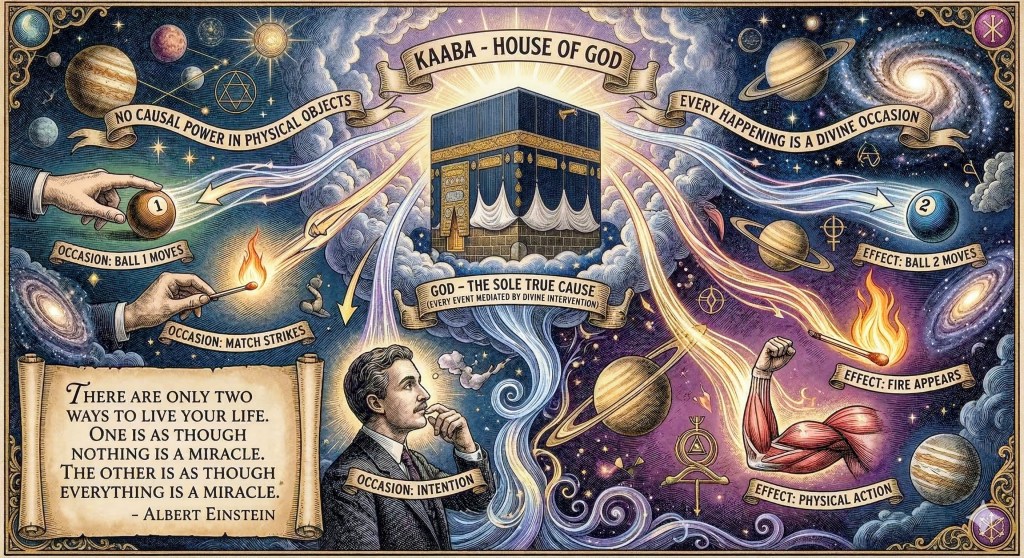
Einstein’s own perspective on this was nuanced. He famously stated, “I want to know how God created this world… I want to know His thoughts, the rest are details”. He did not believe in a personal God who intervened in human affairs, but he felt a “humble admiration of the illimitable superior spirit” revealed in the laws of nature. To Einstein, the “miracle” was the comprehensibility of the world. He argued that one should a priori expect a chaotic world that cannot be grasped by the mind; instead, we find a world that follows elegant, mathematical laws.
He used the analogy of a child in a library to describe the human condition: “The child knows that someone must have written these books… It does not understand the languages… But the child notes a definite plan in the arrangement of the books—a mysterious order which it does not comprehend, but only dimly suspects”.
This “mysterious order” is nowhere more evident than in the reality of light. Light is the messenger of the universe, the medium of life, and the bedrock of physical theory. Its features are not merely functional; they are aesthetically and mathematically “perfect” in their construction. The fact that light serves so many disparate roles—from allowing humans to see, to powering the growth of a leaf, to defining the very structure of time and space—suggests a unified “Artist” who uses light as a primary medium of creation.
The presence of light as a constant c provides a firmament for the universe, much as a foundation provides stability for a building. Without this “miraculous” constant, the laws of physics would be a phantasmagoria of changing rules. The existence of this order is what allows science to exist in the first place. As Eugene Wigner observed, the “unreasonable efficiency of mathematics” in describing the world is a “wonderful gift which we neither understand nor deserve”. Light, in its mind-bending reality, is the most profound manifestation of that gift.
Thematic Epilogue: The Mystic Emotion and the Source of True Science
In the final analysis, the “miracle of light” is not just a subject for the laboratory, but a catalyst for the highest human emotions. Albert Einstein believed that the “finest emotion of which we are capable is the mystic emotion,” which he identified as the germ of all true art and science. To know that what is impenetrable for us really exists and manifests itself as the “highest wisdom and the most radiant beauty”—this, Einstein said, was the core of true religious sentiment.
The sheer presence of light—its speed, its duality, its necessity for life, and its precisely tuned constants—should lead the thinking mind to a state of awe. We find ourselves in a universe where the most fundamental entity, light, is also the most mysterious. Einstein worked on it all his life and admitted failure in truly “knowing” it, yet it was the light he studied that allowed him to see the “thoughts of God” in the geometry of spacetime.
The “Artist” or “Creator” behind this reality has crafted a world where the “language” of light is both comprehensible enough to allow for science and mysterious enough to maintain the “sacred gift” of wonder. As Isaac Newton famously reflected, he felt like a “child playing on the beach,” finding a smoother pebble or a prettier shell, while the “vast oceans of truth” lay undiscovered before him. Light is that ocean. It is the radiance that permits our existence and the mystery that beckons our exploration. To contemplate light is to contemplate the very essence of the mind that conceived it—a mind that set the speed limit of the cosmos, designed the subatomic dance of the leaf, and wrote the “magic number” 137 into the heart of every atom. In the sheer presence of this miracle, we are invited not just to calculate, but to admire the “Artist” whose radiant pencil pushed the world into being.



 The Glorious Quran and Science
Leave a comment