
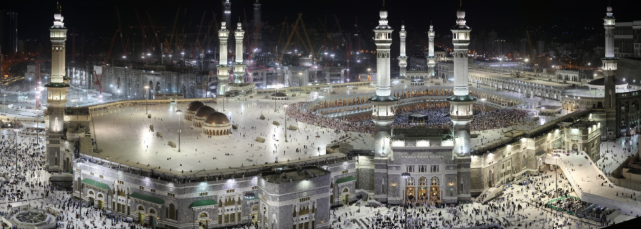
Epigraph
وَأَذِّن فِي النَّاسِ بِالْحَجِّ يَأْتُوكَ رِجَالًا وَعَلَىٰ كُلِّ ضَامِرٍ يَأْتِينَ مِن كُلِّ فَجٍّ عَمِيقٍ
And proclaim unto mankind the Pilgrimage. They will come to you on foot, and on every lean camel, coming by every distant track. (Al Quran 22:27)
Presented by Zia H Shah MD
Abstract
In Islamic scripture and memory, the Kaaba stands as the primordial “House” linked to Abraham and his son Ishmael, the fixed direction of prayer, and the focal point of Hajj and the year-round Umrah—an axis where ritual, geography, and sacred time converge.
Historically, the Kaaba has also been a material structure in a living city: it was a pre-Islamic sanctuary, was damaged and rebuilt multiple times, and has been encircled by one of the largest and most intensively managed sacred infrastructures on earth.
In the last quarter-century—especially after the COVID-era restrictions—the demographics of Hajj and Umrah have been shaped by mobility, public health governance, digital systems, and crowd-safety policies, producing a paradoxical modern pilgrimage: ever larger, ever more regulated, and often experienced by pilgrims as an oasis of safety amid regional turbulence.
Origins in revelation, tradition, and historical memory
The Qur’an’s most explicit framing of the Kaaba is not architectural but theological: it is described as an original sanctuary for humankind, associated with Abraham and marked by “signs,” safety, and pilgrimage obligation. In Abdel Haleem’s translation, 3:96 states, “The first House [of worship]… was the one at Mecca… a source of guidance” (excerpt).
In the same Qur’anic passage (3:96–97), the House is linked to Abraham’s “standing place” and to the idea that entering it is tied to security—an ethic that becomes central to later Muslim imagination of the sanctuary as a protected zone even amid external conflict.
A second cluster of Qur’anic statements emphasizes ritual circulation and purification of the sanctuary. In Abdel Haleem’s translation of 2:125: “We made the House a resort and a sanctuary for people” (excerpt), and Abraham’s “standing” is singled out as a place of prayer.
This Qur’anic sacral geography is narratively complemented by hadith: in one widely cited report, the Prophet is asked which mosque was built first; he answers “al-Masjid al-Haram,” then “al-Masjid al-Aqsa,” with a “forty years” interval.
For the story of Abraham’s household—especially Hagar and Ishmael—Islamic tradition leans heavily on hadith narration rather than Qur’anic naming (Hagar is not named in the Qur’an). A detailed account in describes Abraham bringing Hagar and Ishmael to Mecca, leaving them with limited water, and the setting of events that later relate to the pilgrimage landscape (especially the search for water and settlement near Zamzam).
At the far end of the timeline—“before Adam” and “from Adam”—the evidentiary posture shifts: these are primarily matters of later exegetical and devotional tradition, not archaeologically verifiable history. A modern tafsir tradition (e.g., Maʿarif al-Qur’an) reports strands in which a Kaaba associated with Adam existed until the flood of Noah and was later rebuilt by Abraham on the same foundational traces.
Even a mainstream reference work like presents (as “tradition”) that the Black Stone was given to Adam, and notes that many Muslims interpret the Qur’anic phrase that Abraham and Ishmael “raised the foundations” as implying a rebuilding of an earlier shrine.
A final “pre-prophetic” memory important to Meccan identity is the Elephant narrative. Qur’an 105 is classically read as recalling divine protection of the sanctuary against a campaign involving war elephants. In Abdel Haleem’s translation of 105:1: “Do you [Prophet] not see how your Lord dealt with the army of the elephant” (excerpt).
The tradition is often associated with and the year of the Prophet’s birth in biography-centered accounts (theological meaning foregrounded; precise historical reconstruction debated).
Kaaba in Muhammad’s ministry
When we move from primordial and Abrahamic framing into the Prophet’s 23-year ministry, the historical signal strengthens: we have Qur’anic legislation, external chronology, and later historiography that converge on several pivot points.
One of the most consequential “Kaaba-linked” transformations is the crystallization of qibla. notes that during Muhammad’s early ministry, the Kaaba functioned as the direction of prayer; after the Hijrah to Medina, the qibla briefly shifted to Jerusalem and then returned to the Kaaba.
That movement is not only historical but also hermeneutical: it becomes the Qur’an’s way of weaving continuity with Abraham into an emerging community’s ritual life, while sharply distinguishing monotheistic worship from the pre-Islamic shrine-culture that had filled the sanctuary with idols.
A second pivot is the normalization of pilgrimage access and sanctuary rules in the Medinan era. The Pact of (628) is described in Britannica as a compromise in which Meccan leadership recognized the Muslims’ growing community and, critically, acknowledged their right to return for ʿumrah.
This matters for the Kaaba’s historical trajectory because it turns the sanctuary from a contested tribal-cult center into an increasingly universalized sacred space aligned with Abrahamic monotheism and communal obligation.
The conquest of Mecca (630) functions—within the Islamic historical narrative—as the decisive purification of the shrine. Britannica’s Kaaba article emphasizes that when Muhammad’s forces took the city, he ordered the destruction of pagan idols in the sanctuary and the cleansing of polytheistic traces.
In a related biographical entry, Britannica highlights that Muhammad sought a bloodless capture and forbade revenge, an element often remembered as part of the sanctuary ethic—Mecca conquered without being turned into a theater of retributive violence.
From early caliphates to Ottoman rebuilds
Beyond the Prophetic era, the Kaaba’s history becomes a story of extraordinary continuity punctuated by acute shocks—fires, floods, political violence, and episodes of desecration—followed by restoration.
The most famous medieval rupture is the seizure of the Black Stone. Britannica records that in 930 the Black Stone was carried away by an extreme Shiʿi sect, the , and held for nearly 20 years for ransom.
In the longue durée, that episode illustrates a recurring pattern: the shrine’s physical vulnerability (to armed actors) does not translate into institutional collapse of pilgrimage, because the House’s meaning is sustained by a wider religious and political ecology that repeatedly reconstitutes the sanctuary.
Flood and reconstruction form another axis of continuity. Scholarly work on Ottoman-era interventions identifies the catastrophic flood and the subsequent rebuilding of the Kaaba in the reign of , linking the shrine’s survival to the imperial capacities of the (logistics, material supply, and architectural mobilization under a sacral mandate).
A striking “mirror” episode—relevant to the later comparison with Jerusalem—is the building of the : ’s project in Jerusalem is interpreted by some art-historians as occurring in a political moment when he did not control the Kaaba due to civil war with Ibn al-Zubayr, making Jerusalem’s shrine a kind of alternative religious focal point during that crisis.
Whatever one makes of that interpretive frame, it underscores a historical fact: across Islamic history, political power has repeatedly expressed itself through stewardship (and symbolism) of sacred architecture, and the Kaaba’s centrality has made it both target and prize—yet it persists.
Modern era transformations and recent construction
In the modern period, the Kaaba sits inside an infrastructural megasystem: continuous expansion of the surrounding mosque complex, intensification of crowd and health management, and periodic restoration of the Kaaba itself.
One of the most detailed documented interventions on the Kaaba in the contemporary Saudi era is the 1996 restoration under . Saudipedia itemizes the work as a comprehensive restoration operation that included removing tiles, inspecting the exterior wall, numbering interior stones for reinstallation, removing the roof and supporting columns to address damage, and erecting a protective curtain around the Kaaba during the work.
Such accounts are important because they show how the site’s “untouchability” is balanced with the practical requirement of conservation—done under procedures meant to preserve continuity of material identity while allowing structural renewal.
The annual covering and ceremonial rhythms also show modern standardization. Britannica notes that the kiswah is changed annually and that, since 2022, its change has been set on the first day of Muharram; it also notes a ceremonial washing of the Kaaba in Muharram using perfume and Zamzam water, led in recent times by a representative of the Saudi government.
The larger “built environment” transformation is the expansion of the . Britannica outlines how major modern expansions increased total area and capacity (including the integration/expansion of the Ṣafā–Marwah passage into the mosque structure by the early 1970s), reflecting a shift from a relatively compact sanctuary to a massive, multi-functional complex.
Saudi state narrative sources further describe successive expansions—such as the “third Saudi expansion”—in language of enormous material scale (concrete, steel, marble), signaling how pilgrimage growth has been met by industrial-scale construction rather than incremental urban growth alone.
The skyline around the sanctuary also changed dramatically. —adjacent to the Great Mosque—was completed in 2012 and is described by Britannica as a multitowered complex whose central clock tower reaches 1,972 feet (601 meters).
Whether celebrated as service provision for pilgrims or criticized as a radical urban rupture, its existence illustrates a modern reality: the Kaaba’s “success” is now mediated through hotels, transport corridors, regulated access systems, and high-density services that did not exist for most of the previous 1,300 years.
The most recent wave of construction planning continues to frame expansion as a response to anticipated pilgrimage growth. Reuters reported in 2025 that a “King Salman Gate” project near the Grand Mosque was launched to add roughly 900,000 indoor/outdoor prayer spaces across a vast mixed-use area, positioned within the logic of the kingdom’s larger transformation agenda and religious tourism capacity goals.
Pilgrimage demographics and the post-COVID shift
A demographic history of Hajj and Umrah is, in practice, a history of managed mass mobility. Over the last 25 years, Saudi Arabia’s statistical authority reports that the number of pilgrims across Hajj seasons reached more than 54 million, treating modern pilgrimage as a large-scale national service domain rather than only a ritual cycle.
This framing becomes especially visible after COVID-19, when pilgrimage numbers became not merely “high or low,” but deliberately engineered through public health risk, permit systems, and border policy.
In the pre-pandemic baseline year 2019, reported 2,489,406 Hajj pilgrims, including 1,855,027 from abroad and 634,379 from within the country.
This distribution—large majorities international—helps explain why COVID-era restrictions were so disruptive: controlling Hajj meant controlling borders, visas, and the public health risk of extreme density (the core feature of the ritual itself).
In 2020, the noted that Saudi Arabia decided the Hajj would proceed with a limited number of pilgrims residing within the country, explicitly grounded in risk assessment and WHO mass-gatherings guidance.
Peer-reviewed public health analysis reports that the 2020 Hajj involved about 1,000 pilgrims (residents of Saudi Arabia) with no confirmed COVID-19 cases detected among pilgrims during or after the pilgrimage—an outcome achieved by drastic scale reduction and tight controls.
The rebound is visible in the official statistics. In 2021, Hajj remained limited to citizens and residents in Saudi Arabia, and the total Hajj count was 58,745.
In 2022, Hajj rose to 926,062 total pilgrims, with 781,409 external and 144,653 internal, and a strongly air-dominated arrival profile for internationals.
In 2023, Hajj returned to large international scale: 1,845,045 total pilgrims, 90% external (1,660,915), with the report giving an average external stay of 31.6 nights and a near-identical gender split to surrounding years (52.6% male, 47.4% female).
In 2024, total Hajj pilgrims were 1,833,164, with 1,611,310 external (87.9%) and 221,854 internal (12.1%); the report lists 52.3% male and 47.7% female overall.
A notable recent operational marker is the “Makkah Route Initiative,” which the 2024 Hajj statistics describe as involving seven participating countries—Indonesia, Bangladesh, Pakistan, Malaysia, Turkey, Morocco, and Ivory Coast—with 322,901 beneficiaries in 2024, and with air arrivals comprising 96% of external pilgrims.
This points to a demographic reality: contemporary Hajj is not merely “people arriving,” but a pipeline of pre-clearance, airport processing, and transport choreography that shapes who can come, how they come, and how safely the rites can scale.
For Umrah, the post-COVID “surge” is even more pronounced because Umrah is year-round and can expand elastically. GASTAT’s quarterly Umrah reports for 2024 show totals at extraordinary scale: Q1 recorded 11,574,494 total Umrah performers; Q2 recorded 10,521,465; Q3 recorded 6,270,868; and Q4 recorded 7,435,625—roughly 35.8 million across the year by simple quarter-summing.
These reports also reveal demographic structure: in Q3 2024, overall Umrah performers were 57.3% male and 42.7% female; the external Umrah cohort was near gender parity (50.9% male, 49.1% female), while internal Umrah was more male-skewed (64.8% male, 35.2% female).
Age structure and mobility channels show how pilgrimage is now a “life-course” phenomenon tied to visa categories and travel modalities. In Q1 2024, the reports identify the 55–64 group as the largest share among external Umrah performers (17.9%), while the 30–39 group was the largest share among internal Umrah performers (28.6%).
By Q4 2024, the reports again highlight 30–39 as the largest internal age group (30%) and 35–44 as the largest external age group (17.9%), while noting that 84.4% of external Umrah performers arrived through airports and that entry profiles are overwhelmingly air-based for international pilgrims.
The post-COVID era also made visible a hard problem: unauthorized access, extreme heat, and safety externalities. News reporting on recent Hajj seasons emphasizes tightened permit enforcement and large numbers turned away without authorization, reflecting the state’s attempt to prevent unmanaged density from producing lethal crowd and heat outcomes.
Simultaneously, the return to summer-season Hajj has generated severe heat mortality risks: reporting on 2024 highlights unusually high death tolls associated with extreme temperatures, with unauthorized pilgrims disproportionately affected because they lack accommodation and formal support channels.
Against the backdrop of regional conflict, the demographics of “who comes” also reflect geopolitics: AP reporting on Hajj has noted the pilgrimage proceeding amid the Israel–Hamas war, with restrictions on political protest and with some affected populations unable to attend due to border closures.
This sets up the lived paradox many pilgrims articulate: Hajj and Umrah can feel like islands of safety and spiritual order—yet that safety is achieved through a modern fusion of theology, bureaucracy, security policy, and health governance.
Comparative note on continuity and the twice-destroyed Temple
The user’s comparison—Kaaba “success” versus the non-rebuilding of Solomon’s Temple—turns on a historically complex religious landscape in . According to Britannica, the “First Temple” tradition places completion in the 10th century BCE and destruction by of in 587/586 BCE; the Second Temple was completed in 515 BCE and later destroyed by the in 70 CE.
Britannica further notes that the Western Wall is the only extant trace of the Second Temple’s retaining wall and remains a site of prayer and pilgrimage for Jews, while the loss of the Temple is mourned liturgically (e.g., Tisha b’Av).
Why has the Temple not been rebuilt despite Israel’s military victories of the last 7–8 decades? Any single-cause answer is inadequate, but three constraints dominate the public record. First is sacred-space occupancy: the Temple Mount/Haram al-Sharif contains major Islamic sanctuaries—especially and the Dome of the Rock—whose religious and political status makes “rebuilding” not merely a construction choice but a maximal conflict trigger.
Second is governance status quo: Reuters describes a longstanding arrangement under which Jews may visit the compound but are generally not permitted to pray there, with administration handled by a Jordanian religious trust (Waqf), and Israeli leaders periodically reaffirming that policy even amid internal political pressure.
Third is internal Jewish legal-religious debate: within Judaism, the Temple Mount is itself contested terrain because of purity-law and sanctity concerns about where one may tread or worship, reducing consensus for action even absent the other constraints.
In that sense, the Temple’s non-rebuilding is not simply “lack of capability,” but the outcome of layered constraints—religious, legal, diplomatic, and security-related—on one of the world’s most contested sacred sites.
The contrast with the Kaaba is instructive but should not be used triumphalistically: the Kaaba has also been contested, attacked, and disrupted; its continuity has been maintained through repeated restoration and massive governance systems, not through an absence of threat.
Epilogue
A long view of the Kaaba shows two histories braided together. One is the sacred narrative: a House tied to Abraham and Ishmael, set apart as a place of guidance and return, and remembered as protected—whether in Qur’anic language of sanctuary and obligation or in the Elephant surah’s emblematic defense of the holy place.
The other is the material narrative: a stone-and-marble structure repeatedly repaired after shocks, surrounded by expansions that translate spiritual universality into engineered space—marble, steel, tunnels, crowd corridors, airport pipelines, statistics, and public health protocols.
In the post-COVID epoch, the miracle-language many pilgrims use—“peace in the sanctuary” despite the noise of the world—can be read on two levels at once. For believers, it is the lived sign that the House remains what the Qur’an calls it: a center of return and safety.
For historians and policymakers, it is also the outcome of deliberate governance: restrictions when necessary, relaxation when possible, large-scale service labor, and the systematic prevention of unregulated density—visible in the dramatic 2020 contraction and the carefully staged rebound to 1.8-million-scale Hajj.
In this double reading—sacred meaning sustained through practical stewardship—the Kaaba’s “success” is not merely survival. It is persistence of a unifying ritual grammar across centuries, even when empires rise and fall, and even when the surrounding region is politically fragmented: the House remains a place where millions, speaking hundreds of languages, attempt—at least for a few days—to become one congregation.
If you would rather read in Microsoft Word file:

 The Glorious Quran and Science
Leave a comment