
Epigraph
لَّا تُدْرِكُهُ الْأَبْصَارُ وَهُوَ يُدْرِكُ الْأَبْصَارَ ۖ وَهُوَ اللَّطِيفُ الْخَبِيرُ
“Eyes cannot reach Him but He reaches the eyes. And He is the Incomprehensible, the All-Aware.” (Al Quran 6:103)
Presented by Zia H Shah MD
Audio summary: String theory and the geometry of God:
Abstract
The historical friction between pantheistic worldviews and the monotheistic traditions of Judaism and Islam stems from a fundamental misunderstanding of spatial and metaphysical dimensionality. Pantheism, which identifies the divine with the sum total of the physical universe, often assumes that if God is to be real and present, He must be contained within the three-dimensional manifold accessible to human perception. However, this report argues that the perceived identity of God and Nature in pantheistic thought is a “vague assumption” that overlooks the necessity of extra dimensions. By integrating contemporary theoretical physics—specifically string theory, M-theory, and the concept of compactified dimensions—with the theological constructs of Al-Batin (The Hidden) and Al-Zahir (The Manifest) in Islam, and Tzimtzum (Contraction) in Judaism, a coherent bridge is established. This research demonstrates that the “Hiddenness” of God is not a result of distance but of a dimensional displacement, where the divine exists in higher-dimensional space while remaining immanently closer to human reality than the “jugular vein”. Through a comprehensive analysis of Zia H. Shah’s metaphysical frameworks and the “Architecture of Omniscience,” this report provides the intellectual “fine-tuning” necessary to reconcile pantheistic intuition with the transcendent, personal God of orthodox monotheism.
The Dimensional Fallacy of Classical Pantheism
The primary cognitive hurdle for the pantheist is the reliance on a three-dimensional empirical framework. Pantheism posited by thinkers like Baruch Spinoza and modern naturalistic adherents suggests that God and the universe are synonymous—Deus sive Natura. From a scientific and theological perspective, this view suffers from a category error regarding the nature of existence. If God is entirely restricted to the three dimensions of height, width, and depth (along with the linear flow of time), He becomes subject to the very entropy, decay, and physical limitations that govern matter.
The Islamic and Judaic response to this is not to deny God’s presence in the world, but to elevate His ontological status to a higher-dimensional reality. The Quranic assertion that “Eyes cannot reach Him but He reaches the eyes” (Quran 6:103) points to a structural invisibility—a cognitive closure where human biological sensors are simply untuned to the frequency of higher-dimensional space. Pantheism’s mistake is thus an act of “dimensional reductionism,” where the grandeur of a multi-dimensional Creator is collapsed into the narrow “cosmic cocoon” of human sensory experience.
| Metaphysical Framework | View of God’s Dimension | Relationship with Nature | Key Limitation |
| Pantheism | 3D Space-Time | Identity; God is the physical laws. | Scientific redundancy; God is subject to entropy. |
| Panentheism | 3D + Beyond | Interpenetration; God is in all and more. | Often vague on the mechanism of “more.” |
| Extra-Dimensional Monotheism | 10D / 11D / Infinite | Transcendence-within-Immanence; God sustains nature from higher dimensions. | Inaccessible to direct empirical senses. |
The Spectrum of Pantheistic Thought: From Spinoza to Einstein
To effectively bridge the gap between pantheism and monotheism, one must understand the diverse “flavors” of pantheistic belief. These doctrines range from the rigorous philosophical monism of the 17th century to the “sexed-up atheism” of modern biological naturalism.
The Spinozan Substance and the Problem of Determinism
Baruch Spinoza, arguably the most influential pantheist, argued in his Ethics that there is only one “Substance” in the universe, which he called God or Nature. To Spinoza, an attribute is “that which the intellect perceives as constituting the essence of substance”. He believed that while God has an infinite number of attributes, humans can only perceive two: Thought and Extension.
While this model provided a sense of unity, it stripped God of agency and volition. In Spinoza’s world, everything happens by necessity; there are no miracles, no answers to prayer, and no personal divine intervention. This deterministic view aligns closely with the classical physics of the 19th century but fails to account for the indeterminacy and complexity revealed by modern quantum mechanics and higher-dimensional theories.
Einstein’s God: The Spirit of the Laws
Albert Einstein famously identified with Spinoza’s God, expressing awe at the “orderly harmony” of the universe. Einstein’s religious feeling was characterized by a “humble attitude of mind toward the grandeur of reason incarnate in existence”. He famously used the analogy of a child in a vast library: the child knows someone wrote the books but cannot understand the languages or the plan of the arrangement.
This “dim suspicion” of a mysterious order is the first step toward monotheism. Einstein’s God was a “superior mind” manifest in the laws of physics. However, by limiting God to the laws themselves, Einstein—like Spinoza—remained trapped in a three-dimensional paradigm where the “Spirit” has no existence independent of the material. The transition to monotheism requires the pantheist to recognize that the “Superior Mind” is not just the laws of the 3D world, but the Architect who designed those laws from a higher-dimensional vantage point.
The Islamic Metaphysics of Al-Batin and Al-Zahir
The Quran provides a sophisticated framework for understanding the relationship between the transcendent and the immanent. In Surah Al-Hadid, God is described as “the First and the Last, and the Manifest (Al-Zahir) and the Hidden (Al-Batin)” (Quran 57:3). This dual nature is the key to reconciling the pantheist’s love for the visible world with the monotheist’s worship of the transcendent Creator.
Al-Zahir: The Manifest Signs in the Three Dimensions
Al-Zahir refers to God’s manifestation in the physical world. Islamic theology teaches that the universe is filled with ayat (signs) that point toward the Creator. For the pantheist, these signs are God. For the Muslim, these signs are the “relative reality” that derives its existence from the “Absolute Wujud” of God. The mathematical precision of physical laws, the complexity of biological life, and the vastness of the cosmos are all expressions of Al-Zahir.
Al-Batin: The Hidden Reality of Extra Dimensions
Al-Batin refers to the intrinsic, hidden nature of God that remains beyond human sensory perception. This is where the concept of extra dimensions in physics becomes a powerful theological tool. If God exists in higher dimensions (e.g., the 10th or 11th dimensions of string theory), He is structurally “Hidden” from our 3D perception. This hiddenness is not an absence but an “enfoldment”—the unseen dimensions enfold the visible ones.
The Islamic concept of Wahdat al-Wujud (Unity of Being), as articulated by Ibn Arabi, has often been confused with pantheism. However, Ibn Arabi maintained a clear differentiation: while all things manifest the divine reality, they do not encompass the totality of God. God transcends His creation; the universe is a shadow or a manifestation (tajalli) of the One Being. This “Oneness of Existence” means that nothing has an essential substance except God, and our own being is contingent upon His continuous flow of life-force.
| Attribute | Meaning in Islamic Metaphysics | Connection to Physics |
| Al-Zahir | The Manifest; evident in creation. | The 3D observable universe and physical laws. |
| Al-Batin | The Hidden; intrinsic essence. | Higher dimensions (n>3) and the quantum vacuum. |
| Al-Awwal | The First; eternal origin. | The cosmic singularity; Big Bang origin. |
| Al-Akhir | The Last; ultimate destination. | The “Big Crunch” or “Omega Point.” |
Judaic Mysticism: Tzimtzum and the Geometric Void
In Orthodox Judaism, the Kabbalistic doctrine of Tzimtzum (contraction) provides a remarkably modern-sounding explanation for the existence of a finite universe within an infinite God. Tzimtzum suggests that God (Ein Sof) began creation by “contracting” His infinite light to allow for a “vacant space” where finite realms could exist.
The Sefirot as Dimensions of Reality
Kabbalah teaches that into this vacant space, God emanated ten “Divine Lights” or powers known as the Sefirot. Each of these Sefirot can be understood as a “dimension” of reality. Modern Kabbalists have pointed out that string theory requires exactly ten dimensions for mathematical consistency, mirroring the ten Sefirot of Jewish mysticism.
The physical universe we inhabit corresponds to the lowest of these dimensions (Malkuth), while the higher dimensions remain “compacted” or hidden from our senses. This provides a geometric framework for the pantheist: the “Nature” they worship is merely the three-dimensional “garment” or “vessel” of a much larger, ten-dimensional divine light.
Atzmus vs. Ohr Ein Sof
Hasidic philosophy further distinguishes between the Ohr Ein Sof (the infinite light) and Atzmus (the divine essence). While the light fills all creation (immanence), the essence (Atzmus) is beyond the duality of finite and infinite. This essence both transcends and permeates all levels of existence. This “acosmic monism” resolves the pantheistic dilemma: God is not just the sum of the parts, but the underlying essence that makes the parts possible while remaining independent of them.
The Architecture of Omniscience: Extra Dimensions in Physics
The “Architecture of Omniscience” is a concept that explores how God can be all-knowing and all-present without being a physical part of the 3D world. In theoretical physics, the addition of spatial dimensions drastically changes the observer’s perspective and power.
The Flatland Analogy and the Power of N+1
Edwin Abbott’s Flatland (1884) remains the gold standard for visualizing higher dimensions. In the story, a “Square” living in a 2D world is visited by a “Sphere” from a 3D world.
- Transcendence-within-Immanence: From the 3D perspective, the Sphere can see the “inside” of every 2D shape simultaneously—their internal organs, their locked safes, and their innermost thoughts—without having to “enter” their 2D plane.
- Proximity: The Sphere is closer to the center of the Square than any other Flatlander could ever be, yet the Sphere is completely invisible to the Square until he chooses to pass through the 2D plane.
This is the literal physical mechanism for the Quranic verse: “We are closer to him than his jugular vein” (Quran 50:16). If God exists in the 4th, 5th, or 10th dimension, He is “equidistant” from every point in our 3D world. He can see every quark in every atom simultaneously because he views our 3D “slice” of reality from a higher-dimensional vantage point.
The Hypersphere of Consciousness
Mathematical models of the hypersphere—an n-dimensional analogue of a sphere—provide further insight. In a hypersphere defined by the equation:
x12+x22+⋯+xn2=R2
as the number of dimensions n increases, the “boundary” of the sphere remains a fixed distance from the center, yet its projection in 3D space can encompass the entire universe. This allows for a “consciousness of light” where God remains at the center of existence while being present at every boundary of creation.
String Theory and the Ten Divine Dimensions
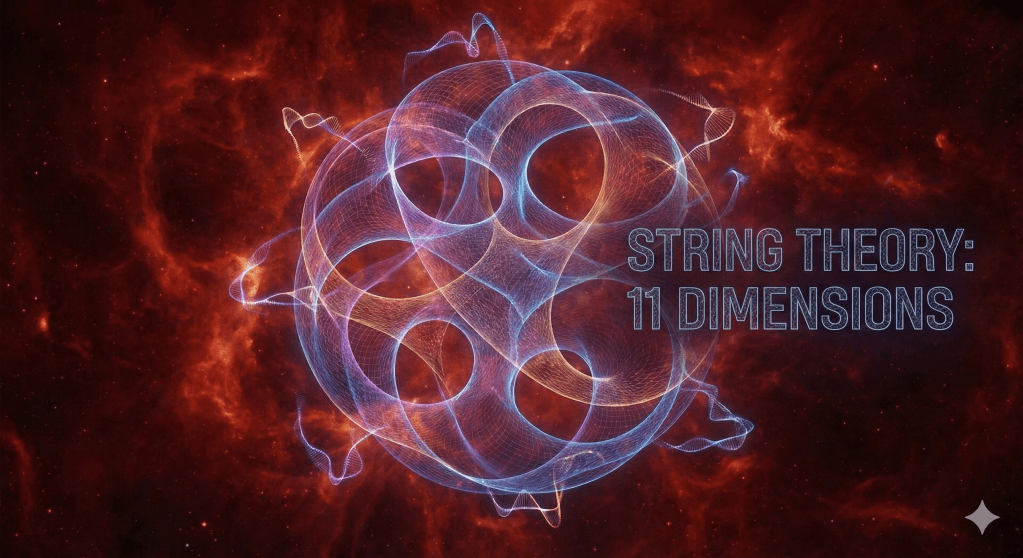
String theory and its successor, M-theory, propose that the fundamental building blocks of the universe are not point-like particles but tiny vibrating strings of energy. For the mathematics of these theories to work, the universe must have ten or eleven dimensions.
Compactification: The Hiddenness of the Divine
Why do we only see three dimensions if ten exist? Physicists use the concept of “compactification”. Imagine a garden hose viewed from a distance; it looks like a 1D line. However, up close, it is a 2D cylinder. If the “circular” dimension of the hose were tiny enough, we would never see it. String theory suggests that six or seven extra dimensions are “curled up” or “compactified” at every single point in our 3D space.
This has profound theological implications:
- Ubiquity: If the extra dimensions are at every point in space, then the “Abode of God” is not in a distant heaven, but right here, at every subatomic scale.
- Accessibility: An omniscient God operating in these compactified dimensions has immediate access to the “innermost thoughts and intentions” of every human being, as the soul may interact with these higher-dimensional fields.
| Theory | Dimensions | Theological Resonance |
| Kaluza-Klein | 5 | Early attempt to unify gravity and light; the “first step” beyond 3D. |
| Superstring Theory | 10 | Matches the ten Sefirot of Kabbalah; represents the “dimensions of God.” |
| M-Theory | 11 | A unified “Theory of Everything”; mirrors the “All-Aware” nature of Allah. |
| Infinite Dimensions | ∞ | The “Abode of God” as an infinitely many-dimensional space. |
Scientific Critique: Why Pantheism is “Sexed-up Atheism”
While pantheism appears religious, critics like Richard Dawkins and Zia H. Shah argue that it is often scientifically redundant. If God is simply the laws of nature, then the word “God” adds no explanatory or predictive value. A scientist can describe the orbit of a planet or the folding of a protein using impersonal laws without ever needing the label “divine”.
The Incoherence of Divine Immanence without Transcendence
The scientific incoherence of pantheism lies in its inability to distinguish God from the object of study. If God cannot “break” the laws of physics or act independently of them, then God is merely a prisoner of causality.
However, by “fine-tuning” pantheism toward the extra-dimensional monotheism of Islam and Judaism, the “divine” becomes functionally relevant again. God is not the laws, but the Source of the laws, acting from higher dimensions. This allows for “Special Divine Action”—miracles or guided evolution—that appears consistent with natural laws in 3D space but is actually a targeted intervention from a higher-dimensional perspective.
The Occasionalist Bridge: Al-Ghazali and Quantum Physics
A significant school of thought in Islam, Al-Ghazali’s occasionalism, posits that there is no inherent causal power in matter; rather, God creates the universe anew at every instant. While this seemed radical to medieval philosophers, it finds a modern echo in quantum physics.
Quantum Witnesses of the Divine
Concepts like quantum entanglement (instantaneous effects at a distance) and tunneling (particles passing through barriers) suggest that the “solid” 3D world is much more fluid than it appears. Al-Ghazali argued that the “burning of cotton by fire” is not an inherent property of fire, but a habitual act of God.
In a higher-dimensional framework, this “continuous creation” is the mechanism by which God sustains the 3D projection. The pantheist’s “Nature” is thus revealed to be a “dynamic complexity” maintained by a higher-dimensional Will. This moves the pantheist from worshipping the “machine” to worshipping the “Sustainer” who “breathes life” into the equations of physics at every plank-second.
Consciousness: The Final Frontier of Unity
The pantheist often believes in “cosmic consciousness”—the idea that the universe itself is aware. Panpsychism, the view that every particle has a shred of consciousness, is a common variant.
The Meeting Point of Finite and Infinite
Islamic and Judaic thought provide a more nuanced “Unity of Being” regarding consciousness. The Quran says: “Eyes cannot reach Him but He reaches the human consciousness” (Quran 6:103).
Human consciousness is seen as the “meeting point” where the 3D biological brain interacts with the higher-dimensional soul. We cannot observe consciousness in an atom or a rock because consciousness is not a property of 3D matter; it is a higher-dimensional phenomenon that “shines through” certain complex physical structures like the human nervous system.
This allows the pantheist to retain their sense of “interconnectedness” without ascribing divinity to inert matter. We are interconnected not because we are made of the same “divine mud,” but because our consciousnesses all derive from the same “Universal Mind” or Atzmus that exists in the higher-dimensional realm.
The Fine-Tuned Bridge: Reconciling the Two Camps
The transition from pantheism to orthodox monotheism requires three specific intellectual shifts:
- From Substance to Source: The pantheist must recognize that the “orderly harmony” they admire is a derivative reality created by a Higher-Dimensional Source.
- From Law to Legislator: The laws of physics are not God; they are the “consistent habits” of God’s action in 3D space.
- From Totality to Transcendence: The universe is not “all that is”; it is a limited, compactified “slice” of a much larger multidimensional reality.
The Theistic Nudge
Zia H. Shah suggests that pantheism is often an “intermediary stage” in the journey from atheism to theism. It represents a “hedge” between the two, where the individual admires the creativity of God but is not yet ready to accept a personal deity. By presenting God as an extra-dimensional Architect, the concept of a “Personal God” becomes much less anthropomorphic and much more scientifically plausible. God is “personal” in the sense that He has access to our thoughts and intentions through higher dimensions, not in the sense that He is a giant human in the sky.
| Perspective | View of the Universe | Perception of God |
| Atheist | Accidental, material, autonomous. | Non-existent. |
| Pantheist | Divine, self-organizing, holy. | Identical to the universe. |
| Panentheist | In God, but partially independent. | Both immanent and transcendent. |
| Extra-Dimensional Monotheist | A finite projection of a higher reality. | The Transcendent Architect and Personal Sustainer. |
Practical Implications: Miracles, Prayer, and the Afterlife
Bringing pantheists into the monotheistic camp changes their relationship with the divine from one of “passive awe” to “active engagement.”
The Mechanism of Miracles
In a pantheistic world, miracles are impossible. In an extra-dimensional world, a miracle is simply an event where a higher-dimensional cause produces an effect in 3D space that cannot be explained by 3D-only laws. This restores the coherence of the Biblical and Quranic accounts of prophetic signs.
The Reality of Prayer
If God is the extra-dimensional “Sphere,” then prayer is not just talking to oneself. It is a communication that “travels” through the compactified dimensions to a Being who is already closer to the “jugular vein” than our own sensory perceptions.
The Afterlife as Dimensional Transition
Finally, the concept of an afterlife becomes a logical extension of physics rather than a “fairytale.” If the human consciousness is rooted in higher dimensions, then the death of the 3D body is simply a “shedding of the cocoon”. The soul continues to exist in the higher-dimensional realms—the “Heavenly Places” or the “Paradise” mentioned in the Quran—where the “Hidden” reality of God becomes “Manifest”.
The Global Synthesis of the Abrahamic Faiths
While Islam and Judaism are often presented as distinct, their core theological concepts regarding God’s unity (Tawhid or Shema) are nearly identical. Both faiths strictly prohibit any image of God, emphasizing His radical uniqueness (Tanzih).
This shared “Aniconic Monotheism” is the perfect landing ground for the pantheist. By moving away from the Christian-developed paradigm of incarnation—which pantheists often find illogical—and toward the “pure monotheism” of Newton, the Quran, and the Torah, the pantheist finds a worldview that respects both the laws of nature and the majesty of the Creator.
| Religion | Core Creed | View of Unity | Relationship to Pantheism |
| Islam | “There is no god but Allah.” | Tawhid; absolute, indivisible oneness. | Corrects pantheism via Batin/Zahir distinction. |
| Judaism | “The Lord our God, the Lord is One.” | Echad; unique, incomparable singularity. | Corrects pantheism via Tzimtzum and Atzmus. |
| Pantheism | “All is God.” | Monism; everything is one substance. | Lacks the dimension of transcendence. |
Epilogue: The Thematic Convergence of Mind and Cosmos
The “fine-tuning” of pantheism is not a rejection of its central insight—that the universe is a unified, awe-inspiring Whole—but an elevation of that insight into its true dimensional context. The mistake of the pantheist is a failure of imagination, assuming that the three dimensions we “find” with our five senses are the totality of God’s canvas. As the Quran reminds us, “To God belong the East and the West. Wheresoever you turn, there is the Face of God” (Quran 2:115). This “Face” is not just the physical matter of the stars and the trees, but the multidimensional glory of a Creator who encompasses all things while being “Incomprehensible” to the limited sight of the 3D observer.
By embracing the “Architecture of Omniscience,” the pantheist moves from a “one-dimensional” existence into a vivid, multidimensional relationship with the divine. They discover that the “Superior Mind” they dimly suspect in the laws of physics is the same God of Abraham who hears the whisper of the heart. In this unified paradigm, science and religion are no longer at odds; they are simply different ways of exploring the same ten or eleven dimensions of the divine reality. The “vague assumption” of identity is replaced by the “certain knowledge” of derivation, leading the seeker back to the original source: the First and the Last, the Manifest and the Hidden, the All-Aware Architect of all worlds.



 The Glorious Quran and Science
Leave a comment