
…
Presented by Zia H Shah MD
Audio summary:
Abstract
This research report presents a comprehensive, multi-disciplinary examination of the phenomenon of human consciousness through the lens of Quranic exegesis, specifically analyzing Surah Fussilat, Verse 53 (41:53). The verse promises that Divine signs will be made manifest in two distinct domains: the “horizons” (al-afaq)—referring to the external macrocosm of the universe—and “within themselves” (fi anfusihim)—referring to the microcosm of the human self. While modern science has successfully decoded many mysteries of the physical universe, the realm of human consciousness remains an intractable enigma for materialist philosophy. This report argues that the “Hard Problem” of consciousness is not merely a scientific gap but a theological signpost. By synthesizing the writings of Dr. Zia H. Shah with the philosophical arguments of Richard Swinburne and the empirical deadlock of over 200 competing theories of consciousness, this report demonstrates the incoherence of metaphysical naturalism. It posits that a “dead” or inert universe cannot give rise to subjective experience without a Prior Mind. Consequently, the study concludes that the phenomenon of consciousness serves as a primary “sign within the self,” leading the rational intellect inescapably to the recognition of a Transcendent Creator. The analysis integrates contemporary neuroscience, the philosophy of mind, and Islamic theology to demonstrate that the “Eclipse of Matter” is underway, revealing the necessity of the Soul.
1. Introduction: The Prophecy of the Two Books
The relationship between the Divine and the human is mediated through revelation, but revelation in Islamic theology is not limited to scripture. The Quran frequently invokes the natural world as a locus of Divine manifestation. However, arguably the most profound articulation of this dual revelation is found in Surah Fussilat, Verse 53:
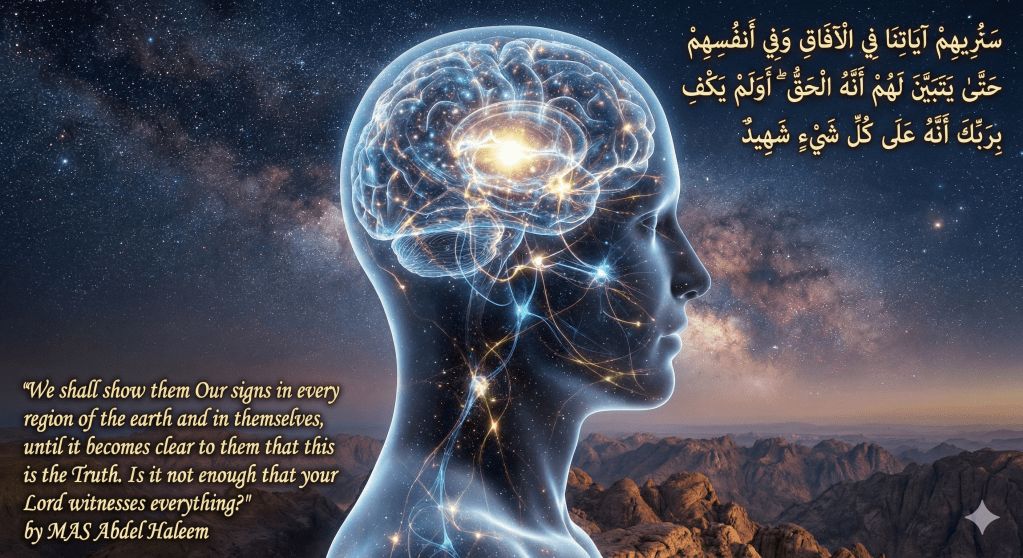
“We will show them Our signs in the horizons and within themselves until it becomes clear to them that it is the truth. Is it not sufficient concerning your Lord that He is, over all things, a Witness?” (Quran 41:53).
This verse establishes a dichotomy of evidence that has guided Islamic intellectual history for centuries. It proposes that the path to confirming the “Truth” (Al-Haqq—one of the names of God) lies in the convergence of two distinct fields of inquiry. First, the “signs in the horizons” (Ayat fi al-Afaq) encompass cosmology, physics, astronomy, and biology—the study of the external, objective reality. Second, the “signs within themselves” (Ayat fi Anfusihim) refer to the internal, subjective reality—psychology, neurology, and, most significantly, the mystery of human consciousness.
For centuries, the “signs in the horizons” took precedence in apologetics, with the teleological design of the heavens serving as the primary proof of God. The intricate movements of the planets, the stability of the earth, and the biological complexity of life were the primary “signs” referenced by theologians. However, the 21st century has witnessed a profound shift. As Dr. Zia H. Shah argues, we are witnessing the “Eclipse of Matter,” where the focus of theistic evidence is shifting inward. The materialist worldview, having mapped the stars and split the atom, has crashed against the shoals of the human mind. It is here, in the “signs within,” that the next great realization of Divine Truth is taking place.
The prophecy of Quran 41:53 uses the future tense (“We will show them”), suggesting a progressive unfolding of knowledge. As humanity advances in its dissection of the material world, the inability of that material world to account for the observer itself becomes increasingly glaring. This report explores why the phenomenon of consciousness—the very fact that we are—constitutes a miraculous disruption of the materialist narrative. It examines the failure of atheistic science to account for the “inner light” of the mind, positing that this failure is the fulfillment of the Quranic promise: that the signs within the self will eventually make the Truth manifest.
2. The Ontology of the Inert Universe
To understand the weight of the theistic argument from consciousness, one must first rigorously define the alternative. The prevailing worldview in secular academia is metaphysical naturalism (or physicalism), which posits that the universe is a closed system composed entirely of matter and energy.
2.1 The Physics of the “Dead” Cosmos
In the atheistic or physicalist framework, the universe is fundamentally “dead” or inert. It originated from a singularity roughly 13.8 billion years ago and consists entirely of space-time, matter, and energy governed by immutable laws. The fundamental constituents of this universe are fermions (matter particles like quarks and leptons) and bosons (force-carrying particles like photons and gluons).
These particles are defined by their physical properties: mass, charge, spin, and velocity. Crucially, none of these particles possess consciousness. An electron does not “feel” electric charge; it merely reacts to it according to the Schrödinger equation. A proton has no hopes, no dreams, and no awareness of its existence. A photon of light is not “aware” of brightness; it is simply a packet of electromagnetic energy. In this reductionist view, the universe is a machine—a colossal, blind mechanism grinding away in silence.
2.2 The Aggregation Problem and Brute Emergence
The central crisis for materialism arises when it attempts to explain the emergence of the “mental” from the “non-mental.” If one atom is unconscious, and two atoms are unconscious, logic dictates that a collection of trillion atoms—such as a stone or a star—remains unconscious. It is merely a “heap” of dead matter, differing from a single atom only in complexity, not in ontology.
However, materialism claims that if you arrange these dead atoms into a specific, highly complex configuration (the human brain), they suddenly “wake up” and acquire a first-person perspective. Dr. Zia H. Shah identifies this transition from dead matter to subjective awareness as “Brute Emergence”. This concept of “Brute Emergence” posits that quality (the redness of a rose, the hurt of pain) can emerge from quantity (neural oscillations) without any causal mechanism explaining the qualitative leap. Dr. Shah argues that believing a dead universe can accidentally give rise to consciousness is philosophically indistinguishable from believing in magic. It posits an effect (consciousness) that is qualitatively superior to and utterly distinct from its cause (inert matter).
2.3 The Thought Experiment of Alien Design
To illustrate the necessity of a “Prior Mind,” Dr. Shah utilizes a reductio ad absurdum thought experiment regarding the origins of intelligence. Imagine an atheist argues that human consciousness is too complex to have evolved by chance, but instead of God, they posit that highly advanced aliens engineered us (a theory akin to “Directed Panspermia”). This hypothesis merely pushes the problem back one step. The question immediately arises: “Who designed the aliens?”
If the aliens were designed by an even older civilization, and those by even older ones, it creates an infinite regress of contingent minds—”turtles all the way down.” Logic dictates that the chain of causality cannot be infinite. Eventually, one must arrive at a First Cause that is not designed and not contingent.
This leaves the rational observer with only two options for the ultimate origin of mind:
- Option A: Dead Matter (The Inert Universe). This view suggests that the base layer of reality is blind, non-conscious dust that miraculously produced sight and awareness.
- Option B: Eternal Consciousness (God). This view suggests that the base layer of reality is a Conscious Mind, and human consciousness is a derived gift or reflection of that Primordial Reality.
Since dead matter lacks the potentiality to create mind (as argued in the aggregation problem), the only rational conclusion is that the universe is grounded in an Eternal Consciousness. As the commentary suggests, “Consciousness and the Inert Universe: The Need for a Prior Mind”.
2.4 The Vacuum of Meaning in Materialism
Dr. Shah emphasizes that in a “dead universe,” meaning itself is an illusion. Atoms do not have purposes; they only have trajectories. If human thoughts are merely the collisions of atoms, then the concepts of “truth,” “justice,” and “love” are merely chemical byproducts, devoid of transcendent reality. This leads to the “rational deficit” of atheism: if our brains are merely survival engines evolved to hunt and gather, why should we trust them to understand quantum mechanics or metaphysics? The fact that we crave meaning in a universe allegedly devoid of it is, in itself, a “sign within the self” pointing to a different origin.
3. The Landscape of Confusion: 200 Theories and the Failure of Consensus
The Quranic challenge in verse 41:53 implies a process (“We will show them… until it becomes clear”). This suggests a period of struggle and confusion preceding the realization of truth. Currently, the field of consciousness studies is characterized by precisely such chaos, which serves as a negative proof of the materialist paradigm’s insufficiency.
3.1 The Taxonomy of Ignorance
Robert Lawrence Kuhn, the creator of the series “Closer to Truth,” has meticulously compiled a taxonomy of over 200 theories of consciousness currently circulating in academia. The sheer volume of competing theories signals a profound crisis in the scientific method when applied to the “soul.”
In normal science, theories tend to converge over time as data accumulates (e.g., the convergence of genetics and Darwinian evolution into the Modern Synthesis). In consciousness studies, however, theories are diverging. New models are proposed annually, each radically different from the last, ranging from quantum microtubule theories to higher-order thought theories. This divergence is a “sign” that the foundational assumption—that matter produces mind—is flawed. When a paradigm fails to produce consensus after decades of intense research, it usually indicates that the paradigm itself is in error.
Kuhn’s landscape classifies these theories into broad categories, yet none have achieved dominance:
- Materialist/Reductive Theories: These attempt to reduce consciousness to neural firing (e.g., “C-fibers firing = Pain”).
- Non-Reductive Physicalism: These claim consciousness emerges from the physical but has distinct properties (Emergentism).
- Quantum Theories: These look for consciousness in the collapse of the wave function (e.g., Orch-OR by Penrose/Hameroff).
- Panpsychism: The desperate conclusion that consciousness must be a fundamental property of all matter, down to the electron.
3.2 The Clash of the Titans: IIT vs. GWT
The disarray in the field is best exemplified by the vitriolic conflict between the two leading scientific theories: Integrated Information Theory (IIT) and Global Workspace Theory (GWT).
Global Workspace Theory (GWT), championed by Stanislas Dehaene and Bernard Baars, posits that consciousness is a result of “broadcasting” information across the brain’s cortex. It is a functionalist theory: consciousness is what the brain does (processing and sharing information). However, GWT fails entirely to explain the “Hard Problem”—why does the broadcasting of data create a subjective feeling? A computer network broadcasts data, yet we do not assume the internet is conscious.
Integrated Information Theory (IIT), proposed by Giulio Tononi, takes a mathematical approach. It posits that consciousness is an intrinsic property of any system with a specific causal structure, measured by a value called “Phi.” The higher the Phi, the more conscious the system. This theory leads to the conclusion that consciousness is not limited to biological brains; even a grid of logic gates could possess a form of consciousness if connected correctly.
The Scandal: In 2023, the scientific community witnessed a public meltdown when a letter signed by 124 scholars branded IIT as “pseudoscience”. This attack was not merely a disagreement over data; it was an ideological war. The signatories felt that IIT’s implications (leading toward panpsychism) were unscientific. This infighting reveals that even the most “scientific” theories are operating without a consensus on what consciousness actually is or how to measure it. The “Pseudoscience Letter” is a symptom of a field that has hit a wall—the wall of the “Inert Universe.”
3.3 The Failure of “Gap” Explanations
Dr. Zia H. Shah argues that these 200 theories attempt to fill the “God of the gaps,” but in this case, the gap is the entire canvas. Consciousness is not a small anomaly in an otherwise explained universe; it is the medium through which we know the universe exists. To try to explain the observer by reference to the observed is a category error. The scientific deadlock validates the Quranic perspective in Surah Al-Isra (17:85): “And they ask you concerning the soul (al-ruh). Say, ‘The soul is by the command of my Lord; and of the knowledge thereof you have been given but a little’”. The “little knowledge” given to humanity is sufficient for functional interaction but insufficient for ontological comprehension without Divine guidance.
4. The Denial of Self: Illusionism and the “Zombie” Apocalypse
Faced with the impossibility of explaining how the “Inert Universe” produces the “Inner Light,” some atheist philosophers have adopted a radical and desperate strategy: denying the reality of consciousness altogether. This position, known as Illusionism or Eliminative Materialism, represents the logical endpoint of atheism.
4.1 The Rise of Illusionism
Illusionism, defended by figures like Daniel Dennett and Keith Frankish, argues that phenomenal consciousness (the feeling of “what it is like” to be you) is a trick played by the brain.
- The User-Illusion: They propose that the brain creates a “user-illusion” of a unified self to facilitate complex social interaction and decision-making, similar to how a computer desktop interface simplifies the complex code underneath.
- Zombiehood: In essence, this view posits that we are “philosophical zombies”—beings who act like we are conscious, speak like we are conscious, but have no inner light, no true subjective depth. We are machines that think we are ghosts.
4.2 The Theological Critique of Illusionism
Dr. Zia H. Shah and other theistic commentators expose Illusionism as the ultimate reductio ad absurdum of atheism—a philosophy that must deny the most obvious fact of existence to save its theory.
- Self-Refutation: To say “consciousness is an illusion” is a contradiction in terms. An illusion requires a conscious subject to be deceived. A camera cannot experience an illusion; only a mind can. If I am under the illusion that I am conscious, I am conscious of the illusion. The existence of the deception proves the existence of the perceiver.
- The Suicide of Reason: If our direct experience of ourselves is a lie, then we have no grounds to trust our sensory perception of the external world (the “horizons”). If the “I” that observes the microscope is a fiction, then the data seen through the microscope is suspect. Illusionism saws off the branch on which science sits.
4.3 The Denial of Free Will
Parallel to the denial of consciousness is the denial of Free Will by scientists like Robert Sapolsky and Sam Harris. They argue that because the universe is deterministic (matter governed by laws) and we are made of matter, human choices are merely the result of electrochemical reactions.
- The Libet Experiment Flaw: Much of this rests on Benjamin Libet’s experiments from the 1980s, which showed brain activity (“readiness potential”) preceding conscious decisions. However, newer research suggests these potentials reflect the brain’s “revving up” rather than a finalized decision, and Libet himself believed in a “free won’t”—the power of the conscious mind to veto the impulse.
- The Quranic Response: The Quranic insistence on the “Self” (Nafs) as a moral agent presumes a capacity for choice. The “Inert Universe” cannot account for agency. A rock does not choose to roll; it is pushed. The fact that humans agonize over choices, feel guilt, and strive for self-improvement is a “sign within themselves” that they possess a faculty (the Soul) that transcends the deterministic laws of physics.
5. The Argument from Consciousness: Richard Swinburne and the Theistic Deduction
While atheism retreats into Illusionism, theistic philosophy offers a coherent explanation that aligns with the data. Richard Swinburne, a prominent philosopher of religion frequently cited by Dr. Zia H. Shah , formalizes this into the Argument from Consciousness (AC).
5.1 The Argument Structure
Swinburne’s argument is inductive (based on probability) rather than deductive. It proceeds through a Bayesian analysis of likelihoods:
| Step | Argument |
| 1. The Datum | We observe a universe that contains correlations between physical brain events and non-physical mental events (intentions, feelings, thoughts). |
| 2. The Failure of Science | Science explains the physical-to-physical (e.g., neuron A firing causes neuron B to fire). It cannot explain the physical-to-mental (e.g., neuron A firing causes the feeling of pain). There is no “law of physics” that necessitates pain arising from C-fiber stimulation. |
| 3. The Hypothesis of Design | If there is a God who intends to create creatures capable of making moral choices and interacting with the world, He would need to connect their physical bodies to a realm of subjective experience. |
| 4. The Likelihood | It is highly probable that correlations between brain and mind exist if God exists (to facilitate agency). It is highly improbable that such correlations would arise by blind chance in a dead universe. |
| 5. Conclusion | Therefore, the existence of consciousness is strong evidence (raising the probability P(h |
5.2 The “Binding” of Mind and Body
Swinburne argues that the “intention of an agent” is the only thing that can bind the disparate worlds of matter and mind. Just as a human engineer connects software to hardware, the Divine Engineer connects the Ruh (Soul) to the biological substrate. This aligns with Dr. Shah’s assertion that consciousness is the “meeting point of finite and infinite”.
Swinburne posits that the correlation between brain events and mental events is a “brute fact” in naturalism—it just happens, with no explanation. In Theism, it is a purposeful connection. The “Principle of Simplicity” favors the Theistic explanation because it postulates one cause (God) for the many correlations, whereas naturalism must postulate billions of inexplicable brute facts for every conscious being.
6. Zia H. Shah’s Synthesis: The Eclipse of Matter
Dr. Zia H. Shah expands on Swinburne’s philosophy by integrating it with Quranic theology, specifically utilizing the metaphor of the Interface or Radio Receiver to explain the relationship between the brain and the soul.
6.1 The “Eclipse of Matter”
In his writings, Dr. Shah argues that as science advances, the sufficiency of matter to explain reality is diminishing—a phenomenon he terms the “Eclipse of Matter”. In the 19th century, matter seemed solid and sufficient. In the 21st century, matter has dissolved into quantum wave functions, dark energy, and information fields. The deeper we look into the brain, the less “material” the explanation becomes. The “hard problem” is not dissolving; it is hardening. This “eclipse” clears the way for the “light of the soul” to be recognized as a necessary independent reality.
6.2 The Radio Analogy
To explain the dependence of the mind on the brain without reducing the mind to the brain, Dr. Shah employs the Radio Analogy.
- The Scenario: Consider a radio playing a symphony. If you smash the radio’s speakers, the sound becomes distorted. If you destroy the radio, the music stops. A materialist observer concludes, “The radio created the music.”
- The Reality: The truth is that the radio was merely receiving a signal from a distant broadcast station. Smashing the radio destroyed the receiver, not the signal. The signal continues to exist even when the receiver is broken.
- Theological Application: The “signal” is the Ruh (Spirit), which exists in the “World of Command” (Alam al-Amr). The brain is the biological transceiver evolved to filter this signal into a linear, temporal experience suitable for survival on Earth.
- Explaining Death: Death is the destruction of the receiver. The signal (the Soul) returns to its Source (“To Him you will all be gathered” – Quran 8:24). This analogy elegantly explains why brain damage affects personality (damage to the tuner affects the fidelity of the reception) without conceding that the brain produces the person.
6.3 Sleep: The Daily Resurrection
The “Signs within themselves” are not just static properties but dynamic cycles. Dr. Shah highlights Quran 39:42: “Allah takes the souls at the time of their death, and those that do not die [He takes] during their sleep”.
- The Metaphysics of Sleep: Sleep is described in the Quran as a “minor death.” The withdrawal of consciousness during sleep and its miraculous return upon waking is a daily sign that consciousness is an “external” gift returned to the body, not an inherent property of the neurons.
- Neuroscience of Sleep: The fact that the brain remains highly active during REM sleep (firing neurons, consuming glucose), yet the “self” is largely absent or hallucinatory (dreaming), reinforces the distinction between the biological machinery and the conscious agent. If consciousness were merely neural activity, we should be “awake” whenever our neurons are firing. The “taking” of the soul during sleep suggests a non-local locus of the self.
6.4 Quran 8:24 and the Divine Intervener
The commentary on Quran 8:24—“And know that Allah stands between a person and their heart”—provides a scriptural basis for this Interactive Dualism.
- The “Heart” as Consciousness: In Quranic terminology, the Qalb (heart) is the seat of the Nafs (self/mind).
- Divine Immanence: The verse suggests that God is not a distant watchmaker but an active participant in the stream of human consciousness. He “intervenes” or “stands between,” implying that the very flow of our conscious thoughts is sustained by the Divine Command.
- Quantum Analogies: Dr. Shah draws parallels to the Quantum Observer Effect. Just as an observer is required to collapse a wave function into a particle, God acts as the Ultimate Observer who sustains the reality of the human self. The “indeterminism” of quantum mechanics provides the “causal joint” where the non-physical Soul can interact with the physical brain without violating conservation laws (energy conservation).
7. The Incoherence of Atheism: A Summary of Deficits
Based on the writings of Dr. Zia H. Shah and the collected research, the atheistic worldview suffers from fatal “Existential, Conscious, and Rational Deficits”. These deficits are not minor anomalies; they are structural failures of the worldview.
7.1 The Rational Deficit
If our minds are merely the accidental byproducts of a dead universe, shaped only by the need to survive on the African savannah, why should we trust them to understand the origins of the universe? As Alvin Plantinga and Dr. Shah argue, the probability that unguided evolution would produce reliable cognitive faculties for metaphysics is low. Atheism thus defeats itself: if your brain is a random accident, your belief in atheism is also the result of a random accident.
7.2 The Existential Deficit
Atheism cannot account for the “felt” reality of human existence—the “Qualia” of love, suffering, and beauty. By reducing these to chemical reactions, atheism alienates the human being from their own experience. It creates a dissonance where a person must live as if their life has meaning, while believing theoretically that it does not.
7.3 The Conscious Deficit
As detailed in the IIT vs. GWT debate, atheism has failed to explain the very medium of explanation: consciousness. The table below summarizes the contrasting positions:
| Feature | Materialist Explanation | Theistic Explanation (Zia H. Shah / Swinburne) | Verdict |
| Origin of Mind | Brute Emergence (Magic) from dead matter. | Gift from an Eternal Consciousness (God). | Theism is logical; Materialism is magical. |
| Unity of Self | Illusion / “User-Illusion” / Heap of atoms. | A single, indivisible Soul (Ruh). | Theism explains the felt unity of “I”. |
| Free Will | Illusion / Deterministic chemistry. | Agency granted by God (Moral Test). | Theism validates human experience; Materialism denies it. |
| Sleep | Biological maintenance / shutting down. | The “minor death” / Soul returns to God. | Theism explains the disconnection of Self from active Brain. |
The existence of consciousness is the “hard rock” on which the ship of materialism runs aground. As Dr. Shah asserts, “You are reading these lines… and in my view that is proof enough that God exists”. The very act of reading, understanding, and evaluating arguments presupposes a reality (Mind) that the materialist universe cannot supply.
8. Epilogue: The Architecture of the Soul
In the final analysis, the study of consciousness is not merely an academic pursuit; it is an act of spiritual archaeology. We are digging through the layers of neurons and synapses, searching for the artifact that explains who we are.
The materialist digs and finds only dust—the “Inert Universe.” He concludes that the artifact does not exist, that he himself is a ghost in a machine, an illusion haunting a dying animal. He is forced to deny his own freedom, his own unity, and eventually, his own reality.
The believer digs and finds a mirror. In the mystery of his own consciousness—in his ability to love, to choose, to wonder—he sees a reflection of the Divine. He realizes that the “Inert Universe” was never the whole story. It was merely the stage, constructed by the Divine Architect, waiting for the actor to arrive.
Quran 41:53 is the map for this excavation. It tells us that the sky above (the Horizons) and the soul within are two pages of the same book. Science reads the first page, decoding the laws of gravity and fusion. Spirituality reads the second page, decoding the laws of meaning and agency. To read only one is to miss the meaning of the story.
The “Eclipse of Matter” is not the end of science; it is the beginning of wisdom. As the physical explanations for the mind recede, the spiritual reality emerges, stark and undeniable. We are not accidental tourists in a dead cosmos. We are conscious witnesses, created by the Ultimate Witness, placed here to observe the signs and, in seeing them, to see Him.
“And He is with you wherever you are.” (Quran 57:4)
The ultimate sign of consciousness is that it makes us capable of knowing this presence. The dead universe is silent, but the conscious soul hears the call. The miracle of our own consciousness is the bridge that leads us back to God, for only Life can beget Life, and only Consciousness can beget Consciousness.
“Is it not sufficient concerning your Lord that He is, over all things, a Witness?”
It is sufficient. The Witness in the heavens is reflected in the witness in our hearts. The sign is clear.



 The Glorious Quran and Science
Leave a comment