
Presented by Zia H Shah MD
Abstract
Human consciousness is a profound mystery at the crossroads of the material and the transcendent. This commentary on Quran 8:24 explores the verse through scientific, philosophical, and theological lenses, highlighting why the human self cannot be understood as purely physical. The verse calls believers to “respond to Allah and His Messenger” and reminds that “Allah intervenes between a person and his heart”. This signifies that our very consciousness – the meeting place of the finite human mind and the Infinite divine presence – lies under God’s intimate purview. Classical Islamic scholars understood this as a call to spiritual life and a warning that God is closer to us than our own hearts, controlling guidance and destiny. Modern insights suggest that consciousness is not fully explainable by physical processes alone, hinting at quantum phenomena (non-local entanglement, tunneling) that might connect the brain to realities beyond space, time, and matter. Philosophically, the heart (Qalb) is framed as an interface between the human and the divine, echoing Quran 17:85 which emphasizes the enigmatic nature of the soul. In summary, while science and philosophy can deepen our understanding of the mind, a part of our consciousness will always remain an enigma known only to God. Quran 8:24 thus offers a timeless reminder: true life springs from answering the Divine call, and the secret of our own consciousness is ultimately in the hands of the Infinite.
Context and Meaning of Quran 8:24
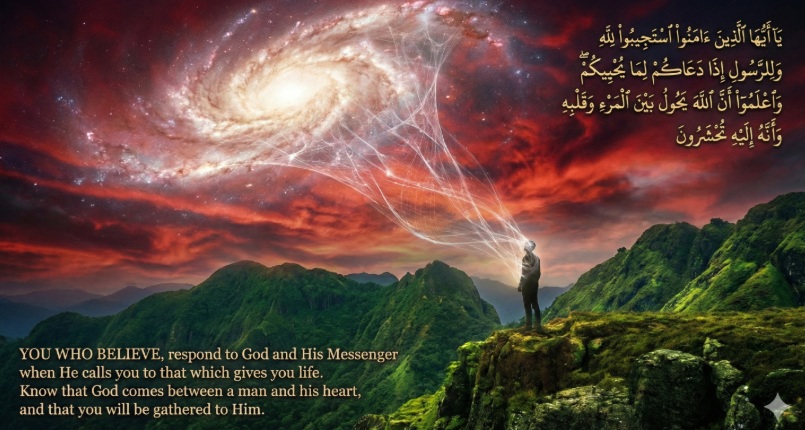
Quran 8:24 (Surah Al-Anfal, “The Spoils of War”) addresses the believers with an urgent call and a theological insight. In one translation it reads:
“O believers! Respond to Allah and His Messenger when he calls you to that which gives you life. And know that Allah stands between a person and their heart, and that to Him you will all be gathered.”
Revealed around the time of the Battle of Badr (624 CE), this verse initially urged the early Muslims to obey the Prophet’s summons – even into battle – but its wording is deliberately general and timeless. “That which gives you life” means whatever revives the soul and conscience. Many classical commentators explain it as the call to faith and guidance itself, which brings spiritual life to hearts that would otherwise be “dead.” In context, the message is that responding to God’s guidance – through the Qur’an and the Prophet’s teachings – is the antidote to spiritual death, bringing enlightenment and purpose to one’s life. The verse portrays Islamic faith and duties as life-giving: they nourish the soul just as rain revives barren land.
The second part of the verse shifts to an indicative statement: “Know that Allah intervenes between a person and his heart.” Here the Arabic word for heart, qalb, refers not just to the physical organ but to the seat of thought, feeling, and intention – what we might call the mind or soul. Thus, God “coming between” a person and his heart is a vivid way of saying that God has immediate access to, and influence over, our innermost self. No human being has absolute autonomy over their own mind or emotions – our very will and consciousness are subject to God’s decree. The verse concludes with a reminder of the Afterlife: “and to Him you will be gathered.” Ultimately, we will all be brought back to God for accountability, emphasizing that the Lord who gives life and knows the secrets of hearts will judge our response to His call.
In short, Quran 8:24 delivers two key messages: (1) Believers are urged to answer God and His Messenger promptly in whatever leads to real life – namely, spiritual and moral vitality. (2) We should “know” that God is intimately involved in our inner life, closer to us than we are to ourselves, and that we are on a journey back to Him. This creates a sense of urgency (do not delay doing good, since God could turn a negligent heart or remove the opportunity) and humility (never be proud of your faith, since success in righteousness comes only by God’s grace guiding the heart).
Theological Insights: Divine Presence in the Heart
Classical Islamic commentators offer rich theological insights into the phrase “Allah intervenes between a person and his heart.” Their explanations, while varied in nuance, revolve around God’s sovereign control over human consciousness and will:
- Direct control of faith and guidance: Early authorities like Ibn ‘Abbās, Sa‘īd ibn Jubayr, and others taught that Allah can come between a person and his heart by turning it toward faith or away from it as He wills. In other words, belief or disbelief ultimately occur by God’s permission and power. No one can believe except if Allah opens their heart, and no one falls into misguidance except that Allah allows their heart to stray – all in response to His wisdom and justice. This interpretation highlights that the light of faith is a gift from God. It echoes other Quranic verses that “Allah guides whom He wills and lets astray whom He wills.” The companions noted that sometimes a person nearly attains faith but Allah “intervenes” and withholds it due to the person’s own insincerity, or He intervenes to keep a believer firm from falling. The Prophet Muhammad (ﷺ) himself would earnestly pray, “O Turner of hearts, make my heart firm upon Your faith!” – acknowledging that hearts turn only by Allah’s command. This view underscores our dependence on God for guidance and stability of belief.
- Preventing one’s intentions or delaying repentance: Some scholars understood “coming between a man and his heart” in a more immediate, life-context sense: Allah might intervene by preventing a person from carrying out their intentions. For example, if someone keeps procrastinating good deeds or repentance, God may remove the opportunity or the inclination from their heart altogether. Through death or a change of heart, God can “separate a man from his heart’s desire”. This interpretation is a moral warning: don’t delay responding to Allah’s call, thinking you have control over your future heart. A classical Persian couplet is often quoted: “O heedless one, whatever good you intend, do it swiftly; for I do not guarantee you tomorrow.” In context, the verse is telling believers to act while they are inspired, for Allah can step in between your resolve and your action if you waver too long. It is a theological way of saying “seize the moment of guidance before it’s too late.”
- God’s intimate knowledge and nearness: Other commentators focus on the idea that Allah literally is closer to a person than their own heart. They cite Quran 50:16, where God says “We are nearer to the human being than his jugular vein.” Allah’s “intervening” between someone and his heart means that no veil whatsoever exists between God and our innermost thoughts. He knows our feelings and ideas even before we articulate them. In this view, the verse is a powerful reminder of God’s omniscience: every whisper of the soul, every inclination, is immediately in Allah’s grasp. There is “no barrier between our consciousness and God’s awareness.” For the believer, this is both awe-inspiring and comforting: awe because one cannot hide any secret intention from God, and comfort because God understands our struggles, pains, and sincerity better than we do ourselves. This interpretation transforms the verse into a “great admonition” to be mindful of one’s inner life, knowing Allah sees it completely.
- Divine sovereignty (Occasionalism): Imām al-Ṭabarī and later theologians like the Ash‘arites synthesized these ideas under the doctrine that Allah has absolute ownership and rule over human hearts – indeed, over every cause and effect in the universe. This view, sometimes called occasionalism (championed by Abu Hamid al-Ghazālī in Islamic philosophy), holds that what we consider “natural” causes are only occasions for Allah’s direct intervention. Every single heartbeat, every thought, every spark that ignites an explosion happens because God directly creates that outcome at each moment. Thus, Allah is truly between a person and his heart at all times – not just metaphorically but in the sense that nothing, not even our mind’s functioning, operates independent of His will. Fakhr al-Dīn al-Rāzī, a great 12th-century scholar, gave a vivid example: when a flint spark meets gunpowder, it isn’t the mere material interaction that causes the blast – “Allah creates the explosion” at that moment. Likewise, when the heart decides or changes, it is by Allah’s creation of that change. The Quranic text, by asserting God’s interposition in the heart, aligns with this idea that every heartbeat of faith or doubt is orchestrated by Allah. The purpose of this doctrine is to instill complete reliance on God’s grace. A believer who internalizes this will hasten to obey God (since any delay could result in God turning their heart away) and will remain humble about their faith (since only God’s constant help keeps one’s heart in the light).
In sum, the theological message of “Allah between a person and his heart” is to inspire urgency in responding to God and humility in recognizing His control. We are urged to answer Allah’s call now – “that which gives you life” – because our next breath and our next heartbeat of guidance are not guaranteed. As one scholar remarked, how could anyone dare to hide a sinful intention “from the One who is between him and his own heart?” Yet for those who strive to obey, this verse is also a reassurance: God is closer to you than your jugular vein, so He can purify your heart from within and support your sincerity when you respond to Him. Ultimately, Quran 8:24 teaches that while we act – we must choose to respond to the divine call – any success in that act is by God’s will, and our hearts remain forever in His hand.
Philosophical Perspectives: Consciousness as the Meeting of Finite and Infinite
The Qur’anic notion that God can interpose Himself in the human heart opens up a profound philosophical reflection on the nature of consciousness. It suggests that human consciousness is the nexus of two orders of reality – the created, physical order and the divine, transcendent order. Our finite minds, in a sense, touch and intersect with the infinite reality of God. This means consciousness cannot be understood as purely material or emergent only from brain chemistry. It “carries a spark of the transcendent,” a breath of the Divine, within it.
In Islamic theology, consciousness is often equated with the rūḥ (spirit or soul), which the Qur’an says was breathed into Adam by God Himself (e.g. Quran 15:29, 32:9). The rūḥ is a direct gift from Allah, not a product of earthly evolution – it is of a higher order. Thus from the Islamic perspective, the human soul or conscious self is “not fully reducible to matter.” It originates from God’s command and belongs to Him. When Quran 8:24 states that Allah comes between a person and his heart, it reinforces this view by implying a direct link or interaction between God and the human center of awareness. As one modern commentator noted, this verse “indicates God can intervene in our very consciousness”. In other words, our capacity to think, to be aware, and to feel – the very qualities that define our life as conscious beings – operate under God’s constant oversight and sustenance. The heart/mind is presented as a kind of meeting place or interface where Creator and creature connect: “the interface where creator and creation meet in experience.”
This view carries fascinating philosophical implications. It posits that the mind is more than the sum of physical processes in the brain. In philosophy of mind, the notorious “hard problem of consciousness” asks how subjective experience (qualia – the sensation of “what it’s like” to be you) arises from mere electrochemical activity in neurons. To date, secular thought has no satisfying answer to this. Some philosophers (and scientists) have even suggested that the human intellect might never fully comprehend its own consciousness – that the mind may be fundamentally incapable of explaining itself. This idea, known as the hypothesis of cognitive closure, basically says that certain phenomena could be forever beyond human understanding, just as a two-dimensional being could never grasp three-dimensional space. Remarkably, the Qur’an anticipated such humility regarding the soul. It tells us plainly that there are dimensions to the spirit that we cannot fathom:
“They ask you [O Prophet] about the Spirit (al-rūḥ). Say: The Spirit is of the Command of my Lord; and you have not been given of knowledge except a little.”* (Quran 17:85)
By declaring the rūḥ (spirit) to be “from the command (amr) of my Lord” and that human knowledge of it is but a drop in the ocean, the Qur’an affirms that a full understanding of human consciousness lies beyond our grasp – it is a secret known to God alone. Our intellect can probe the brain and describe correlations between mental states and neural states, but it cannot reach into the essence of the soul. As Quran 17:85 indicates, the very origin of our conscious spirit is in God’s amr (command), not in the dust of material causation.
Islamic scholars have often interpreted “from the command of my Lord” as pointing to a fundamental distinction between the realm of creation (‘Ālam al-Khalq) and the realm of command (‘Ālam al-Amr). The ‘ālam al-khalq is the physical universe – things that are created, develop, live and die. The ‘ālam al-amr refers to God’s direct decree – things that exist by God’s command “Be!” without material intermediaries (for example, the angels, or the laws of nature, or the souls). The human soul, the rūḥ, belongs to the world of command rather than the world of creation. It is transcendent in origin, not bound by the limitations of matter. One analysis describes the human being as an “isthmus” (barzakh) between the temporal world of matter and the timeless world of Divine command – a meeting point of two realities. Our consciousness thus straddles these two worlds: one foot in the physical brain, the other in a higher metaphysical realm. This is why the Qur’an says God can insert Himself between us and our heart – because our consciousness is, by nature, a point of contact with the Divine. As another commentator beautifully put it, “consciousness lies at [the] boundary” of the finite and Infinite. It is precisely at this mysterious boundary that God’s light touches the human mind, through inspiration, intuition, and revelation.
All of this implies that some aspects of the self will remain inherently mysterious. Just as Quran 17:85 admonishes, we have only a little knowledge of the rūḥ – “there will always be an aspect of the soul and consciousness that eludes human science.” This is not a discouragement from study, but a reminder of our epistemic limits. Our finite intellect, no matter how advanced our neuroscience, might never fully grasp how subjective awareness is imbued into matter, or how exactly the Divine breath animates the clay of our bodies. As the Qur’an says elsewhere, “Eyes cannot perceive Him, but He perceives all perception” (6:103) – God by definition exceeds our sensory and intellectual reach, yet “He is closer to us than our jugular vein” (50:16). Likewise, we cannot objectively see the soul or bottle up consciousness in an equation, but God penetrates our perception and knows us completely. Consciousness is the meeting place of these two truths – we feel the presence of something infinite (life, awareness, selfhood) within our finite minds, and thus we know that not everything about us can be explained by quarks and neurons. We can measure brain waves and map neural circuits, but the inner subjective life – where a finite human “I” encounters perhaps the Infinite (for example, in moments of prayer or insight) – may transcend what laboratory measurements can capture.
Crucially, affirming the spiritual mystery of consciousness does not negate scientific inquiry. The Qur’an does not tell us to abandon the study of the mind; rather, it places that study in a larger, sacred context. It teaches that consciousness is a special phenomenon – one that bridges two realms. The physical aspects of the mind (neurons firing, chemical signals) are within the scope of neuroscience and psychology. But the immaterial aspects – our capacity to reason about abstract truths, to apprehend moral ideals, to experience God – point to something beyond the sum of neuronal connections. In Islamic terms, this immaterial dimension is the rūḥ, breathed into us by Allah. In Quran 8:24, when Allah says He comes between a man and his heart, it is almost poetic language for this intimate interplay: it is “as if transcendent software is running within the hardware of our brain by God’s command.” The human being is an ensouled being – a composite of clay and spirit, body and soul – and our consciousness is precisely where the earthly meets the Divine. Little wonder, then, that not everything about consciousness yields to dissection or analysis; part of it is literally God’s light within us.
The Enigma of Consciousness and Quran 17:85
The Qur’anic perspective on the soul (rūḥ) and consciousness reaches a crescendo in Quran 17:85, already quoted above. To repeat, Allah instructs the Prophet:
“They ask you concerning the Spirit (al-rūḥ). Say: The Spirit is of the Command of my Lord; and you have not been given of knowledge except a little.”
This verse was revealed when the Prophet Muhammad ﷺ was asked by curious questioners about the nature of the human spirit. The response he received from God makes two things clear: (1) The soul’s origin and nature are from the divine command (amr) of Allah, as opposed to the created world (khalq); (2) Human beings have only very limited knowledge about it. In the context of our discussion, this verse powerfully underlines the idea that no matter how much we probe the brain or debate philosophy, the core of our conscious self will remain partly mysterious. The Creator has deliberately kept full knowledge of the rūḥ to Himself, perhaps because our minds (which are themselves the product of the rūḥ) cannot completely comprehend their own essence – a case of an eye trying to see itself.
The phrase “of the Command (amr) of my Lord” is especially significant. Islamic theologians note that the Qur’an uses amr (command) in contrast to khalq (creation). The realm of “Command” (alam al-amr) is a transcendent realm where Allah’s will is executed instantly and directly, unhindered by the cause-and-effect processes of the physical universe. In Quran 36:82, for instance, it says “His Command, when He intends a thing, is only that He says to it ‘Be!’ – and it is.” By saying the Spirit is from the amr of Allah, the verse suggests that the soul belongs to the divine, timeless domain. It isn’t forged from physical components; it is breathed into the body by God’s word. Thus our consciousness has a foot in the transcendent. We might say the soul is a “particle” of the command-world inserted into the matrix of creation – a spark of the Infinite in the heart of the finite.
This perspective dovetails with what we have described earlier: that human beings are a bridge between two worlds. We are corporeal creatures on one hand, made of cells and minerals; on the other hand, we are spirits whose full reality comes from beyond the stars. One contemporary analysis puts it succinctly: “We are ‘isthmuses’ (barzakh) where the temporal world of matter intersects with the timeless world of Divine Command.” Our consciousness is precisely the point of intersection. Little wonder, then, that conscious experience has qualities that physical science struggles to quantify – it was never entirely of the physical world to begin with.
By emphasizing our ignorance (“you have been given but little knowledge”), Quran 17:85 teaches intellectual humility. It does not discourage scientific or philosophical inquiry into the mind, but it sets a boundary: the ultimate nature of the soul (“al-rūḥ”) is known only to God. This has an interesting parallel in modern philosophy. Noted thinkers like Colin McGinn have argued that the human mind might be “cognitively closed” to certain explanations – that perhaps our brains aren’t equipped to fully unravel how consciousness arises. Whether or not one accepts that view, the Quranic message is that the soul’s secret is divinely guarded. We can describe what the soul does (animating the body, perceiving, willing), but we cannot grasp how it truly is or why it has the properties it has. This ensures that, even as we study neuroscience and psychology, we remember the metaphysical truth: the life-force in us is from beyond the material universe.
Quran 17:85 also brings comfort to the believer’s heart. Since the soul is from Allah’s command, and Allah has kept its full knowledge to Himself, we can trust that our lives are known and cared for by One far wiser than us. The enigma of consciousness thus isn’t a dead-end – it’s a doorway to faith. When we hit the limits of what science can explain about the mind, we encounter the Divine mystery. The proper response at that threshold is reverence and submission to the One who fashioned us. As one scholar commented, since our consciousness lies at the boundary of the finite and Infinite, we should expect a veil of mystery – and that mystery evokes awe, reminding us that “of knowledge, you (mankind) have been given only a little.”. In practical terms, this humbling knowledge teaches us reliance on God for what we don’t know and cannot control. We did not give ourselves consciousness, nor can we fully command our hearts – how then can we not turn to the One who is in command of the soul at every moment?
Scientific Reflections: Consciousness and Quantum Reality
From a scientific perspective, the Qur’anic insights about consciousness resonate in intriguing ways with cutting-edge discussions in physics and neuroscience. Modern science, especially in the last few decades, has increasingly recognized how perplexing consciousness truly is. Despite astonishing advances in mapping the brain, the fundamental gap between subjective experience and objective brain activity remains – this is the infamous “hard problem.” As one scientific author put it, after all our studies of neural circuits we still cannot answer, “Why are we not philosophical zombies?” – why do we feel and experience rather than just mechanically process inputs? This frank admission of an explanatory gap has opened the door for theories that would have sounded highly speculative a century ago. In particular, quantum physics – with its strange, non-intuitive phenomena – has entered the conversation about consciousness.
Researchers in the emerging field of “quantum consciousness” have proposed that classical, deterministic physics alone might not be sufficient to account for the workings of the mind. Quantum mechanics, the physics of the subatomic realm, introduces elements that seem eerily suitable for minds: indeterminism, non-local connections, observer-dependent effects, and the blending of states. For example, quantum theory features entanglement – a phenomenon where two particles can be correlated in such a way that a change in one is instantly reflected in the other, no matter the distance. There is also superposition – particles existing in a fuzzy combination of states until an observation “collapses” them into one state. Some scientists have speculated that such quantum effects could be at play within the brain’s neuronal networks. If, say, certain particles in our neurons become entangled or exist in superposition, then parts of our mind could be non-local (not confined to one place) or in indeterminate states that only resolve when “observed” by… perhaps our own consciousness. It sounds fantastical, but serious efforts have been made to explore these ideas mathematically and experimentally.
One concrete avenue of research involves quantum tunneling in neurons. Quantum tunneling is a well-observed phenomenon where a particle can “tunnel” through an energy barrier that it classically shouldn’t be able to – essentially appearing on the other side of a wall without breaking it. In warm, wet environments like the brain, one might think quantum effects would wash out. Yet intriguingly, experiments have shown that electrons do tunnel in certain biomolecules even at body temperature. A study on dopamine-producing neurons found evidence of electron tunneling in a protein (ferritin) inside those cells. The implication is that there could be tiny probabilistic events happening in the brain – little quantum “leaps” – that are not strictly determined by prior physical causes. If such events are then amplified (for instance, influencing whether a neuron fires or not), they could inject a degree of genuine indeterminacy into our thought processes. In theory, this might provide a physical basis for free will or creativity – the mind would not be a closed clockwork, but a system partly open to spontaneity. It also suggests the tantalizing possibility that the brain is tapping into deeper laws of physics that blur the line between matter and information, between local processes in the skull and non-local phenomena in the wider universe.
Of course, these ideas remain hypotheses on the frontier of science. The mainstream scientific view is still skeptical of “quantum mind” theories, and critics label some of them as quantum mysticism. Yet, what’s important for our purposes is that science is increasingly acknowledging that consciousness might not fit into a tidy classical framework. The willingness of respected physicists and neuroscientists to even consider quantum effects in the brain shows an openness to the notion that “there is more to consciousness than neurons firing.” In a way, science is catching up to the Quran’s assertion that life and consciousness involve a dimension beyond ordinary matter. As one article on the subject noted, if quantum physics reveals that information and observation are fundamental to reality, it “dovetails with the Quranic notion that life (ḥayāt) and consciousness (rūḥ) involve something beyond ordinary matter.”.
Perhaps the most fascinating parallel between modern physics and Quran 8:24 comes from the quantum “observer effect.” In quantum experiments, the act of observation seems to participate in determining the outcome. A classic example: electrons passing through a double-slit can behave like waves (creating an interference pattern) until you actively measure which slit they go through – at which point the interference pattern disappears and they behave like particles. It’s as if the electron’s behavior “chooses” a definite state when observed. Some interpretations of quantum mechanics (like the Copenhagen interpretation) even posit that consciousness might be what causes the wave-function collapse, though this is hotly debated. Regardless, the principle is that the observer cannot be completely removed from the system – at least at the quantum scale, observing something influences it.
Now, consider the theological assertion in Quran 8:24: Allah is the ultimate “observer” between man and heart – the active knower and sustainer of our inner processes. We might draw an analogy: If human observers can affect a physical system by observing it, how much more can the Lord who observes everything affect reality by His observation? The verse implies that God is indeed an actor in our innermost reality. His constant “observation” of our hearts is not a passive gaze; it comes with the power to shape outcomes. In quantum terms, one could whimsically imagine that all the swirling possibilities in our neurons and particles resolve into the course they take because Allah is continuously “measuring” and choosing the outcome. This is essentially what the doctrine of occasionalism says in religious language – that at every moment, God is choosing the state of the world. Al-Ghazālī’s view that fire does not burn by itself, but by God’s act, is mirrored by the idea that a quantum particle doesn’t decide its state except by the permission of the All-Knowing Observer. Thus, the indeterminism of quantum physics offers a kind of stage where God’s will can operate without violating natural laws – because, at the fundamental level, the laws allow multiple outcomes. Modern scientists like John Wheeler have even mused that we live in a “participatory universe” – one that isn’t fixed but somehow comes into being through interactions that include observers. For a believer, it is easy to take the next step: the most fundamental observer is Allah, who sees everything from quark to galaxy, and thereby sustains the world by His observation and command.
Some contemporary thinkers have gone further and likened the universe to a kind of information processing system – essentially a cosmic computation rather than a big machine. Interestingly, this aligns with the Islamic view of continuous creation, where the world is every instant being “programmed” by God’s kun (His word “Be!”). The Quran says, “Allah commands each affair from the heavens to the earth…” and that if He stopped willing a thing, it would cease to exist. In the language of physics, reality might be more like software than hardware, with divine information sustaining every particle’s existence. We see an analogy of this in the “simulation hypothesis” popularized by people like Elon Musk – the idea that maybe our reality is a simulation in some super advanced computer. While that is a secular and speculative idea, it has an “odd echo,” as the writer of our source article notes, of Qur’anic ideas: that worldly life is an illusion or a test, and that a higher power (the Simulator, so to speak) can alter what we perceive. The difference, of course, is that Islam says reality is real but utterly subject to God’s will (not literally a computer program). Yet the comparison serves to illustrate how modern paradigms are groping towards the notion of an all-encompassing, orchestrating Intelligence behind what we call reality. The fact that respected physicists talk about the universe as information and are puzzled by the special role of observers suggests that, indirectly, science is re-discovering the need for God in the narrative of existence – or at least leaving room for something beyond strict materialism.
To be clear, none of this is to claim that quantum physics has proven the soul or that neuroscientists have found God in the brain. The quantum mind hypothesis remains speculative, and many experts are cautious about it. It’s entirely possible that consciousness will eventually be explained in purely biological terms that we just haven’t thought of yet. However, the current state of knowledge is that consciousness is a “deep puzzle”, one that has not yielded to reductive explanations. And in trying to solve this puzzle, scientists are indeed considering radical ideas – including those that invoke non-material aspects (be it quantum information fields or new physical principles). This openness is exactly in line with the Qur’anic assertion that life and mind are not just matter. The enduring mystery of subjective experience – the fact that your inner world of thoughts and feelings cannot be seen or measured by anyone outside of you – reinforces the idea that the human being has an inner dimension that transcends what is physical. In Islamic terms, that is the rūḥ, the spirit from Allah.
In summary, modern science and the Quranic worldview seem to be converging on a profound truth: consciousness is not an incidental byproduct of matter, but a fundamental aspect of reality that in some ways hints at the Divine. Quran 8:24 asserted that our consciousness is under God’s direct authority – He can enter our “program” at will. Today, as scientists struggle to even define consciousness, the believer can see that as an affirmation of what Allah told us – “of the soul, you have been given but a little knowledge.” We may map neural networks in astonishing detail (and we should try), but there will always be a gap where the breath of God animating clay leaves empiricism silent. It’s at that gap that faith and wonder begin.
Epilogue: Embracing the Mystery and the Call
Reflecting on Quran 8:24 in light of all these dimensions, we come away with a deepened sense of awe. The verse weaves together a spiritual command with a metaphysical truth: it calls us to “respond” to God – to embrace the guidance that gives true life – and it reminds us of our utter dependence on God’s will, even for the beating of our hearts and the thoughts in our mind. The meeting of the finite and Infinite in our own chest is both humbling and ennobling. It is humbling because we realize our conscious life is a gift we neither fully control nor comprehend. It is ennobling because it means each human being carries a connection to the Ultimate Reality – an “amr” from the Lord of the Worlds resides in us, making us capable of knowing and loving Him.
For the general reader, these insights underscore why in Islam the heart is so central. We are urged to protect our hearts from spiritual disease, to remember God often, and to not become arrogant – because the heart is the domain of Allah’s gaze and action. As the Prophet Muhammad ﷺ said, “Truly, Allah does not look at your outward forms and wealth, but He looks at your hearts and your deeds.” Knowing that God “comes between us and our heart” inspires a constant mindfulness that God is closer than close. It encourages us to pray for His guidance – just as the Prophet (ﷺ) taught: “O Allah, Turner of hearts, keep our hearts firm on Your faith.”
Finally, tying everything together, we see that faith and science both, in their highest reaches, lead to wonder. The classical scholars felt wonder at God’s power over the heart; the scientists now feel wonder at the elusive nature of consciousness. The Qur’an provides a unifying perspective: our consciousness is the ayat (sign) of Allah within us – the very fact that we can contemplate ourselves and the universe is a sign pointing to the One who encompasses all knowledge. We are truly, as the Qur’an says, “created in the best of forms”, and part of that best form is the gift of an intellect and soul that can touch the edges of eternity even while walking on earth.
In the end, Quran 8:24 stands as a timeless reminder that real life – spiritual life, purposeful life – springs from responding to the Divine call, and that our very consciousness is under God’s constant care and dominion. This is a humbling insight that bridges ancient wisdom and modern science. It tells us that however advanced our understanding becomes, the core of who we are remains connected to the Infinite. Our journey of understanding will always lead back to the Great Mystery of God. Embracing that mystery, we respond in trust and obedience to Him who calls us “to that which gives you life.”
All knowledge is with Allah, and to Him we shall indeed be gathered.
Sources:
- The Quran, 8:24 and 17:85 (translation by M.A.S. Abdel Haleem)
- Zia H. Shah, “Al Ghazali’s Occasionalism and God’s Control Even On Human Intimate Thoughts: Quran 8:24 – Text, Commentary, and Deeper Reflections”
- Zia H. Shah, “The Glorious Quran 8:24 – Consciousness at the Meeting Point of Finite and Infinite”
- Zia H. Shah, “The Divine Interstice: Quantum, Philosophical, and Theological Dimensions of Consciousness in Quran 8:24 & 17:85”
- Stanford Encyclopedia of Philosophy, “Quantum Approaches to Consciousness” (2019) (discussing quantum indeterminism and free will)
- [Peer-reviewed study] Fischer et al., “Quantum Tunnelling in Neural Synaptic Proteins”, Journal of Neuroquantology (2020) – evidence of electron tunneling in brain proteins.
- Wheeler, John A., “Information, Physics, Quantum: The Search for Links” (1990) – proposition of an information-centric universe (the “It from Bit” hypothesis).
If you would rather read in Microsoft Word file:

 The Glorious Quran and Science
Leave a comment