
Presented by Zia H Shah MD
Abstract
We can get into the brain of another person as a neurosurgeon but can never get into the mind of any other person other than ourselves. Only God can!
This commentary explores Quran 8:24 through scientific, philosophical, and theological lenses, focusing especially on human consciousness as the meeting place of the finite and the Infinite. The verse calls believers to respond to God’s call “which gives you life” and reminds us that “Allah intervenes between a person and his heart” – a profound statement on divine closeness and control over our inner selves. Classical Islamic exegesis sees this as a call to spiritual life and an assertion that God is nearer to us than our own consciousness. Modern insights suggest that human consciousness cannot be fully explained by physical processes alone, hinting at quantum phenomena (like non-local entanglement and tunneling) that might connect the brain to a reality beyond space, time, and matter. Philosophically, consciousness is framed as a nexus between the finite human mind and the infinite Divine, echoing Quran 17:85 which emphasizes the elusive, enigmatic nature of the soul. Our analysis integrates classical tafsir with contemporary scientific theories (e.g. quantum mind hypotheses) and theological reflections to show that while we can deepen our understanding of consciousness, a part of it will always remain an enigma, known only to God. In conclusion, Quran 8:24 emerges as a timeless reminder that true life springs from answering the Divine call and that our very consciousness is under God’s purview – a humbling insight that resonates with both ancient wisdom and modern science.
Context and Meaning of Quran 8:24
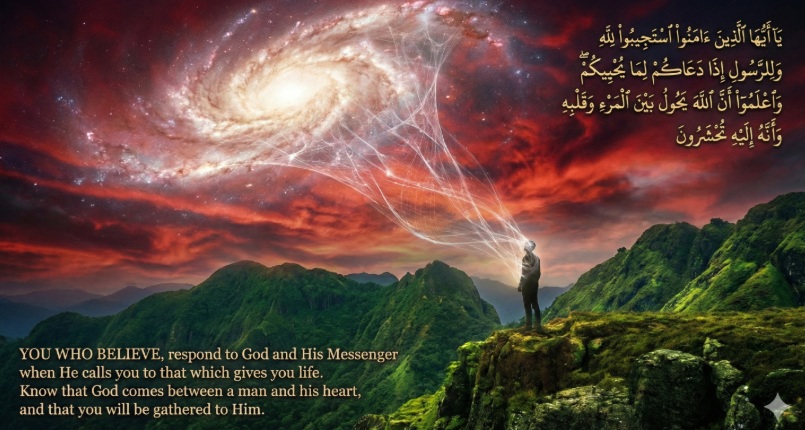
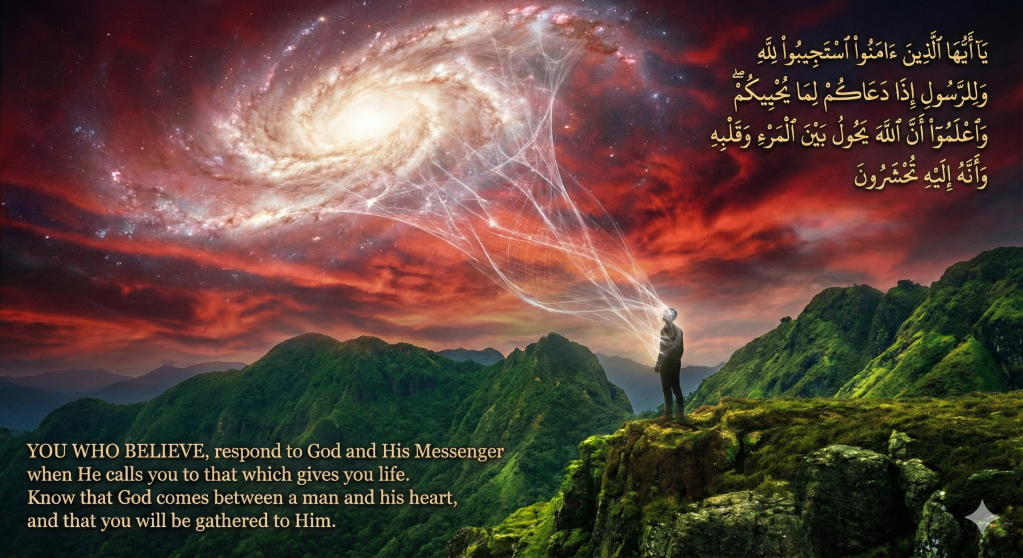
Quran 8:24 (Surah Al-Anfal, verse 24) addresses the believers with an urgent imperative and a theological reminder. The verse in translation reads, for example:
“O you who believe! Respond to Allah and His Messenger when He calls you to that which gives you life. And know that Allah intervenes between a person and his heart, and that to Him you will be gathered.”
In its immediate context, this verse was revealed around the time of the Battle of Badr (2 A.H.), urging the early Muslims to obey the Prophet Muhammad’s call, even into battle. However, the phrasing is general and timeless – “that which gives you life” is not limited to a single event. Classical scholars note it encompasses all of Islam’s guidance that vivifies the soul. It is both a spiritual call – to faith, to truth, to the Qur’an’s teachings – and a source of new life for the community (even in the worldly sense of strength and honor). Thus, responding to God’s call is portrayed as the antidote to spiritual “death,” bringing enlightenment and purpose to one’s life.
The second part of the verse states “Allah comes between a person and his heart.” The Arabic word qalb (heart) in Qur’anic language signifies the inner self – the seat of thought, intention, and feeling, akin to mind or soul. So the verse implies that God has immediate access to and influence over one’s innermost thoughts and emotions. It “packs a profound theological message” – namely, that no human has absolute autonomy even over their own heart. The verse closes with “to Him you will be gathered,” reminding us of our ultimate return to God for accountability.
In summary, Quran 8:24 delivers two key messages: (1) Believers are urged to eagerly answer God’s and His Messenger’s summons to whatever brings true life (spiritually and morally). (2) We should “know” that God is intimately involved in our inner life – He can interpose Himself between us and our very hearts, and eventually we all return to Him. This creates a sense of urgency (do not delay in doing good, since God could turn a negligent heart) and humility (realize that success in obeying God comes by His grace guiding the heart).
Classical Exegesis: God’s Presence in the Heart
Early Islamic commentators offered rich explanations for the phrase “Allah intervenes between a person and his heart.” Their insights, though varied in wording, converge on the theme of God’s sovereign involvement in human consciousness and guidance:
- Control over belief and guidance: Many classical scholars (such as Ibn ‘Abbās, Sa‘īd ibn Jubayr, Al-Ḍaḥḥāk) understood it to mean that Allah can turn a person’s heart toward or away from faith at will. In this view, guidance is ultimately in God’s hands – no one can believe or disbelieve except by His permission. As one report from Ibn ‘Abbās says, God may come between a disbeliever and belief or between a believer and falling into disbelief. This echoes other Quranic verses that “Allah guides whom He wills and lets astray whom He wills,” though always justly and in response to people’s intentions. It highlights our dependence on Allah for the light of faith.
- Preventing action or procrastination: Some took it more literally in life’s events – Allah might intervene between a person’s intention and their ability to act. For example, if someone delays responding to God’s call or plans to repent “later,” Allah could block the fulfillment of that intention by suddenly taking their soul or depriving them of the opportunity. This interpretation adds a practical moral: don’t put off until tomorrow what you should do today. A classical Persian couplet is often quoted: “O heedless one, whatever good you intend, do it swiftly; I do not guarantee you tomorrow.” In other words, God’s coming between a man and his heart can mean time may run out or one’s resolve may be removed if one procrastinates in doing the right thing.
- Absolute nearness and knowledge: Another perspective is that Allah is between a person and his heart in the sense that He is closer to us than we are to ourselves. The Qur’an elsewhere explicitly says, “We are closer to him than his jugular vein” (50:16). So God’s knowledge of us is total – every whisper of our soul, every secret intention, is immediately known to Him. There is no barrier between our consciousness and God’s awareness. This interpretation emphasizes God’s intimate presence and is a “great admonition” to be mindful: one cannot hide rebellion in the heart from the One who is always in between. At the same time, it is comforting – God understands our pain and sincerity even better than we do ourselves.
- Divine sovereignty over the heart: Imām al-Ṭabarī, an early exegete, essentially synthesized all the above views under the principle that Allah owns and rules human hearts more than people themselves do. We might intend or decide something, but Allah can override it if He wills. No one can even grasp faith or knowledge unless Allah makes the heart receptive. In al-Ṭabarī’s words, “no one is able to believe, disbelieve, or understand anything unless Allah makes his heart receptive to it.” This is a clear statement of God’s omnipotence over human guidance – later formalized by theologians (especially of the Ash‘ari school) as the doctrine of occasionalism (the idea that every instance of causation is directly caused by God). The Prophet Muhammad ﷺ himself would frequently pray, “O Turner of hearts, make my heart firm upon Your faith,” acknowledging that hearts turn only as Allah directs. Thus, believers are warned not to be complacent – we respond to God’s call eagerly now, recognizing that only by Allah’s grace can our hearts remain steadfast.
Classical scholars tied these interpretations back to the verse’s overall message of urgency and humility. The command “respond to Allah and the Messenger” is immediately followed by “and know that Allah intervenes between a person and his heart” – implying: Act while you can, and never think you’re independent of God’s help. If you hesitate, God may seal your heart or remove your opportunity; if you do respond, never be proud, for it was Allah who enabled your heart to do so. As Fakhr al-Dīn al-Rāzī noted, God’s command doesn’t negate His power over hearts; rather His power is what enables those who turn to Him. Ultimately, the verse balances human responsibility with divine power and grace in perfect tension.
In sum, the traditional understanding is that Allah’s call (through revelation and prophetic guidance) is the source of true life for the soul, and that Allah’s will is intimately involved in our inner life. Our consciousness, or “heart,” is never outside Allah’s control – a notion that instills reverence and reliance on God. As one scholar remarked, how can anyone hide rebellion in his heart from “the One who is between him and his own heart”? Yet for the believer, this is also reassurance: if you strive to answer God, He can purify and turn your heart from within.
Consciousness – The Nexus of Finite and Infinite
The Qur’anic concept of the heart (qalb) as the locus of divine-human interaction opens a profound philosophical reflection: human consciousness is the meeting point of the finite and the Infinite. Our finite minds are, in a sense, being touched by the infinite reality of God. This means that consciousness cannot be explained as a merely physical or material phenomenon – it carries a spark of the transcendent.
Islamic theology holds that consciousness (often equated with the rūḥ, or soul/spirit) is a direct gift from God, a “breath” of the Divine breathed into Adam and his progeny (cf. Quran 15:29, 32:9). It is “not fully reducible to matter”. The verse “Allah comes between a person and his heart” reinforces this by indicating God’s direct connection to our consciousness. In fact, one modern writer commented that this verse “indicates God can intervene in our very consciousness”. Our ability to be aware, to think and to feel – the very essence of life within us – operates under God’s constant oversight. Thus, the Qur’an presents the human heart/mind as a realm of immediate Divine interaction, the interface where creator and creation meet in experience.
From a philosophical standpoint, this suggests that the mind is more than the sum of physical processes. The “hard problem of consciousness” in philosophy asks how subjective experience (qualia) arises from physical brain activity. Secular thought has struggled with this, leading some philosophers to propose that the human intellect might never fully comprehend its own conscious experience – it could remain a “mystery” beyond our cognitive limits. The Qur’an anticipated this humility: “They ask you concerning the soul (rūḥ). Say: ‘The soul is by the command of my Lord; and of the knowledge thereof you have been given but a little.’”. In other words, there will always be an aspect of the soul and consciousness that eludes human science.
Notably, the Qur’an (6:103) states: “Eyes cannot reach Him but He reaches [all] vision/insight; He is the Subtle, the All-Aware.” This has been interpreted to mean human perception cannot encompass God, but God can penetrate human perception (consciousness). God is infinite; our minds are finite. Yet our consciousness is precisely where God’s guidance and inspiration are received – “the sacred boundary between the finite and Infinite.” In the words of one commentator, since “consciousness lies at [this] boundary,” it is reasonable to expect that it will always retain elements of mystery beyond material explanation. We can analyze brainwaves and neurons, but the inner subjective life, where a finite self encounters the Infinite (such as in moments of inspiration, intuition, or spiritual experience), may transcend what laboratory measurements can capture.
This does not mean consciousness is somehow outside of nature or that we should not study it scientifically. Rather, it means consciousness is a special kind of phenomenon – one that bridges two orders of reality. The finite aspects (neuronal firings, chemical signals) can be studied by neuroscience, but the infinite or transcendent aspect – the capacity to relate to God, to truth, to abstract values – suggests there is something immaterial or non-physical intertwined with our physical substrate. In Islamic understanding, this immaterial aspect is the rūḥ (spirit), bestowed by God. The verse under discussion (8:24) poetically captures that interplay: God is so close to us that He can “insert” Himself between us and our own mind, almost as if transcendent software is running within the hardware of our brain by God’s command. We are, in effect, ensouled beings – our consciousness is where the earthly and the divine meet.
Scientific Insights: Quantum Perspectives on Mind and Matter
It is fascinating that certain findings and theories in modern science echo the idea that there is “more to consciousness than neurons firing.” While classical Islamic thought reached this conclusion theologically, contemporary science is exploring how mind arises from matter – and encountering puzzling phenomena that challenge a purely materialistic view. In particular, quantum physics and neuroscience have opened conversations that resonate with the Quran’s message of a non-material dimension to life.
Modern hypotheses of quantum consciousness propose that classical physics alone may not explain our minds. Quantum processes – bizarre by everyday standards – could be at play in the brain. For example, quantum entanglement (which creates non-local connections between particles across distances) and superposition (a particle existing in multiple states until observed) might contribute to brain function. These phenomena violate the intuitive, deterministic rules we expect of neurons; instead, they hint that the brain might tap into deeper physical laws where outcomes are probabilistic and information is not confined to one location. If consciousness arises from such quantum processes, it means our mind could in some ways transcend the apparent limits of classical matter, allowing influences beyond the brain’s immediate biochemical interactions.
One concrete example is the hypothesis of quantum tunneling in neurons. Quantum tunneling is a process where a particle passes through an energy barrier it classically couldn’t surmount – essentially a “leap” through a wall. In brain cells, researchers have observed that electrons can tunnel within certain proteins at body temperature. One study on catecholaminergic neurons (which produce dopamine) found evidence that electron tunneling occurs in the ferritin protein inside these neurons. Such a mechanism could allow signals or choices in the brain that are not purely deterministic – a tiny quantum indeterminacy could be amplified to affect neural firing, potentially playing a role in how decisions or thoughts emerge. While these ideas are still speculative, they show that biological systems might exploit quantum effects normally thought negligible at warm, wet brain conditions.
Quantum physics has also introduced the famous observer effect: at the subatomic level, the act of observation seems to influence outcomes. Until measured, particles exist in hazy states of possibility; upon observation, one outcome “collapses” into reality. Some interpretations (like the Copenhagen interpretation) suggest that consciousness itself might be tied into this collapse – though this is debated. Regardless, we can draw a parallel: if human observers can affect a quantum system by observing, how much greater is the effect of the ultimate observer, Allah, on reality. Quran 8:24 implies God is an actor in our innermost reality; likewise, one could imagine all of nature’s quantum possibilities resolving as they do because God is continuously observing and choosing the outcomes (an analogy for His decree). Al-Ghazālī’s occasionalism – the idea that every cause and effect at every moment is directly orchestrated by God – resonates with this quantum unpredictability. As an illustration, classical scholars like Fakhr al-Rāzī said when a spark meets gunpowder, it isn’t the material spark that truly causes the explosion; Allah directly creates the explosion at that moment. In modern terms, we might say the myriad quantum possibilities in that encounter happen to collapse in an explosive way because Allah willed that outcome. Such a view sees physical law not as an autonomous machine but as information or “code” continuously executed by the Divine will. Intriguingly, some physicists today describe the universe fundamentally as information rather than matter – a notion harmonious with a universe utterly dependent on God’s command.
Even more imaginative is the comparison to the simulation hypothesis in science philosophy. Some thinkers (e.g. Nick Bostrom, Elon Musk) have speculated that our reality could be a sophisticated computer simulation. While this idea is usually secular and conjectural, it bears a striking analogy to Islamic concepts. The Quran often describes worldly life as a play, an illusion, a test – temporary and not ultimate (see 57:20). If we fancifully imagine Allah as a cosmic programmer, then the physical laws are the program code and the universe is the simulated environment. He has “root access” to the system of our being, meaning He can intervene or alter anything at any time, just as a programmer can tweak a simulation. Quran 8:24 saying “God comes between a man and his heart” is like saying the programmer can directly adjust a character’s internal variables. Indeed, the Quran gives examples of God’s interventions that sound like “glitches” or overrides in the simulation of reality: at Badr, the Muslims’ blows were said not to be their own but God’s in truth (8:17); God placed a barrier on the vision of enemies hunting the Prophet, rendering them effectively blind to him (36:9); or the famous case of the crucifixion in 4:157 where it was made to appear so to onlookers, implying a divinely caused perceptual illusion. All such examples reinforce that physical reality is subject to God’s direct control at all levels – just as 8:24 asserts in the realm of the heart.
Bringing this back to consciousness: if the universe is finely tuned “information,” perhaps consciousness is the intended receiver of that information. Some scholars have mused that the cosmos is designed for life and mind – as if expecting observers. Our brains might be built to interface with the deeper fabric of reality. For instance, recent research theorizes that the brain’s neuronal networks resonate with the quantum vacuum zero-point field that permeates space. In this view, conscious states arise from the brain tapping into these omnipresent quantum fields, literally connecting our minds to the “hum of the universe”. While far from proven, it’s a tantalizing idea: our consciousness could be a local node of a much grander, non-local reality. This aligns with the Islamic view that the soul has a higher origin and that the heart’s enlightenment comes from God’s light, not just from sensory data.
To be clear, science has not proven a quantum basis for consciousness, and many experts remain skeptical. The quantum mind theories are speculative and sometimes criticized as “quantum mysticism.” However, what’s important is that mainstream science acknowledges consciousness as a deep puzzle – one which might demand new paradigms to solve. That openness has led to exploring exotic avenues like quantum effects, which inadvertently dovetails with the Quranic notion that life (ḥayāt) and consciousness (rūḥ) involve something beyond ordinary matter. In any case, the enduring mystery of subjective experience – the fact that your inner world of thoughts and qualia cannot be seen or measured by an outsider – already suggests that mind cannot be exhaustively described in third-person physical terms. This subjective, first-person aspect of consciousness is exactly where religious thought locates the meeting with the Divine. It’s where a person experiences faith, inspiration, moral conscience – all of which, believers say, come from beyond the material self. Quran 8:24’s assurance that answering God “gives you life” may hint that without plugging into this higher source, a person remains biologically alive but spiritually lifeless (a state the Qur’an compares to death or darkness). The verse beautifully merges the scientific wonder of life, the philosophical puzzle of consciousness, and the theological truth of God’s sustenance into one: true life of the heart springs from responding to the One who already permeates our heart.
The Enigma of Consciousness and Quran 17:85
Despite advances in neuroscience and physics, human consciousness remains an enigma. There are over 200 competing theories of consciousness in science and philosophy, yet no consensus. Some thinkers, dubbed “new mysterians,” even argue that the human mind may never fully unravel its own workings. Renowned intellectuals have weighed in:
- Noam Chomsky notes that certain problems might forever lie beyond our cognitive horizon, distinguishing between solvable “problems” and unsolvable “mysteries.” He suspects aspects of consciousness might be in the latter category for us.
- Thomas Nagel famously pointed out that an organism’s subjective experience (“what it is like to be” that organism) is inherently tied to a perspective that cannot be fully captured by objective science. By that token, an objective understanding of the mind might always miss the subjective essence.
- David Chalmers formulated the “hard problem of consciousness,” highlighting that even if we map all neural correlates of consciousness, there remains the question: why do these brain processes produce an inner feeling? Why doesn’t all that processing go on in the dark, without awareness? This gap – sometimes called the explanatory gap – suggests a qualitative leap from matter to mind that we don’t know how to account for.
All these perspectives echo a humbling theme: the essence of consciousness might transcend what the human intellect can grasp about itself.
The Qur’an strikingly mirrors this humility. In Quran 17:85, when asked about the nature of the rūḥ (spirit or soul), the Prophet Muhammad is instructed to respond: “The spirit is of the command of my Lord; and you (humankind) have been given of knowledge only a little.”. This verse directly sets a limit on human self-knowledge regarding our own souls. It suggests that the inner workings of life and consciousness belong to God’s domain (“of the command/order (amr) of my Lord”) and that our attempts to fully analyze or dissect it will only go so far. After all, if consciousness is the interface between the human and the Divine, the finite brain may not be equipped to comprehend the infinite aspect of it. We touch the Infinite through our soul, but we cannot contain the Infinite in our thought. Quran 8:24 and 17:85 together convey that the life-force in us is from God and ultimately known by God alone – we must not be arrogant in thinking we’ll reduce it to a simple formula.
As the commentary of Quran 17:85 points out, revelation itself involves an “obvious interface issue”: how can an Infinite God communicate with finite minds? The Qur’an addresses it by reminding that God’s knowledge envelops us but our knowledge cannot envelop Him. “Eyes (and by extension, human faculties) cannot reach Him, but He reaches the human consciousness”. This beautifully encapsulates the asymmetry: God perceives us entirely – even our thoughts – but we perceive Him only as much as He allows, through signs and revelations, never directly in full. Our consciousness is thus a receiver, not an originator, when it comes to higher truth. It is “shrouded in mystery” not in the sense of being useless or completely opaque, but in the sense that it has depths only God understands. We delve and discover layers of brain function and cognition, but if there is a divine spark within, its core may lie forever beyond empirical dissection.
Crucially, admitting this mystery is not a defeat for knowledge – it’s an invitation to wonder and humility. The Quran does not discourage the study of nature or the mind; on the contrary, it urges reflection on creation and oneself. But it also sets the expectation that when it comes to the ultimate truth of things (like the reality of the soul, or God’s essence), we will hit a horizon beyond which only faith can operate. This protects the sacred from reductionism. It means that we can pursue neuroscience and psychology and benefit immensely from them, but we should not be surprised if consciousness retains an irreducible secret. As one author concluded after surveying these issues, the lack of consensus in hundreds of theories of mind is itself a testament to the Quranic insight that we have “only a little knowledge” of the soul.
In practical terms, what does this mean for a believer reading Quran 8:24? It reinforces that responding to God’s call is not only about external actions but about opening one’s heart to the Divine influence. Our consciousness is designed to receive and resonate with revelation – it’s an “interface” for communion with God. But we must also acknowledge our dependence: we can’t fully control our heart without Allah, nor can we fully understand it. Life, in the fullest sense, comes by aligning our finite minds with the Infinite guidance. Conversely, a heart empty of God’s remembrance is described in the Qur’an as “dead” or “hard as stone” (Quran 2:44, 57:16). We are only truly alive when our consciousness connects to its source.
Epilogue
Quran 8:24 offers a profound tapestry of meaning, weaving together the urgency of faith, the theology of God’s nearness, and even hints of what we today call the mind-body problem. In its own succinct way, the verse tells us that the secret of life lies in answering the Call of the Creator, and that the heart – the core of our being – is under the constant gaze and grip of that Creator. This has devotional implications (be quick to obey, and rely on God for guidance) and deep metaphysical implications (our autonomy is limited; God is the ultimate reality in every heartbeat).
When we reflect on human consciousness through this Quranic lens, we come away with a sense of awe. Our brain with its billions of neurons is itself part of God’s material creation, obeying physical laws. Yet within that gray matter arises the light of awareness – something that experiences, thinks, chooses and, significantly, has the capacity to perceive the divine. This meeting of dust and spirit, clay and breath, neuron and ruh, is what makes us human. It is why reductionist science alone feels inadequate to capture the full truth of “what gives us life.” The empirical approach can analyze the rhythms of the brain, but not the music of the soul. Theologically, we understand that is because the soul’s origin is with God, who transcends our dimensions.
In an age where artificial intelligence and neuroscience strive to decode the mind, Quran 8:24 stands as a reminder of the dignity and mystery of the human heart. It tells the believer that your consciousness is not an accident of atoms; it is a deliberate gift and arena for God’s involvement. It tells us that every moment of awareness is God-sustained – He is closer to you than your jugular vein, closer than your own thoughts. And it tells us that ultimate fulfillment (“life”) comes from turning that consciousness towards the higher call – the call of truth, goodness, and submission to the One who made it.
Finally, pairing Quran 8:24 with Quran 17:85, we grasp a holistic message: Seek knowledge and understanding, but remember the soul’s full reality is known only to Allah. We should neither despair at the mystery nor become arrogant with partial knowledge. Rather, we live in wonder. The human heart is a place of meeting – where finite creation encounters infinite Creator. Such a locus will always elude complete scientific capture, and that is by design. For if we could quantify and control our soul entirely, where would be the space for reverence, for dependence on God, for the leap of faith? Instead, God invites us to ponder, “Look within, see My signs in your own self – the life, the consciousness you have – and realize it points beyond itself.” In responding to that realization, in saying “Labbaik” (here I am) to the Divine call, we find a life that is truly alive.
In conclusion, human consciousness stands as one of the grandest signs of God – an ever-present reminder that reality is more than matter. It is the meeting point of the earthly and the divine. Quran 8:24 encapsulates this by asserting God’s intimate presence in our inner life, while exhorting us to embrace the very guidance that nourishes that life. The verse’s wisdom bridges 7th-century spiritual counsel and 21st-century intellectual quests. It reassures us that being fully alive is not just a biological state but a spiritual achievement – attained by connecting our finite hearts to the Infinite source of Life. And it humbles us with the knowledge that, as much as we learn about the brain and cosmos, the ultimate truth of the ruh will remain with Allah. This humility, paired with faith, allows us to marvel at our own consciousness as a gift and trust the One who holds our hearts in His hand.
Sources:
- Quran 8:24 – Multiple translations and classical commentary
- Al-Qurṭubī, Ibn Kathīr, al-Ṭabarī – Tafsīr on Quran 8:24 (God’s control over hearts)
- Zia H. Shah, The Glorious Quran and Science – “Allah intervenes between a man and his heart” and consciousness
- Zia H. Shah, Can Consciousness be Explained in the Light of the Quran? – Quran 17:85 and limits of human knowledge on the soul
- Quantum mind hypotheses – nonlocal entanglement and tunneling in brain processes
- Discussion of quantum observer effect and al-Ghazali’s occasionalism
- Quran 6:103 – God’s incomprehensibility vs. His knowledge of human consciousness
- Classical and contemporary interpretations bridging science and faith.
If you would rather read in Microsoft Word file:

 The Glorious Quran and Science
Leave a comment