
Epigraph
لَّا تُدْرِكُهُ الْأَبْصَارُ وَهُوَ يُدْرِكُ الْأَبْصَارَ ۖ وَهُوَ اللَّطِيفُ الْخَبِيرُ
Eyes cannot reach Him but He reaches the eyes. And He is the Incomprehensible, the All-Aware. (Al Quran 6:103)
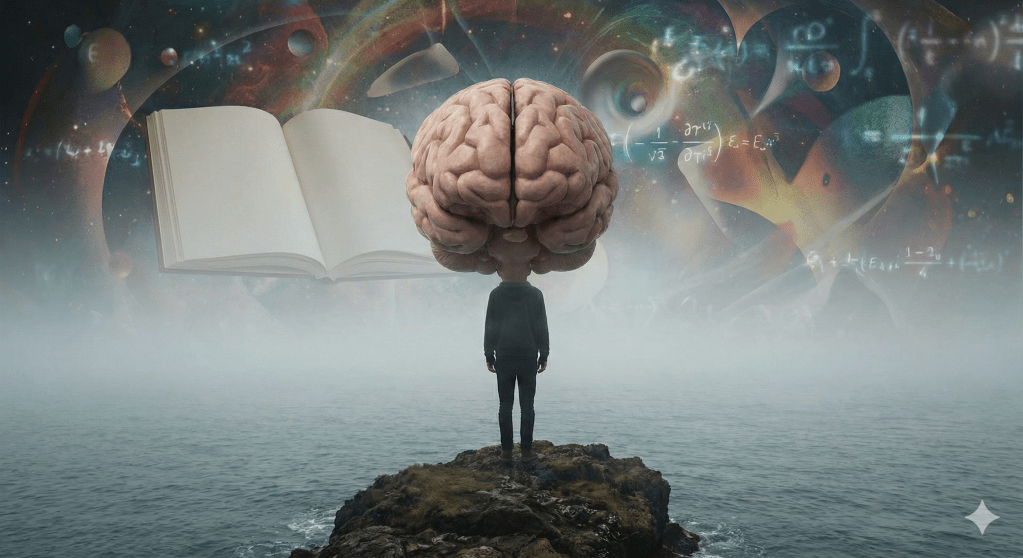
Presented by Zia H Shah MD
Audio teaser:
Abstract
This research report presents an exhaustive scientific, philosophical, and theological examination of the limits of human knowledge, framed by the “Cognitive Closure” thesis. Central to this inquiry are two potent analogies: the canine inability to conceptualize prime numbers and the human inability to subjectively inhabit the radar vision of a bat. These metaphors serve as the foundation for a rigorous exegesis of Quranic verses 6:102-104 and 2:255, which delineate the boundaries between the created intellect and the Uncreated Divine Essence.
Drawing extensively from the writings of Dr. Zia H. Shah, the report challenges the prevailing materialist “Generator Model” of consciousness, proposing instead a “Receiver” or “Transceiver” model. In this view, the brain functions as a biological resonator for a non-local consciousness derived from the “World of Command” (Alam al-Amr). The analysis integrates contemporary findings in quantum neurobiology—specifically the role of the Zero-Point Field (ZPF) and cortical microcolumns—to provide a physical mechanism for this reception.
Ultimately, the report argues that human knowledge is necessarily finite, an “island of the known” surrounded by an infinite ocean of the Ghayb (Unseen). The Quranic assertion that “Vision encompasses Him not, but He encompasses all vision” is presented not merely as theological dogma, but as a fundamental epistemological law, defining the event horizon of human comprehension and necessitating Revelation as the sole bridge to the Transcendent.
Introduction: The Arrogance of the Enlightenment and the Wall of the Mind
The history of human intellectual development, particularly since the Enlightenment, has been characterized by a trajectory of optimistic naturalism. The prevailing assumption—often unspoken but deeply embedded in the scientific method—is that there are no “unsolvable” problems, only problems that have not yet been solved. From the motion of the celestial spheres to the splitting of the atom, and finally to the decoding of the human genome, the “known” has aggressively encroached upon the territory of the “unknown.” This linear progression suggests a future where the human mind, aided by technology, achieves a “Theory of Everything,” encompassing the totality of existence from the quantum foam to the nature of consciousness itself.
However, this narrative of limitless cognitive expansion faces a formidable, perhaps insurmountable, barrier. This barrier is not technological, but ontological. It is the realization that the human mind is not a universal Turing machine capable of running any software or solving any algorithm, but rather a biological organ, evolved for specific survival tasks within a specific ecological niche. Just as the wings of an eagle are aerodynamic structures with physical limits, the human brain is a cognitive structure with epistemic limits.
This report explores the geography of these limits. It posits that the “Hard Problem” of consciousness—the question of how objective matter gives rise to subjective experience—is not a puzzle waiting for a smarter neuroscientist, but a mystery that lies beyond the “Cognitive Closure” of the human species.1 To illustrate this, we utilize two primary analogies found in the philosophy of mind:
- The Dog and the Prime Number: Illustrating the inability to grasp abstract concepts due to neural architectural limitations.1
- The Bat and the Radar: Illustrating the distinction between objective detection and subjective quality (qualia).3
These philosophical constraints find their ultimate expression and resolution in the theology of the Quran. Through a detailed commentary on Surah Al-An’am (6:102-104) and Ayat al-Kursi (2:255), this report synthesizes the secular philosophy of limits with the sacred theology of Divine Encompassment (Idrak). It integrates the work of Dr. Zia H. Shah, who argues that the “Enigma of the Self” is the “Moses’ staff” that swallows the “snakes” of materialism, proving that while we may build radars to see the stars, we remain blind to the Source of the Light unless It chooses to reveal Itself.4
Part I: The Architecture of Ignorance — Philosophical Foundations
1.1 The Thesis of Cognitive Closure
The concept of “Cognitive Closure” was formalized by the philosopher Colin McGinn as a response to the intractable nature of the mind-body problem. “New Mysterianism,” as this school of thought is known, does not posit that the solution to consciousness is miraculous or supernatural. Rather, it posits that the solution is natural but inaccessible to the human cognitive apparatus.1
McGinn argues that every mind, by virtue of being an evolved biological system, has a “scope” of comprehension. There are properties of the universe that fall inside this scope, and properties that fall outside it. For the human mind, the relationship between brain tissue (meat) and the feeling of pain (mind) falls outside this scope. We are, in McGinn’s terminology, “terminally confused” by our own existence.
1.1.1 The Analogy of the Dog and the Prime Number
The most potent illustration of this thesis is the relationship between a canine and the field of number theory.
“Just as a dog is ‘cognitively closed’ to the concept of a prime number—not because prime numbers are magical, but because the dog’s brain lacks the architecture to grasp them—human beings are likely cognitively closed to the property P that links the brain to the mind.”.1
Consider the domestic dog (Canis lupus familiaris). It possesses a sophisticated sensory suite. It can hear frequencies humans cannot (up to 45 kHz). It has an olfactory bulb forty times larger than a human’s relative to brain size, allowing it to “smell time” (detecting the decay of odor molecules to determine who walked by an hour ago). In the realm of scent, the dog is superior to the human.
However, place a dog in front of a blackboard displaying the proof that there are infinitely many prime numbers (Euclid’s theorem). The dog can see the chalk marks. It can smell the chalk dust. It can hear the tapping of the chalk. But it cannot, under any circumstances, grasp the concept of a prime number.
- The Barrier: The barrier is not that the prime number is invisible (like a ghost). The barrier is that the concept requires a level of abstraction (identifying integers, understanding divisibility, grasping the concept of “one” and “self”) that the canine neural architecture simply does not support.
- The Implications: To the dog, the world of mathematics is not “unknown”; it is “non-existent.” It is a dimension of reality that the dog walks through every day but can never interact with.
McGinn’s argument is that humans are “spiritual dogs” when it comes to the link between the brain and consciousness. We can see the neurons (the chalk marks). We can feel the consciousness (the chalk dust). But the logic that connects them is the “prime number”—a property of nature that our brains are not wired to compute. We can formulate the question, but we are constitutionally incapable of understanding the answer.5
1.2 The Limits of Objectivity: The Bat and the Radar
While McGinn focuses on conceptual closure, Thomas Nagel focuses on phenomenological closure. In his seminal 1974 paper, “What is it like to be a bat?”, Nagel attacks the reductionist claim that a complete physical description of a system is a complete description of the system.3
1.2.1 The Bat’s Umwelt
Bats (Order Chiroptera) are unique among mammals for their reliance on echolocation. They emit ultrasonic calls and interpret the returning echoes to navigate and hunt. This “radar vision” allows them to perceive texture, distance, and speed in total darkness.8
Nagel asks us to imagine being a bat. We can imagine:
- Hanging upside down.
- Flying through the dark.
- Having webbing on our arms.
- Eating insects.
However, Nagel argues, this is merely imagining what it would be like for a human to behave like a bat. It is not imagining what it is like for a bat to be a bat. The subjective quality—the qualia—of perceiving a moth via sonar is fundamentally alien to us. Is it like hearing? Is it like seeing? Is it a texture? We do not know.3
1.2.2 Radar Technology vs. Radar Experience
The user query notes: “Humans can have a radar vision like bats do.” This statement requires careful dissection.
Technologically, humans have developed Radar (Radio Detection and Ranging) and Sonar (Sound Navigation and Ranging). We can build devices that emit waves and display the returns on a screen.
- The Human Radar: The human sees a blip on a green CRT screen or a color-coded weather map. The input is visual. We translate the sound data into light data (graphs, maps) to process it.
- The Bat Radar: The bat likely experiences the sound directly as a spatial map, perhaps integrated with a form of “acoustic color” or texture.
The difference is the “Subjective Gap.” We can build a machine that replicates the function of the bat (detecting the moth), but we cannot build a mind that replicates the experience of the bat. This reinforces the report’s central theme: Functional expansion (technology) does not equal ontological comprehension. We can expand our data gathering (seeing more), but we cannot expand our mode of being (seeing as).
1.3 The Failure of Materialism
These two analogies—the dog’s ignorance of primes and the human’s ignorance of bat-ness—converge to dismantle “Metaphysical Naturalism” or Materialism.
Materialism asserts that physics is closed: everything that happens can be explained by physical particles and forces. But if human consciousness (the feeling of “redness” or “pain”) cannot be reduced to physical descriptions (as the bat argument suggests) and cannot be explained by our cognitive concepts (as the dog argument suggests), then Materialism is incomplete.
Dr. Zia H. Shah emphasizes this “Collapse of Materialism” in his collected writings.4 He argues that the persistence of the “Hard Problem” is not a delay in science, but a proof of the soul. If the material brain cannot account for the “self,” then the “self” must be an entity that intersects with the brain but is not identical to it. This leads us to the “Receiver Model,” which will be explored in Part IV.
Part II: The Mechanics of Perception — A Scientific Commentary
To understand the theological “Limit of Vision” (La tudrikuhu al-absar), we must first understand the scientific mechanism of vision and its inherent limitations.
2.1 The Spectrum of the Seen and Unseen
Human vision is biologically limited to a narrow band of the electromagnetic spectrum (roughly 380 to 740 nanometers). We call this “Visible Light.”
- Below 380nm: Ultraviolet, X-rays, Gamma rays. (Invisible to us, visible to bees/birds).
- Above 740nm: Infrared, Microwaves, Radio waves. (Invisible to us, visible to snakes/bats via heat or sound analogs).
Science has allowed us to build “eyes” for these invisible wavelengths (telescopes, FLIR cameras, radio receivers). This is the “horizontal” expansion of the Absar (vision). We have widened the aperture of our perception.
However, the Quranic limitation refers to a “vertical” limit. No matter how much we widen the spectrum, we are still detecting physical interactions—photons hitting sensors. The Divine Essence is not a photon, nor a wave, nor a particle. Therefore, the “radar” of science, no matter how advanced, scans the wrong frequency for the Divine.
2.2 Quantum Clues to Consciousness: The Zero-Point Field
If the brain is not a generator of consciousness but a receiver, what is the medium of transmission? Recent research highlighted by Dr. Shah points to the Zero-Point Field (ZPF).9
2.2.1 The Physics of the ZPF
In Quantum Electrodynamics (QED), the vacuum of space is not empty. It is a seething ocean of energy where virtual particles pop in and out of existence. This is the Zero-Point Field. It is the lowest possible energy state of a quantum mechanical physical system.
2.2.2 The Brain as a Quantum Resonator
The research by Joachim Keppler and others suggests that the brain taps into this ubiquitous field.
- The Interface: The proposed interface is the Cortical Microcolumn. These are vertical columns of neurons (approx. 100 neurons each) in the cortex.
- The “Tuner”: The neurotransmitter Glutamate (and the water molecules surrounding it) may resonate with specific frequencies of the ZPF.9
- The Process: When the brain enters a state of “Self-Organized Criticality” (a balance between chaos and order, typical of the Gamma wave state associated with focus), the glutamate pools in the microcolumns couple with the ZPF.
- The Result: This resonant coupling amplifies the quantum signal, collapsing the probability function into a specific conscious moment (a “biophoton” emission).
This scientific model provides a startlingly accurate physical corollary to the theological “Receiver Model.”
- The Signal: The ZPF (Infinite, ubiquitous, invisible).
- The Receiver: The Brain (Finite, fragile, tunable).
- The Broadcast: Consciousness.
If the brain is damaged (e.g., anesthesia or trauma), the “tuning” is lost. The microcolumns lose their criticality. The signal (ZPF) is still there, but the music (consciousness) stops. This refutes the idea that the brain makes the mind; rather, the brain facilitates the mind’s presence in the physical world.
2.3 Echolocation and the “Signs” of God
The snippet regarding bats emphasizes that the Quran considers animals as “Signs” (Ayat).8 The discovery of echolocation by Donald Griffin in 1940 was initially met with disbelief—scientists couldn’t believe a “blind” animal could “see” with its ears.8
This disbelief mirrors the skepticism of the materialist towards the Unseen (Ghayb). Just because the human sensorium cannot detect the mechanism (be it ultrasound or the Soul), does not mean the mechanism does not exist. The bat is a living proof that “vision” is not limited to the eyes, and “reality” is not limited to the human visible spectrum.
- Technological Irony: Humans developed Radar for war (WWII) before realizing bats had been using it for millions of years. This confirms the Quranic sentiment that “There is not a thing but glorifies Him with His praise; but you understand not their glorification” (Quran 17:44).8 The bat’s “praise” is its navigation of the dark, a mode of being we are only just beginning to comprehend technologically.
Part III: The Theology of the Unseen — A Quranic Commentary
The philosophical and scientific limits discussed above find their ultimate codification in the Quran. The text does not merely describe God; it describes the relationship between the observer (Man) and the Observed (God/Universe).
3.1 Commentary on Surah Al-An’am (6:102-104)
The Text:
(102) That is Allah, your Lord; there is no deity except Him, the Creator of all things, so worship Him. And He is Disposer of all things.
(103) Vision perceives Him not, but He perceives all vision; and He is the Subtile, the All-Aware.
(104) There has come to you enlightenment from your Lord. So whoever sees, does so for [the benefit of] his own soul, and whoever is blind [does harm] against it. And [say], “I am not a guardian over you.”
Exegesis of Verse 103: The Asymmetry of Idrak
The central pivot of this passage is the phrase La tudrikuhu al-absar (“Vision perceives Him not”).
- Philology of Idrak vs. Basar:
- Al-Absar is the plural of Basar (sight/vision).
- Tudriku comes from Idrak, meaning to reach, to overtake, to grasp, and most importantly, to encompass (Ihata).10
- The verse does not say “Eyes do not see Him” (La tarahu al-ayun). It says “Vision does not encompass Him.”
- The Double Negation of Materialism:
- First Clause: Vision perceives Him not. This establishes the Transcendence (Tanzih). God is not an object in the physical universe. He reflects no light, emits no sound, and has no “radar cross-section.” He is the “Cognitive Closure” for all created beings. Even the combined vision of all humans, jinns, angels, and radars cannot encompass His reality.10
- Second Clause: But He perceives all vision. This establishes the Immanence and Omniscience. While we are blind to His Essence, He is fully aware of our observation. This is the asymmetry of the “Panopticon”: The Creator sees the creature; the creature sees only the creation.
- The Subtile (Al-Latif) and The Aware (Al-Khabir):These two names explain why vision fails.
- Al-Latif (The Subtile) implies “fineness” so extreme it penetrates all things but cannot be touched or seen. It is the “impalpable.” In the context of the ZPF theory, the ZPF is “subtile”—it is everywhere, inside every atom, yet invisible.
- Al-Khabir (The Aware) implies internal knowledge. He knows the secret thoughts of the “Dog” and the “Bat” and the “Human.”
3.2 Commentary on Ayat al-Kursi (2:255)
The Text:
“…He knows what is before them and what is behind them, and they encompass nothing of His knowledge except what He wills…”
Exegesis: The Boundaries of the Known
- “Before Them” and “Behind Them”: Commentators like Al-Tabari and modern exegetes offer multiple layers of meaning 12:
- Temporal: Future (Before) and Past (Behind).
- Epistemic: The Seen World (Before/Visible) and the Unseen World (Behind/Hidden).
- Existential: This Life (Before) and the Afterlife (Behind).
- “They encompass nothing of His knowledge except what He wills”:This is the theological formulation of the “Closure Thesis.”
- The Default State: The default state of the human mind is ignorance (closure). We know nothing.
- The Exception: “Except what He wills.”
- Implication for Science: Scientific discovery is not the “conquest” of nature; it is the “permission” of God. When we discovered the electron, it was because He “willed” that specific knowledge to be encompassed. When we fail to discover the nature of consciousness (The Hard Problem), it is because He has not willed it. It remains a “Prime Number” to our “Dog.”
3.3 The Dog, The Bat, and The Believer
Integrating the analogies:
- The Disbeliever (Materialist): Acts like the Dog staring at the blackboard, denying the existence of Prime Numbers because he cannot eat them. He denies the Ghayb because his radar (science) yields no return.
- The Believer: Acknowledges he is a Dog regarding Prime Numbers (Divine Essence). He accepts the existence of the Primes based on the authority of the Mathematician (Revelation). He acknowledges he cannot “be” a Bat (know the subjective reality of others or God), and thus relies on God’s description of Himself.
Part IV: The Enigma of Self — A Synthesis with Zia H. Shah
Dr. Zia H. Shah, in his extensive writings on The Muslim Times and TheQuran.Love, provides the connective tissue between the neuroscience of consciousness and the theology of the Quran. His work focuses on “The Divine Command” (Amr) as the missing link in the mind-body problem.4
4.1 The Spirit as Command (Quran 17:85)
The key verse for Dr. Shah’s analysis is:
“They ask you concerning the Spirit (Ruh). Say: ‘The Spirit is by the Command (Amr) of my Lord, and of knowledge you have been given but little.’” (Quran 17:85)
Here, the “Closure Thesis” is explicit: “Of knowledge you have been given but little.”
Dr. Shah interprets the term Amr (Command) as a specific ontological category.
- Alam al-Khalq (World of Creation): The physical universe, governed by cause and effect, time and space. Evolution, biology, and brains belong here.
- Alam al-Amr (World of Command): The transcendent realm of Divine Will. It is non-local, instantaneous (“Be! and it is”). The Soul (Ruh) belongs here.
The Insight: Materialism fails because it tries to find the Ruh in the Alam al-Khalq. It tries to find the “Command” inside the “Machine.” This is like trying to find the Prime Number inside the chalk dust. It is a category error.
4.2 The “Receiver Model” of the Brain
Dr. Shah champions the “Transceiver Theory” of the brain to explain consciousness.
| The Generator Model (Materialism) | The Receiver Model (Theistic Dualism) |
| Premise: The brain secretes consciousness like the liver secretes bile. | Premise: The brain receives consciousness like a radio receives a signal. |
| Evidence: Brain damage alters personality. | Evidence: Damage to a radio alters the sound quality, not the signal source. |
| Problem: The Hard Problem (Subjectivity). | Problem: Requires a non-physical signal (The Soul/Amr). |
| Analogy: The Dog thinks the blackboard creates the math. | Analogy: The Bat uses radar, but the radar is not the Bat. |
Quotations and Themes from Zia H. Shah: Dr. Shah argues that “human consciousness defeats metaphysical naturalism”.4 He writes:
“The eclipse of matter: The insufficiency of physicalism and the necessity of the soul in the light of consciousness.”
He uses the “Radio Analogy” to explain the preservation of the self. If the radio (brain) is destroyed at death, the signal (Soul) remains with the Broadcaster (God). This aligns with the “Daily Resurrection” of sleep (Quran 39:42), where the soul is partially withdrawn but the body remains alive—a temporary “turning down” of the receiver volume.4
4.3 The “Blind Spot” of the Materialist
Dr. Shah also engages with the concept of the “God of the Gaps.” Atheists argue that religion hides in the gaps of science. Dr. Shah argues that Consciousness is not a “gap” that will be filled; it is the canvas on which science is painted.
Referring to the “Dog/Prime Number” analogy, Dr. Shah suggests that the “gap” between Brain and Mind is a “Design Feature,” not a bug. It forces the human to look upwards.
- If we could explain the soul purely biologically, we would be trapped in determinism (robots).
- The fact that the soul is “by the Command” ensures human Free Will and moral responsibility. We are “open systems,” receiving input from the Divine Command.
4.4 Synthesis: The Radar of Revelation
If our internal radar (intellect) is jammed by the “Closure” of 17:85, how do we navigate?
Dr. Shah posits that Revelation is the guidance system for the “blind” intellect.
- We cannot “see” the Prime Numbers of Morality or Afterlife.
- So, God sends “Signs” (Ayat)—Prophets and Scriptures.
- These are “beacons” that our radar can detect. We detect the miracle of the Quran, the character of the Prophet, the order of nature.
- Once we “lock on” to these beacons, we trust the navigation data they provide about the Unseen.
Epilogue: The Sanctuary of the Unknown
The exploration of the dog, the bat, and the human mind leads us to a profound humility. We stand on the shores of a vast cosmic ocean. Our “radar”—the tools of science and logic—can map the surface. We can count the waves (atoms), measure the tides (gravity), and predict the storms (weather).
But the depth of the ocean—the Malakut (Kingdom) of the Heavens, the nature of the Ruh (Soul), and the Essence of Allah—remains strictly La tudrikuhu al-absar (Vision encompasses Him not).
This limitation is not a defeat. It is a mercy.
- If we were Bats: We would know sonar, but we wouldn’t know poetry.
- If we were Angels: We would know the Divine Light, but we wouldn’t know the struggle of faith.
- As Humans: We are placed uniquely in the “Middle Station.” We are animals with a spark of the Divine Command. We have the “Dog’s” brain but the “Angel’s” longing.
The “Cognitive Closure” regarding the self and God ensures that the relationship remains one of Pursuit and Worship, not Possession and Control. We cannot “possess” God through our intellect. We can only be “possessed” by Him through our surrender (Islam).
As the report has demonstrated, the Quran anticipates the “New Mysterianism” of the 21st century. It confirms that while the eyes may fail and the radar may fade, the Heart that tunes itself to the “World of Command” finds a vision that transcends physics.
“We will show them Our signs in the horizons and within themselves until it becomes clear to them that it is the truth. Is it not sufficient concerning your Lord that He is, over all things, a Witness?” (Quran 41:53)
Our vision cannot encompass Him. But He is the Witness who encompasses us. In that Encompassment, we find our rest.
Technical Appendix
Table 1: The Hierarchy of Cognitive Closure
| Entity | Cognitive Capability | Cognitive Closure (Cannot Know) | Analogy (McGinn/Nagel) | Quranic Status |
| Inanimate Matter | None (Information Processing only) | Existence, Selfhood | The Rock | Musakhar (Subservient) |
| Animal (Dog/Bat) | Sensory Perception, Basic Emotion | Abstract Entities (Prime Numbers, Logic) | The Dog and the Blackboard | Umam (Communities) |
| Human (Insan) | Rationality, Abstraction, Technology | The Link (P) between Brain & Mind; The Essence of God | The “Hard Problem”; The Bat’s Qualia | Khalifa (Vicegerent) |
| The Divine (Allah) | Al-Muhit (All-Encompassing) | None (Absolute Knowledge) | The Light (No Analogy) | Al-Alim (The All-Knowing) |
Table 2: Models of Consciousness
| Feature | Generator Model (Materialism) | Receiver Model (Theistic/Shah) |
| Source | Neuronal firing patterns | Alam al-Amr (World of Command) |
| Mechanism | Emergence from complexity | Quantum Resonance (ZPF/Glutamate) |
| Analogy | The Liver secreting bile | The Radio receiving a signal |
| Death | Extinction of the signal | Destruction of the receiver (Signal persists) |
| Key Flaw | The Binding Problem / Qualia | Requires non-physical entity |


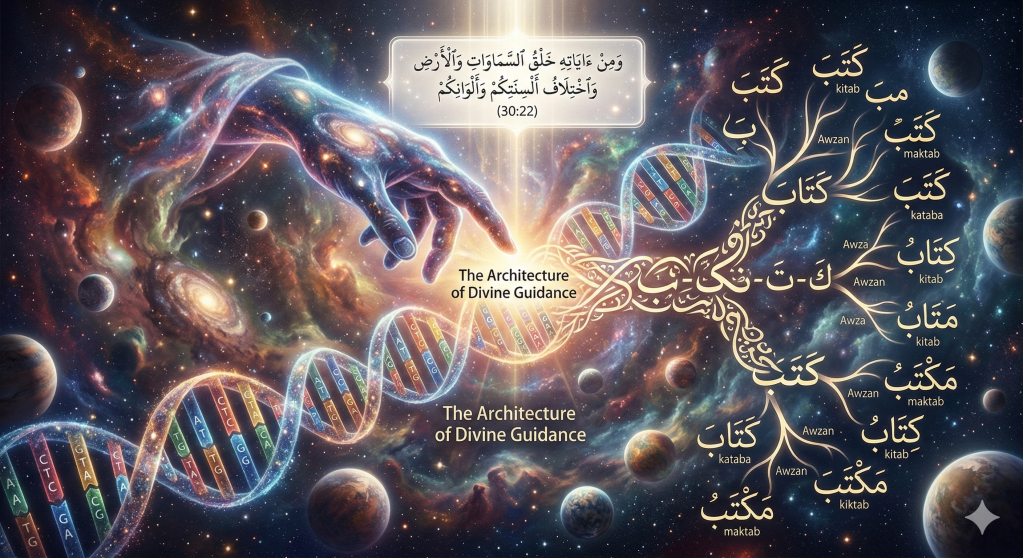

 The Glorious Quran and Science
Leave a comment