
Presented by Zia H Shah MD
Abstract
The eleventh verse of Surah Fatir (35:11) represents a seminal intersection of ontology, biology, and theology within the Quranic corpus. This report provides a comprehensive, expert-level analysis of the verse, tracing the trajectory of human existence from its elemental origins in dust (Turab) to the intricacies of genetic conception (Nutfah), sexual differentiation (Azwaj), and the phenomenon of senescence (Mu’ammar). By juxtaposing the hermeneutics of classical exegetes—such as Al-Tabari, Al-Qurtubi, and Al-Razi—with the contemporary scientific commentaries of Tantawi Jawhari, Zaghloul El-Naggar, and modern geneticists, the study illuminates how the theological understanding of “Decree” (Qadar) has evolved from a static metaphysical concept to a dynamic, informational framework akin to the genetic code. The report extensively investigates the biological mechanisms of aging, specifically telomere attrition and epigenetic modification, proposing them as the physical manifestations of the “shortening” and “lengthening” of life mentioned in the scripture. Furthermore, the analysis extends into the domain of preventive medicine and bioethics, examining the tensions between divine predestination and modern interventions such as radical life extension, cryonics, and transhumanism. Through a synthesis of medieval manuscripts and cutting-edge biomedical research, this document argues that the “Kitab” (Register) of 35:11 serves as a bridge between the celestial archetype of destiny and the terrestrial reality of the human genome.
1. Introduction: The Philological and Contextual Architecture of Fatir 35:11
Surah Fatir, titled “The Originator,” is a Meccan Surah that fundamentally addresses the creative power of the Divine (Fatir al-samawat wa al-ard). Within this macro-cosmological framework, Verse 11 shifts the focus to the micro-cosmology of the human being, encapsulating the entire biological lifecycle in a succinct yet dense narrative. The verse operates on multiple semantic levels, moving from the primordial to the biological, and finally to the metaphysical administration of time.
1.1 The Verse and its Semantic Components
The translation of the verse, synthesized from various authoritative sources, reads:
“And Allah created you from dust, then from a sperm-drop; then He made you mates. And no female conceives nor does she give birth except with His knowledge. And no aged person is granted [additional] life nor is his lifespan lessened but that it is in a register. Indeed, that for Allah is easy”.1
A rigorous philological breakdown reveals the verse is structured around four distinct existential phases, each governed by specific terminology that has evolved in meaning over centuries of exegesis:
- Turab (Dust/Soil): This term denotes the primordial origin. Historically interpreted as the substance from which Adam was sculpted, modern readings extend this to the elemental composition of the human species, linking it to the geochemical reality of the earth’s crust.3
- Nutfah (Drop/Minute Quantity): In classical Arabic, Nutfah referred to a small quantity of liquid, specifically semen or the mingled fluids of reproduction. In contemporary embryology, this term is increasingly identified with the zygote, the singular cell resulting from gamete fusion that contains the complete genetic blueprint.4
- Azwaj (Mates/Pairs): While often translated simply as “couples,” the term implies a complementary binary system. In the context of 35:11, it follows the Nutfah, suggesting that sexual differentiation is a sequential developmental stage post-conception, a fact now corroborated by chromosomal genetics.5
- Mu’ammar (The Aged/Long-lived): Derived from the root ‘A-M-R (life/age), this passive participle refers to one who has been granted long life. The grammatical construction implies an external agent of lengthening; one is “made” to live long (yu’ammaru).6
- Kitab (Book/Register): The concluding noun serves as the repository of all biological and temporal data. The indefinite nature of the word Kitab allows for a plurality of interpretations, ranging from the transcendental Al-Lawh Al-Mahfuz (Preserved Tablet) to the physical genome.8
1.2 The Thematic Context of Surah Fatir
The placement of this verse within Surah Fatir is critical. The Surah opens with the praise of the Originator of the heavens and earth and discusses the distinct roles of angelic messengers. Verse 11 serves as a pivot, grounding the abstract power of creation in the observable reality of human biology. It acts as an empirical argument for the Resurrection (Al-Ba’th): if the Creator can sequence life from dust to complexity and manage the minute details of aging, the reconstitution of life is logically plausible.10
Classical exegetes noted that this verse was often cited to refute the arrogance of the Meccan polytheists. By reminding humanity of its humble origins (“dust” and a “despised fluid”), the verse dismantles socio-economic hierarchies, a recurring theme in Meccan revelations.11
2. Classical Exegesis: The Metaphysical View of Destiny and Time
For over a millennium, the interpretation of Quran 35:11 was the domain of theologians and jurists. Their primary intellectual challenge was not biological mechanisms, but the theological reconciliation of Divine Omniscience (Al-Ilm) with the apparent variability of human life. If destiny is fixed, what does it mean for a life to be “lengthened” or “shortened”?
2.1 The Traditionalist School: Ibn Kathir and Al-Tabari
Ibn Kathir (d. 1373 CE) and Al-Tabari (d. 923 CE), representing the Tafsir bi-l-Ma’thur (exegesis based on tradition), provided the foundational definitions that guided Islamic thought for centuries. Their analysis of the phrase “And no aged person is granted [additional] life nor is his lifespan lessened” generally falls into two categories:
2.1.1 The Collective/Generic Interpretation
This view posits that the verse refers to the human species as a collective entity rather than a specific individual biography.
- “Granted life”: Refers to those individuals within the species whom God blesses with longevity, allowing them to reach old age (e.g., 80 or 90 years).
- “Lifespan lessened”: Refers to a different set of individuals who die young or before reaching senility.
- Synthesis: Under this view, there is no change in a single person’s record; rather, the “Book” records the diversity of lifespans across the population. Some are written for long lives, others for short.8
2.1.2 The Sequential Decrement Interpretation
A more metaphysical interpretation, attributed to early authorities like Ibn Abbas and Saeed bin Jubayr, suggests that the “lessening” refers to the passage of time itself for any given individual.
- The Mechanism: Every day that passes is a “subtraction” from the total allotted lifespan. As the individual grows older (Mu’ammar), the remaining capital of time is “lessened.”
- The Arabic Couplet: This sentiment is encapsulated in the poetic wisdom cited in Ruh ul-Ma’ani: “Your life is (the name of) counted breaths. So, whenever a breath passes away… a part of it decreases”.8
2.2 The Theological Paradox: Al-Razi and the Ash’ari Response
Fakhr al-Din al-Razi (d. 1210 CE), known for his philosophical rigor, addressed the inherent paradox in the verse. If the Ajal (appointed term of death) is fixed and immutable in the knowledge of God, how can the text speak of “lengthening” or “shortening”?
Al-Razi and other Ash’ari theologians proposed a dual-layered understanding of Destiny (Qadar):
- Ajal Musamma (The Absolute Term): This is the final, unchangeable lifespan known only to Allah and recorded in the Al-Lawh Al-Mahfuz. This term never changes.
- Ajal Mu’allaq (The Conditional Term): This is the lifespan made known to the angels or recorded in subordinate registers. It is conditional upon human action. For example, an angel may be told, “If this person upholds kinship ties, write his age as 90; if not, write 60.”
- This framework allows for the literal interpretation of “lengthening” within the angelic sphere of knowledge, while maintaining the immutability of Divine knowledge. The “changes” mentioned in 35:11 occur in these conditional scrolls, while the final outcome is eternally present in the “Mother of the Book” (Umm al-Kitab).12
2.3 The Metaphor of Barakah (Blessing)
Another dominant classical view, reported by Al-Qurtubi and others, interprets “lengthening” not as chronological extension but as qualitative expansion. A person “granted life” is one whose time is filled with Barakah (blessing), allowing them to accomplish in a short time what others fail to do in a lifetime. Conversely, “shortening” refers to a life void of benefit, where time is wasted in sin or heedlessness. This interpretation aligns with the Sufi emphasis on the quality of spiritual life over the quantity of material existence.12
3. Scientific Commentary I: From Dust to Elemental Biochemistry
With the advent of modern chemistry and geology, the exegesis of “created you from dust” (Turab) shifted from a purely historical reference to Adam toward an analysis of elemental composition.
3.1 The Elemental Congruence of Soil and Somata
Contemporary scientific commentaries, such as those by Zaghloul El-Naggar, emphasize the striking chemical parity between the human body and the earth’s crust. Scientific analysis confirms that the human body is composed of approximately 65-99% of six primary elements: Oxygen, Carbon, Hydrogen, Nitrogen, Calcium, and Phosphorus. All of these are abundant in soil.15
Furthermore, trace elements essential for human physiology—such as Iron for hemoglobin, Zinc for enzymes, and Magnesium for metabolic processes—are found in the lithosphere. A comparative study of soil and human tissue notes that “the origin of the word human is humus, which means soil… our bodies are formed from the same components as soil”.16 This data transforms the Quranic Turab from a mythological clay into a precise geochemical description of human composition.3
3.2 The Clay Hypothesis and Abiogenesis
Going deeper into the origins of life, theoretical biology offers insights into the specific mention of “clay” or “dust.” The “Clay Hypothesis,” popularized by chemist Graham Cairns-Smith, suggests that the intricate crystalline structures of clay minerals (silicates) served as the first templates for self-replicating molecules, eventually giving rise to organic life.
- Catalytic Properties: Research at institutions like Harvard has shown that clay minerals (e.g., montmorillonite) can catalyze the formation of fatty acid vesicles (protocells) and facilitate the polymerization of RNA from nucleotides.18
- The Quranic Sequence: The Quranic narrative often moves from Turab (dust) to Tin (clay) to Salsal (dry clay). This mirrors the scientific hypothesis of life arising from a mineral substrate that facilitated the organization of organic molecules. Verse 35:11’s starting point of Turab is thus seen by modern commentators not just as a reference to Adam, but as an allusion to the biochemical matrix necessary for abiogenesis.19
3.3 The Cycle of Mineral Recycling
From an ecological perspective, the creation from dust implies the cycle of nutrient recycling. Humans consume plants (grown from soil) or animals (which eat plants), integrating the elements of the earth into their biology. Upon death, decomposition returns these elements to the soil. Verse 35:11 captures this cyclical reality, positioning humanity as a temporary organization of terrestrial elements held together by the Divine command.16
4. Scientific Commentary II: Embryology, Genetics, and the “Knowledge” of Conception
The verse proceeds from the elemental to the biological: “then from a sperm-drop (Nutfah); then He made you mates (Azwaj).” This sequence has been the subject of extensive “Scientific Miracle” (Ijaz Ilmi) literature.
4.1 The Nutfah as the Zygote
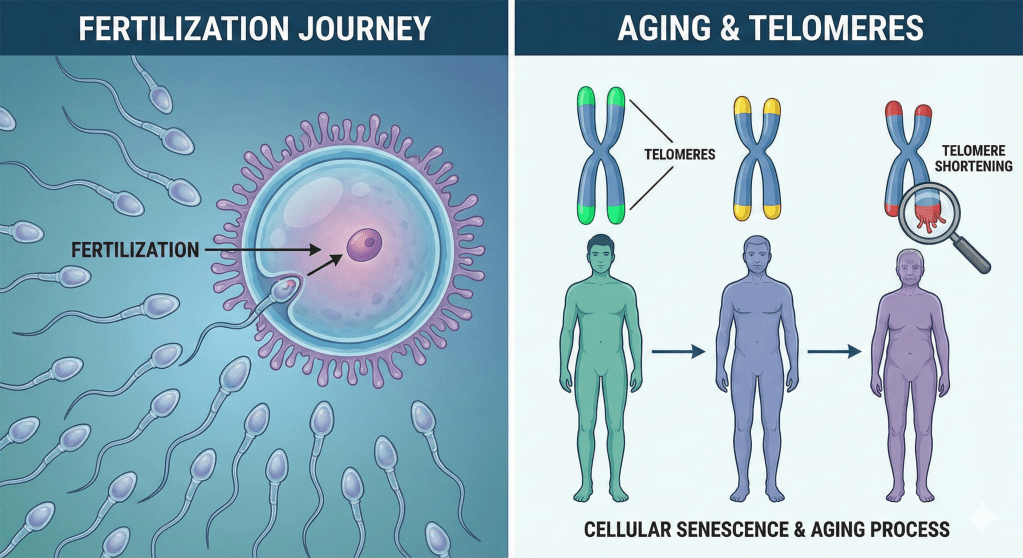
While classical scholars interpreted Nutfah as semen, modern linguistic analysis aligns it with the zygote—the fertilized ovum. The zygote is a “drop” in size but monumental in potential. It contains the 46 chromosomes (23 pairs) necessary to form a human.
- The “Mingled” Fluid: Other Quranic verses describe the Nutfah as Amshaj (mingled), which modern embryologists correlate with the mixing of male and female genetic material at fertilization.4
4.2 Sexual Differentiation and the “Making of Pairs”
The phrase “then He made you mates” follows the Nutfah. This sequential particle “then” (thumma) is significant.
- Chromosomal Sex: Sex is determined at the exact moment of fertilization by the sperm’s contribution (X or Y chromosome). The “making” of the pair is genetically established within the Nutfah stage.5
- Phenotypic Differentiation: However, the physical manifestation of maleness or femaleness (gonadal differentiation) occurs later in embryonic development (around week 6-7). The Quranic “then” accurately reflects this biological delay between genetic determination and physical differentiation.5
- Critique of Galenic Influence: Skeptics argue that Quranic embryology mirrors the knowledge of Galen and Aristotle. However, the specific nuances—such as the emphasis on the Nutfah containing the blueprint for the “mate”—diverge from ancient theories that viewed the sperm as merely a coagulating agent for menstrual blood.21
4.3 Mitochondrial Inheritance and Maternal “Knowledge”
The verse emphasizes: “And no female conceives nor does she give birth except with His knowledge.”
Modern genetics offers a fascinating layer to this maternal-centric phrasing. While nuclear DNA is inherited from both parents, mitochondrial DNA (mtDNA) is inherited exclusively from the mother.
- The Cellular Powerhouse: Mitochondria, the energy generators of the cell, contain their own distinct DNA. This genetic material is passed down the maternal line unchanged (barring mutation).
- The “Knowledge” of the Cytoplasm: The cytoplasm of the egg contains the critical regulatory factors (mRNA, proteins) that initiate and guide the early division of the zygote. The “knowledge” required to kickstart life lies predominantly in the female gamete. Scientific commentaries suggest that the Quran’s specific mention of the female in the context of “knowing” alludes to this biological reality—that the mother provides the structural and metabolic machinery for the new life.5
5. The “Kitab” in the Genomic Era: DNA as the Biological Register
Perhaps the most radical shift in the interpretation of 35:11 concerns the word Kitab (Register). In the 21st century, the notion of a “Book” containing the details of life has moved from a metaphysical abstraction to a tangible biological reality: the Genome.
5.1 The Genome as Information Storage
The Human Genome Project revealed that the nucleus of every human cell contains a code of approximately 3 billion base pairs (A, C, G, T). This sequence acts exactly as a book does—storing information, instructions, and history.
- Information Density: Harun Yahya and other proponents of the Ijaz school argue that if the information in a single DNA molecule were written out, it would fill a library of 900 volumes.22
- The “Register” of Traits: The verse states that changes in life are “in a register.” Geneticists now know that susceptibility to diseases, potential longevity, and developmental milestones are encoded in this biological text. The “Book” of 35:11 is seen by contemporary scholars like Zaghloul El-Naggar as a dual reference: the transcendent Lawh Mahfuz and the immanent DNA.9
5.2 The Linguistic Analogy of DNA
The parallel between the “Word of God” (Kalimat) and the “Genetic Code” is profound. Just as the Quran is a text composed of letters that form meaningful verses, DNA is a text composed of nucleotides that form meaningful genes.
- Zaghloul El-Naggar’s Exegesis: El-Naggar argues that the Quranic usage of “Kitab” predates and predicts the Information Age definition of life—that biology is fundamentally the processing of information. The “decree” is the software; the body is the hardware.24
- Refutation of Randomness: This informational view is often used to argue against materialist evolution. Information, proponents argue, requires an Author. The presence of a “Kitab” within the cell is cited as evidence of Intelligent Design, aligning with the Surah’s theme of the “Originator” (Fatir).25
6. The Science of Mu’ammar: Telomeres, Aging, and the “Lessening” of Life
The verse’s discussion of the “aged person” (Mu’ammar) and the “lessening” of life finds its most compelling scientific correlate in the field of gerontology, specifically in the study of telomeres.
6.1 Telomeres: The Cellular Clock
Telomeres are repetitive nucleotide sequences (TTAGGG) at the ends of chromosomes that protect genetic data. They function like the plastic tips on shoelaces.
- The Mechanism of “Lessening”: With every cell division, telomeres shorten. They cannot be fully replicated by the standard DNA polymerase machinery (the “end replication problem”).
- The Hayflick Limit: When telomeres reach a critical shortness, the cell enters senescence (stops dividing) or undergoes apoptosis (programmed death). This is a literal, physical “lessening” of the organism’s potential life with every biological event.26
- Exegesis: The phrase “nor is his lifespan lessened” can be interpreted scientifically as the attrition of telomere length. The “Book” (DNA) literally loses pages (base pairs) as life progresses.
6.2 Epigenetics and the “Lengthening” of Life
The verse also speaks of life being “granted” or extended. Until recently, biology viewed the genome as static. However, the field of Epigenetics has revealed that while the code is fixed, the expression of the code is plastic.
- Lifestyle Regulation: Factors such as diet (caloric restriction), stress management, and exercise can upregulate the enzyme Telomerase, which rebuilds telomeres.28
- The “Writing” of Environment: Methylation marks (chemical tags) are added to DNA based on environmental interaction. A person can “lengthen” their functional lifespan by adopting behaviors that preserve telomere length. This provides a biological mechanism for the classical concept of Ajal Mu’allaq (conditional destiny).
- Integration with Hadith: The Prophet Muhammad said, “Whoever would like his provision increased and his life extended, should uphold ties of kinship” (Bukhari). Scientifically, strong social support systems reduce cortisol (stress hormone), which is a known accelerator of telomere shortening. The “extension” of life promised in theology has a measurable biological pathway.30
6.3 Table: Comparative Analysis of “Lifespan” Concepts
| Concept in 35:11 | Classical Theological View (Tabari/Razi) | Biomedical/Genetic View (El-Naggar/Modern Science) |
| “In a Book” (Kitab) | Al-Lawh Al-Mahfuz (Metaphysical Tablet). | The Genome (DNA) & Epigenome (Biological Record). |
| “Lifespan Lessened” | Passing of time; dying young; loss of blessings. | Telomere attrition; accumulation of cellular damage; oxidative stress. |
| “Granted Life” | Barakah (Blessing) in time; conditional decree. | Telomerase activity; epigenetic longevity factors; caloric restriction effects. |
| “Knowledge” | Divine Omniscience of the outcome. | The informational content of the Zygote (3 billion base pairs). |
7. Preventive Medicine, Theology, and the Paradox of Action
The intersection of Divine Decree (Qadar) and medical intervention is a central theme when applying 35:11 to modern life. If life is “in a register,” is preventive medicine an act of defiance or compliance?
7.1 The Theological Justification for Medicine
Classical scholars like Ibn Qayyim al-Jawziyya argued that medical treatment does not contradict Qadar. Rather, it is “repelling the decree of Allah with the decree of Allah” (Rad al-Qadar bi al-Qadar). Just as one repels the “decree” of hunger by eating, one repels the “decree” of illness with medicine.32
- Verse 35:11 as Validation: By stating that these fluctuations are “in a register,” the Quran implies they are part of a system. Medicine utilizes the laws of that system (biology) to navigate the outcomes. The “Register” contains both the disease and the cure.
7.2 Preventive Medicine and “Secondary Causes” (Asbab)
Ash’ari theology typically emphasizes occasionalism—God creates the effect directly, not the cause. However, in the context of medicine, even Ash’aris accept the validity of “Secondary Causes” (Asbab).
- Primary vs. Secondary Prevention: In modern cardiology, primary prevention (treating risk factors before disease) and secondary prevention (treating after an event) are methods of altering the probability of death.33
- The “Mu’ammar” and Risk: The “Aged Person” (Mu’ammar) mentioned in the verse is often the result of successful interaction with these Asbab. The “Book” records the potential for heart disease (genetic predisposition), but the human agency (free will/action) determines whether that potential is realized or mitigated through preventive measures.34
8. Bioethics and the Future: Radical Life Extension and Transhumanism
As medical science advances from prevention to enhancement, verse 35:11 becomes the fulcrum for bioethical debate regarding Radical Life Extension (RLE) and Transhumanism.
8.1 The Transhumanist Challenge
Transhumanism views aging not as a natural stage (Mu’ammar) but as a disease to be cured. Technologies like CRISPR gene editing, telomerase therapy, and cryonics aim to extend life indefinitely, potentially centuries beyond the current limit.36
- The Conflict: Does this violate the “Decree”? Is it an attempt to usurp the attribute of Al-Baqi (The Everlasting)?
- Islamic Bioethical Response: Most Islamic bioethicists argue that extending life is permissible in principle as it falls under the mandate to seek cure. However, the claim to “immortality” or the total elimination of death is rejected as a theological impossibility and a delusion (Ghurur).37
8.2 Cryonics: Freezing the “Book”
Cryonics involves freezing a corpse in hopes of future revival.
- Theological Ruling: This is widely considered impermissible (Haram). Verse 35:11 implies a continuity of life managed by God. Death is the cessation of the “term.” Artificial suspension interferes with the Barzakh (intermediate realm) and violates the dignity of the deceased (Hurmat al-Mayyit). Furthermore, it presumes a materialist view of the soul—that restoring the “hardware” (body) automatically recalls the “software” (soul), a premise Islamic theology rejects.39
8.3 Genetic Engineering and “Altering Creation”
The potential to edit the “Book” (DNA) via CRISPR to enhance longevity raises the issue of Taghyir Khalq Allah (altering God’s creation).
- Therapy vs. Enhancement: Islamic ethics generally distinguishes between therapy (restoring normal function/health) and enhancement (exceeding natural limits). Editing genes to prevent premature aging (Progeria) aligns with 35:11’s “lengthening” as a restorative act. Editing embryos to create “super-centenarians” is viewed by many scholars as tampering with the “Book” in a forbidden manner, crossing the line into “playing God”.41
9. Comparative Hermeneutics: The Evolution of Tafsir
The journey of interpreting 35:11 reveals a distinct evolution in Muslim intellectual history.
9.1 Classical Methodology (Tafsir bi-l-Ma’thur)
- Focus: Linguistic purity, reliance on Hadith, metaphysical reverence.
- View of 35:11: A proof of God’s power over social destinies and a call to piety. “Shortening” life is a metaphor for loss of blessing or a relative comparison between people.43
9.2 Modernist Methodology (Tafsir Ilmi)
- Focus: Concordance with science, empirical evidence, rationalism.
- View of 35:11: A scientific miracle. The verse predicts DNA, embryological stages, and telomeres. The “Book” is physical.
- Key Figures: Tantawi Jawhari (who filled his Tafsir with diagrams of cells and plants) and Zaghloul El-Naggar.
- Critique: While compelling, this approach risks reducing the Quran to a science textbook. If science changes (e.g., if telomere theory is disproven), the interpretation collapses. Critics argue for a nuanced “complementary” view where science elucidates but does not limit the text.23
10. Thematic Epilogue: The Convergence of the Three Books
The contemplation of Surah Fatir 35:11 leads to a synthesis of three distinct “Books” recognized in Islamic thought:
- Al-Kitab Al-Mastuur (The Revealed Book): The Quran itself, which articulates the truth of existence in verses.
- Al-Kitab Al-Manzur (The Observed Book): The Universe and the human body, which articulate the truth of existence in atoms and cells.
- Al-Kitab Al-Maknun (The Hidden Book): The Genome/Preserved Tablet, which contains the code and destiny of the creation.
Verse 35:11 is the nexus where these three books meet. The Revealed text speaks of the Hidden register that governs the Observed biological reality.
Developments in medicine—from the microscope discovering the Nutfah to the sequencer decoding the Kitab—have not rendered the verse obsolete; rather, they have increased its resolution. The “Aged Person” (Mu’ammar) is no longer just a grey-haired elder but a biological marvel of telomere maintenance and epigenetic survival.
Ultimately, the verse serves as a reminder that while humanity may learn to read the “Book” of DNA and even edit its margins through medicine, the authorship remains Divine. The “lengthening” and “shortening” are mechanisms placed within our grasp, but the “Knowledge” remains absolute. As we stand on the brink of post-human futures, 35:11 remains a grounding tether, asserting that every base pair, every heartbeat, and every nanosecond of life is accounted for, significant, and strictly recorded.
“Indeed, that for Allah is easy.”
If you would rather read in Microsoft Word file:
 The Glorious Quran and Science
Leave a comment