

Presented by Zia H Shah MD
Abstract
In the closing month of 2025, the intellectual and theological landscape of South Asia was momentarily galvanized by a high-profile confrontation at the Constitution Club of India in New Delhi. The debate, titled “Does God Exist?”, featured the celebrated poet, lyricist, and vocal atheist Javed Akhtar against the Islamic scholar Mufti Shamail Nadwi. The event, intended as a civil exchange of ideas, rapidly metamorphosed into a digital phenomenon, with millions of viewers across the Muslim world hailing the proceedings as a decisive intellectual triumph for theism. Social media platforms were inundated with clips celebrating the apparent dismantling of secular skepticism by classical Islamic scholasticism. However, beneath the veneer of this celebrated “victory” lies a profound fragility.
This research report offers a comprehensive and critical examination of the Akhtar-Nadwi engagement, dissecting the classical arguments employed—ranging from Avicennian contingency to the problem of evil—and analyzing the sociological dimensions of the community’s reaction. The report then pivots to a substantial critique articulated by Dr. Zia H. Shah, MD, a prominent voice in the dialogue between religion and science. Dr. Shah contends that the celebrations of the Muslim community are premature and arguably dangerous. He posits that relying on 12th-century metaphysics while ignoring 21st-century molecular biology constitutes a strategic failure in the face of modern atheism.
Central to this report is the detailed presentation of Dr. Shah’s thesis: that the “elephant in the room” for Muslim apologetics is the theory of evolution. By synthesizing evidence from molecular biology—specifically the irrefutable data regarding Endogenous Retroviruses (ERVs) and common ancestry—with a rigorous exegesis of the Quran, the report outlines a model of “Guided Evolution.” This synthesis argues that only by accepting the “Two Books” theory—where the Work of God (Nature) and the Word of God (Scripture) are in concordance—can Islamic theology offer a robust, coherent, and empirically grounded response to the incoherence of materialistic atheism.
Part I: The Theater of Dialectic – The Akhtar-Nadwi Engagement
1.1 The Cultural and Intellectual Context
To understand the gravity of the debate between Javed Akhtar and Mufti Shamail Nadwi, one must first appreciate the volatile intellectual milieu of contemporary India and the broader Muslim world. The dichotomy between secular rationalism and religious orthodoxy has intensified, fueled by the global rise of “New Atheism” and the specific socio-political pressures facing Muslims in the subcontinent. The “New Atheist” movement, characterized by a reliance on scientific naturalism and a moral critique of religion, has found a receptive audience among the youth, challenging traditional religious narratives with questions grounded in empirical science and human rights.
It is within this charged atmosphere that the debate was organized. Javed Akhtar stands as a colossus in Indian culture—a master of Urdu poetry, a screenwriter of legendary status, and a fierce secularist who has publicly identified as an atheist for decades. His atheism is not merely a lack of belief but a positive assertion of humanism, often critiquing religion as a source of division and irrationality. Opposing him was Mufti Shamail Nadwi, a scholar representing the Ulama—the traditional guardians of Islamic learning. Educated at the prestigious Darul Uloom Nadwatul Ulama and the International Islamic University Malaysia, Nadwi brought to the table not the fiery rhetoric of a televangelist, but the disciplined logic of Ilm al-Kalam (Islamic scholastic theology).
The event at the Constitution Club was more than an academic exercise; it was a cultural flashpoint. For a community often marginalized in political discourse and frequently accused of intellectual stagnation, the prospect of a traditional scholar engaging a secular giant on equal footing was electrifying. The debate was framed by organizers not as a religious confrontation, but as a philosophical exchange on the fundamental question of existence.
1.2 The Architecture of the Argument: Contingency and Necessity
The core of the debate revolved around the classical metaphysical proofs for the existence of God. Mufti Nadwi’s primary offensive strategy relied on the Argument from Contingency, a philosophical construct deeply rooted in the Islamic Peripatetic tradition (Falsafa), particularly the work of Ibn Sina (Avicenna). This argument avoids the pitfalls of purely physical evidence, focusing instead on the logical properties of existence itself.
1.2.1 The Concept of the Contingent (Mumkin al-Wujud)
Nadwi introduced the concept of the “Contingent Being” (Mumkin al-Wujud). In philosophical terms, a contingent entity is one whose existence is not necessary; it is possible for it to exist, and it is possible for it not to exist. Its existence is dependent on external factors to tip the scales from non-existence to existence.
To illustrate this, Nadwi utilized the analogy of a painting. He posited that a canvas, paint, and brush—no matter how long they sit together—do not possess the intrinsic capacity to organize themselves into a masterpiece. They are “contingent” variables. They require an external agent—the painter—to actualize their potential. Their existence as a painting is dependent, not necessary.
Nadwi extended this analogy to the cosmos. The universe is composed of matter, energy, and physical laws. These components change, decay, and are subject to time. Because they are subject to change, they are contingent. If every individual part of the universe is contingent, then the aggregate—the universe itself—must also be contingent. It cannot be the source of its own existence because a thing cannot create itself; it would have to exist before it existed, which is a logical absurdity.
1.2.2 The Infinite Regress and the Necessary Being (Wajib al-Wujud)
Having established the universe as contingent, Nadwi argued that it requires a cause. However, if that cause is also contingent, it too requires a cause. This leads to the problem of Infinite Regress (Tasalsul). Nadwi argued that an infinite chain of dependent causes is impossible. He used the analogy of a soldier waiting for an order to fire. If the soldier must wait for an order from his superior, and that superior must wait for his superior, and so on ad infinitum, the order will never be given, and the shot will never be fired. The fact that the “shot has been fired” (i.e., the universe exists) proves that the chain of command must terminate.
Therefore, logic dictates that the chain of causes must stop at a Necessary Being (Wajib al-Wujud)—an entity whose existence is intrinsic, uncaused, eternal, and independent of all else. This Being does not “receive” existence; It is existence. Nadwi identified this Necessary Being as Allah, the Creator (Al-Khaliq) and the Originator (Al-Bari), distinguishing the divine act of creation from human discovery. Humans merely rearrange existing matter; God brings matter into existence from nothingness.
1.3 The Atheist Rejoinder: The Problem of Evil and the Silence of God
Javed Akhtar, while acknowledging the intricate logic of metaphysical arguments, grounded his counter-offensive in the visceral reality of human experience, specifically The Problem of Evil. His approach was less about the possibility of a First Cause and more about the character of the deity proposed by religion.
1.3.1 The Gaza Paradox
Akhtar’s most potent rhetorical weapon was the ongoing humanitarian catastrophe in Gaza. He posed a dilemma that has haunted theologians for millennia, reformulated for the geopolitical tragedies of the 21st century. He questioned how an omnipotent (all-powerful) and omnibenevolent (all-good) God could reconcile His nature with the suffering of innocents.
“If you are omnipotent and omnipresent, then you must be present in Gaza as well. You must have seen the children torn to shreds, and you still want me to believe in you?”.
Akhtar argued that the “silence of God” in the face of such atrocities is empirical evidence against the existence of a compassionate, intervening deity. He challenged the utility of prayer, asking why, if God listens, He remains mute when the prayers of dying children are most desperate. For Akhtar, the existence of suffering is not merely a mystery; it is positive evidence that the “Necessary Being,” if It exists, does not possess the moral attributes claimed by Islam.
1.3.2 Morality as Social Contract
Akhtar further attacked the theistic claim to objective morality. He posited that morality is not a divine mandate sent down from the heavens, but a social consensus evolved for group survival. He likened morality to traffic lights. Traffic signals are not “natural” or “divine”; nature does not produce red or green lights. Rather, they are arbitrary rules agreed upon by society to prevent chaos and ensure collective safety. Similarly, human ethics—do not kill, do not steal—are evolutionary adaptations for social cohesion, not cosmic truths.
1.4 The Theistic Defense: Free Will and the “Test”
Mufti Nadwi’s response to the Problem of Evil was grounded in traditional Islamic theodicy. He argued that the existence of evil does not negate God; rather, it affirms human agency.
- Free Will and Human Agency: Nadwi asserted that acts of violence, such as those in Gaza, stem from human choices, not divine malevolence. God granted humans free will, a capacity that necessitates the possibility of choosing evil. To remove the possibility of evil would be to remove free will, turning humans into automatons.
- The Test (Bala): He framed life as a temporary testing ground. Suffering serves a metaphysical function—it acts as a test of faith, a purification, or a means to elevate one’s spiritual rank. The world (Dunya) is not intended to be a paradise; it is a place of trial.
- Justice is Eschatological: Nadwi argued that true justice is impossible within the confines of a material world. A dictator who kills thousands can only be punished once in this life. Perfect justice requires an afterlife (Akhirah), where every atom of good and evil is accounted for. Thus, the apparent injustices of this world are resolved in the next.
Akhtar rejected this defense as “insensitive poetry,” arguing that justifying the agony of a child as a “test” is morally repugnant. He contended that such explanations are convenient theological shields that fail to address the raw reality of pain.
Part II: The Digital Aftermath – Anatomy of a Viral “Victory”
2.1 The Sociology of Celebration
Following the debate, the Muslim digital sphere in India, Pakistan, and beyond erupted in celebration. The debate was viewed millions of times across platforms like YouTube, Facebook, and Twitter, with the overwhelming sentiment among Muslims being that Nadwi had delivered a “decisive blow” to atheism.
This reaction reveals less about the rigorous philosophical evaluation of the arguments and more about the psychological state of the community. In an era where Muslims often feel besieged by geopolitical weakness, rising Islamophobia, and a perceived backwardness in science and technology, the image of a young, articulate scholar holding his own against a famous, secular icon provided a profound sense of catharsis. The “victory” was symbolic; it represented the resilience of the faith against the encroachments of modernity.
2.2 The Misinformation Ecosystem
The intensity of the desire for victory led to the rapid spread of misinformation. A viral image circulated claiming that Javed Akhtar had converted to Islam following the debate, showing him in a skullcap. This was quickly debunked as an AI-generated deepfake. Akhtar himself took to social media to denounce the “rubbish” claims, reaffirming his atheism. This incident highlights the vulnerability of the community to confirmation bias and the desperation for validation that can cloud critical judgment.
2.3 The Commentary Industry
A cottage industry of reaction videos sprang up, further cementing the “victory” narrative.
- Orya Maqbool Jan, a prominent Pakistani commentator, analyzed the debate, praising Nadwi for his use of the contingency argument and framing the debate as a clash between divine truth and secular confusion.
- Kelaya Reacts and Kumar Shyam, popular YouTube reactors, fueled the discourse by analyzing the “shocking” moments of the debate, often framing Nadwi’s calm demeanor against Akhtar’s emotional appeals as a sign of intellectual superiority.
- Reddit Discourse: On platforms like Reddit, users debated the outcome, with some arguing that Akhtar’s points on suffering were not adequately answered, while others claimed the audience bias in the hall (which applauded Nadwi frequently) created an illusion of victory.
Part III: The Premature Celebration – Dr. Zia H. Shah’s Critique
3.1 The Diagnosis: Winning the Wrong Battle
Amidst the clamor of celebration, Dr. Zia H. Shah, MD, a physician and Chief Editor of The Muslim Times, offered a sobering critique. Dr. Shah argues that the Muslim community’s celebration is premature and ultimately hollow. While Mufti Nadwi successfully articulated the classical arguments of 12th-century theology, the debate largely sidestepped the primary arsenal of modern atheism: the scientific narrative of unguided evolution and the empirical realities of biology.
Dr. Shah posits that the “God of the Philosophers” (the Necessary Being) is logically sound but empirically distant. The modern atheist does not just argue from logic; they argue from science. They claim that the theory of evolution, driven by natural selection acting on random mutations, provides a sufficient explanation for the complexity of life, rendering the hypothesis of a Creator superfluous. By focusing solely on metaphysics and ignoring biology, Muslim apologists like Nadwi are fighting a 21st-century war with medieval weaponry.
3.2 The “Elephant in the Room”: Evolution
Dr. Shah identifies Biological Evolution as the “elephant in the room” that the Muslim intelligentsia refuses to acknowledge. He critiques the prevailing attitude among Muslim scholars—epitomized by figures like Zakir Naik and Harun Yahya—who actively deny evolution or dismiss it as “just a theory”.
Shah argues that this denial is a strategic disaster. When a scholar stands on a stage and denies established scientific facts, they discredit the entire Islamic tradition in the eyes of the scientifically literate. They force educated Muslims into a false dichotomy: choose between the Quran and the Biology textbook. Dr. Shah asserts that this is a suicidal trajectory for the faith. The “victory” of Nadwi is fragile because it relies on the audience’s ignorance of the biological evidence that contradicts the “Special Creation” narrative often assumed by traditionalists.
3.3 The Failure of Imported Creationism
Dr. Shah specifically targets the importation of Christian Creationist arguments into Islamic discourse. He notes that scholars like Zakir Naik often use arguments developed by American Evangelicals (e.g., the “irreducible complexity” of the eye, or the lack of transitional fossils) to attack evolution. Shah argues that this is “Wrong Theology”. Unlike the Bible, which contains specific chronologies (e.g., the Bishop Ussher timeline dating the earth to 6,000 years), the Quran speaks of creation in deep time (ayyam meaning periods, not 24-hour days) and stages (atwaran). There is no scriptural need for Muslims to adopt Young Earth Creationism, yet many do, to their intellectual peril.
Part IV: The Scientific Reality – Molecular Evidence for Common Ancestry
To understand the weight of Dr. Shah’s critique, one must examine the scientific evidence that he claims renders common ancestry an “established fact.” This evidence moves beyond the fossil record (which can be fragmentary) to the genome, which acts as a pristine historical archive of life.
4.1 Molecular Biology: The Divine Archive
Dr. Shah describes molecular biology as a “checkmate to Creationism”. While comparative anatomy allows us to see similarities in bone structures, genetics allows us to read the source code of life. This code reveals patterns that are mathematically impossible to explain without common descent.
4.2 The “Smoking Gun”: Endogenous Retroviruses (ERVs)
One of the most compelling lines of evidence highlighted in Dr. Shah’s analysis is the phenomenon of Endogenous Retroviruses (ERVs).
4.2.1 The Mechanism of Integration
Retroviruses (a class of viruses that includes HIV) replicate by inserting their genetic material (DNA) into the host’s genome. If a retrovirus infects a somatic cell (like a skin cell), the infection dies with the host. However, if the virus infects a germline cell (a sperm or egg cell) and that cell goes on to form an embryo, the viral DNA becomes a permanent part of the organism’s genetic code. This organism will pass the viral DNA to every one of its descendants. These inherited viral sequences are called Endogenous Retroviruses.
4.2.2 The Argument from Probability
The human genome contains thousands of these ERV insertions—relics of ancient viral infections. Crucially, molecular biologists have discovered that humans and chimpanzees share many of the exact same ERV insertions at the exact same locations in their respective genomes.
Dr. Shah utilizes a probability argument here. The human genome consists of 3 billion base pairs. The probability of a virus inserting itself into the exact same base pair in two independent “creation events” (if humans and chimps were created separately) is vanishingly small—essentially zero. To share multiple identical insertions is statistically impossible unless:
- Common Descent: An ancient ancestor was infected by the virus. This ancestor passed the viral DNA to its descendants, two lineages of which evolved into humans and chimpanzees, both carrying the same genetic scar.
- The Deceptive God: God created humans and chimps separately but deliberately inserted non-functional viral DNA into the exact same spots in both genomes to make it look like they evolved. Dr. Shah argues that this second option depicts God as a Deceiver, which is theological blasphemy.
Thus, the presence of shared ERVs is not just evidence; it is a “genomic fossil” that confirms common ancestry beyond reasonable doubt.
4.3 Synteny and Chromosomal Fusion
Dr. Shah also points to the evidence of Chromosomal Fusion. Humans have 23 pairs of chromosomes, while great apes (chimpanzees, gorillas, orangutans) have 24 pairs. If we share a common ancestor, there is a discrepancy: where did the extra chromosome go?
Science provides the answer: Human Chromosome 2. Detailed genetic analysis reveals that Chromosome 2 is formed by the head-to-head fusion of two ancestral ape chromosomes. It contains two centromeres (one active, one vestigial) and internal telomeres (sequences usually found only at the tips of chromosomes). This “scar” of fusion is definitive proof that humans belong to the same lineage as the great apes. Dr. Shah argues that theology must embrace this fact, not deny it.
| Feature | Creationist Explanation | Evolutionary Explanation (Supported by Dr. Shah) |
| Shared ERVs | Coincidence or “Common Designer” using same parts | Inherited viral infections from a common ancestor |
| Chromosome Count | Humans created with 23 pairs, Apes with 24 | Human Chromosome 2 is a fusion of two ape chromosomes |
| Genetic Similarity | Functional similarity | Genealogy and descent |
| Theological Implication | God created misleading evidence | God used evolution as a mechanism of creation |
Part V: Guided Evolution – The Theistic Synthesis
Having established that common ancestry is an undeniable fact, Dr. Shah proposes a constructive theological model: Guided Evolution (or Theistic Evolution). This model accepts the scientific what (evolution happened) but challenges the atheistic how (it was blind and random).
5.1 Reconciling Randomness and Providence
The standard Neo-Darwinian synthesis asserts that evolution is driven by random mutations filtered by natural selection. Atheists argue that “random” means “purposeless.” Dr. Shah challenges this metaphysical leap.
- The Habits of God: Shah argues that what scientists call “natural laws” are simply the “Habits of God” or the Sunnah of Allah. Gravity, electromagnetism, and evolution are the methods by which God sustains and creates the universe.
- Quantum Indeterminacy: Shah suggests that the “randomness” of mutations may be the locus of Divine Action. In quantum mechanics, events are probabilistic and not strictly determined by prior physical states. Shah proposes that God may influence quantum events (causing specific mutations) in a way that appears random to scientific instruments but is teleologically directed toward a specific goal: the emergence of complex life and consciousness.
- Rejection of the “Blind Watchmaker”: Shah firmly rejects the “Blind Watchmaker” thesis of Richard Dawkins. He argues that the complexity and directionality of evolution—leading from single cells to the sentient human mind—evidence a Guiding Hand. The process is not a stumble in the dark, but a calibrated ascent.
5.2 The “Truth Cannot Contradict Truth” Hermeneutic
Dr. Shah’s approach relies on the epistemological principle that “Truth Cannot Contradict Truth” (Haqiqat kehte hain use jo na ho taghayyur). This principle, championed by philosophers like Ibn Rushd (Averroes), posits that since God is the Author of both the Scripture (Quran) and the Universe (Nature), there can be no genuine conflict between them.
If a conflict appears, it is due to a flaw in human understanding—either a misinterpretation of the scripture or an error in the science. However, when science reaches the level of “established fact” (like the sphericity of the earth or common ancestry), the literal interpretation of scripture must be re-evaluated in favor of a metaphorical or deeper understanding. Shah argues that this is not “changing” Islam, but refining our understanding of it to align with reality.
Part VI: Scriptural Harmony – The Quran and the Cosmos
Dr. Shah contends that the Quran is not only compatible with evolution but contains verses that resonate deeply with an evolutionary perspective. He warns against “Bucaillism” (finding specific scientific miracles in the text), preferring a thematic resonance that invites scientific study.
6.1 Quranic Verses on Creation
Dr. Shah highlights several verses that support a gradualist view of creation:
- Creation in Stages (Atwaran): “What is the matter with you that you do not attribute to Allah due grandeur, when He has created you in stages?” (Quran 71:13-14). Shah interprets stages not just as embryological phases but as the long biological history of the species.
- Origin from Water: “Have those who disbelieved not considered that the heavens and the earth were a joined entity, and We separated them and made from water every living thing?” (Quran 21:30). This aligns with the biological fact that life originated in the primordial aquatic environment.
- The Clay Metaphor: Verses describing the creation of man from “sounding clay” or “mud” are interpreted by Shah as references to the chemical composition of life (carbon, nitrogen, water) rather than a description of a potter molding a statue. The “essence” of clay points to our material origins, compatible with the abiogenesis of early life forms.
6.2 The Status of Adam
The most contentious issue is the creation of Adam. Traditionalists view Adam as the first biological human, created instantaneously without parents. Dr. Shah offers an alternative view supported by some modern and classical thinkers:
- Adam as Chosen (Isafa): The Quran uses the word Isafa (chose) regarding Adam: “Indeed, Allah chose Adam and Noah…” (Quran 3:33). One cannot be “chosen” unless there are others to be chosen from. This implies Adam was selected from an existing population of hominids and imbued with a soul, consciousness, and the capacity for revelation.
- The Khalifa on Earth: When God announces the creation of a Vicegerent (Khalifa), the angels ask, “Will You place therein those who will make mischief and shed blood?” (Quran 2:30). Shah suggests the angels inferred this from the behavior of pre-Adamic hominids who existed before Adam.
By adopting these interpretations, Dr. Shah argues, Muslims can maintain their faith in the Quran without denying the fossil and genetic evidence of human history.
Part VII: The Offensive – Turning Evolution Against Atheism
Once the “scientific hurdle” of evolution is cleared via Theistic Evolution, Dr. Shah argues that the Muslim apologist is positioned to dismantle atheism on its own turf. He employs the Evolutionary Argument Against Naturalism (EAAN), famously associated with philosopher Alvin Plantinga, to show that atheism is self-refuting.
7.1 The Epistemological Crisis of Naturalism
Atheism posits that human cognitive faculties (reason, logic, memory) are the result of unguided evolutionary processes geared solely toward survival and reproduction, not the discovery of objective truth.
- Utility vs. Truth: A primate needs to know that a tiger is dangerous (utility). It does not need to know the truth of quantum mechanics or metaphysics. Evolution selects for beliefs that lead to survival behaviors. As Shah points out, a creature could survive perfectly well with false beliefs (e.g., avoiding a predator because it thinks the predator is a ghost) as long as the behavior (running away) is correct.
- The Undermining of Reason: If our brains are merely survival engines built by random mutations, why should we trust them when they engage in abstract metaphysical reasoning, such as “Does God exist?”? The probability that a survival-focused brain produced by randomness would be reliable in discerning deep metaphysical truths is low or inscrutable.
7.2 The Self-Defeat of Atheism
Dr. Shah argues that the atheist is in a “performative contradiction.” They use their reason to deny the Designer of reason.
- The Atheist Claim: “My brain is a product of blind chance and survival selection.”
- The Atheist Act: “I will use this brain to determine the ultimate truth of the universe and conclude there is no God.”
- The Contradiction: If premise (1) is true, there is no reason to trust the conclusion in (2). Atheism cuts off the branch it sits on.
In contrast, Theism offers a coherent epistemology: We can trust our reason because our minds are made in the image of the Divine Mind (God), who created the universe to be intelligible. Thus, Theistic Evolution validates science, while Atheistic Evolution undermines the reliability of the scientist.
7.3 Consciousness and the Soul
Finally, Shah argues that Consciousness remains the “Hard Problem” that materialism cannot solve. While evolution explains the hardware (the brain), it cannot explain the software (subjective experience). The leap from inert matter to feeling, thinking, and self-awareness is unbridgeable by natural selection alone. Shah argues that consciousness is the “breath of God,” a phenomenon that necessitates a non-material explanation, further supporting the Guided Evolution model.
Thematic Epilogue: The Convergence of Horizons
The debate between Javed Akhtar and Mufti Shamail Nadwi was a collision of two distinct intellectual epochs: the age of classical metaphysics and the age of secular humanism. Akhtar spoke for the heart, demanding a theodicy that accounts for the tears of Gaza. Nadwi spoke for the mind, outlining the logical necessity of a Cause for the cosmos. Both scored points in their respective domains, but neither achieved a total victory because they failed to engage the third and most dominant domain of our time: the domain of Science.
Dr. Zia H. Shah’s work serves as a bridge between these worlds. He warns the Muslim community that the celebration of rhetorical victories is a dangerous sedative. As long as the community ignores the “elephant” of evolution, their faith remains fragile, isolated from the reality of the physical world. The true victory against atheism will not be found in the denial of science, but in its integration.
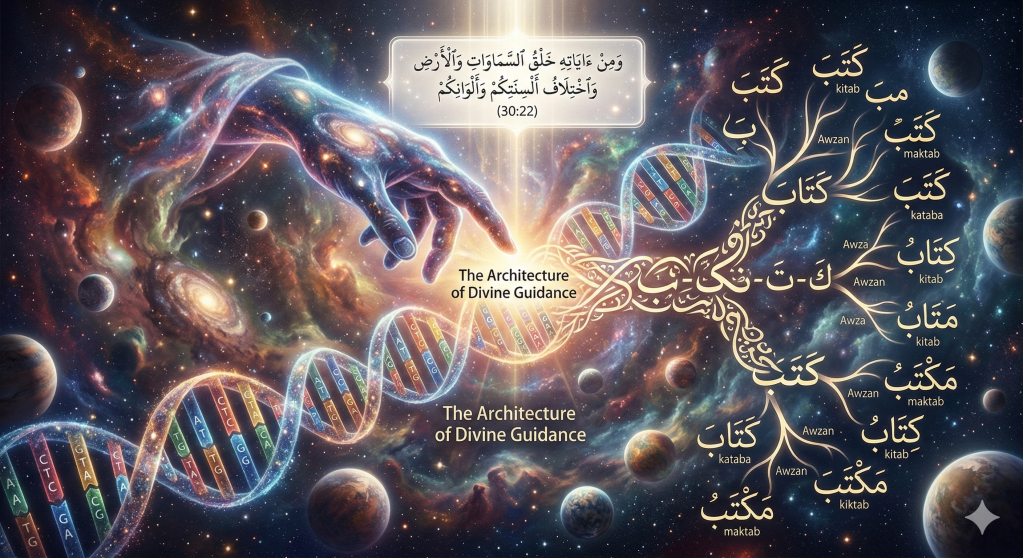
The future of Islamic apologetics, according to Dr. Shah, lies in the Convergence—the realization that the Ayat (Signs) of the Quran and the Ayat of the Genome tell the same story. It is a story of a universe that is not a cosmic accident, but a deliberate, guided unfolding. It is a story where the scars of our evolutionary past—the retroviruses in our DNA, the fused chromosomes in our cells—are not evidence of God’s absence, but of His method.
By embracing Guided Evolution, Muslims can answer Javed Akhtar’s skepticism not just with logic, but with evidence. They can show that the very process of evolution, which atheists claim as their own, is in fact the mechanism of Al-Bari (The Evolver). In doing so, they can move from a defensive posture of denial to a confident assertion that the Universe, in all its biological complexity, is indeed a living eulogy for its Creator.
| Core Issue | Classical Apologetics (Nadwi) | Atheistic Critique (Akhtar) | Theistic Evolution Synthesis (Dr. Shah) |
| Origin of Life | Special Creation (Instantaneous) | Unproven / Natural Abiogenesis | Guided Evolution (Process from water/clay) |
| Mechanism | Divine Fiat (“Be and it is”) | Random Mutation & Natural Selection | Laws of Nature as “Habits of God” / Quantum Guidance |
| Human Origins | Adam as distinct from animals | Common Descent with Apes | Common Descent confirmed; Adam as “Chosen” & Ensouled |
| Evidence Base | Metaphysical Logic (Contingency) | Empirical Suffering (Problem of Evil) | Molecular Biology (ERVs) & EAAN (Epistemology) |
| Role of Reason | To deduce the Necessary Being | To maximize social utility/survival | Reliable only if grounded in Divine Mind (Validates Science) |
Conclusion: The intellectual battle of the 21st century requires a new weaponry. The “victory” celebrated in New Delhi was a skirmish won with ancient tools. The war for the hearts and minds of the next generation will be fought in the laboratory and the library. It is there, Dr. Shah argues, that the Muslim mind must meet the challenge of atheism—not by rejecting the light of science, but by showing that this light is but a reflection of the Light of the Heavens and the Earth.



 The Glorious Quran and Science
Leave a comment