
Presented by Zia H Shah MD
Abstract
This report provides an exhaustive, expert-level examination of Dr. Zakir Naik’s theological and epistemological rejection of the Theory of Evolution. Dr. Naik, a globally influential Islamic preacher and President of the Islamic Research Foundation, has formulated a distinct apologetic framework that seeks to harmonize the Qur’an with “established scientific facts” while vigorously denying the biological ancestry of human beings and the mechanism of natural selection. By analyzing transcripts from his lectures—specifically video sources verifying his direct claims—and correlating them with his written works and the broader corpus of Islamic creationist literature, this document deconstructs the architecture of his argument. The analysis reveals that Naik’s position relies on a rigid bifurcation of “Theory” versus “Fact,” a specific “Four Waves” hypothesis regarding hominid fossils, and a reliance on selected, often decontextualized, citations from Western scientists to construct a narrative of scientific uncertainty.
The report details how Naik denies the common ancestry of all life forms, specifically the descent of humans from primates, by framing evolution as a “hypothesis” that contradicts the Quranic narrative of Special Creation (Adamic Exceptionalism). Furthermore, it investigates the forensic origins of his specific claims—such as the “Thomas Thompson” letter attributed to Charles Darwin and the “daydream” critique attributed to Pierre-Paul Grassé—demonstrating how 20th-century Christian creationist talking points have been adapted into a modern Islamic apologetic context. The study situates Naik within the spectrum of contemporary Islamic thought, contrasting his scientific literalism with other theological approaches, and concludes with a thematic epilogue on the implications of his discourse for the relationship between faith and reason in the Muslim world.
1. Introduction: The Architect of “Scientific” Apologetics
1.1 The Rise of Dr. Zakir Naik and the Da’wah Ecosystem
Dr. Zakir Naik represents a paradigm shift in modern Islamic proselytization (Da’wah). Unlike traditional Ulama (religious scholars) whose authority stems from mastery of classical Arabic, Fiqh (jurisprudence), and Tafsir (exegesis), Naik’s authority is constructed upon a modernist, rationalist, and comparative platform. A medical doctor by training, he emerged in the 1990s as a protégé of the late Ahmed Deedat, inheriting the mantle of aggressive comparative religion but evolving the methodology to suit the satellite television era. Through his media empire, Peace TV, Naik reaches hundreds of millions of viewers, presenting Islam not merely as a theological truth but as a “scientifically verified” reality.1
His methodology is fundamentally “Concordist.” Concordism is the hermeneutical approach that seeks to interpret scripture in a way that aligns with the findings of modern science. For Naik, science is the “yardstick” of the modern age; if the Qur’an is the word of God, it must satisfy the rigorous demands of empirical rationality. This approach has led him to champion the “Scientific Miracles” (Ijaz Ilmiy) of the Qur’an, arguing that the text accurately described embryological development, the water cycle, and the Big Bang centuries before their discovery.2
However, this reliance on scientific validation creates a profound vulnerability. When the consensus of the scientific community contradicts a foundational theological tenet—specifically, the creation of Adam—the concordist framework faces a crisis. It is at this fracture point that Naik’s anti-evolution polemic is constructed. He cannot reject science, for it is his primary apologetic tool; therefore, he must redefine evolution out of the category of science.
1.2 The Evolution Conundrum in Islamic Theology
The Theory of Evolution, particularly the concept of common ancestry, presents a unique challenge to Islamic theology compared to other scientific advances. While the heliocentric model or the expansion of the universe can be harmonized with metaphorical readings of Quranic verses, the creation of Adam is described in the Qur’an with a level of specificity—created from dust, clay, and water, and breathed into by God’s spirit—that resists easy allegorization for literalists.
Naik’s stance is a defense of Adamic Exceptionalism: the belief that while the universe may operate under physical laws, the origin of the human species is a miraculous discontinuity. To maintain this position without appearing “anti-science,” Naik has developed a sophisticated rhetorical strategy that distinguishes between “proven science” (which the Qur’an supports) and “unproven theory” (which the Qur’an rejects).3
1.3 Methodology of Analysis
This report utilizes a multi-layered analytical approach:
- Direct Source Analysis: Examination of Naik’s spoken arguments in the provided video lectures 3 and written transcripts 1 to capture his exact phrasing, tone, and rhetorical delivery.
- Forensic Source Tracing: Investigating the origins of the specific scientific authorities Naik cites (e.g., Darwin, Grassé, Keith) to determine the accuracy and context of his references.
- Theological Contextualization: Placing Naik’s views within the broader debate on Islam and evolution, comparing him with contemporaries like Yasir Qadhi and critics like Shoaib Malik.
- Epistemological Critique: Analyzing the philosophy of science implicit in Naik’s arguments, specifically his definitions of “theory,” “fact,” and “proof.”
The following sections will dissect these components to provide a definitive account of how and why Zakir Naik denies biological evolution.
2. Epistemological Framework: The “Theory vs. Fact” Dichotomy
2.1 The Linguistic Trap: Defining “Theory”
The bedrock of Dr. Naik’s argument against evolution is a semantic distinction between “Scientific Theory” and “Scientific Fact.” In the provided video sources, Naik explicitly states: “I have not come across a single book in my life which says… ‘The Fact of Evolution’. It is ‘Theory of Evolution’”.6
This argument exploits a colloquial misunderstanding of scientific terminology.
- Scientific Definition: In science, a “theory” is a comprehensive explanation of some aspect of nature that is supported by a vast body of evidence (e.g., the Theory of Gravity, the Germ Theory of Disease). It is the highest level of scientific certainty.
- Naik’s Definition: Naik treats “theory” as synonymous with “hypothesis,” “guess,” or “speculation.” He frames it as a tentative idea that has yet to be proven.
By categorizing evolution solely as a “theory,” Naik grants his audience permission to dismiss it. He contrasts this with the “Fact” of the Big Bang (which he claims is proven and Quranic) or the “Fact” of the spherical earth.3 This selective epistemology allows him to filter modern science: whatever agrees with the Qur’an is elevated to “Fact,” and whatever disagrees is demoted to “Theory.”
2.2 The “Unproven” Hypothesis
In the video Is Evolution True? 3, Naik argues that evolution is “only a hypothesis.” He asserts that “Darwin’s theory is not 100% established” and that the “scientific consensus fluctuates”.3 He suggests that the theory is kept alive not by evidence, but by media propaganda and a lack of alternatives in the secular mind.
Naik asks his audience to verify the status of evolution themselves, confident that they will find the word “Theory” attached to it in textbooks, which he presents as a “gotcha” moment. He frequently challenges audiences: “If you were present at Darwin’s time this theory would have been proven to be right! Trying to insinuate that he looks like an Ape!”.5 This rhetoric serves to decouple evolution from the realm of empirical reality, positioning it instead as a Victorian-era philosophical conjecture that has failed to graduate to “facthood.”
2.3 The “Micro” vs. “Macro” Concession
To maintain his scientific credibility, Naik does not deny biological change entirely. He accepts micro-evolution—variation within a species. He acknowledges that organisms adapt to their environments, citing examples like skin color differences between humans in different geographies.7
- The Limit of Change: Naik draws a hard line at speciation (macro-evolution). He argues, “We only reject common ancestry which is just a hypothesis, we don’t have an issue accepting the fact that organisms change and adapt over time”.8
- The Theological Utility: This distinction is crucial. It allows him to accept observable phenomena (like antibiotic resistance or dog breeding) while rejecting the unobservable deep-time connection between humans and primates. It positions him as a “moderate” skeptic rather than a total denialist.
2.4 The Appeal to Statistics and Consensus
Naik frequently utilizes arguments ad populum to bolster his epistemological claims. He cites statistics suggesting that “in the USA, only 25% believe humans came from monkeys”.3 By invoking the skepticism of the American public—citizens of the world’s leading scientific power—he validates the skepticism of his Muslim audience. He implies that if the “advanced” West is divided on the issue, then the “theory” must be fundamentally flawed.
Furthermore, he claims that “hundreds of scientists speak against it”.5 This reference to a “silent majority” or a significant minority of dissident scientists is a standard trope in creationist literature (often referencing lists like the Discovery Institute’s “Dissent from Darwin”), which Naik repurposes to show that the rejection of evolution is a scientifically viable position.
3. The Denial of Common Ancestry: “Humans Did Not Come From Monkeys”
3.1 Deconstructing the “Monkey” Narrative
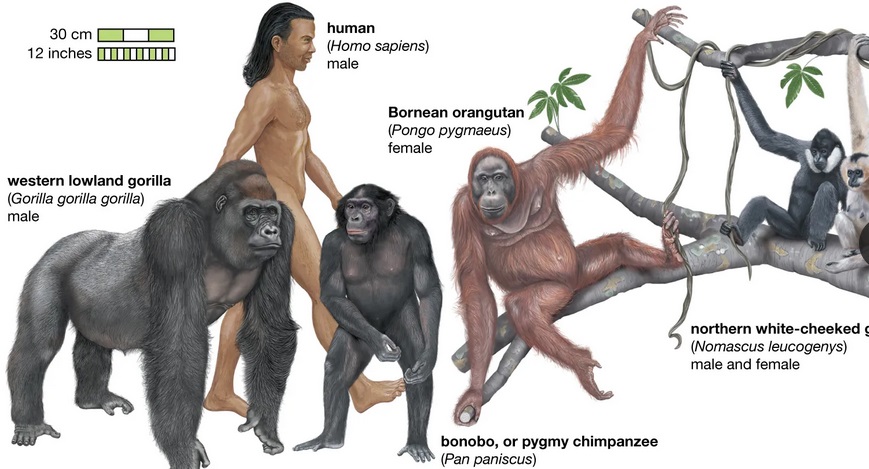
Dr. Naik’s rejection of evolution is most visceral when discussing human origins. He repeatedly asserts, “Humans did not come from monkeys”.3 This phrasing is significant for several reasons:
- Phylogenetic Strawman: Evolutionary biology posits that humans and modern apes (chimpanzees, bonobos) share a common ancestor, not that humans descended from modern monkeys. Naik’s rhetoric conflates the two, attacking the idea of direct descent which is easier to ridicule.
- Dignity and Disgust: Naik leverages the emotional revulsion to animal ancestry. He suggests that the theory “insinuates” that humans look like apes.5 By framing evolution as an insult to human dignity, he aligns the rejection of evolution with the preservation of human honor (Karamah).
3.2 The “Missing Link” Argument
A central pillar of Naik’s denial of common ancestry is the concept of the “Missing Link.” He argues that if species evolved from one to another, the fossil record should be teeming with “innumerable transitional forms”.5
- Darwin’s Confession: He frequently quotes Charles Darwin expressing concern over the lack of transitional fossils in his own time, arguing that this “gap” has never been filled.
- The Demand for Chimeras: Naik’s demand for transitional forms often implies a need for “half-fish / half-reptiles”.5 This misunderstanding of mosaic evolution allows him to dismiss the subtle transitional forms that do exist (like Archaeopteryx or Tiktaalik) because they do not fit the cartoonish “half-and-half” expectation.
3.3 The “Four Waves” Hypothesis: Naik’s Paleoanthropology
Perhaps the most unique aspect of Naik’s anti-evolution construct is his specific explanation for hominid fossils. He does not deny the existence of fossils like Australopithecus (Lucy), Neanderthals, or Cro-Magnons. Instead, he integrates them into a “Four Waves” theory.
| Naik’s “Four Waves” Concept | Scientific Consensus |
| Wave 1: Australopithecus (e.g., Lucy). An extinct, separate creation. No link to humans. | An early hominin genus, likely ancestral to Homo. |
| Wave 2: Neanderthals. A separate, extinct species. No link to modern humans. | A sister species to Homo sapiens, with proven interbreeding (genetic admixture). |
| Wave 3: Cro-Magnons. Another distinct group. No link to previous waves. | Early European Modern Humans (Homo sapiens); anatomically identical to us. |
| Wave 4: Modern Humans (Adam). Created independently. No connection to waves 1-3. | Homo sapiens, evolved from ancestral hominins in Africa. |
Analysis of the “Four Waves”:
- Source: In his lecture 6, Naik states: “The first wave was ‘Lucy’… Lucy was first wave, which name three and a half million years… I will tell you about all the four waves.”
- The Logic of Disconnection: Naik asserts that “science has found there is no link between them”.1 By claiming they are disconnected “waves,” he acknowledges the physical evidence (the fossils) but denies the biological relationship. He interprets them as separate experiments or creations of Allah that lived and died before Adam.
- Reconciling Time: This theory solves the timeline problem. Naik notes that fossils are millions of years old, while the Bible suggests Adam is 6,000 years old. He argues the Qur’an has no date for Adam.3 Therefore, Lucy can be 3.5 million years old and simply be a non-human creature that pre-dated Adam. This allows Naik to accept deep time geology while rejecting evolutionary biology.
3.4 Denial of Universal Common Ancestry
Naik’s rejection extends beyond humans. He denies the common ancestry of all life forms. While he accepts that “We made from water every living thing” (Quran 21:30) 3, he interprets this as a statement of chemical composition (cytoplasm is 80% water) rather than evolutionary origin.
- Independent Phyla: He cites figures like Austin Clark or references the “Cambrian Explosion” (implicitly) to argue that major animal groups appeared suddenly and independently.
- Refutation of the “Tree of Life”: He refers to the evolutionary tree as the “blanket tree” theory 10 (likely a transcription error for “branching tree” or “family tree”) and dismisses it as a diagram of assumption, not fact.
4. Forensic Analysis of Citations: Deconstructing the Authority
Dr. Naik’s rhetorical power comes from his ability to cite specific names, dates, and quotes from Western scientists, creating an aura of encyclopedic knowledge. A forensic analysis of these citations reveals a pattern of using out-of-date, misattributed, or decontextualized sources.
4.1 The Case of the “Thomas Thompson” Letter (1861)
One of Naik’s most specific claims is that Charles Darwin admitted to a lack of proof in a letter to “Thomas Thompton” in 1861.
Naik’s Claim:
“He wrote a letter to his friend Thomas Thompton in 1861 – ‘That I believe in this theory of natural selection because …I don’t have any proof… Only because it helps me in Natural Selection, it helps me in Embryology, in classification in Rudimentary Organ’”.6
Forensic Reality:
- The Recipient: There is no record of a “Thomas Thompton” in Darwin’s primary correspondence regarding this specific quote. Darwin did correspond with Thomas Thomson (a botanist) 11, but the quote in question is actually a pastiche of sentiments Darwin expressed to George Bentham (1863) and Asa Gray.
- The Actual Quote: In a letter to George Bentham (May 22, 1863), Darwin wrote: “The belief in natural selection must at present be grounded entirely on general considerations… When we descend to details, we can prove that no one species has changed… nor can we prove that the supposed changes are beneficial, which is the groundwork of the theory.”.12
- Contextual Distortion: Darwin was admitting the difficulty of direct observation of speciation in a human lifetime, not the falsity of the theory. He argued that the consilience of induction (explaining embryology, geology, morphology) was the proof. Naik strips this context to present Darwin as an agnostic about his own work.
4.2 The Pierre-Paul Grassé “Daydream” Quote
Naik frequently cites “P.P. Grasse” to claim evolution is a “daydream” or “fairy tale.”
Naik’s Claim:
“According P.P. Grasse, he says it is letting a man’s imagination run too wide just based on few wastages that we are assuming that we have been evolved from apes”.1
Forensic Reality:
- The Source: Pierre-Paul Grassé (1895–1985) was a distinguished French zoologist and President of the French Academy of Sciences. He was an evolutionist but a fierce critic of Darwinian Natural Selection (chance mutation), favoring Neo-Lamarckian mechanisms.
- The “Fairy Tale” Misattribution: The phrase “Evolution is a fairy tale for adults” is widely circulated in creationist literature but is often a misattribution or a mistranslation of Jean Rostand or a distortion of Grassé’s critique of chance.13
- The Function: Naik uses Grassé’s prestige to validate the idea that “top scientists” reject evolution. He omits that Grassé firmly believed in common ancestry and evolution, differing only on the mechanism driving it.
4.3 Sir Arthur Keith and “Unthinkable” Creation
Naik (and his predecessor Deedat) often cite Sir Arthur Keith as saying: “Evolution is unproved and unprovable. We believe it only because the only alternative is special creation, and that is unthinkable.”.14
Forensic Reality:
- Origin: This quote is a creationist “zombie quote.” It is often attributed to Keith’s introduction to the 1959 edition of Origin of Species, but Keith died in 1955. It likely originates from a misquotation in a 1940s creationist tract or a distortion of D.M.S. Watson.
- Significance: Naik uses this to argue that scientists are biased atheists who only accept evolution to avoid God, not because of evidence.
4.4 The “Four Waves” Source
Naik’s “Four Waves” theory likely derives from a misreading or simplification of mid-20th-century paleoanthropology textbooks that listed Australopithecines, Homo erectus (Java Man), Neanderthals, and Cro-Magnons as distinct stages. His specific phrasing “Four Waves” does not align with modern cladistics but mirrors language found in older encyclopedias or creationist reinterpretations of the fossil record like those of Harun Yahya, from whom Naik draws significant inspiration.15
5. Theological Synthesis: The “Quran and Science” Concordat
Dr. Naik’s rejection of evolution is not merely destructive; it is part of a constructive theological project. He seeks to replace the “Evolutionary Myth” with the “Scientific Miracle” of the Qur’an.
5.1 The Water, The Clay, and The Clot
Naik contrasts the “theory” of evolution with the “facts” of Quranic creation.
- Water (21:30): He cites the verse “We made from water every living thing.” He aligns this with the biological fact that cytoplasm is ~80% water.3 This serves as his “bridge” to science—showing that the Qur’an knows biology.
- Creation of Man: He synthesizes various verses describing man’s creation from “dust” (Turab), “clay” (Tin), and a “clot” (Alaqah). For Naik, these are literal stages of a miraculous manufacturing process, not metaphors for evolutionary stages.
- The Embryological Defense: He heavily relies on the work of Keith Moore, a Canadian embryologist who, in the 1980s, collaborated with the Saudi government to validate Quranic embryology.16 Naik uses Moore’s endorsement to argue: If the Qur’an is perfectly accurate about the embryo (which we can see), it must be accurate about the origin of man (which we cannot see).
5.2 The Timeline Argument: Quran vs. Bible
A critical component of Naik’s apologetic is distinguishing Islam from Christianity. He uses evolution to attack the Bible while shielding the Qur’an.
- The Biblical Flaw: Naik argues that the Bible (through genealogies) dates Adam to ~6,000 years ago. He accepts the scientific evidence that hominids and humans are much older (millions of years). Therefore, the Bible is scientifically false.3
- The Quranic Safety Valve: He emphasizes that the Qur’an does not give a date for Adam. “The Quran doesn’t give a specific date”.3
- The Implication: This allows Naik to accept the deep geologic time of the fossil record (the “Four Waves”) without contradiction. He posits that Adam could have been created at any point in deep time, or that the fossils are pre-Adamic. This flexibility is a key selling point in his Da’wah to rationalist audiences.
5.3 Adamic Exceptionalism
Ultimately, Naik’s view settles on Adamic Exceptionalism. He asserts that Adam was a unique creation, inserted into the world by Allah. Even if evolution explains plants or animals (which he is ambiguous about), it stops at the human. This view aligns with the majority of traditional Sunni orthodoxy, which views the descent of Adam from non-human parents as a violation of the text.
6. Comparative Landscape: Naik in the Spectrum of Islamic Thought
To understand the specificity of Naik’s views, it is necessary to compare him with other voices in the contemporary Islamic discussion on evolution.
| Scholar/Apologist | View on Evolution | Approach to “Science” | Relation to Naik |
| Dr. Zakir Naik | Rejectionist. Accepts micro-evolution, rejects macro-evolution and human ancestry. “Theory vs. Fact.” | Concordist. Science proves the Qur’an, but Evolution is “bad science.” | The primary subject. |
| Dr. Yasir Qadhi | Theological Stop. Accepts scientific consensus on evolution generally but posits a miracle for Adam (Kharq al-‘adah). | Scripturalist. Prioritizes theology over science; admits science supports evolution but Scripture blocks it for humans. | Less combative against the science itself; focuses on the theological exception.9 |
| Harun Yahya (Adnan Oktar) | Total Denial. Rejects all evolution. Heavily relies on “Living Fossils” and Intelligent Design arguments. | Pseudoscience. Flooded the market with glossy anti-evolution books in the 2000s. | Major influence on Naik’s arguments (e.g., usage of Grassé, “Missing Link” rhetoric).15 |
| Shoaib Malik | Academic Analysis. Classifies views; argues “Adamic Exceptionalism” is a valid theological stance but critiques Naik’s scientific understanding. | Philosophical. Critiques the “Theory vs. Fact” error in Naik’s epistemology. | Critical of Naik’s methodology.17 |
6.1 The “Harun Yahya” Connection
Research suggests a strong intellectual lineage between the Turkish creationist Harun Yahya and Zakir Naik. The specific quotes (Grassé, Keith), the focus on the Cambrian Explosion, and the visual style of “smashing” Darwinism are hallmarks of Yahya’s material, which saturated the Muslim world in the late 1990s. Naik effectively translated these arguments into English and broadcast them via Peace TV, stripping away some of Yahya’s more esoteric Mahdist claims but keeping the core anti-evolution content.
6.2 Critique from Muslim Academia
Scholars like Dr. Shoaib Malik critique Naik for his lack of nuance. They argue that Naik employs a “God of the Gaps” fallacy and confuses the philosophy of science. By staking the Qur’an’s truth on the rejection of evolution, Naik risks a crisis of faith for young Muslims if they become convinced by the biological evidence. Malik notes that Naik’s “Theory vs. Fact” argument is philosophically untenable, as gravity and relativity are also “theories”.7
7. Sociological Dimensions: The “Medical Doctor” Authority
7.1 The Appeal of the “Dr.” Title
Zakir Naik invariably introduces himself or is introduced as “Dr. Zakir Naik, Medical Doctor.” This title is crucial to his authority. It signals to his audience that he is a man of science, not just a theologian.
- The Insider Critique: When Naik attacks evolution, he does so as a “scientist” critiquing his own field. He often says, “I am a medical doctor… I know about Darwin’s theory”.6 This ethos effectively disarms lay audiences, who assume his medical training grants him authority in evolutionary biology (despite the fields being distinct).
7.2 The Public Debates and Q&A
Naik’s evolution views are primarily disseminated through Q&A sessions, often with “skeptics” or “atheists.”
- The Setup: In videos like 18 or 19, Naik is seen engaging with questioners. He uses a rapid-fire delivery, overwhelming the questioner with citations (verses, book names, scientific quotes).
- The Victory Lap: The structure of these events is designed to show the “defeat” of the evolutionary worldview. When a questioner converts or is silenced, it serves as social proof for the audience that Evolution cannot stand up to Islamic Truth.
- Impact on Education: Reports suggest that Naik’s rhetoric has influenced Muslim students in the UK and South Asia, leading to resistance against teaching evolution in biology classes. By framing evolution as “just a hypothesis” and “anti-God,” he provides a religious mandate for scientific disengagement on this topic.20
8. Conclusion: The “Scientific” Rejection of Science
Dr. Zakir Naik’s views on evolution are a complex amalgam of theological necessity and pseudo-scientific rationalization. His rejection of common ancestry is absolute, driven by the Quranic narrative of Adam. However, unlike traditional creationists who might reject science wholesale, Naik attempts to co-opt the authority of science to destroy one of its central pillars.
His arguments rely on:
- Semantic Redefinition: Downgrading “Theory” to “Guess.”
- Paleoanthropological Segmentation: The “Four Waves” theory that disconnects fossils from humanity.
- Authority Pastiche: Using out-of-context quotes from Western scientists to fabricate a lack of consensus.
- Biblical Contrast: Using the Deep Time of the fossil record to validate the Qur’an over the Bible, while simultaneously rejecting the biological implications of that record.
Naik represents a modern form of Islamic Creationism that is eager to embrace technology and physics but draws an iron curtain around biology. For Naik, the human being must remain a creature of the “Best Stature” (Ahsan-i-Taqwim), biologically distinct from the animal kingdom, a position he defends not with mysticism, but with a “medical doctor’s” prescription of citations, statistics, and certainty.
Thematic Epilogue: The Boundaries of Identity and Origin
The discourse of Dr. Zakir Naik regarding evolution transcends a mere debate about bones and genes; it is a profound assertion of identity in a post-colonial, scientifically dominated world. By adopting the posture of the skeptic—the one who demands “proof” and exposes the “myths” of the West—Naik reverses the traditional power dynamic between Religion and Science.
In his narrative, it is the Evolutionist who is the blind believer, following a “fairy tale” (Grassé’s daydream), and it is the Muslim who is the empiricist, demanding “facts.” This inversion is the source of his immense popularity. He offers his audience a way to be modern without being Western, and to be scientific without being secular.
However, this fortress is built on a specific, fragile historiography of science—one where Darwin doubts his own theory and where “Lucy” is just an extinct ape with no connection to us. As the genetic and fossil evidence for common ancestry becomes more high-resolution, the gap that Naik’s “Four Waves” theory occupies shrinks. Yet, the theological imperative remains: to preserve the sanctity of the Adamic moment, the instant where the divine breath turned clay into Man, separating the believer from the beast. In the world of Zakir Naik, that separation is not just a theological truth; it is a biological “fact,” defended with the fervor of a final siege.
If you would rather read in Microsoft Word file:



 The Glorious Quran and Science
Leave a comment