
Presented by Zia H Shah MD from Pew Research Center
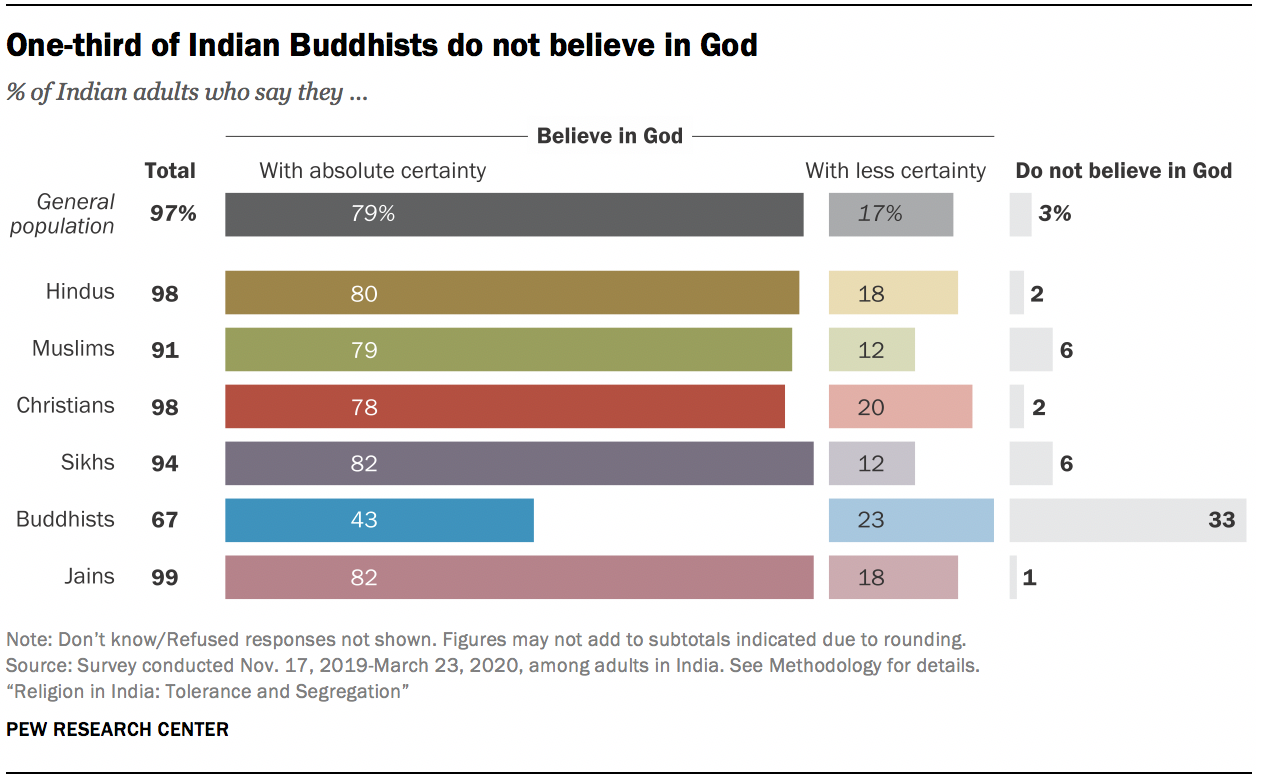
Nearly all Indians say they believe in God (97%), and roughly 80% of people in most religious groups say they are absolutely certain that God exists. The main exception is Buddhists, one-third of whom say they do not believe in God. Still, among Buddhists who do think there is a God, most say they are absolutely certain in this belief.
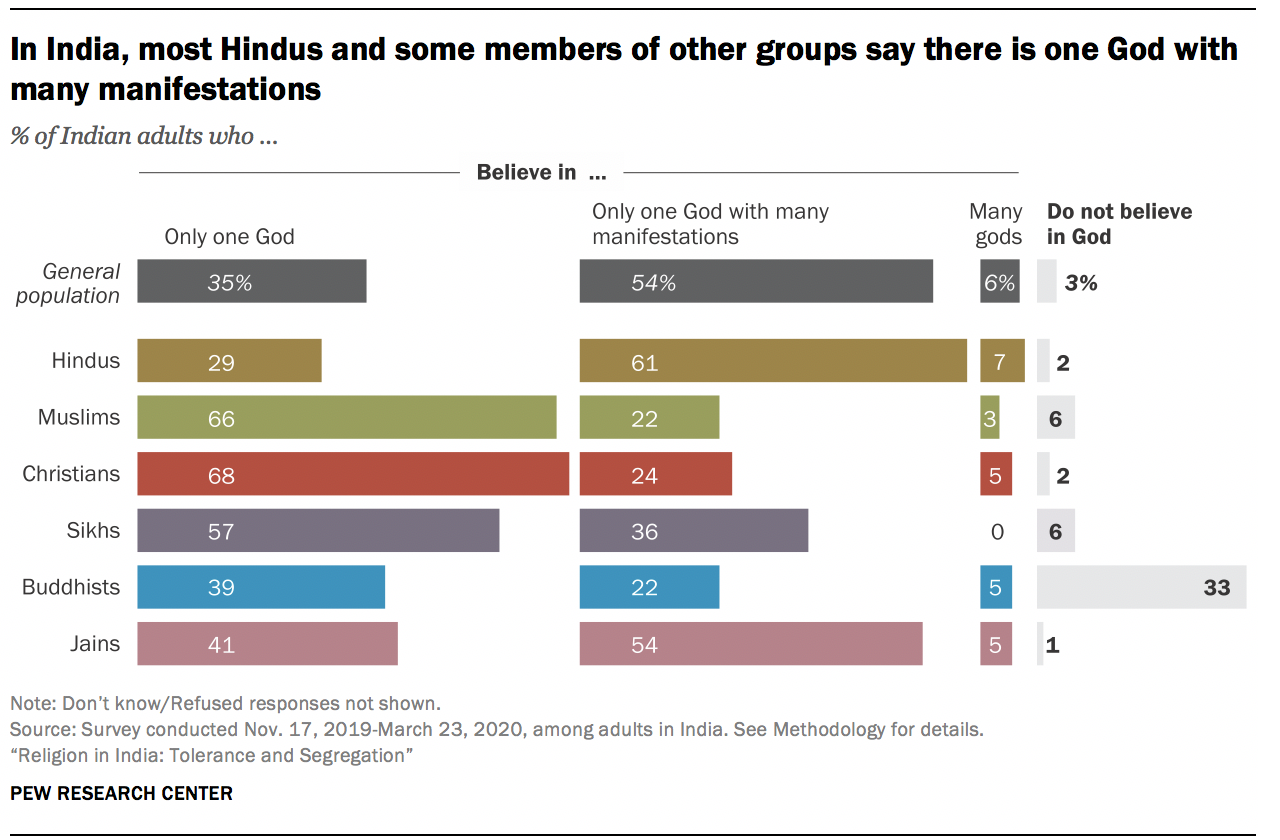
While belief in God is close to universal in India, the survey finds a wide range of views about the type of deity or deities that Indians believe in. The prevailing view is that there is one God “with many manifestations” (54%). But about one-third of the public says simply: “There is only one God” (35%). Far fewer say there are many gods (6%).
Even though Hinduism is sometimes referred to as a polytheistic religion, very few Hindus (7%) take the position that there are multiple gods. Instead, the most common position among Hindus (as well as among Jains) is that there is “only one God with many manifestations” (61% among Hindus and 54% among Jains).
Among Hindus, those who say religion is very important in their lives are more likely than other Hindus to believe in one God with many manifestations (63% vs. 50%) and less likely to say there are many gods (6% vs. 12%).
By contrast, majorities of Muslims, Christians and Sikhs say there is only one God. And among Buddhists, the most common response is also a belief in one God. Among all these groups, however, about one-in-five or more say God has many manifestations, a position closer to their Hindu compatriots’ concept of God.
Most Hindus feel close to multiple gods, but Shiva, Hanuman and Ganesha are most popular
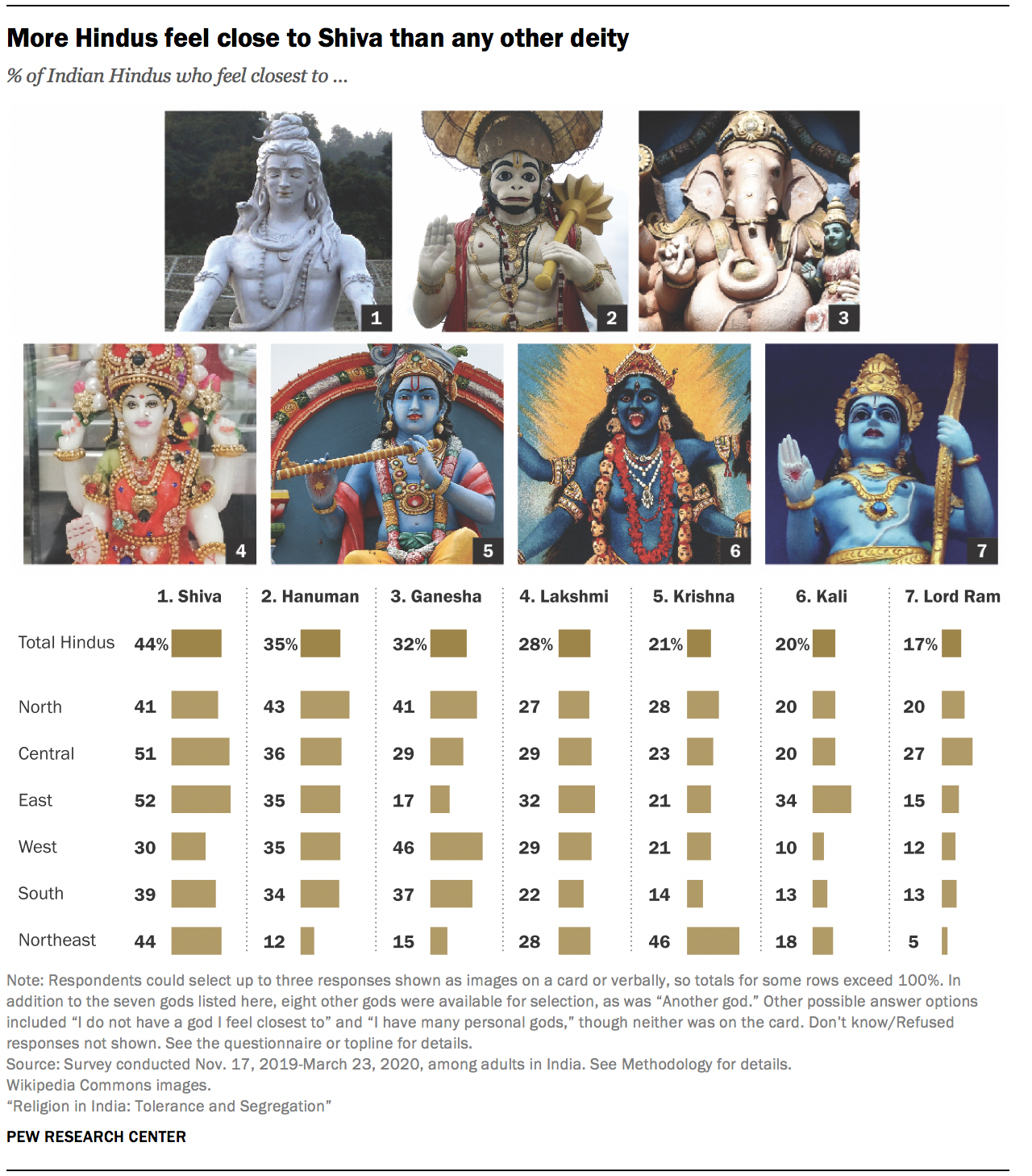
Traditionally, many Hindus have a “personal god,” or ishta devata: A particular god or goddess with whom they feel a personal connection. The survey asked all Indian Hindus who say they believe in God which god they feel closest to – showing them 15 images of gods on a card as possible options – and the vast majority of Hindus selected more than one god or indicated that they have many personal gods (84%).7 This is true not only among Hindus who say they believe in many gods (90%) or in one God with many manifestations (87%), but also among those who say there is only one God (82%).
The god that Hindus most commonly feel close to is Shiva (44%). In addition, about one-third of Hindus feel close to Hanuman or Ganesha (35% and 32%, respectively).
There is great regional variation in how close India’s Hindus feel to some gods. For example, 46% of Hindus in India’s West feel close to Ganesha, but only 15% feel this way in the Northeast. And 46% of Hindus in the Northeast feel close to Krishna, while just 14% in the South say the same.
Feelings of closeness for Lord Ram are especially strong in the Central region (27%), which includes what Hindus claim is his ancient birthplace, Ayodhya. The location in Ayodhya where many Hindus believe Ram was born has been a source of controversy: Hindu mobs demolished a mosque on the site in 1992, claiming that a Hindu temple originally existed there. In 2019, the Indian Supreme Court ruled that the demolished mosque had been built on top of a preexisting non-Islamic structure and that the land should be given to Hindus to build a temple, with another location in the area given to the Muslim community to build a new mosque. (For additional findings on belief in God, see Chapter 12.)



 The Glorious Quran and Science
Leave a comment