
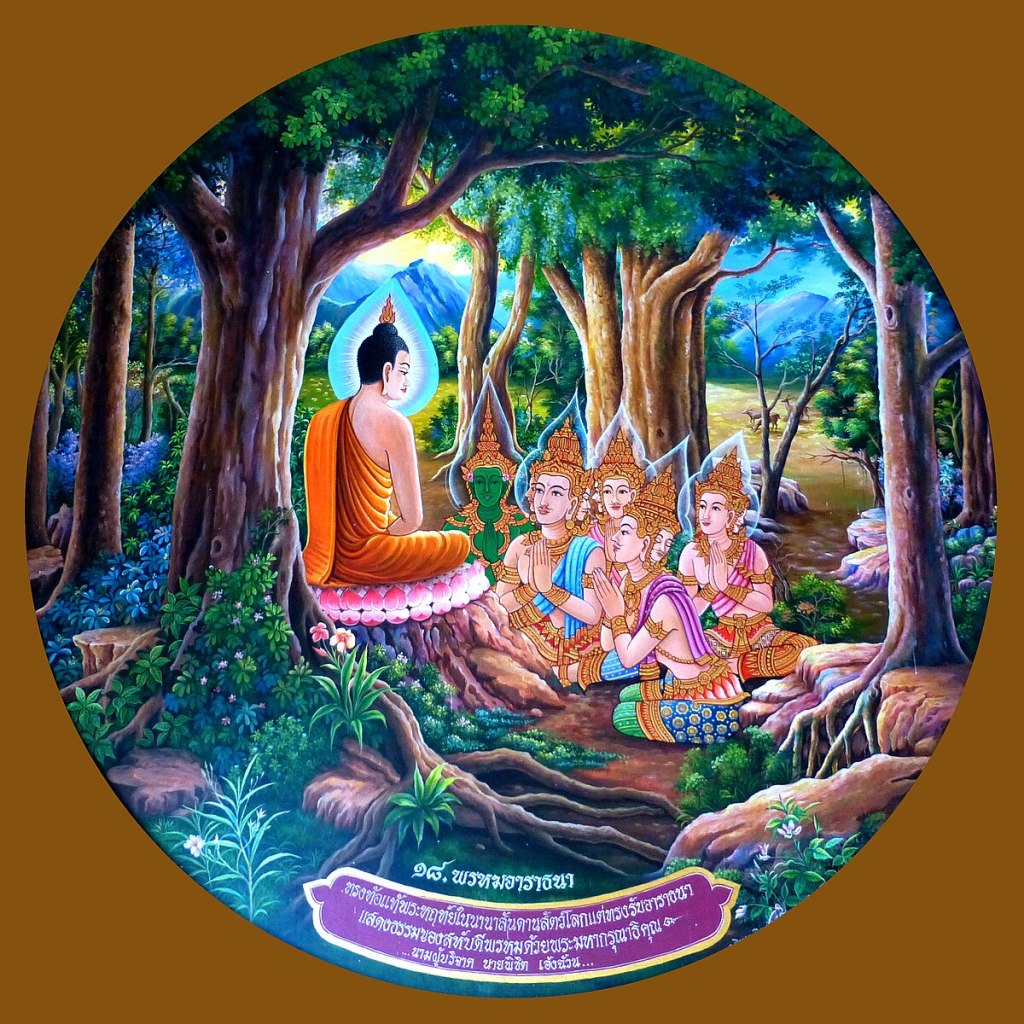
Brahma Sahampati requests the Buddha to Teach despite his Reluctance
Presented by Zia H Shah MD
Abstract
Buddhism is often described as a non-theistic tradition, lacking a creator God, whereas Islam is founded on uncompromising monotheism (Tawḥīd). This report examines how Buddhist traditions (Theravāda, Mahāyāna, Vajrayāna) understand or reject theism and how those views compare with Islamic theology. It outlines Buddhist scripture references to gods and ultimate reality, the evolving status of the Buddha from enlightened teacher to an almost divine figure in some sects, and cultural adaptations that introduced quasi-theistic elements into Buddhist practice. Quotations from Buddhist leaders illustrate attitudes toward divinity and truth, while an Islamic perspective reflects on the absence of a personal Creator in Buddhism. Despite fundamental theological differences – one path centered on a single, personal Creator God, the other on an impersonal law of Dharma – both religions share ethical concerns and profound spiritual goals. The concluding epilogue reflects on whether Buddhism’s lack of a theistic God undermines or complements its moral and metaphysical vision, suggesting that understanding these differences is key to deeper interfaith respect.
Gods and Ultimate Reality in Buddhist Scriptures
From the earliest scriptures, Buddhism recognizes the existence of multiple gods (devas) in various heavens, yet it pointedly denies any supreme Creator among themen.wikipedia.orgen.wikipedia.org. The Theravāda Pāli Canon records numerous interactions between the Buddha and these celestial beings: for example, the deity Brahmā Sahampati respectfully implored the Buddha to share his teaching with the world (as depicted above)en.wikipedia.org. However, such devas are neither omnipotent nor eternal; they live long but eventually die, caught in saṁsāra (the cycle of rebirth) just like humansen.wikipedia.org. Buddhist ontology, grounded in dependent origination, leaves no room for a first cause or unmoved creator – all phenomena arise from preceding conditionsen.wikipedia.org. Accordingly, the Buddha taught that the universe has no discernible beginning in time, and thus no need for a creator-god to start iten.wikipedia.org. As Peter Harvey remarks, Buddhism assumes an infinite past and rejects the notion of any “world‐creator” deityen.wikipedia.org.
In fact, early Buddhist suttas openly critique the creator idea. In the Tevijja Sutta (Dīgha Nikāya 13), the Buddha debates brahmin priests who seek union with Brahmā (conceived as the highest God). He exposes that none of them have ever seen Brahmā or know the path to him; their claims are “vain and empty”, a product of speculation rather than experienceen.wikipedia.orgen.wikipedia.org. The Buddha remains less interested in outright atheism than in practical truth: he dismisses metaphysical creator speculation as irrelevant to ending sufferingen.wikipedia.org. In another dialogue, he warns that believing all events are “the creation of a supreme deity” (Issara) leads to moral fatalism – people might blame God for their sins and stop making effort to do gooden.wikipedia.orgen.wikipedia.org. Thus the Buddha criticized the doctrine of a Creator God as dangerous determinism, saying it would encourage laziness and immoralityen.wikipedia.org. With characteristic pragmatism, he even quips that if a God did create all our pain and pleasure, then that God must be cruel, given the random suffering we seeen.wikipedia.org. Such passages underscore that classical Buddhism finds the creator concept both unhelpful and ethically problematic.
Instead of a creator, Buddhist scripture presents an impersonal ultimate reality. The Theravāda tradition holds up Nirvāṇa – the “Unborn, Unconditioned” state beyond all causes – as the highest truth, but Nirvāṇa is a state or dharma rather than a deity. The Mahāyāna tradition articulates concepts like Śūnyatā (emptiness of intrinsic existence) and Dharmakāya (the universal “Truth body” of Buddhahood) as ultimate reality, again without personifying them as a creator. Mahāyāna sūtras introduce a vast pantheon of enlightened beings: innumerable Buddhas and bodhisattvas residing in various pure lands or Buddha-fields. Some of these celestial Buddhas possess extraordinary qualities and lifespans that invite comparison to divinity. For instance, Amitābha Buddha (revered in Pure Land Buddhism) is described as the Buddha of “Infinite Light” and “Infinite Life,” who presides over a Western Paradise and saves devotees who call upon him. Indeed, Mahayana texts portray fully awakened Buddhas as omniscient, compassionate savior figures with eternal presence, yet crucially they are not creators of souls or worldsen.wikipedia.orgen.wikipedia.org. Even the primordial Buddha concept in some Vajrayāna texts (known as Ādi-Buddha, e.g. Adi-Buddha Samantabhadra or Vajradhara) serves as a symbolic first enlightenment principle rather than a creator God. In short, no Buddhist scripture attributes the origin or governance of the universe to a singular divine will. Buddhism’s cosmology is pluralistic (with many gods and heavens) and “trans-polytheistic” – focused beyond the godsen.wikipedia.org – with impersonal law (Dharma), not a god, ensuring moral orderhts.org.za.
Notably, Buddhist lore even offers an origin story for belief in a Creator. According to the Pāli Canon, after one cosmic eon ends, beings are reborn in a high heaven. One mighty deva (Mahā Brahmā) appears alone in the void and, not recalling his previous lives, assumes himself to be the All-creator. When other beings later arise in his realm, he believes he made them, and some of those who are later reborn on earth remember this and preach that “Mahā Brahmā is the Creator, the Almighty”en.wikipedia.org. Thus, from the Buddhist perspective, belief in a Creator God is a misunderstanding – a false conceit of a powerful but ignorant deity, a story even reinforced by Māra (the cosmic tempter) to mislead humansen.wikipedia.org. In sum, Buddhist scriptures acknowledge gods and even recount dialogues with deities, but consistently reject any eternal, omnipotent One God. Ultimate reality is seen as a truth to be realized (nirvāṇa or Buddha-nature), not a Creator to be worshipped. This core non-theism sets Buddhism apart from faiths like Islam, which center religious life on devotion to one supreme Creator.
The Buddha’s Status: Human Teacher or Divine Being?
A central question in comparing Buddhism with monotheism is how the Buddha himself is regarded. Gautama Buddha never claimed divinity; he presented himself as a human who attained perfect enlightenment through effort and insight. In early texts the Buddha is a teacher (satthā) and guide: extraordinary in wisdom and compassion, yet still human. He explicitly denied being a god or an incarnation of a god. However, he was accorded profound respect—called Bhagavān (Lord) and “teacher of gods and humans.” Over centuries, this reverence evolved into what some see as a substitute for theism: the Buddha was exalted to an almost divine status by his followers, especially in later traditionsnewageislam.com.
Theravāda Buddhism (the tradition closest to early Buddhism) emphasizes the Buddha’s humanity. Devotees honor him with offerings and chant his virtues, but do not pray to him for salvation in the way a theist prays to God. The Buddha is venerated as a supremely awakened man who pointed the way, not a savior granting grace. Yet even here, an emotional devotional element exists: people bow to Buddha images and relics, seeking blessings or inspiration. Some scholars describe this as a kind of “Buddhist theism” in practice – the Buddha functions as an object of worship if not a creator deity. This tendency became far more pronounced in Mahāyāna Buddhism. Mahāyāna sutras portray Shakyamuni Buddha in grandiose, transcendent terms. In the Lotus Sūtra, for example, the Buddha declares that his enlightenment actually occurred countless eons ago, and his appearance in India was just a skillful displayen.wikipedia.org. Here the Buddha is effectively eternal and omnipresent, caring for beings lifetime after lifetime – a concept reminiscent of eternal divine presence. The Mahāyāna Mahāparinirvāṇa Sūtra even states that the Buddha is “eternal” and one with the Dharmakāya (Universal Truth)en.wikipedia.org. Such texts blur the line between enlightened human and cosmic principle, equating the Buddha in his ultimate aspect to an eternal truth pervading the universe.
As Buddhism spread across Asia, the deification of the Buddha accelerated. Mahāyāna sects developed a doctrine of Trikāya (“Three Bodies” of Buddha): (1) the Nirmāṇakāya, the earthly human form of Gautama; (2) the Saṃbhogakāya, a celestial glorified form residing in pure lands; and (3) the Dharmakāya, the formless truth body, limitless and all-pervasive. The Dharmakāya concept paints the ultimate Buddha as an abstract, impersonal reality – something that could be analogized to God as the truth of the universe, though without personhood or creator status. In Pure Land Buddhism, the Buddha Amitābha is worshipped as a savior figure who has vowed to bring believers into his paradise. Devotees call his name in prayer (Nembutsu), very much as a theist would call on God’s name. One branch of Pure Land (Jōdo Shinshū) even teaches that Amida is the eternal Buddha and “personification of Nirvana itself,” who manifested on earth as Shakyamunien.wikipedia.org. Similarly, esoteric Vajrayāna schools like Shingon regard Mahāvairocana (the “Great Sun” Buddha) as the cosmic Buddha embodying the Dharmakāya – essentially the cosmic principle of enlightenment personifieden.wikipedia.org. These developments show a clear trend of “divinization” of the Buddha in many Buddhist traditions, functionally comparable to deifying a prophet or saint.
From an external perspective, such as the Islamic, this evolution can look like Buddhism filled the vacuum of God with the Buddha himself. Muslim scholar Maulana Abul Kalam Azad observed that when the Buddha left the question of God open, “his followers soon filled the vacant seat of divinity. When they found no God to worship, they placed Gautama Buddha himself upon that throne.”newageislam.com. Initially, not all Buddhists agreed – there was a split: Hinayāna (conservative schools, including Theravāda) maintained the Buddha’s humanity, whereas Mahāyāna “raised him to a superhuman and divine level”. Over time the Mahāyāna view dominated much of Asia, with lavish temples, colossal Buddha statues and devotional cults testifying to worship-like adoration. It reached a point where, as Azad described, “half of the world became filled with [the Buddha’s] images and idols.”newageislam.com
It is crucial to note, however, that even in deifying the Buddha, Buddhists did not ascribe to him the role of a creator or ruler of the cosmos. The Buddha’s exalted status is as an ultimate teacher and savior (showing the path to liberation), not a lord who commands the universe. For example, he is said to possess boundless compassion and omniscience, but not omnipotence over others’ karma. He cannot forgive sins or alter the law of cause and effect. In a sense, Buddha occupies a role analogous to a redeemer (like prophets or even Christ in Christianity) but without the metaphysical attributes of an almighty God. This fine line has sometimes confused outside observers: Is Buddhism atheistic if Buddha is effectively worshipped? The answer from within is that such veneration (pūjā) is ultimately directed toward the ideal of enlightenment that Buddha represents, not to a creator-being. As one modern Buddhist monk, Walpola Rahula, put it sharply: humans have psychological reasons for imagining God, but the Buddha’s approach was to solve human suffering directly. “For self-protection man has created God, on whom he depends… just as a child depends on its parent. For self-preservation man has conceived the idea of an immortal Soul… In his ignorance, weakness, fear, and desire, man needs these two things to console himself.”laotzu.xyz. The Buddha replaced dependence on a divine savior with self-reliance on the Dharma, encouraging followers to take refuge in the Buddha, Dharma, and Sangha (the Three Jewels) rather than in any Creator. Nevertheless, from an Islamic viewpoint, many practices in Buddhism – bowing before Buddha images, offering prayers or chants in hope of blessings – appear functionally similar to idol-worship or saint-worship, blurring the distinction between a non-theistic philosophy and a religion of devotion.
Devotion and Theistic Elements in Buddhist Cultures
While Buddhism’s philosophy is non-theistic, popular Buddhism often accommodates a rich tapestry of gods, spirits, and devotional rituals. As the religion spread, it assimilated local deities and beliefs, sometimes in surprisingly theistic or monotheistic-like ways. Historical and cultural adaptations allowed Buddhism to thrive in diverse contexts – from the polytheistic milieu of ancient India, through the folk religions of East Asia, to modern nations with laws favoring monotheism. These adaptations reveal Buddhism’s flexibility but also create intriguing parallels with theistic faiths.
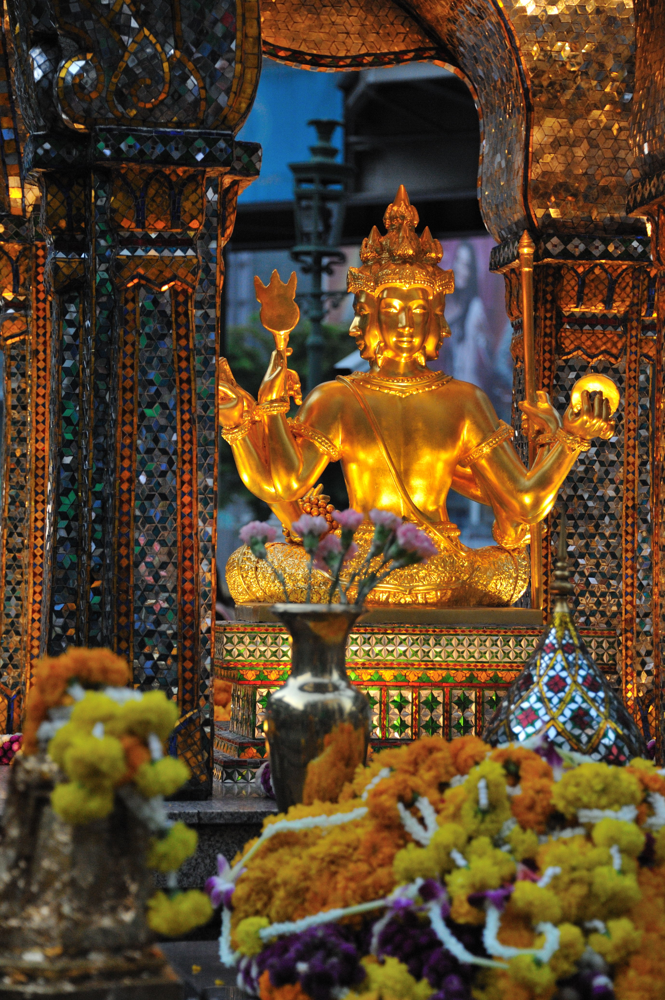
One example is the incorporation of Hindu and folk deities into Buddhist practice. In countries like Thailand and Cambodia (Theravāda strongholds), villagers regularly make offerings not just to Buddha images but also to local spirits (phi) and Hindu gods adopted into Buddhism. Brahmā, whom the Buddha himself refuted as Creator, is ironically revered in popular Thai Buddhism. The famous Erawan Shrine in Bangkok enshrines a four-faced Brahmā statue (Phra Phrom) that attracts throngs of Buddhist devotees seeking his aid in worldly matters.
Likewise, in Tibet and Mongolia, Vajrayāna Buddhism absorbed the indigenous pantheon of spirits and gods, converting them into Dharma protectors or manifestations of Buddhas. Fierce mountain gods became wrathful Bodhisattvas; local goddesses were identified with Tārā (a savior bodhisattva). The result is a colorful polytheism under the umbrella of Buddhist cosmology. To devout laypeople, the distinction between honoring a bodhisattva and worshipping a god can be blurry – both are entreated for blessings, much as a Hindu or folk religionist would entreat a deity.
Another quasi-theistic feature is the cult of Bodhisattvas and Buddhas who respond to prayers. In East Asia, millions pray to Guanyin (Avalokiteśvara) – the Bodhisattva of Compassion – for mercy and miracles, as if she were an all-hearing divine mother (akin in some ways to Mary in Christian devotion). Temples to Guanyin, or to Maitreya (the future Buddha), dot the landscape, functioning much like shrines to gods. In Japanese Pure Land Buddhism, faith in Amida Buddha is so central that some scholars compare it to monotheistic devotion: Amida’s heavenly vow assures salvation to the faithful much as God’s grace assures salvation in Christianityen.wikipedia.org. Amitābha is sometimes called the “Lord of the Western Paradise,” and art often depicts him enthroned in glory receiving souls of the departed – a scene resonant of a heavenly judgment or welcome by a savior.
Perhaps the most striking adaptation is modern Indonesian Buddhism’s embrace of an explicit “God-concept.” Indonesia’s state ideology (Pancasila) requires belief in One Supreme God (Ketuhanan Yang Maha Esa) for any recognized religion. In the 20th century, Buddhist monk Ashin Jinarakkhita ingeniously argued that Buddhism does have a concept of an ultimate One: he introduced Sanghyang Ādi Buddha as the term for the supreme divine principle in Buddhismmandalas.life. Sanghyang Ādi Buddha (literally “Primordial Buddha” or “Primordial Enlightenment”) is presented as an equivalent to God so that Buddhism would be officially acceptable. This concept, while not part of classical Theravāda doctrine, drew on the Mahāyāna/Vajrayāna idea of Ādi-Buddha (found in some late scriptures of Java and Nepal) – effectively a single primordial Buddha from whom all Buddhas emanate. Indonesian Buddhists describe Ādi Buddha as “the Almighty Oneness” behind the universe, thus ticking the monotheism box, even though in practice they still meditate and take refuge in the Buddha’s teachings rather than worship a creatormandalas.life. This adaptation shows Buddhism’s pragmatism: the Dharma was framed as the will of a Supreme Being to satisfy legal definitions, even as the core teaching remained one of self-realization and impersonal law. (Not all Buddhist sects in Indonesia agreed – Theravādins were wary of calling any Buddha “God” – but the concept stands as an officially sanctioned interpretation.)
Historically, Buddhist civilizations have even at times flirted with near-monotheistic rhetoric. For instance, some medieval texts extol Vairocana Buddha as an omnipresent reality, language that can sound like a description of God as immanent in all thingsen.wikipedia.org. And in certain tantric traditions, practitioners focus devotion on a single chosen deity (often a Buddha or bodhisattva form) as the embodiment of ultimate truth, analogous in feel to worshipping a personal god – with the crucial understanding that this “deity” is a manifestation of one’s own enlightened mind.
In summary, while doctrinal Buddhism has no creator and is technically non-theistic, Buddhist culture is rich with god-like figures and devotional practices. The masses found accessible objects of faith – be it the Buddha, a bodhisattva, or even adopted gods – to pray to for solace and aid, much as adherents of theistic religions do. From an Islamic perspective, these developments make Buddhism resemble idolatry or polytheism, despite its philosophical core. Classical Muslim observers noted Buddha images and rituals and classified Buddhists as idolaters (mushrikūn) rather than “People of the Book.” Indeed, Muslim rulers in India and Central Asia often saw Buddhist statue worship as a blatant violation of Tawḥīd, leading to some iconoclastic events (famously, the Buddhas of Bamiyan were destroyed by the Taliban in 2001 for this reason). The difference, of course, is that Buddhists do not consider their images to be God or independent divine powers – they are reminders of enlightened qualities or placeholders for deep principles. Nonetheless, the functional similarity of praying to Buddha or bodhisattvas and praying to saints or lesser deities has frequently been noted. As one Indonesian Muslim writer dryly commented, “If [Buddhism] is a religion, it should consist of faith in a supreme power… Buddha himself can neither be considered a Prophet nor a founder of any religion [in the Islamic sense]. He received no revelation. After his death, [his followers] felt a loophole – no concept of divinity – and eventually they positioned Buddha equal to God, contrary to [his] original teachings.”hts.org.zahts.org.za. This critique highlights how, from the outside, Buddhist practice can appear to fill the role of God with other figures, even as Buddhist doctrine maintains silence on God.
Buddhism Through the Islamic Lens of Tawḥīd
From the standpoint of Islamic theology, Buddhism poses a perplexing case: a major world religion with high ethical teachings and millions of followers, yet without affirming a Creator or Revealer God. Islam, like its Abrahamic counterparts Judaism and Christianity, is staunchly monotheistic – it revolves entirely around faith in one personal God (Allah) who is the Creator, Sustainer, Lawgiver, and Judge of all beings. The Islamic doctrine of Tawḥīd (oneness of God) declares that nothing is worthy of worship except this one God, and associating others with God (shirk) is the gravest sin. Naturally, a religion that not only lacks a Creator figure but also features images and multiple revered beings is challenging to reconcile with an Islamic view of legitimate faith.
Classical Muslim jurists and scholars, upon encountering Buddhism, often classified it as a form of unbelief (kufr) or idolatry. Unlike Christianity or Judaism, Buddhism was not easily seen as having had a genuine prophetic revelation that was merely distorted. (There is no mention of Buddhism or the Buddha in the Qur’an or Hadith.) Historically, most Muslims regarded Buddhists as mushrikīn (those who commit shirk by worshipping others beside God), due to their veneration of idols and lack of monotheistic creedhts.org.za. For example, medieval Muslim writers like Al-Bīrūnī and Al-Shahrastānī, who documented Indian religions, noted that Buddhists venerate statues and do not believe in God – placing them outside the fold of Ahl al-Kitāb (people of scripture) in the Islamic taxonomy. In Islamic law, Buddhists under Muslim rule were often treated similarly to Hindus: they could be granted protection (dhimma) in exchange for jizya tax, but they were not seen as following a valid God-sanctioned religion. The theological gap was clear: “The one God in Islam has no Buddhist equivalent,” as one scholar succinctly statesberkleycenter.georgetown.edu. Monotheism is absolutely central to Islam, whereas Buddhism deems the question of God irrelevant to liberationberkleycenter.georgetown.edu.
From an Islamic perspective, Buddhism’s non-theism can be seen in two lights. On one hand, many Muslims view it simply as misguidance – humans groping for moral truths but ignoring the Source of all truth. The Qur’an emphasizes that God sent messengers to all nations to proclaim His oneness; in Islamic thought, if a tradition has no concept of a creator God, it signals that the original message was lost or that the people deviated into jāhiliyya (ignorance). Some Muslims have even speculated whether the Buddha might have been an unmentioned prophet whose teachings were later corrupted into an atheistic philosophy. Interestingly, a few modern Islamic scholars and even historical figures have entertained this idea. They point to Qur’anic verses mentioning that God sent prophets to every people, and to Islamic legends of prophets in India. In the 11th–12th centuries, scholars like Al-Shahrastānī wrote of a figure in India named Budhasaf or al-Khidr and compared some of Buddha’s ideas to those of a wise prophet, though without formally recognizing him as suchhts.org.zahts.org.za. These were minor opinions – mainstream Islam does not consider Buddha a prophet, especially given the non-theistic nature of his teaching. (One exception is the Ahmadiyya Muslim sect, which explicitly lists Buddha as a prophet of God, but this is not a majority viewreddit.com.) By and large, the absence of Tawḥīd in Buddhism means it cannot be squared with Islamic theology, which holds that recognizing and worshipping the one God is the first purpose of religion.
On the other hand, some Muslims adopt a more philosophical or tolerant view, seeing Buddhism as more of an ethical philosophy than a religion in the theological sense. They note that the Buddha focused on ethical self-cultivation and freeing people from suffering, not on metaphysics. In this view, Buddhists aren’t denying God so much as ignoring the question. As one Muslim commentator put it, “Non-theism does not connote atheism (denial of God); rather it acknowledges the existence of any Deity but is unconcerned about it.”hts.org.za. The Buddha’s famous parable of the poisoned arrow comes to mind: when a man is shot with a poison arrow, he shouldn’t waste time inquiring who made the arrow or what kind of poison – he should focus on removing the arrow. Buddha likewise steered disciples away from idle cosmological speculation (including the existence of God) to concentrate on the urgent task of ending sufferinghts.org.za. Many Muslims can respect this pragmatic approach while still believing that by leaving out God, Buddhism is incomplete. From Islam’s vantage, there can be no true moral law without the Lawgiver, and no ultimate justice without a Judge. Buddhists, of course, argue that karma fulfills a similar role – an impersonal moral law that ensures just results for good and bad actions. But Islamic theology insists that moral order derives from God’s will and wisdom, not from an automated cosmic law. The idea that the universe runs itself without a sovereign creator is deeply counter to the Qur’anic worldview, where “Allah is the Creator of all things, and He is the Disposer of affairs” (Qur’an 39:62).
Perhaps surprisingly, in modern times there have been efforts at Muslim-Buddhist dialogue highlighting common values. Some Muslims acknowledge that Buddhism’s ethical teachings and spiritual disciplines have much in common with Islamic virtues. For instance, both traditions emphasize compassion, charity, honesty, and purity of mind. Both warn against excessive attachment to material life and stress accountability for one’s actions – if not before God, then in the very fabric of cause and effect. A scholar at the Berkley Center notes: “Both Muslims and Buddhists believe that every action has a consequence, and it behooves followers of each faith to pursue good works.”berkleycenter.georgetown.eduberkleycenter.georgetown.edu. Muslims believe in a Day of Judgment where each soul reaps what it sowed; Buddhists believe in karma and possible rebirth in heavens or hells according to one’s deedsberkleycenter.georgetown.edu. While the frameworks differ (one personal and eschatological, one impersonal and cyclic), the moral impetus to do good and avoid evil is convergent. Additionally, both traditions value interfaith dialogue and understanding – the Dalai Lama has frequently engaged with Muslim leaders, and the Qur’an (5:48) suggests that God allowed diversity of religions as a test so people could “vie with each other in goodness”berkleycenter.georgetown.edu. On this basis, some Muslims argue that Hikmah (wisdom) can be found in Buddhism even if Imān (faith in God) is absent. Such a view maintains that Buddhists can be people of high virtue, whom Muslims are instructed to treat with justice and kindness, even as Muslims ultimately pray that everyone may come to recognize the one God.
In practical terms, Islam’s interaction with Buddhism has been mixed. In some historical periods, there was hostility – for example, the 8th-century Abbasid Caliphate’s expansion wiped out remaining Buddhism in Central Asia, and later Turkic-Muslim conquerors in India destroyed famous Buddhist monasteries like Nālandā, seeing them as infidel strongholds. In other contexts, relative peace prevailed – Buddhist-majority Southeast Asia traded with and hosted Muslim minorities for centuries with little friction. Today, sadly, religious tensions exist (e.g. violence against Rohingya Muslims in Myanmar by extremist Buddhists, or prejudice against Buddhist minorities in some Muslim countries), showing that misunderstandings remainberkleycenter.georgetown.eduberkleycenter.georgetown.edu. Theology plays a role in these tensions: hardliners on each side see the other as infidels or heathens. Yet, there are also heartening examples of dialogue, where monks and imams emphasize shared ethics over differing doctrines. For instance, both communities can agree on the importance of compassion – whether it’s viewed as a divine command (rahma) or the natural outflow of enlightened mind.
From the perspective of strict Islamic doctrine, Buddhism’s challenge is its very goodness without God. Islam teaches that goodness ultimately must be rooted in knowing and serving God; a path that bypasses God entirely is, from this view, missing the highest truth. But it also poses a question: if millions of Buddhists lead ethical, spiritually disciplined lives without belief in Allah, what does this mean? Some Muslims answer that Allāh judges people by their sincerity and deeds, and only He knows the fate of individuals; thus they refrain from condemning Buddhists wholesale. Others reaffirm that however virtuous a Buddhist might be, lacking īmān (faith in God and His prophets) is a grave deficiency concerning salvation. These differences aside, a growing number on both sides seek mutual understanding rather than confrontation, focusing on how Buddhism and Islam each address the human condition in their own ways.
Epilogue: Non-Theism and the Quest for Truth
In the final analysis, does the absence of a theistic God in Buddhism undermine its moral and metaphysical aims, or might it in some ways complement them? The answer may depend on one’s theological vantage point. For devout Muslims (and other monotheists), a spiritual path without God might seem to lack a unifying source of meaning, grace, and ultimate justice. From this perspective, Buddhism’s framework – noble as it is – could be seen as incomplete: Who guarantees the triumph of good or the reality of enlightenment if not a Supreme Being? The Islamic creed would argue that moral laws require a divine Lawgiver, and that human beings, with all their flaws, need the guidance and mercy of a personal God. The Buddhist negation of any creator might thus appear to undermine metaphysical grounding, leaving an elegant but possibly cold system of cause and effect. Without a God, questions arise such as: What is the foundation of compassion or the ultimate point of the universe? Buddhism answers with concepts like interdependence and Nirvana, but these are impersonal; there is no lover-beloved relationship as mystics in theistic faiths celebrate, nor a promise of eternal communion with a Creator.
Yet, from the Buddhist standpoint, the absence of a Creator God is not a deficiency but a deliberate feature of its philosophy. It directs attention to human responsibility and empirical inquiry. There is no outside savior to rely on – “Attā hi attano nātho”, the Buddha said: “Oneself is one’s own lord/helper.” Instead of divine command ethics, morality in Buddhism is seen as naturally arising from understanding suffering and its causes. Remarkably, this has not prevented Buddhists from leading lives of great virtue, compassion, and discipline. In fact, one could argue the absence of a theistic authority fosters a sense of personal accountability: since no God forgives sins or dispenses rewards, each individual must vigilantly tend to the karma they create. Buddhism’s non-theism also avoids certain pitfalls – for example, the Buddha was keen to reject fatalism and excuse-making (“God’s will” as a justification for passivity) in favor of energetic self-improvementen.wikipedia.org. The focus is on transformation of consciousness here and now, which might be complementary to theistic faiths’ focus on obedience to God’s will. It is perhaps telling that some practitioners in the modern world, including ex-Christians and ex-Muslims, have turned to Buddhism’s methods of meditation and ethics not to reject God per se, but to find a practical path to inner peace without doctrinal conflicts. For such individuals, Buddhism’s silence on God can be a neutral space to explore spirituality universally.
From an interfaith understanding perspective, the contrast between Islam’s monotheism and Buddhism’s non-theism offers an opportunity for learning. Each tradition shines a light on a different aspect of the human quest for ultimate truth. Islam, with its passionate monotheism, frames the quest as a relationship with the Divine – surrender (islām) to God’s perfect guidance, which brings about justice, compassion, and spiritual fulfillment. Buddhism, with its methodical non-theism, frames the quest as a purification of the mind – uprooting ignorance and attachment to realize an ultimate freedom (nirvāṇa) that is described as profound peace. Are these aims fundamentally at odds? Perhaps not in practice: a peaceful, just society of enlightened individuals is a goal both would applaud, even if one credits Allah and the other credits the Dharma. The moral and metaphysical aims of Buddhism – ending suffering, cultivating loving-kindness and wisdom, understanding the nature of reality – do not depend on a Creator figure, and in that sense, Buddhism stands on its own as a complete system. Its longevity and the saintliness of many of its adherents attest that a religion can thrive and uplift without invoking God. This is a point that challenges monotheists to appreciate the breadth of the spiritual landscape.
Conversely, for Buddhists, engaging with monotheistic faiths can underscore elements their own tradition underplays. The warm devotional fervor seen in Islam – love of God, gratitude for divine blessings, the sense of a personal relationship with the sacred – these have echoes in some forms of Buddhist devotion (like Pure Land faith or guru devotion in Vajrayāna), but Buddhism by itself can sometimes feel impersonal. Dialogue with Muslims might inspire Buddhists to articulate the compassionate intelligence of the Dharma in more personal terms, or at least to understand why theistic believers yearn for a personal Absolute. As the Dalai Lama famously said, “Whether you believe in God or not does not matter so much; whether you believe in Buddha or not does not matter so much; as a Buddhist, what matters is your behavior. It is very wrong to harm others. It is very important to make others happy.” This pragmatic ethic resonates strongly with Islamic teachings about character and service – even if the theological justifications differ.
In conclusion, Buddhism’s lack of a theistic God neither invalidates its noble goals nor makes it inferior – it represents a distinct approach to ultimate reality. For a Buddhist, no divine lawgiver is needed for a life of virtue; the principles of cause and effect suffice. For a Muslim, those same principles are the manifest wisdom of God whether one acknowledges Him or not. In a paradoxical way, the two perspectives can complement each other: Buddhism reminds the theist that ethical conduct and mental cultivation are indispensable (one cannot rely on God’s grace alone without effort), while Islam reminds the Buddhist that the mystery of existence might include a personal dimension beyond the visible (a point to ponder, even if not readily verifiable through Buddhist methods). Neither tradition’s moral-metaphysical aim is undermined by the other; rather, each can probe the other’s strengths and blind spots. As interfaith understanding grows, many Buddhists and Muslims find that they share a commitment to compassion, peace, and human dignity that transcends the doctrinal gulf about Godberkleycenter.georgetown.eduberkleycenter.georgetown.edu. Ultimately, recognizing this shared humanity – that a Muslim’s devotion to Allah and a Buddhist’s devotion to Dharma both inspire them to alleviate suffering and live righteously – is key to a harmonious coexistence. In the garden of world spirituality, the lotus of Buddhism and the rose of Islam bloom in different colors, but both can be appreciated for their beauty. By learning from each other, believers in the One God and followers of the No-God path may find their understanding of truth enriched, and their capacity for empathy enlarged. Such mutual respect does not erase theological differences, but it does pave the way for wisdom and compassion to flourish – the true aims, arguably, of both Buddhism and Islam.

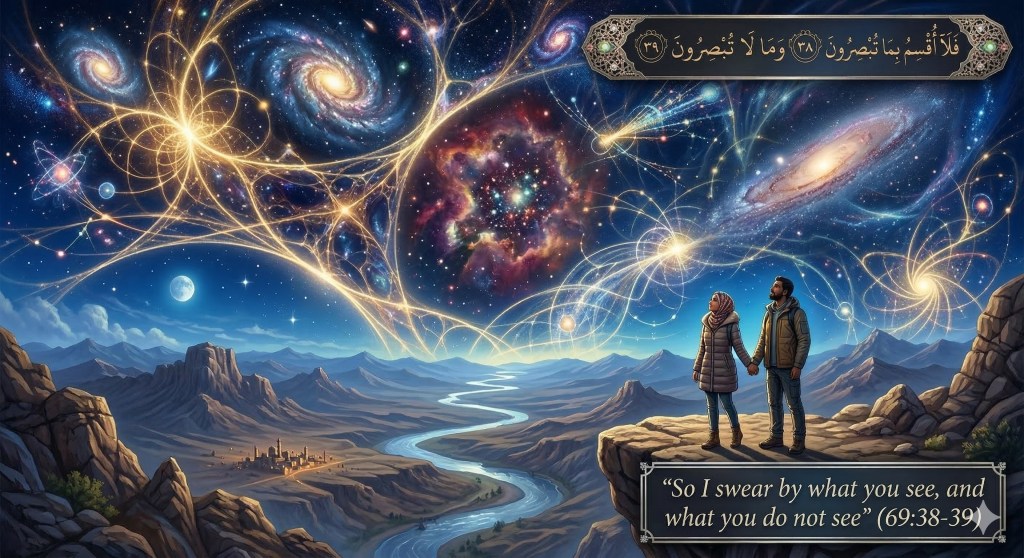
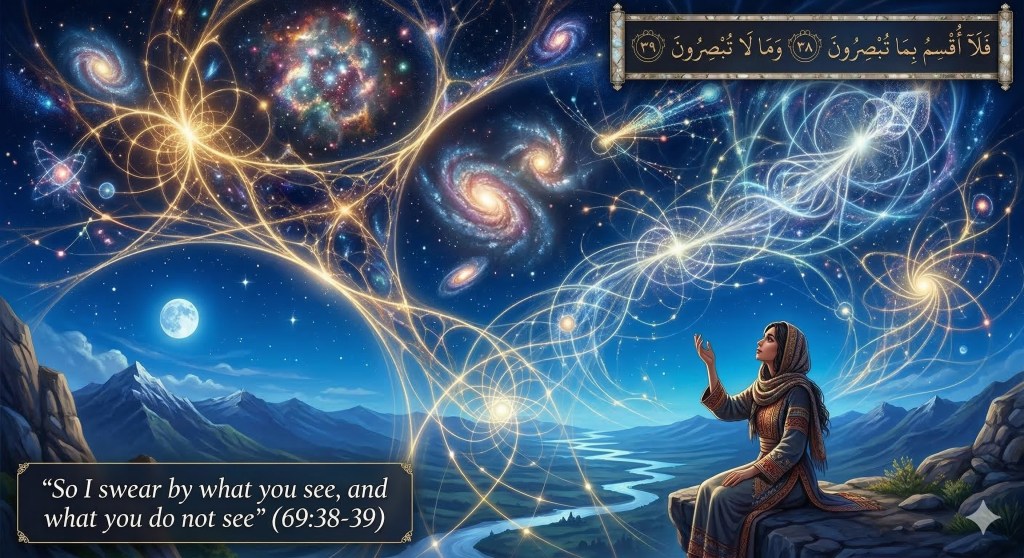
 The Glorious Quran and Science
Leave a comment