
Presented by Zia H Shah MD
Introduction: The Dual Identity of a Global Icon
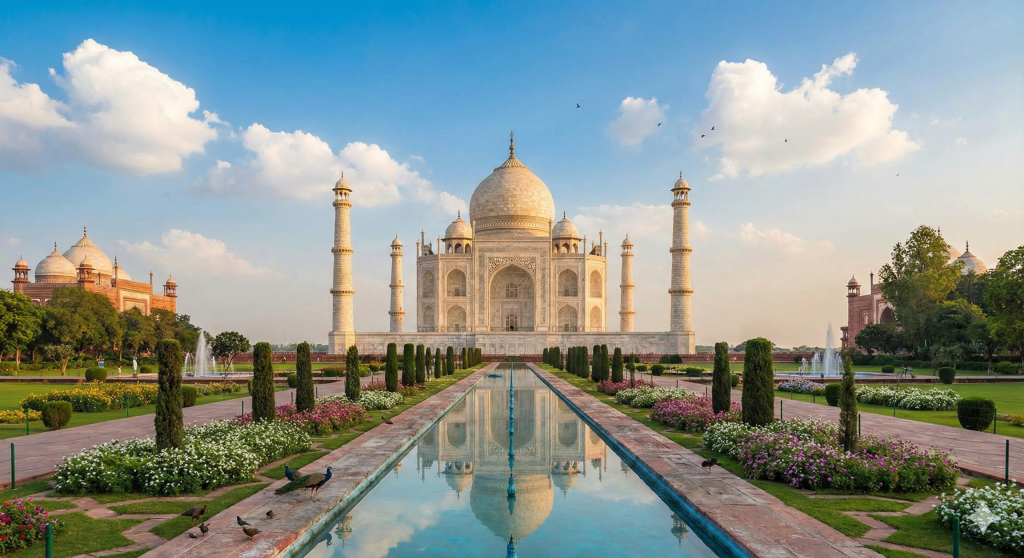
The Taj Mahal, rising from the banks of the Yamuna River in Agra, is universally recognized as the supreme achievement of Mughal architecture. Completed in the mid-17th century under the patronage of Emperor Shah Jahan, it has long been romanticized in popular imagination as a “teardrop on the cheek of time,” a poetic epithet bestowed by Rabindranath Tagore that emphasizes its emotional resonance as a monument to conjugal love.1 However, to reduce this complex edifice to a mere sentimental gesture is to overlook the profound intellectual, theological, and scientific rigors that underpin its creation. The Taj Mahal is not merely a mausoleum; it is a crystallized assertion of Mughal imperial ideology, a physical manifestation of Islamic eschatology, and a masterwork of mathematical engineering rooted in the scientific advancements of the Islamic Golden Age.2
This report presents an exhaustive analysis of the Taj Mahal, positing a dual argument: first, that the monument is an indelible symbol of Muslim heritage, its very form and proportions derived from the mathematical treatises of scholars like Al-Kashi and Al-Khwarizmi, and its symbolism deeply embedded in Quranic revelation.5 Second, that it is simultaneously and inseparably a symbol of India, representing the syncretic “Hindustani” culture that evolved under Mughal rule, incorporating indigenous craftsmanship, materials, and aesthetics into a Persianate framework.8 By examining the historical circumstances of its commission, the logistical magnitude of its construction, the sophisticated application of geometric principles, and the modern debates surrounding its identity, this report aims to reconcile these dualities into a unified narrative of architectural brilliance.
The narrative that follows will dissect the monument not just as a static object of beauty, but as a dynamic intersection of theology, politics, and science. It will challenge revisionist histories that seek to strip the Taj of its Islamic identity while also highlighting the indigenous Indian elements that ground the structure in the soil of the subcontinent. Through this lens, the Taj Mahal emerges not as a point of contention, but as the zenith of a civilizational encounter between the Islamic world and India.
Part I: The Genesis of the Illumined Tomb
The Historical Context: Shah Jahan and the Golden Age of Mughal Architecture
The reign of Shah Jahan (1628–1658) is widely categorized by historians as the Golden Age of Mughal architecture. The Mughal dynasty, established by Babur in 1526, had by the 17th century consolidated its control over the Indian subcontinent, creating an empire of immense wealth and cultural sophistication.10 While his predecessors had their own architectural proclivities—Babur introducing the Persian Charbagh (garden), Akbar synthesizing Hindu and Muslim styles in red sandstone, and Jahangir focusing on the naturalistic arts—Shah Jahan was possessed by a distinct vision of structural perfection, symmetry, and the hierarchical use of white marble.3
Shah Jahan’s era witnessed a transition from the robust, masculine, and eclectic style of Akbar to a more refined, feminized, and geometrically rigorous aesthetic. This shift was not merely stylistic but ideological. The Emperor viewed architecture as a tool of statecraft, a means to project the “perfect” order of the Mughal state and its divinely sanctioned legitimacy.12 The use of white marble, previously reserved for the tombs of saints (such as the tomb of Salim Chishti in Fatehpur Sikri), was elevated to the imperial sphere, symbolizing the semi-divine status of the monarch and his family.12
The Tragedy at Burhanpur
The commission of the Taj Mahal was precipitated by a personal tragedy of imperial magnitude. In 1631, Arjumand Banu Begum, known to history as Mumtaz Mahal (“The Chosen One of the Palace”), accompanied Shah Jahan on a military campaign to the Deccan. In the city of Burhanpur, she died due to complications arising from the birth of their fourteenth child, a daughter named Gauhar Ara.10 Mumtaz Mahal was not merely a wife but the Emperor’s inseparable companion and political confidante, and her death plunged the court into profound mourning.
Contemporary court chronicles, such as the Padshahnama by Abdul Hamid Lahori, describe the Emperor’s grief in vivid detail, noting that his beard turned grey almost overnight and that he abstained from music, jewelry, and fine clothes for two years.10 The body of the Empress was temporarily interred in the garden of Zainabad in Burhanpur before being transported to Agra six months later, where the construction of the Rauza-i-Munauwara (The Illumined Tomb) began in 1632.10 This sequence of events establishes the personal emotional core of the monument, which was then translated into a public statement of dynastic power and religious piety.
Part II: The Mobilization of an Empire
The Logistics of Construction
The construction of the Taj Mahal was a colossal undertaking that mobilized the resources of the entire Mughal Empire and its trading networks. The project was not a localized effort but a pan-Asian enterprise, reflecting the interconnectedness of the 17th-century world. The site chosen was on the banks of the Yamuna River, south of the walled city of Agra. The land was acquired from Raja Jai Singh I, a prominent Rajput vassal, in exchange for four mansions in the city center, a transaction documented in surviving farmans (imperial decrees).15
The logistics of material procurement demonstrate the centralized power of the Mughal state. A fleet of 1,000 elephants was employed to transport materials.16 The white marble, the defining feature of the monument, was quarried from Makrana in Rajasthan, over 400 kilometers away. This marble is renowned for its durability and its ability to reflect light, a quality that Mughal poets compared to the “flush of dawn”.12
Material Origins and Symbolic Geography
The materials used in the Taj Mahal were sourced from regions that spanned the known world, creating a symbolic geography that placed the Mughal Emperor at the center of a vast network of tribute and trade.
| Material | Source Region | Symbolic/Functional Significance |
| White Marble | Makrana, Rajasthan (India) | Purity, divinity, priestly caste (Brahmin) symbolism in Hindu texts; Divine light in Islamic thought. |
| Red Sandstone | Fatehpur Sikri / Dholpur (India) | Imperial power, warrior caste (Kshatriya) symbolism; Used for subsidiary buildings to create hierarchy. |
| Jasper | Punjab | Used in Parchin Kari (inlay) for floral motifs. |
| Jade & Crystal | China | Exotic luxury, endurance; used in intricate inlay work. |
| Turquoise | Tibet | Apotropaic qualities; vivid color contrast against white marble. |
| Lapis Lazuli | Afghanistan | Associated with the heavens/sky; high value pigment source. |
| Sapphires | Sri Lanka | Gemstone of royalty; used sparingly in high-value detail. |
| Carnelian | Arabia | Warmth, associated with blood/life; common in floral inlay. |
| Coal/Charcoal | Local | Used for bitumen/black outlining in the inlay process. |
Table 1: Origins and Significance of Materials Used in the Taj Mahal Complex.13
This table illustrates the fusion of Indian materials (marble, sandstone) with pan-Asian luxury goods, reinforcing the argument that the Taj Mahal is a product of Indian geology shaped by Islamic artistic vision.
The Human Capital: A Meritocracy of Artisans
The workforce employed on the Taj Mahal is estimated to have numbered around 20,000.15 This labor force was organized into a strict hierarchy, ranging from unskilled laborers (bildars) to highly specialized craftsmen (artizans). The recruitment of these specialists reveals the cosmopolitan nature of the Mughal court.
While the manual labor was largely local, the technical expertise was drawn from across the Islamic world.
- Ismail Afandi (Ismail Khan): A master dome builder from the Ottoman Empire, likely trained in the tradition of the great Mimar Sinan. He was responsible for the engineering of the massive double dome, a feature that required sophisticated knowledge of load distribution.17
- Qazim Khan: A goldsmith from Lahore who was tasked with casting the solid gold finial that crowned the dome, a masterpiece of metallurgy.17
- Chiranjilal: An indigenous lapidary from Delhi who served as the chief sculptor and mosaicist, overseeing the complex parchin kari work.17
- Amanat Khan (Abdul Haq): The Persian calligrapher from Shiraz who designed the monumental inscriptions. His status was such that he is the only artist permitted to sign his work on the Taj Mahal itself, inscribing “Written by the insignificant being, Amanat Khan Shirazi” at the base of the interior dome.15
This collaborative model, where a Persian calligrapher worked alongside an Ottoman engineer and an Indian lapidary, underscores the Taj Mahal as a synthesis of the best talents of the Indo-Islamic world.
Part III: The Mathematical Foundations and the Islamic Golden Age
To argue that the Taj Mahal is a symbol of Muslim heritage is to recognize its deep intellectual indebtedness to the Islamic Golden Age (8th–14th centuries). The architecture of the Taj is not arbitrary; it is the physical application of advanced mathematical concepts developed by scholars in Baghdad, Samarkand, and Cairo.3 The Mughals, tracing their lineage to the Timurids of Central Asia and the Mongols, were the inheritors of this scientific tradition.
The Transmission of Mathematical Knowledge
The architectural precision of the Taj Mahal relies on two key branches of mathematics: Hindsa (geometry) and Hisab (arithmetic). These disciplines were revolutionized during the Islamic Golden Age by scholars such as Euclid (whose Elements was translated into Arabic by Nasir al-Din al-Tusi), Al-Khwarizmi (the father of algebra), and Al-Kashi.19
By the time of Shah Jahan, these mathematical treatises were standard curriculum for the muhandis (engineer/architect). The Diwan-i-Muhandis (a collection of poems by Lutfullah Muhandis, the son of the Taj’s architect) explicitly mentions his father’s mastery of these sciences.21 This textual evidence links the design of the Taj Mahal directly to the intellectual lineage of Islamic science.
Ustad Ahmad Lahori: The Mathematician-Architect
The identity of the chief architect was a subject of debate for centuries, but 20th-century scholarship has conclusively identified him as Ustad Ahmad Lahori.23 Lahori was not a mere mason; he was a polymath—an astronomer, geometer, and mathematician. Shah Jahan conferred upon him the title Nadir-ul-Asr (“Wonder of the Age”), acknowledging his mastery over the “science of building” (ilm-i-mi’mari).21 His background in astronomy was crucial for the alignment of the monument and the calculation of the prayer times for the mosque, illustrating the seamless integration of science and faith in Islamic architecture.
The Science of the Dome and Al-Kashi’s Legacy
The dome of the Taj Mahal is a masterpiece of engineering that would have been impossible without the mathematical groundwork laid by Ghiyath al-Din Jamshid al-Kashi (d. 1429), a Timurid mathematician. Al-Kashi’s treatises, particularly The Key to Arithmetic (Miftah al-Hisab), provided the theoretical framework for calculating the volumes of domes and the structural properties of arches.6
The Taj utilizes a double-shell dome, a technique pioneered in the Timurid era (e.g., the Gur-e-Amir) to solve a dual aesthetic problem: a dome that is proportionate to the interior chamber is often too small for the exterior grandeur, and vice versa. The double dome consists of:
- The Inner Shell: A hemispherical dome that fits the scale of the cenotaph chamber.
- The Outer Shell: A high, bulbous onion dome (amrud) that dominates the skyline.
- The Void: A hollow space between the two, reinforced by spoke-like masonry webs.
The profile of the dome utilizes a “four-centered” arch (quinto-acuto), a shape mathematically generated using compass-and-straightedge constructions described in Islamic geometric manuals.7 This link between the Taj’s silhouette and Timurid mathematical texts is a primary evidence of its Muslim heritage.
The “Baghdad Octagon” and Modular Planning
Professor Ebba Koch, a leading historian of Mughal architecture, has demonstrated through rigorous field surveys that the entire Taj Mahal complex is governed by a strict modular grid system based on the Shahjahani Gaz (approx. 80.5 cm).26
The plan of the mausoleum is based on the Baghdad Octagon (Muthamman-i-Baghdadi), a geometric figure derived from a square with chamfered corners. This shape is not merely decorative; it facilitates the Hasht Bihisht (“Eight Paradises”) floor plan.
- The Structure: A central octagonal chamber (housing the cenotaphs) is surrounded by eight smaller chambers on two stories, linked by radiating corridors.
- The Symbolism: This “nine-fold” plan (one center + eight surrounding) is a spatial representation of the eight levels of Paradise in Islamic cosmology.10
- The Geometry: The layout of these chambers relies on the “Root-Two” rectangle system, a geometric progression used to maintain rational proportions throughout the building.28
The Golden Ratio and Girih Patterns
Mathematical analysis has revealed the presence of the Golden Ratio ($ \phi \approx 1.618 $) in the Taj Mahal’s elevations. The ratio of the width of the central pishtaq (portal) to the height of the main facade approximates $ \phi $, creating a naturally pleasing aesthetic balance often referred to as “Divine Proportion”.5
Furthermore, the surface ornamentation utilizes Girih (knot) patterns—complex geometric tessellations formed by decagonal and pentagonal stars. Recent research by physicists like Peter Lu has shown that these Islamic patterns, found in Mughal and Timurid architecture, exhibit “quasicrystalline” properties—mathematical structures that are ordered but non-periodic.7 These patterns were generated using a set of five template tiles (girih tiles), a method that predates Western mathematical understanding of such tessellations by centuries.7 This sophisticated use of geometry to represent the infinite nature of the Divine is a hallmark of Islamic art and a key argument for the Taj’s status as a pinnacle of Muslim scientific heritage.
Part IV: The Architecture of Paradise
The Taj Mahal is not a standalone building; it is the climax of a vast Charbagh (four-fold garden) complex. This garden is the theological heart of the monument, explicitly designed to represent Jannah (Paradise) as described in the Quran.
The Charbagh: Rivers of Milk and Honey
The Charbagh layout originates from ancient Persia but was endowed with specific Islamic symbolism by the Mughals. The garden is divided into four quadrants by water channels, representing the four rivers of Paradise mentioned in Surah Muhammad (47:15): rivers of water, milk, wine, and honey.33
- The Intersection: At the center of the garden, where the four channels meet, lies a raised marble tank (the al-Kawthar). In Islamic eschatology, this is the “Pond of Abundance” where the faithful will quench their thirst upon entering Paradise.33
- The Planting: The garden was originally planted with fruit trees (symbolizing life and abundance) and cypresses (symbolizing death and eternity), creating a botanical allegory of the cycle of life.35
The “Throne of God” Theory
A major scholarly debate concerns the placement of the mausoleum. In traditional Mughal tomb gardens (like Humayun’s Tomb), the mausoleum is placed at the geometric center of the Charbagh, representing the center of the cosmos. However, in the Taj Mahal, the mausoleum is located at the northern end of the garden, on a raised terrace overlooking the river.4
Conventionally, this was attributed to the need for a riverfront foundation. However, art historian Wayne Begley proposed a radical reinterpretation known as the “Throne of God” theory. Begley argued that the layout of the Taj complex corresponds to the “Plain of Assembly” (Ard al-Hashr) on the Day of Judgment, as depicted in the diagrammatic futuhat of the Sufi mystic Ibn Arabi.4
- The Mapping: In this theory, the garden represents Paradise. The mausoleum, sitting above and at the end of the garden, represents the Divine Throne (Arsh), which overlooks Paradise.
- The Implication: By placing his own tomb within the “Throne” structure, Shah Jahan was making a potent theological and political statement—casting himself as the Zill-i-Ilahi (“Shadow of God”) who presides over the “paradise” of his empire.8 While some scholars like Ebba Koch find this interpretation overly specific, the presence of eschatological inscriptions strongly supports a reading that goes beyond simple romance.
Part V: The Skin of the Monument – Calligraphy and Ornamentation
The visual identity of the Taj Mahal is defined by its surface decoration, which adheres strictly to Sunni Islamic orthodoxy by avoiding anthropomorphic representation. Instead, it relies on three modes of ornamentation: calligraphy, geometry, and vegetative motifs.
The Writing on the Wall: An Eschatological Narrative
The Taj Mahal is wrapped in the Word of God. The calligraphic inscriptions, executed in black marble inlaid into white marble, were designed by Amanat Khan.15 Far from being random selections, the Quranic passages form a coherent eschatological narrative focusing on the Day of Judgment, Divine Mercy, and the fate of the soul.
| Location | Surah (Chapter) | Theme |
| Great Gate (South Arch) | Surah Al-Fajr (89) | Invitation to the “Soul at Rest” to enter Paradise. |
| Great Gate (North Arch) | Surah Al-Balad (90) | The struggle of life and the path of righteousness. |
| Mausoleum (South Arch) | Surah Ya Sin (36) | The reality of the Resurrection; the “Heart of the Quran”. |
| Mausoleum (West Arch) | Surah Al-Waqi’ah (56) | The Inevitable Event (Judgment Day). |
| Mausoleum (North Arch) | Surah Al-Mulk (67) | The Dominion of God over life and death. |
| Cenotaph (Upper) | Surah Fussilat (41) | Divine protection; angels descending on believers. |
Table 2: Key Quranic Inscriptions and Their Thematic Focus.8
The sequence is liturgical. As the visitor approaches the Great Gate, they read Surah Al-Fajr (89:27-30): “O Soul, thou art at rest. Return to the Lord at peace with Him… Enter among My servants, And enter into My garden”.8 This explicitly frames the entry into the Taj complex as a metaphorical entry into Paradise. The inscriptions on the tomb itself warn of judgment (Ya Sin), creating a somber counterpoint to the beauty of the gardens. This focus on judgment and the afterlife serves as a powerful argument for the monument’s Islamic identity, prioritizing the spiritual fate of the deceased over earthly romance.4
Parchin Kari: The Floral Metaphor
The inlay work, known as Parchin Kari (often referred to as Pietra Dura due to its Italian parallels), utilizes semi-precious stones to create intricate floral designs. While the technique may have been influenced by Florentine lapidaries, the imagery is distinctly Mughal.16 The flowers depicted—tulips, lilies, irises, and poppies—are not merely decorative; they are symbols of the “Garden of Paradise” where flowers bloom eternally. The naturalism of these flowers reflects the scientific interest in botany cultivated by Jahangir and Shah Jahan, yet their symmetrical arrangement retains the formal order required by Islamic aesthetics.12
Part VI: The Contested Symbol – Heritage and Nationalism
In the modern era, the identity of the Taj Mahal has become a subject of intense debate, often reflecting the polarized political landscape of India.
The “Tejo Mahalaya” Controversy
A revisionist theory, propagated primarily by P.N. Oak in his book Taj Mahal: The True Story (1989), claims that the Taj Mahal was originally a Hindu Shiva temple named “Tejo Mahalaya,” which was seized and converted by Shah Jahan.38 Oak argued that the name “Taj Mahal” is a corruption of the Sanskrit term and that the monument predates the Mughal era.
This theory has been universally rejected by serious historians and archaeologists for several reasons:
- Archaeological Evidence: The structural system of the Taj (true arches, domes, and mortar) is fundamentally Islamic and distinct from the trabeated (beam-and-lintel) construction of pre-Islamic Hindu temples in the region.39
- Textual Records: Contemporary Mughal court chronicles (e.g., Padshahnama) and European traveler accounts (e.g., Peter Mundy) document the entire construction process, from the purchase of the land to the completion of the dome.2
- Judicial Ruling: In 2000, the Supreme Court of India dismissed a petition by Oak to declare the Taj a Hindu monument, citing a complete lack of historical merit. The Archaeological Survey of India (ASI) has consistently maintained the monument’s Mughal origin in court affidavits.40
Despite the scholarly consensus, the “Tejo Mahalaya” narrative persists in certain political circles as a means to challenge the Islamic contribution to Indian heritage.41
The Taj as a Symbol of Syncretic India
While the “Muslim Heritage” of the Taj is undeniable, arguing that it is only a Muslim symbol ignores the profound ways in which it is also a symbol of India. The genius of the Taj lies in its Indo-Islamic synthesis.
- Indigenous Elements: The monument incorporates key features of indigenous Indian (Rajput/Hindu) architecture. The most prominent are the Chhatris (domed kiosks) that surround the main dome. These are traditional Rajput elements used in palaces and cenotaphs, here adapted to soften the silhouette of the Timurid dome.10
- The Lotus Finial: The dome is crowned not by a crescent moon alone, but by a finial rising from a stylized lotus—a sacred symbol in Hinduism and Buddhism representing purity and cosmic birth. This fusion of the Islamic dome with the Hindu lotus is the ultimate architectural expression of the “Hindustani” culture.28
- Color Symbolism: The use of white marble for the tomb and red sandstone for the surrounding structures mirrors the ancient Indian caste color coding (White/Brahmin/Purity vs. Red/Kshatriya/Power), suggesting a conscious adaptation of local traditions by Mughal architects.13
Thus, the Taj Mahal is a symbol of India not despite its Islamic origins, but because of them—it represents a period when Indian craftsmanship and materials were elevated by Islamic scientific and aesthetic vision to create something unique to the subcontinent.
Conclusion: The Convergence of Science and Faith
The Taj Mahal stands today not merely as a tourist attraction but as a profound historical document in stone. Its history reveals a narrative of imperial ambition and personal grief, executed through the mobilization of a continent’s resources. Its architecture serves as a testament to the intellectual legacy of the Islamic Golden Age, proving that the abstract mathematics of Al-Khwarizmi and Al-Kashi could be translated into the tangible beauty of marble and masonry. The geometric precision, the modular planning, and the optical corrections are not accidents of design but the results of a scientific tradition that viewed the study of patterns as a path to understanding the Divine.
Simultaneously, the Taj Mahal is the ultimate symbol of India’s composite heritage. It is a building where Persian calligraphers, Ottoman engineers, and Indian stonecutters worked in unison. It incorporates the lotus and the chhatri alongside the dome and the arch. To strip the Taj of its Islamic identity is to ignore its very structural logic; to deny its Indian identity is to ignore its soul. It remains, in the face of all contestation, a “Illumined Tomb” that enlightens us about the potential of human synthesis—a monument where the mathematics of the stars met the stone of the earth to create a vision of Paradise.
If you would rather read in Microsoft Word file:


 The Glorious Quran and Science
Leave a comment