
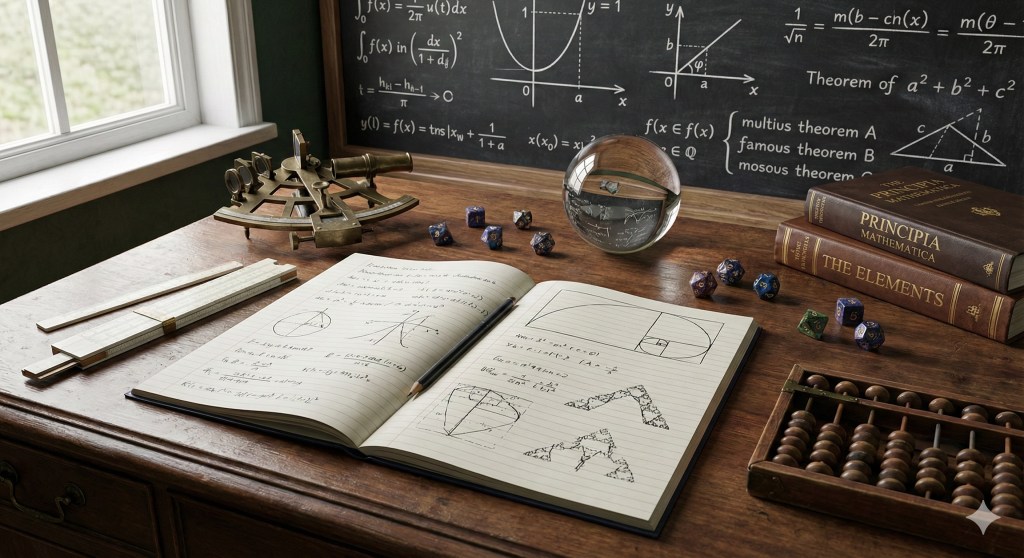
Presented by Zia H Shah MD
Abstract
The emergence of Generative Artificial Intelligence (GenAI) and Large Language Models (LLMs) capable of performing complex mathematical operations has precipitated a crisis of pedagogical purpose. The user’s query posits a compelling analogy: if the Global Positioning System (GPS) has effectively rendered the memorization of maps and routes obsolete without catastrophic societal consequence, does the advent of AI systems capable of “accurate and precise understanding” of mathematics similarly obviate the need for human mathematical mastery? This report interrogates this proposition through a multidisciplinary framework, synthesizing evidence from cognitive neuroscience, evolutionary educational psychology, computer science, and democratic theory.
While the “GPS analogy” offers a seductive vision of cognitive efficiency, this investigation reveals it to be fundamentally flawed on three distinct levels: the neurobiological, the epistemological, and the sociopolitical. Neurobiologically, mathematics is not merely a utilitarian skill for deriving answers but a “biologically secondary” domain that structures neural architecture, specifically in the prefrontal cortex and intraparietal sulcus. The process of learning mathematics—specifically through “productive struggle”—creates the cognitive infrastructure required for executive function, inhibition, and logical reasoning, capacities that “cognitive offloading” to AI actively erodes. Epistemologically, the premise of AI accuracy is currently overstated; LLMs operate as probabilistic “stochastic parrots” rather than deterministic logical engines, prone to hallucinatory errors that require expert human verification. Sociopolitically, the opacity of algorithmic decision-making creates a democratic imperative for “intellectual self-defense,” where mathematical literacy becomes a civil right necessary to audit the “Weapons of Math Destruction” that increasingly govern public life.
This report argues that AI necessitates a transformation, rather than an elimination, of human mathematical education. We must transition from a curriculum of rote calculation to one of high-level “computational thinking” and “system architecture,” where humans remain the “humans-in-the-loop”—not as redundant calculators, but as the essential arbiters of truth, designers of inquiry, and guardians of democratic agency.
1. Introduction: The GPS Analogy and the Crisis of Utility
1.1 The Seduction of the Black Box
The history of human technological progress is, in many respects, a history of cognitive offloading. We offloaded memory to the written word, physical strength to the steam engine, and simple arithmetic to the pocket calculator. In each instance, the human capacity for the offloaded task atrophied, but the net societal gain was deemed sufficient to justify the loss. We memorized fewer epic poems but accessed more information; we lost the physical robustness of the hunter-gatherer but gained the industrial city.
The user’s query suggests we are at a similar inflection point with mathematics. The Global Positioning System (GPS) serves as the paradigmatic case study for this argument. Before GPS, navigation required a complex synthesis of spatial memory, landmark recognition, mental rotation, and route planning—a cognitive process known as “wayfinding”.1 Today, this cognitive load is almost entirely externalized to digital algorithms. The driver simply obeys: “Turn left in 200 feet.” The result is hyper-efficiency: fewer lost drivers, optimized fuel consumption, and predictable arrival times. If the goal of driving is simply arrival, the GPS is a triumph.
The argument follows: if the goal of mathematics is simply the answer—the value of $x$, the area under the curve, the statistical significance of a dataset—and AI can provide this answer with GPS-like speed and precision, then the human labor of learning mathematics becomes as vestigial as the ability to use a sextant. Why struggle through the “desirable difficulties” of calculus when a neural network can generate the solution in milliseconds?.2
1.2 Distinguishing Wayfinding from Navigation
However, closer scrutiny of the GPS analogy reveals a critical distinction between “navigation” (the act of moving from A to B) and “wayfinding” (the cognitive understanding of one’s environment). Research in cognitive science indicates that while GPS aids navigation, it degrades wayfinding. Frequent GPS users show reduced volume in the hippocampus, the brain region responsible for spatial memory and mental mapping.3 They travel through the world without understanding it, creating a form of “cognitive tunnel vision.”
In the physical world, the consequences of this are minor—perhaps getting lost if the battery dies. In the intellectual world of mathematics, the consequences are existential. Mathematics is not just a tool for getting from the problem to the solution; it is the framework we use to understand the logical structure of reality. To treat math solely as a utility is to confuse the map with the territory. As we shall explore, the “GPS effect” in mathematics does not just mean we forget how to integrate functions; it means we lose the neural architecture required for rigorous logical deduction, error detection, and complex problem-solving.4
1.3 The Fragility of the “Accurate” Machine
Furthermore, the premise that AI provides “accurate and precise understanding” is, at this stage of technological development, a dangerous oversimplification. Unlike a GPS, which relies on deterministic satellite triangulation, Generative AI relies on probabilistic token prediction. It does not “know” math; it mimics the language of math. This leads to subtle, plausible, and often undetectable errors—”hallucinations”—that only a mathematically literate human can identify. If we abdicate our mathematical competence to the machine, we lose the capacity to verify the machine’s output, leaving us vulnerable to a new class of errors that we lack the conceptual tools to diagnose.6
1.4 Scope of the Report
This report will systematically dismantle the “obsolescence argument” through the following sections:
- The Evolutionary & Neurobiological Basis: Why the brain effectively needs the struggle of math to develop properly.
- The Technological Reality: Why AI is currently an unreliable narrator in the realm of logic.
- The New Curriculum: How education is shifting from “calculation” to “computation” under the guidance of visionaries like Conrad Wolfram.
- The Democratic Imperative: Why math is a tool of political power and civil rights.
- The Future of Human-AI Symbiosis: How we will work with AI, rather than be replaced by it.
2. Evolutionary Educational Psychology: Why Math is Hard (and Why That Matters)
To understand the friction between human learners and mathematics, and the temptation to offload it, we must turn to Evolutionary Educational Psychology. This field, pioneered by researchers like David Geary, provides a framework for understanding why some skills are easy and others are cognitively expensive.8
2.1 Biologically Primary vs. Secondary Knowledge
Geary distinguishes between two types of cognitive abilities:
| Feature | Biologically Primary Knowledge | Biologically Secondary Knowledge |
| Examples | Spoken language, face recognition, spatial navigation, social dynamics. | Reading, writing, higher mathematics (algebra, calculus), coding. |
| Acquisition | Natural, effortless, unconscious. “Built-in scaffolding.” | Effortful, requires formal instruction, conscious practice. |
| Evolutionary History | Evolved over millions of years for survival. | Cultural inventions of the last few millennia. |
| Motivation | Intrinsically motivated (kids want to talk/play). | Extrinsically motivated (requires school/discipline). |
| AI Impact | AI mimics these (NLP, Computer Vision) but humans retain them easily. | AI excels here; humans want to offload these due to high cognitive cost. |
Table 1: Geary’s Framework of Evolutionary Educational Psychology.8
The user’s query is rooted in the fact that mathematics is Biologically Secondary Knowledge. It is evolutionarily unnatural. Our brains are not wired to intuitively grasp integrals or complex statistics; we have to “hijack” neural circuits evolved for other purposes (like spatial navigation) to process these abstract concepts.11 Because acquiring secondary knowledge is metabolically expensive and cognitively painful, humans have a natural drive to offload it. The invention of the calculator, and now AI, appeals to this “cognitive miser” tendency in the human brain.12
2.2 The “Use It or Lose It” Neural Imperative
However, the difficulty of acquiring secondary knowledge is precisely what makes it developmentally vital. The “unnatural” act of learning math forces the brain to build new, robust neural architectures that do not exist by default.
- Myelination and Connectivity: The “productive struggle” of solving math problems stimulates the production of myelin, the fatty sheath that insulates axons and speeds up neural transmission. It forces the recruitment of the prefrontal cortex (executive function) and the intraparietal sulcus (quantity representation).13
- Inhibition and Reasoning: A landmark study published in PNAS examined adolescent brain development and found that students who engaged in mathematical education exhibited higher levels of GABA (gamma-aminobutyric acid) in the middle frontal gyrus. GABA is an inhibitory neurotransmitter crucial for focus, logic, and the suppression of impulsive answers. The study found that GABA levels predicted mathematical attainment 19 months later, suggesting a reciprocal loop: math builds the brain, and the built brain does better math.4
2.3 The Consequence of Offloading
If we treat math like a GPS route to be offloaded, we disrupt this developmental loop. The “GPS” user in math avoids the cognitive load required to strengthen the prefrontal cortex. This leads to “Skill Erosion”.15
- The Paradox of Automation: As AI becomes more capable, humans become less capable. When the AI fails (which, as we will see, it does), the human lacks the “cognitive reserves” to intervene.
- Generalization of Deficits: The skills built by math—working memory, attention control, logical sequencing—are domain-general. A deficit in the neural architecture built by math can bleed over into other areas requiring complex reasoning, such as legal argumentation, strategic planning, and scientific analysis.16
3. The Architecture of Hallucination: Why AI is Not a Trustworthy GPS
The user’s premise hinges on the clause: “if AI provides accurate and precise understanding and calculations.” This “if” is the heaviest word in the query. Current Artificial Intelligence, specifically Large Language Models (LLMs) like GPT-4, Gemini, and Claude, differs fundamentally from the rigid logic of a GPS or a calculator.
3.1 The Stochastic Parrot: Probability vs. Logic
A traditional calculator or GPS is deterministic. If you input 2 + 2, the logic gates ensure the output is 4. A GPS calculates the shortest path using Dijkstra’s algorithm or A*; it does not “guess” the route.
LLMs are probabilistic. They are trained on vast corpora of text to predict the next likely token. When an LLM answers a math problem, it is not “solving” it in the way a human or a calculator does; it is predicting what the solution looks like based on patterns it has seen before.6
- The “Strawberry” Test: Early versions of LLMs famously failed to count the number of “r”s in the word “strawberry,” often answering “two.” This was not a logic error but a tokenization error—the model “sees” the word as tokens (e.g., “straw” + “berry”) and cannot access the character-level data. While this specific error has been patched in some models, it reveals the non-human architecture of their “reasoning”.19
3.2 Case Study: The Fragility of “GSM-Symbolic”
Recent research by Apple has devastated the idea that LLMs possess robust mathematical reasoning. The researchers created a benchmark called “GSM-Symbolic” which took standard math word problems (which LLMs solve easily) and slightly altered them.
- The “Kiwi” Problem: The researchers took a simple addition/subtraction problem about picking kiwis but added a semantically irrelevant clause: “Five of them were smaller than average.”
- The Failure: State-of-the-art models frequently subtracted the five small kiwis from the total count. A human child recognizes that size is irrelevant to the count. The AI, matching patterns, saw a number and a negative-sounding attribute (“smaller”) and probabilistically determined that subtraction was the next step.7
- Implication: This proves that the AI does not understand the math; it is performing sophisticated pattern matching. It is brittle. A GPS that drives you into a river because the street sign font changed would be discarded immediately. Yet, this is the current state of AI “reasoning”.22
3.3 The Verification Paradox
This brittleness creates the Verification Paradox: To safely use AI for mathematics, the user must possess sufficient mathematical knowledge to detect when the AI is hallucinating.
- Recursive Dependency: If we stop teaching humans math because “AI can do it,” who will check the AI? We risk creating a closed loop where AI models are trained on data generated by other AI models, leading to “model collapse” and a drift away from reality.
- High-Stakes Environments: In fields like aerospace engineering, pharmacology, or cryptography, a 1% error rate is catastrophic. Human verification—grounded in deep mathematical fluency—is the only safety break.23
4. The “Wolfram” Paradigm: Shifting from Calculation to Computation
If we accept that (1) math builds the brain, but (2) manual calculation is tedious and increasingly automatable, how do we resolve the conflict? The answer lies in redefining what math education is. Conrad Wolfram, a mathematician and educational theorist, argues that we have confused the “mechanics” of math with the “essence” of math.
4.1 The Four Steps of the Mathematical Process
Wolfram breaks down solving a math problem into four distinct stages 25:
| Step | Description | Human Role | AI/Computer Role |
| 1. Define Questions | Identifying a real-world problem (e.g., “Is this climate model accurate?”, “Am I normal?”). | Primary. Requires context, ethics, curiosity. | Minimal. |
| 2. Abstract | Translating the problem into mathematical language (equations, code, models). | Primary. Requires conceptual understanding of which tools fit the problem. | Assistive (Code generation). |
| 3. Compute | Processing the abstraction to get an answer (solving for $x$, integrating). | Secondary. Humans are slow and error-prone. | Primary. Fast, accurate, efficient. |
| 4. Interpret | Translating the mathematical result back into the real world. Verification. | Primary. Requires judgment, intuition, skepticism. | Assistive (Visualization). |
4.2 The “Horse and Cart” Curriculum
Wolfram argues that traditional math education spends 80% of its time on Step 3 (Compute)—teaching students to hand-calculate long division, factor polynomials, and integrate by parts. This is the “GPS” equivalent: memorizing the turn-by-turn directions. Wolfram calls this “teaching people to drive a horse and cart” in the age of the Ferrari.27
He advocates for “Computer-Based Math” (CBM), a curriculum where the computer does the calculation, and the student focuses entirely on Defining, Abstracting, and Interpreting.
- Example Module (“Am I Normal?”): Instead of a worksheet of mean/median calculations, students tackle the vague question “Am I Normal?” They must define what “normal” means in different contexts (height, weight, shoe size), collect data, choose the right average (mean vs. median), use a computer to process it, and interpret the outliers. This teaches Data Science, not just arithmetic.28
4.3 The “Driver vs. Mechanic” Counter-Argument
While Wolfram’s vision is compelling, cognitive scientists and educators argue that one cannot completely sever Step 3 (Compute) from the others without losing intuition.
- Number Sense: Just as a driver needs to “feel” the car to drive safely at speed, a mathematician needs “number sense”—an intuition for magnitude and relationship—to effectively Abstract and Interpret. This sense is often built through the repetitive practice of calculation.30
- The “Black Box” Danger: If a student never learns how a derivative is calculated (the limit of the difference quotient), they may misapply it in modeling. They become “button pushers” rather than “engineers.” The consensus emerging is a hybrid model: teach calculation enough to build intuition, then switch to computers for complexity.31
5. Case Studies in Human-AI Symbiosis: The Future of Discovery
The future of mathematics is not “AI replacing Humans,” but “AI amplifying Humans.” This is nowhere more evident than in professional research mathematics.
5.1 Industrial Scale Mathematics
Terence Tao, a Fields Medalist and one of the world’s greatest living mathematicians, envisions a future of “Industrial Scale Mathematics.” Historically, math has been a solitary or small-group endeavor because checking proofs is incredibly labor-intensive.
- The New Workflow: Tao suggests that AI can handle the “translation” of human intuition into formal proofs (using languages like Lean). This allows massive collaborations where mathematicians contribute small pieces of a puzzle, and the AI acts as the “integrator,” ensuring all the pieces fit logically.33
- The Role of Intuition: In this model, the human’s value shifts to Intuition. AI can verify a proof, and it can suggest steps, but it cannot currently generate the “grand conjecture”—the creative leap that reframes a field. As noted in Nature, AI guides human intuition by finding patterns in high-dimensional data (e.g., knot theory) that humans then prove.35
5.2 AlphaGeometry and Neuro-Symbolic Systems
DeepMind’s AlphaGeometry represents the cutting edge of this symbiosis. It solves Olympiad-level geometry problems by combining an LLM (creative, intuitive, pattern-matching) with a Symbolic Engine (logical, deterministic, rigorous).
- The Mechanism: The LLM suggests “constructs” (e.g., “try adding a point here”), and the Symbolic Engine checks if that helps solve the proof.
- The Lesson: The AI works because it has a “logic checker” built in. In the classroom, the student must be the logic checker for the AI. If the student lacks mathematical training, they cannot perform this function.37
6. The Democratic Imperative: Mathematics as a Civil Right
Moving beyond the classroom and the lab, we must consider the societal implications of mathematical literacy. The user’s query is not just about utility; it is about power.
6.1 Weapons of Math Destruction
Cathy O’Neil, in her seminal book Weapons of Math Destruction, argues that algorithms are “opinions embedded in code.” We live in a society governed by mathematical models that determine creditworthiness, insurance rates, hiring prospects, and prison sentences.39
- The Black Box Society: If the general public treats these models as “magic” or “infallible GPS,” they are defenseless against systemic bias. For example, a recidivism algorithm might unfairly penalize minority defendants based on flawed proxy data.
- Intellectual Self-Defense: Mathematical literacy is the only shield against this. A citizen who understands statistics can ask: “What is the false positive rate?” “Is the training data representative?” “Is this correlation or causation?”.41
6.2 The New Literacy Divide
Robert Moses, the civil rights leader and founder of the Algebra Project, famously argued that “Math literacy is a civil right”.43 In the 20th century, algebra was the gatekeeper to economic participation. In the 21st century, algorithmic literacy is the gatekeeper.
- A Caste System of Competence: If we allow a “GPS mentality” to take over public education—where students just learn to use tools—while elite schools continue to teach the mechanics of math, we will create a caste system. The elite will be the “Programmers” who understand and control the AI; the masses will be the “Programmed,” following the directions of the machine without understanding the destination.44
7. Pedagogical Futures: The “Human-in-the-Loop” Classroom
How do we teach math in a world where the answer is free? The classroom must shift from “getting the answer” to “defending the reasoning.”
7.1 From Answer-Getting to Explaining
If a student can just ask ChatGPT for the solution, the value of the homework assignment drops to zero. Assessment must change.
- Oral Exams & Defense: Students should be required to verbally explain their logic. AI can simulate the output, but it cannot simulate the student’s internal understanding in real-time questioning.
- AI as the “Student”: One powerful pedagogical model is to have the AI generate a flawed solution, and task the student with finding the error. This turns the “hallucination” bug into a “critical thinking” feature.46
7.2 AI Tutors and the Zone of Proximal Development
Tools like Khanmigo (Khan Academy’s AI) are attempting to implement this responsibly. Instead of giving the answer, Khanmigo uses the Socratic method to guide the student.
- Scaffolding: It operates in Vygotsky’s “Zone of Proximal Development” (ZPD), providing just enough support to keep the student struggling productively, but not so much that they offload the cognitive work. This mimics the role of an expert human tutor, potentially democratizing access to high-quality instruction—if the student stays engaged in the struggle.47
7.3 Desirable Difficulties
The concept of “Desirable Difficulties” 2 must become the guiding principle of AI-era education. We must intentionally introduce friction. We must require students to calculate by hand, not because the calculation is the goal, but because the effort is the goal. We must resist the “seamless” interface of the AI-GPS and insist on the “bumpy road” of learning.
8. Conclusion: The Map is Not the Territory
The user’s query asks why humans should master mathematics if AI can do it for us. The answer, ultimately, is that mathematics is not a task to be completed; it is a way of being.
The GPS analogy fails because navigation is a means to an end (arrival), whereas mathematics is a means to an understanding. To treat math as a utility is to strip it of its transformative power. We learn math to structure our brains, to build the neural highways that allow for logical thought, critical analysis, and deep focus. We learn math to become the architects of the AI systems, rather than their subjects. We learn math to defend ourselves against the manipulation of statistics and the tyranny of the black box.
In the age of AI, the human who has mastered mathematics is not redundant; they are more powerful than ever. They are the pilot who knows how to fly when the autopilot disengages. They are the explorer who can look at the GPS, recognize that it is leading them off a cliff, and choose a new path.
Thematic Epilogue: The Library of Babel
Jorge Luis Borges famously imagined the “Library of Babel,” a library containing every possible book—every truth, every lie, and every variation of gibberish. The librarians in this story were driven to madness because they possessed all knowledge but lacked the ability to filter it.
Generative AI is the modern Library of Babel. It contains the sum of human mathematical knowledge, but it also contains infinite hallucinations, subtle errors, and confident falsehoods. It can write a proof that looks perfect and is completely wrong. It can solve a problem in seconds that would take a human hours, but it can also fail to count the fingers on a hand.
In this library, the mathematician is not the writer; the mathematician is the Editor. The mathematician is the one who possesses the “truth filter”—the internal logic, built through years of productive struggle—that allows them to distinguish the signal from the noise. Without the human mathematician, the library is just a chaotic sea of symbols. With the human, it becomes a repository of wisdom. We must master mathematics not to write the books, but to read them, to understand them, and to ensure that the story of human knowledge remains true.
Key Data & Concept Summary
| Concept | The “GPS” Argument (Pro-AI) | The “Wayfinding” Reality (Pro-Human) | Key Research Support |
| Cognitive Impact | Offloading frees up brain power for “higher” tasks. | Offloading causes “skill erosion” & neural atrophy (hippocampus/PFC). | PNAS (GABA levels) 4; Maguire (Taxi Drivers).49 |
| Accuracy | AI is accurate and precise. | AI is a “stochastic parrot” prone to hallucinations & brittleness. | Apple “GSM-Symbolic” 21; “Strawberry” Problem.19 |
| Pedagogy | Teach students to use tools (Wolfram’s CBM). | Teach “number sense” & intuition through manual struggle. | “Productive Struggle” 50; “Desirable Difficulties”.2 |
| Democracy | AI optimizes societal decision-making. | AI creates “Weapons of Math Destruction” requiring audit. | Cathy O’Neil 39; Robert Moses (Civil Rights).43 |
| Future Role | Human as “passenger” / consumer. | Human as “Architect” / “Human-in-the-Loop” verifier. | Terence Tao (Industrial Math) 33; AlphaGeometry.37 |

 The Glorious Quran and Science
Leave a comment