
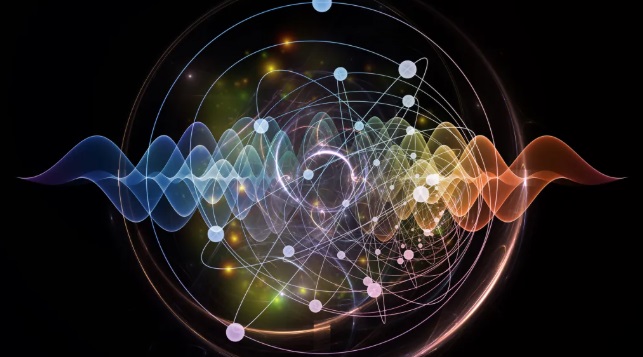
Source: MSN
What if your conscious experiences were not just the chatter of neurons, but were connected to the hum of the universe? In a paper published in Frontiers in Human Neuroscience, I present new evidence indicating that conscious states may arise from the brain’s capacity to resonate with the quantum vacuum—the zero-point field that permeates all of space.
More specifically, I argue that macroscopic quantum effects are at play inside our heads. This insight results from a synthesis of brain architectural and neurophysiological findings supplemented with quantitative model calculations. The novel synthesis suggests that the brain’s basic functional building blocks, cortical microcolumns, couple directly to the zero-point field, igniting the complex dynamics characteristic of conscious processes.
Self-organized criticality in the brain
Neuroscientists have long observed that conscious states are linked to synchronized brain activity in the beta and gamma ranges. These patterns display the hallmarks of self-organized criticality, a delicate balance where the brain operates in the vicinity of a critical point of a phase transition.
In this regime, sensory inputs can trigger large neuronal avalanches that are thought to underlie conscious perception. When consciousness fades, such as under anesthesia, this critical balance disappears. The big question has been: What keeps the brain tuned to this critical state?
Resonance in microcolumns
The answer lies in quantum electrodynamics (QED), the fundamental theory of electromagnetism. In this theory, the vacuum is not empty but filled with a fluctuating ocean of energy known as the electromagnetic zero-point field (ZPF). QED-based model calculations demonstrate that specific frequencies (modes) of the ZPF can resonate with glutamate, the brain’s most abundant neurotransmitter. The resonant interaction takes place in microcolumns, cortical units made up of about 100 neurons bathed in a glutamate pool.



 The Glorious Quran and Science
Leave a comment