
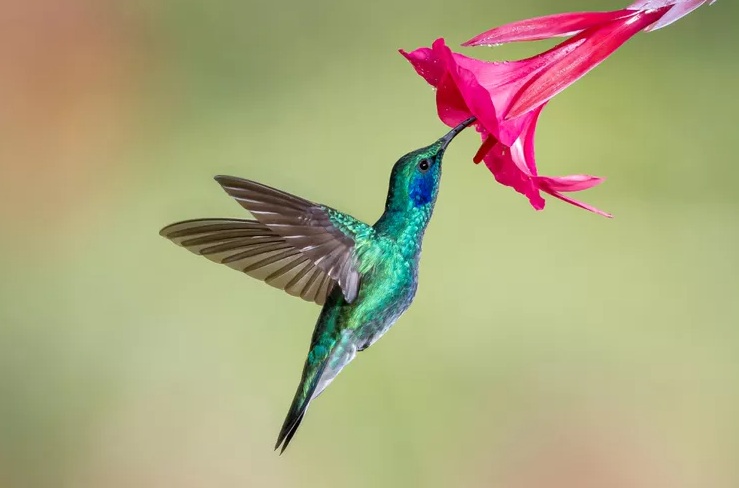
Epigraph
Do they not see the birds made to fly through the air in the sky? Nothing holds them up except God. There truly are signs in this for those who believe. (Al Qur’an 16:79)
Do you not see that Allah is praised by all that is in the heavens and the earth, and the birds with wings outspread? Each knows its mode of prayer and praise.” (Al Qur’an 24:41).
Presented by Zia H Shah MD
Abstract
The family Trochilidae (hummingbirds) represents a singular evolutionary trajectory in the avian kingdom, characterized by a convergence with insectile aerodynamics and a metabolic intensity that skims the theoretical limits of vertebrate physiology. This report provides an exhaustive examination of the biomechanical, physiological, and sensory mechanisms that enable the hummingbird’s defining capability: sustained hovering flight. Through an analysis of Digital Particle Image Velocimetry (DPIV) data, we deconstruct the long-standing debate regarding lift symmetry, demonstrating that unlike insects, hummingbirds generate approximately 75% of their lift during the downstroke and 25% during the upstroke—a functional consequence of their avian musculoskeletal architecture. We explore the “unsteady” aerodynamics of the Leading Edge Vortex (LEV), a phenomenon that allows these birds to operate at angles of attack that would stall conventional airfoils.
Physiologically, the report details the extreme bioenergetics required to support wingbeat frequencies ranging from 30 to 80 Hz. We analyze the mitochondrial saturation of flight muscles (35% by volume), the rapid oxidation of dietary sugars, and the critical survival mechanism of nocturnal torpor, where metabolic rates are suppressed by 95% to prevent starvation. The sensory algorithms governing high-speed navigation are also scrutinized, revealing a counter-intuitive reliance on vertical feature size rather than optic flow for lateral collision avoidance. Finally, this empirical investigation serves as a foundation for a metaphysical synthesis. Drawing upon the Quranic concept of Tasbih (Cosmic Liturgy) and specific verses regarding the “holding” of birds in the sky (Quran 16:79, 67:19), we argue that the hummingbird’s existence acts as a tangible sign (Ayah) of Divine sustainment, bridging the observational rigors of science with the contemplative depths of theology.
1. Introduction: The Evolutionary Paradox of the Hovering Bird
In the vast and varied taxonomy of the class Aves, the hummingbird stands as a paradoxical entity—a creature that retains the skeletal blueprint of a dinosaur but moves with the mechanics of a bee. Comprising over 300 species native exclusively to the Americas, the family Trochilidae has colonized a diverse array of environments, from the oxygen-thin reaches of the high Andes to the lush lowlands of the Amazon and the temperate woodlands of North America. Yet, despite this geographic radiation, they share a singular, defining physiological imperative: the absolute dependence on high-energy floral nectar, accessed through the biomechanically demanding feat of hovering.
The evolutionary origins of this family remain a subject of intense paleontological scrutiny. The discovery of Eurotrochilus fossils in the Rupelian Stage of the Early Oligocene of Europe suggests that the lineage of hummingbird-like birds was once more widespread before becoming restricted to the New World. This deep history points to a complex adaptation to nectarivory, driving a suite of morphological changes that have resulted in the smallest endotherms on the planet. From the minuscule Bee Hummingbird (Mellisuga helenae), weighing a mere 1.95 grams, to the Giant Hummingbird (Patagona gigas), tipping the scales at 24 grams, the clade demonstrates a scaling of flight mechanics that challenges the boundaries of fluid dynamics and muscle physiology.
To understand the hummingbird is to understand the physics of scale. At the size of a hummingbird, the air itself behaves differently than it does for an eagle or a crow. The viscosity of the fluid becomes a dominant force, creating a drag-heavy environment described by low Reynolds numbers (Re). In this regime, gliding is inefficient; continuous power generation is required to remain aloft. This report seeks to dismantle the “miracle” of hummingbird flight into its constituent physical and biological laws, revealing a level of complexity that aligns the organism closer to a precision-engineered machine than a typical bird.
2. Aerodynamics: The Physics of Suspension
The central problem of hovering is the generation of a vertical force (lift) equal to the bird’s weight, with zero net forward velocity. In conventional fixed-wing aircraft and most birds, lift is a product of forward airspeed over a cambered airfoil. For a hovering hummingbird, the wing itself must generate the airflow, acting as a reciprocating pump that accelerates a jet of air downwards to create an upward reaction force.
2.1 The Reynolds Number Regime
Hummingbird wings operate at Reynolds numbers typically less than 8,000. In fluid dynamics, the Reynolds number (Re) is the ratio of inertial forces to viscous forces.
- High Re (>1,000,000): Inertial forces dominate; air flows smoothly over wings; lift is efficient (e.g., commercial jets, albatrosses).
- Low Re (<10,000): Viscous forces (stickiness of the air) dominate; flow tends to separate easily; turbulence is significant (e.g., insects, hummingbirds).
Operating in this “sticky” air requires distinct aerodynamic strategies. The boundary layer of air on the wing surface is prone to separation, which would lead to a catastrophic loss of lift (stall) in a conventional bird. Hummingbirds, however, have evolved to exploit this instability.
2.2 The Stroke Cycle: Symmetry vs. Asymmetry
For decades, the prevailing hypothesis in ornithology was that hummingbirds utilized “symmetric” hovering, similar to insects like hawkmoths or dragonflies. In insects, the wing hinge allows for a near-perfect figure-eight motion where the angle of attack is mirrored on the upstroke and downstroke, generating roughly equal lift (50:50 distribution).
However, recent groundbreaking research utilizing Digital Particle Image Velocimetry (DPIV)—a technique where lasers illuminate smoke particles to visualize airflow vortices—has corrected this assumption. Studies on the Rufous Hummingbird (Selasphorus rufus) have revealed a critical asymmetry:
- Downstroke: Generates approximately 75% of the weight support.
- Upstroke: Generates the remaining 25%.
This 75:25 ratio is a definitive departure from the insect model. It reflects the anatomical constraints of the avian shoulder. Unlike the insect’s flexible exoskeletal hinge, the bird’s humerus-scapula-coracoid joint has limits on its rotation. During the upstroke, the hummingbird must invert its wing (supinate) to present the leading edge to the airflow. However, because the wing feathers are cambered (curved) for the downstroke, this inversion presents a “wrong-way” camber to the air, reducing aerodynamic efficiency. Despite this, the production of any significant lift on the upstroke is unique among birds; most other species simply fold their wings or slice them through the air passively during the recovery phase.
2.3 The Leading Edge Vortex (LEV)
The secret to the hummingbird’s high lift coefficients lies in the Leading Edge Vortex (LEV). In standard aerodynamics, increasing the angle of attack beyond 15 degrees usually causes the airflow to detach from the wing, creating a turbulent wake and destroying lift (stall).
Hummingbirds, however, induce a stable spiral of air—the vortex—that sits directly atop the leading edge of the wing.
- Mechanism: As the wing sweeps through the air at a high angle of attack, the air separates at the sharp leading edge.
- Vortex Formation: Instead of becoming chaotic, this separated air rolls up into a tight vortex.
- Low Pressure Zone: The high-speed rotation of the air within the vortex creates a region of extremely low pressure (suction) on the upper surface of the wing.
- Lift Enhancement: This suction pulls the wing upward, generating lift forces far greater than what conventional laminar flow could sustain.
Research using dynamically scaled robotic wings has shown that while hummingbirds use LEVs, they differ slightly from insects. In insects, the LEV is often stable and attached throughout the stroke. In hummingbirds, specifically Calypte anna, the LEV is more transient. It forms rapidly during the high-acceleration phases of the stroke reversal (when the wing flips direction). This “unsteady” aerodynamic mechanism allows the bird to manipulate transient forces, effectively “catching” its own wake to boost lift.
2.4 Maneuverability and Control
This mastery of unsteady aerodynamics grants the hummingbird a maneuverability envelope that is unmatched in the vertebrate subphylum.
- Backward Flight: By tilting the plane of the wing stroke backward, the lift vector is directed slightly forward, pulling the bird in reverse.
- Inverted Flight: Hummingbirds can fly upside down for short durations, a necessary skill for evasion and complex courtship displays.
- Rapid Dives: During courtship, male hummingbirds of species like the Anna’s Hummingbird climb to heights of 30 meters or more before plunging in a power dive. By tucking their wings to reduce drag, they can reach speeds of 60 mph (approx. 27 m/s). At the bottom of the dive, they pull up, experiencing G-forces that would cause a human pilot to black out.
- Instantaneous Stops: By flaring the wings and tail, they create massive drag, acting as an air brake to transition from high speed to a stationary hover in fractions of a second.
The wingbeat frequency required to drive this system is staggering:
| Flight Mode | Frequency (Beats/Sec) |
| Normal Hovering (Large Species) | 10 – 15 Hz |
| Normal Hovering (Small Species) | 30 – 80 Hz |
| Courtship Dives | Up to 200 Hz |
3. Musculoskeletal Physiology: The Engine of Flight
To sustain wingbeat frequencies of 50 Hz or higher requires a muscular engine of extraordinary power density and fatigue resistance. The hummingbird body plan has been radically reorganized by evolution to prioritize the flight motor above all else.
3.1 Flight Muscle Hypertrophy
In a typical passerine (perching bird), the flight muscles—the pectoralis and the supracoracoideus—constitute about 15% of the bird’s total body mass. In hummingbirds, these muscles have hypertrophied to account for 25% to 30% of the total body weight.
- Pectoralis Major: This massive muscle powers the downstroke, providing the primary propulsive force (75% of lift).
- Supracoracoideus: In most birds, this is a relatively small muscle used only to lift the wing back up for the next beat. In hummingbirds, however, the upstroke is a power stroke (providing 25% of lift). Consequently, the supracoracoideus is unusually large and powerful. It operates via a tendon that passes through a canal in the shoulder (the triosseal canal), acting like a pulley to hoist the wing with significant force.
3.2 Mitochondrial Density and the “Space Constraint”
The endurance of the hummingbird muscle is defined by its ability to burn fuel aerobically. Anaerobic metabolism (which produces lactic acid) causes fatigue quickly and is useless for sustained hovering. Therefore, hummingbird muscles are packed with mitochondria—the cellular power plants where oxidative phosphorylation occurs.
Microscopic analysis of hummingbird flight muscle fibers reveals a staggering statistic: Mitochondria occupy approximately 35% of the muscle fiber volume. This figure is believed to represent a “theoretical upper limit.” A muscle fiber needs two things:
- Myofibrils (Actin/Myosin): The contractile proteins that generate force.
- Mitochondria: The generators that provide the ATP energy for contraction.
If the mitochondrial volume were to increase beyond 35%, it would displace the myofibrils, reducing the muscle’s force-generating capacity. The hummingbird has thus reached a perfect equilibrium, maximizing endurance without sacrificing power. The inner surface area of these mitochondria (cristae density) is also significantly higher than in mammals, allowing for faster rates of oxygen consumption.
3.3 The Cardiovascular Pump
Fuel and oxygen must be delivered to these mitochondria at a torrential rate. The hummingbird heart is a marvel of hydraulic engineering:
- Relative Size: It is the largest heart relative to body size of any homeotherm (warm-blooded animal), comprising 2.5% of the body mass.
- Heart Rate Dynamics:
- Resting: 250 – 500 beats per minute (bpm).
- Maximal Flight: Over 1,200 bpm.
- Torpor: < 50 bpm.
This immense cardiac output ensures that the entire blood volume is circulated through the lungs and muscles repeatedly every minute, maintaining the oxygen gradients necessary for diffusion into the mitochondria.
4. Metabolism: The Furnace of Life
The metabolic rate of a hummingbird is the highest of any vertebrate. Mass-specific metabolic rate (energy burned per gram of tissue) is roughly 100 times faster than that of an elephant. This intensity dictates every aspect of their behavior, ecology, and survival.
4.1 Sugar as High-Octane Fuel
Most vertebrates use glycogen (stored carbohydrates) or fatty acids for endurance exercise. Glycogen stores are heavy and limited, and fatty acids take time to mobilize. Hummingbirds have evolved a pathway to burn dietary sugar almost immediately. Within 15-20 minutes of ingesting nectar, the sucrose is hydrolyzed into glucose and fructose, absorbed into the bloodstream, and oxidized in the flight muscles.
- Suarez et al. (UBC) Findings: Research indicates that hummingbirds possess exceptionally high levels of hexokinase and other glycolytic enzymes, allowing them to cycle sugar from the gut to the muscle mitochondria at rates that would be toxic or impossible for other animals.
- Daily Intake: To fuel this furnace, a hummingbird must consume approximately its own body weight in nectar every single day. This requires visiting hundreds, sometimes thousands, of flowers, making them critical pollinators.
4.2 The Energetic Knife-Edge
Because they burn energy so quickly, hummingbirds carry very little reserve fuel during the day. They are typically only a few hours away from starvation. A sudden storm that prevents foraging for an afternoon can be fatal. This vulnerability has driven the evolution of extreme energy-saving mechanisms for the periods when they cannot feed.
4.3 Torpor: The Regulated Hypothermia
At night, hummingbirds cannot see well enough to forage, yet their metabolic fire continues to burn. If they maintained their normal body temperature (approx. 40°C) through the night, they would burn through their energy reserves and starve before dawn. To survive, they enter a state of daily torpor.
Torpor is a profound physiological depression, distinct from sleep:
- Thermal Crash: The body temperature (Tb) set-point is lowered, allowing the bird to cool down to near ambient temperature. Tb can drop from 40°C to 18°C or even lower (approx. 10-12°C in some species).
- Metabolic Suppression: Oxygen consumption drops by 95%.
- Cardiac Slowing: Heart rate plummets from 500+ bpm to fewer than 50 bpm.
While torpor saves energy (reducing consumption by ~50-fold), it comes with high risks. A torpid bird is sluggish and unable to fly, making it easy prey. Furthermore, the process of “waking up” (arousal) is energetically costly. The bird must activate its brown fat deposits (if present) or shiver its flight muscles violently to generate heat. This re-warming process can take 20 minutes to an hour, during which the bird is vulnerable. Recent studies on the Ruby-throated Hummingbird confirm that this is a highly regulated state, with mitochondrial enzyme activity preserved to ensure rapid reactivation upon arousal.
5. Sensory Navigation: Processing Reality at Speed
Flying at 45 mph through a dense forest canopy requires a visual processing system that operates faster than the human eye. The hummingbird brain, though small, is optimized for high-speed spatial awareness.
5.1 The Visual Tunnel Experiments
How do hummingbirds judge speed and avoid obstacles? In insects, the dominant theory is “optic flow”—the rate at which images move across the retina. Insects center themselves in a tunnel by balancing the speed of image motion on the left and right eyes. If the left wall moves faster (implying it is closer), the insect steers right.
To test if hummingbirds use the same algorithm, researchers at the University of British Columbia (Altshuler, Dakin et al.) placed hummingbirds in virtual reality tunnels with moving patterns on the walls. The results were surprising:
- Insects: Steer based on Pattern Velocity (speed of motion).
- Hummingbirds: Steer based on Vertical Feature Size.
When the researchers projected patterns that moved at different speeds, the hummingbirds did not react as insects would. Instead, they consistently steered away from patterns that appeared “larger” in the vertical axis.
- Lateral Control: They interpret larger vertical features as “closer” or “threatening obstacles” and steer away from them, regardless of the speed at which those features are moving.
- Altitude Control: However, for controlling height (up/down), they do use vertical pattern velocity. If the ground appears to be moving up (looming), they fly higher.
5.2 Implications for Navigation
This distinction—using feature size for steering and motion for altitude—suggests a more complex, object-oriented cognitive map than the reflexive motion-response of insects. It allows hummingbirds to navigate chaotic environments (like wind-blown leaves) without being disoriented by the rapid, erratic motion of the background. They focus on the physical size of the branches (obstacles) rather than the confusing swirl of motion patterns.
6. Environmental Resilience: Mastering the Elements
Hummingbirds do not exist in a vacuum; they must forage in rain, wind, and turbulence.
6.1 Flight in Rain: The 132 Hz Shake
For a 4-gram bird, a raindrop is a heavy projectile. Accumulation of water on feathers increases weight and disrupts the aerodynamic profile of the wing. Research by Ortega-Jimenez and Dudley (UC Berkeley) revealed a spectacular adaptation for moisture management: the mid-air shake.
Using high-speed cameras, they observed Anna’s Hummingbirds foraging in simulated heavy rain. When water accumulated, the birds performed a violent whole-body shake while hovering.
- Frequency: The head shakes at approximately 132 Hz (132 times per second).
- Kinematics: The head rotates through an angle of 202 degrees.
- G-Forces: This rapid oscillation generates centrifugal accelerations of up to 34 G at the tip of the beak.
This force is sufficient to atomize water droplets and eject them instantly from the plumage. Remarkably, the birds maintain their hovering position during this paroxysm, with only a minor increase in metabolic cost (approx. 9%). This ability allows them to maintain their energy intake even during storms that ground larger birds.
7. Migration: The Impossible Crossing
The migration of the Ruby-throated Hummingbird (Archilochus colubris) is perhaps the most famous example of endurance in the avian world. These birds, weighing roughly 3 grams (the weight of a penny), breed in eastern North America and winter in Central America.
7.1 The Gulf of Mexico Barrier
Twice a year, millions of these birds face a formidable barrier: the Gulf of Mexico. While some follow the coastline overland, a significant population chooses the direct route—a non-stop flight over open water.
- Distance: Approximately 500 miles (800 km).
- Duration: 18 to 22 hours of continuous flight.
- The Stakes: There is no place to land. If they stop, they drown.
7.2 The Physiology of Hyperphagia
To survive this crossing, the hummingbird transforms its metabolism. In the weeks leading up to migration, it enters a state of hyperphagia (extreme eating).
- Weight Doubling: The bird increases its body mass from ~3 grams to ~6 grams.
- Lipogenesis: This weight gain is almost entirely fat. Fat is anhydrous (contains no water) and energy-dense (9 kcal/g vs 4 kcal/g for sugar).
- Energetic Math: Flight models calculate that a 3-gram hummingbird has roughly enough fuel for 6-8 hours of flight. By doubling its weight with fat, it extends its range to 20-24 hours.
However, the margin for error is razor-thin. A strong headwind can increase the flight time beyond the fuel reserve capacity. In such cases, the bird will perish at sea. This brutal selection pressure ensures that only the most physiologically perfect specimens survive to pass on their genes.
8. Divine Control: The Quranic Perspective on Flight
“Do they not see the birds held in the midst of the sky? None holds them up except Allah. Indeed in that are signs for a people who believe.” (Quran 16:79)
Before concluding with the broader metaphysical implications of the hummingbird’s existence, we must address the specific scriptural attention given to the act of flight itself. The Quran draws a direct link between the physical phenomenon of birds remaining aloft and the sustaining power of the Creator.
8.1 The Concept of “Holding” (Imsak)
In Surah An-Nahl (16:79) and Surah Al-Mulk (67:19), the text uses the verb yumsikuhunna—”He holds them.”
“Do they not see the birds above them with wings outspread and [sometimes] folded in? None holds them except the Most Merciful. Indeed He is, of all things, Seeing.” (Quran 67:19)
From the perspective of the scientific data presented above, the “holding” of the hummingbird is mediated through:
- Unsteady Aerodynamics: The transient Leading Edge Vortices that generate suction.
- Muscular Power: The 35% mitochondrial volume driving the wings at 80 Hz.
- Neural Control: The visual algorithms stabilizing the hover.
However, in Islamic theology (specifically the Ash’ari school), secondary causes (physics/biology) are not independent agents. They are the Sunnah (Habit) of God. The air has no inherent power to support the bird; the wing has no inherent power to generate lift. These properties exist and function only because they are sustained moment-by-moment by the Divine Will.
The verse challenges the observer to look past the mechanism to the Sustainer of the mechanism. The hummingbird, with its defiance of gravity via a 75:25 lift ratio and its “unsteady” manipulation of invisible air vortices, is a particularly potent illustration of this “holding.” It hangs in the air, suspended by forces we cannot see, fueled by a metabolism that teeters on the edge of collapse, sustained only by the “Mercy” (Ar-Rahman) that provides the nectar and the physical laws of the universe.
8.2 The Flight as a Sign (Ayah)
The intricate details—the 132 Hz rain shake, the 202-degree head rotation, the doubling of weight for migration—are not merely biological trivia. In the Quranic worldview, they are Ayat (Signs). The precision required for a 3-gram bird to cross the Gulf of Mexico is a sign of Al-Qadar (Divine Measure). The ability to enter torpor and “resurrect” each morning is a sign of Ba’th (Resurrection). The Quran urges the believer to “reflect” (tafakkur) on these signs, moving from the appreciation of the creature’s complexity to the adoration of the Creator’s capability.
9. Epilogue: The Cosmic Liturgy
We arrive, finally, at the synthesis of the empirical and the spiritual. The hummingbird is not just a masterpiece of bio-engineering; it is a worshiper in the Cosmic Liturgy.
“Do you not see that Allah is exalted by whomever is within the heavens and the earth and [by] the birds with wings spread [in flight]? Each [of them] has known his [means of] prayer and exalting [Him], and Allah is Knowing of what they do.” (Quran 24:41)
9.1 Instinct as Revelation and Prayer
The verse above (24:41) contains a profound psychological insight: Kullun qad alima salatahu—”Each has known his prayer.” For the hummingbird, its “prayer” is its flight. Its instinctual knowledge—how to navigate by vertical feature size, how to find the specific flowers that match its beak length, how to navigate the stars during migration—is a form of Wahy (inspiration) or Ilham (innate guidance) bestowed by the Creator.
When the hummingbird hovers, vibrating its wings at 50 beats per second, it is fulfilling the purpose of its creation. In Islamic metaphysics, a thing “worships” by acting in accordance with its God-given nature (Fitrah). The hum of the wings is its psalm; the migration is its pilgrimage.
9.2 The Universal Chorus of Tasbih
“The seven heavens and the earth and whatever is in them exalt Him. And there is not a thing except that it exalts [Allah] by His praise, but you do not understand their [way of] exalting…” (Quran 17:44)
As explored in the article “The Cosmic Liturgy” by Zia H. Shah, the universe is not a silent vacuum but a resonant hall of praise (Tasbih). The hummingbird’s metabolic fire, burning sugar to generate motion, is a physical manifestation of this praise. The article notes that even the mountains and birds joined the Prophet David (Dawud) in his praise:
“…And We subjected the mountains to exalt [Us], along with David and [also] the birds…” (Quran 21:79)
This was not a passive echo, but an active participation. The hummingbird, in its intense, vibrant aliveness—a heart beating 1,200 times a minute, wings blurring the visible spectrum—represents a high-frequency glorification of the Living God (Al-Hayy).
9.3 Conclusion
The study of the hummingbird teaches us that reality is layered.
- The Layer of Science: We see a generic convergence of insect aerodynamics and avian physiology, driven by natural selection to exploit the nectar niche. We measure lift coefficients, mitochondrial densities, and Reynolds numbers.
- The Layer of Spirit: We see a creature held in the sky by the Mercy of God, engaging in a perpetual liturgy of flight.
The hummingbird is a “Suspended Gem”—suspended in the air by vortices, and suspended in existence by the Divine Command. To look at it with the eyes of science is to be awed by its complexity; to look at it with the eyes of faith is to join it in its praise.
“And if all the trees on earth were pens, and the sea (were ink), with seven more seas added to it, the words of Allah would not be exhausted. Indeed, Allah is Almighty, All-Wise.” (Quran 31:27)
Just as the ink of the oceans cannot exhaust the words of God, our scientific volumes cannot exhaust the marvels hidden within even the smallest of His creations.
Table 1: Aerodynamic & Physiological Parameters of Trochilidae
| Parameter | Hummingbird (Trochilidae) | Insect (Hawkmoth) | General Bird (e.g., Pigeon) |
| Lift Distribution | ~75% Down / 25% Up | ~50% Down / 50% Up | ~100% Down / 0% Up (Active) |
| Reynolds Number (Re) | 2,000 – 8,000 | 2,000 – 8,000 | > 100,000 |
| Leading Edge Vortex | Transient / Unsteady | Stable / Attached | Absent (Laminar Flow) |
| Wing Inversion | Wrist supination (Avian shoulder) | Wing hinge rotation | None (Wing folding) |
| Flight Muscle Mass | 25 – 30% of body weight | ~10 – 15% | ~15 – 20% |
| Mitochondrial Vol. | ~35% (Theoretical Max) | High | ~5 – 10% |
| Visual Steering | Vertical Feature Size | Optic Flow (Velocity) | Optic Flow / Landmarks |
Table 2: The Dynamics of the Rain Shake
| Variable | Hummingbird Shake | Mammalian Shake (e.g., Dog) |
| Frequency | ~132 Hz | ~4 – 5 Hz |
| Head Rotation | 202 degrees | ~90 – 120 degrees |
| G-Force (Acceleration) | 34 G | ~2 – 5 G |
| State | In-flight (Hovering) | Standing |
| Function | Maintain aerodynamic efficiency | Thermoregulation / Drying |



 The Glorious Quran and Science
Leave a comment