
Epigraph
Do they not see the birds above them spreading and closing their wings? It is only the Lord of Mercy who holds them up: He watches over everything. (Al Quran 67:19)
Do you not see that Allah is praised by all that is in the heavens and the earth, and the birds with wings outspread? Each knows its mode of prayer and praise.” (Al Qur’an 24:41).
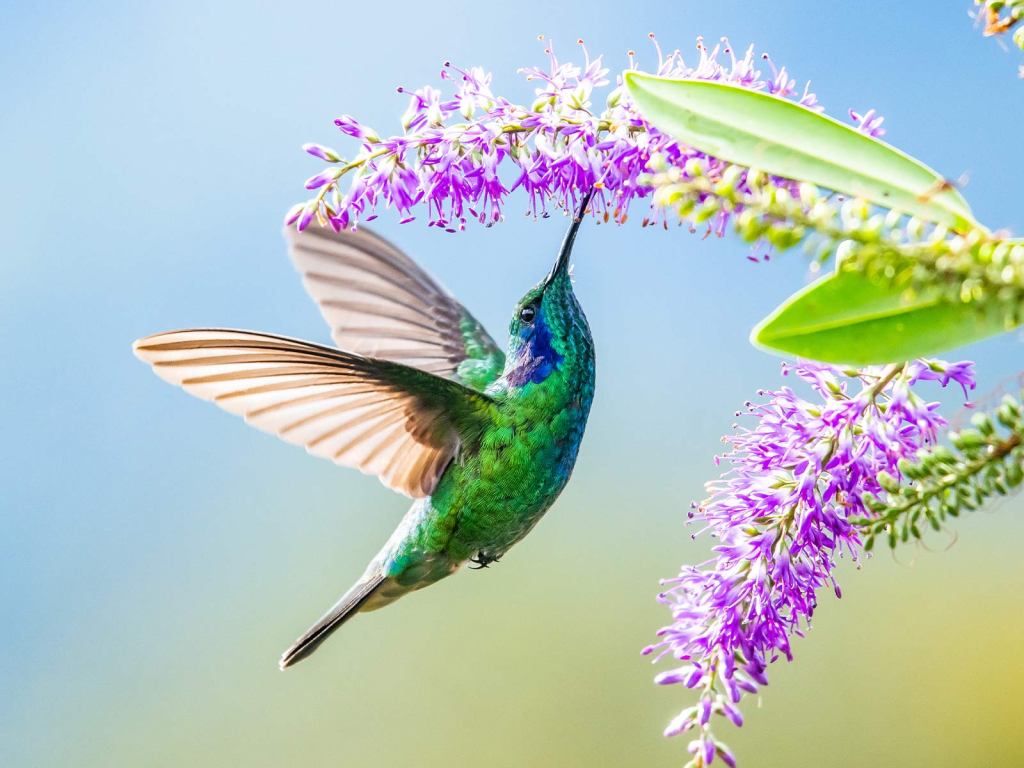
Presented by Zia H Shah MD
Abstract:
Hummingbirds are nature’s aerial marvels, displaying flight abilities unparalleled among birds. They beat their wings with blistering speed (dozens of times per second), tracing a figure-eight path that produces lift on both the downstroke and upstrokenews.vanderbilt.edu. This unique wing motion, combined with extraordinary muscle power and energy metabolism, allows hummingbirds to hover in place, fly backwards and even upside downsmithsonianmag.com. They can accelerate to impressive speeds (exceeding 50 km/h) yet stop on a dime mid-airphys.org, and in courtship dives some reach ~60 mphnationalgeographic.com – the fastest aerial maneuvers relative to body size of any vertebrate. Such feats demand immense energy; hummingbirds consume nectar almost constantly and have the highest metabolic rates among animalshummingbirds.vetmed.ucdavis.eduhopkinsmedicine.org. This article explores the science behind hummingbirds’ amazing flight and physiology – from wing mechanics and muscular power to metabolism and migration – and reflects on how these tiny creatures, through their exquisite design and behavior, exemplify the broader theme that all creation glorifies its Creator. In the end, a thematic epilogue draws on Islamic scripture and metaphysics, linking the hummingbird’s “humming” flight to the concept of nature’s continuous praise of the Divine.
Key Flight Characteristics
Wing Mechanics – Lift on Both Strokes: Hummingbirds flap their wings in a fundamentally different way from other birds. Rather than simply flapping up and down, they rotate and sweep their wings in a horizontal figure-eight patternasknature.org. This means the wing is angled to generate lift both as it pushes down and as it pulls back up. During hovering, a hummingbird’s wing effectively functions like an insect’s wing: by inverting on the upstroke, it continues to produce positive lift even as it moves backwardnews.vanderbilt.edu. High-speed imaging and simulations of a ruby-throated hummingbird have confirmed that about 30% of the lift is generated on the upstroke (with 70% on downstroke), making the upstroke nearly as efficient aerodynamically as the downstrokenews.vanderbilt.edunews.vanderbilt.edu. In contrast, most birds generate lift only on the downstroke and simply fold or raise their wings on the upstroke. This unique wing kinematics allow hummingbirds to hover like bees or helicopter blades, holding steady in front of flowers as they sip nectar.
Maneuverability – Helicopter-Like Agility: The same wing motion that enables hovering also grants hummingbirds exceptional maneuverability. They are the only birds capable of sustained backward flight and can also fly sideways and even briefly upside downsmithsonianmag.com. Field observations and experiments show hummingbirds can execute swift aerobatic turns and flips to evade predators or chase rivals, often appearing to “teleport” from one spot to another in a flashsmithsonianmag.com. Their agility in tight spaces is astounding – for example, they navigate dense foliage by either slipping through gaps sideways (momentarily flying with their body turned sideways) or by tucking their wings and darting straight through like a bulletsmithsonianmag.comsmithsonianmag.com. They can adjust their wingbeat amplitude and body orientation on the fly to avoid obstacles, an ability researchers call a “novel and unexpected method of aperture transit” in birdssmithsonianmag.com. In effect, a hummingbird can hover, reverse, or change direction almost instantaneously, giving it precise control over its position in the air.
Speed and Dives: Although built for agility rather than outright speed, hummingbirds are far from slow. In direct flight they commonly cruise at 20–30 miles per hour, and some species have been clocked at over 33 mph in level flighthummingbirds.vetmed.ucdavis.edunationalgeographic.com. More impressively, during courtship display dives, male hummingbirds reach extreme speeds. The male Anna’s hummingbird, for instance, can plummet in a dive at about 60 miles per hour, which is 385 body lengths per second – making it the fastest vertebrate motion relative to body sizenationalgeographic.com. At the bottom of such a dive, it experiences nearly 10 G’s of acceleration when it pulls out of the swoopnationalgeographic.com. For comparison, fighter pilots risk blacking out beyond ~7 G, yet the 5-gram hummingbird endures this regularly by withstanding the strain for mere fractions of a secondnationalgeographic.com. In normal flight, hummingbirds routinely perform rapid bursts of acceleration and deceleration. They can go from full speed to a full stop “on a dime”, as one research team observedphys.org. This ability to instantly brake and hover is crucial for feeding from blossoms and is enabled by precise modulation of wing strokes and perhaps tail feather adjustments. The hummingbird’s speed and nimbleness, especially in dive displays, illustrate the peak of avian athleticism – with even larger raptors falling short in relative termsnationalgeographic.com.
Energy Demands of Flight: Such acrobatic flight comes at a tremendous energetic cost. Hovering is considered the most energetically expensive form of locomotion in the animal kingdompubmed.ncbi.nlm.nih.gov, and hummingbirds, which often hover for prolonged periods, have pushed this to the extreme. Their wingbeat frequencies range from around 12 beats per second in the largest species to about 50–80 beats per second in typical small hummingbirds, and up to ~90 per second in the tiny bee hummingbirdhopkinsmedicine.orghummingbirds.vetmed.ucdavis.edu. This muscle activity, along with rapid heart rates of ~500–1200 beats per minute, means they burn energy at an almost inconceivable rate. A hummingbird at rest already has a high metabolism, but in flight its oxygen consumption per gram of muscle is the highest recorded for any vertebratepubmed.ncbi.nlm.nih.govpubmed.ncbi.nlm.nih.gov. Consequently, hummingbirds must refuel constantly. On average, they consume one to three times their body weight in food every dayhummingbirds.vetmed.ucdavis.edu. This diet is mostly nectar (a quick source of sugar) supplemented by small insects for protein. The tiny birds feed every 10–15 minutes throughout the day and visit hundreds of flowers dailyhummingbirds.vetmed.ucdavis.edu. If a hummingbird goes more than a couple of hours without eating, it risks starving – a testament to how energy-intensive its flight is. Indeed, one study noted that if hummingbirds were human-sized, they would be burning on the order of 150,000 calories per day to support their lifestylehopkinsmedicine.org. The reward for this voracious appetite is the ability to perform their remarkable flight feats continuously: a well-fed hummingbird can spend hours in motion each day, zipping from flower to flower with barely a moment’s rest.
Aerodynamics and Physiology
Powerful Flight Muscles: To achieve their flying prowess, hummingbirds rely on exceptionally developed flight muscles. The pectoralis (chest) muscles, which power the wings, make up roughly 25–30% of a hummingbird’s total body masshummingbirds.vetmed.ucdavis.edu. (In most other bird species, the flight muscles are only about 15% of body masshummingbirds.vetmed.ucdavis.edu.) These muscles are not only large in proportion, but also extraordinarily specialized. Analyses of hummingbird muscle at the microscopic level show extreme adaptations for aerobic performance. Mitochondria – the “powerhouse” organelles that produce energy in cells – are packed into the flight muscle fibers at densities exceeding 30% of cell volumepubmed.ncbi.nlm.nih.gov. Furthermore, the internal membrane area of those mitochondria (where respiration occurs) is about double that found in typical mammal musclespubmed.ncbi.nlm.nih.gov. In practical terms, a hummingbird’s flight muscle mitochondria can consume oxygen and produce energy at 2× or greater the rate of a comparably sized mammal’spubmed.ncbi.nlm.nih.gov. This endows the bird with enormous aerobic capacity. In addition, a high capillary density supplies abundant blood oxygen to the muscles, and enzymes that manage oxidative stress (like superoxide dismutase) are ramped up to cope with byproducts of intense metabolismpubmed.ncbi.nlm.nih.gov. All these features ensure the flight muscles can contract rapidly and repeatedly without fatiguing. They are often described as “red muscle” (rich in myoglobin and mitochondria) tuned for endurance. In fact, measured by oxygen demand per gram, hummingbird flight muscle outperforms that of virtually any other vertebrate, enabling the prolonged hovering and swift maneuvers that define hummingbird flightpubmed.ncbi.nlm.nih.govpubmed.ncbi.nlm.nih.gov.
Vision and Flight Control: Hummingbirds not only have special wings and muscles, but also a refined sensorimotor system to control their aerobatics. Their eyes are large relative to their head, and their brains have well-developed regions for processing visual motion. Researchers have studied how hummingbirds use visual cues to guide their flight by observing them in controlled flight tunnel experimentsphys.orgphys.org. Interestingly, it appears hummingbirds utilize different visual strategies than insects (and perhaps other birds) when it comes to gauging speed and avoiding collisions. In one study, birds were flown through a tunnel with moving patterns on the walls. Flying insects like bees typically judge their ground speed by the rate at which patterns (“optic flow”) move past their eyes; however, the hummingbirds did not simply match their speed to the moving stripes on the wallsphys.org. Instead, they paid more attention to features like the size of objects: as a pattern or object loomed larger, the bird took it as a cue of approaching a barrierphys.orgphys.org. This suggests that to avoid crashes at high speeds, hummingbirds prioritize looming cues (object expansion) which reliably indicate distance to an obstacle, rather than solely optic flow speedphys.org. On the other hand, for vertical movements (changes in altitude), hummingbirds do respond to pattern motion similar to how insects do. The same experiments showed that when the tunnel’s wall patterns moved up or down (simulating ascent or descent), the birds adjusted their flight accordinglyphys.org. In essence, hummingbirds combine an internal “autopilot” model for forward flight velocity with real-time visual feedback for altitude and precision tasksscience.ubc.cascience.ubc.ca. This dual strategy likely helps them remain stable and agile: they filter out excessive visual noise when zooming forward, yet still react swiftly to avoid obstacles or to hover with millimeter accuracy at a flower. Their vision is even tuned to see into the ultraviolet range, which may aid in recognizing flower cues during high-speed flight. Overall, a hummingbird’s neural control and vision work in harmony with its wings, enabling split-second adjustments in flight – whether it’s weaving through branches or braking mid-air to hover.
Metabolic Marvels: Underlying all of this is a metabolism of almost inconceivable intensity. Hummingbirds have the highest mass-specific metabolic rate of any bird – indeed, of any endothermic animal. One comparison often cited is that a hummingbird’s metabolism is about 100 times faster than an elephant’s (per unit weight)hummingbirds.vetmed.ucdavis.edu. In absolute terms, a hummingbird uses oxygen and burns calories at a rate far above what even an elite athlete of equivalent size would. Researchers at Johns Hopkins University found that hummingbird metabolism runs roughly 77× the rate of a human’shopkinsmedicine.org. To support this, hummingbirds have evolved extraordinary biochemical adaptations. Their digestive system can rapidly absorb sugars and their muscle cells can directly burn glucose and fructose for immediate energy – a capability almost unique among vertebrateshummingbirds.vetmed.ucdavis.edu. In most animals (including humans), fructose must be processed by the liver into glucose or fat before it can be used by muscles; hummingbirds, however, can oxidize fructose on the fly, literally using the sugar from nectar as instant fuel. In fact, much of the sugar they drink goes straight to powering their flight muscles within minuteshopkinsmedicine.org. Any excess sugar is shunted to the liver and converted to fatty acids, which are then stored as fat – crucial for periods of fasting or long flightshopkinsmedicine.org. Their blood sugar levels can spike extremely high (enough to cause pathology in a human), yet hummingbirds avoid sugar shock or insulin issues entirelyhopkinsmedicine.orghopkinsmedicine.org. Their enzymes, especially in liver and muscle, are “hyper-charged” to process fuel and also to mop up metabolic byproductshopkinsmedicine.orgpubmed.ncbi.nlm.nih.gov. The tiny birds also have an oversized heart (constituting ~2.5% of body weight) that can beat over 1,200 times per minute during activity, pumping oxygenated blood to tissues at a frantic pacehopkinsmedicine.org. Breathing rates can exceed 200 breaths per minute at rest and much higher in flight. All these physiological traits enable what one might call a metabolic turbo-engine. However, this engine must idle at night – literally. To avoid starving when they cannot feed, hummingbirds often enter torpor (an energy-saving, hibernation-like state) at night. In torpor, their metabolic rate plummets (sometimes to just 1/15th of normal), heart rate drops to a few dozen beats per minute, and body temperature can fall dramatically. This metabolic “sleep mode” conserves enough energy for the bird to survive until the next morning, when it can refuel with the sunrise. In summary, the hummingbird’s physiology represents an extreme on the spectrum of life’s strategies: it has maximized intake, fuel use, and power output to achieve feats of flight that appear almost miraculous, and it balances on a knife-edge of energy expenditure that it manages with unique adaptations (like torpor and supercharged enzymes).
Migration Endurance and Fuel Strategy
One might think such a tiny, high-strung creature would be incapable of long-distance travel, yet some hummingbirds undertake prodigious migrations. The Ruby-throated Hummingbird (Archilochus colubris), for example, migrates between North America and Central America each year. Remarkably, many of them perform a non-stop flight across the Gulf of Mexico, flying for 18–20 hours straight over ~500 miles of open waterhummingbirds.vetmed.ucdavis.edu. For a bird that weighs about 3 grams, this journey is equivalent to a human running a marathon every day for weeks. How do they manage? The key lies in strategic fuel loading and metabolic efficiency. Before migration, hummingbirds enter a state of hyperphagia – essentially gorging themselves on nectar and insects. A ruby-throat will nearly double its body mass in the days or weeks before crossing the Gulf, going from about 3g to 5+ghopkinsmedicine.orghopkinsmedicine.org. About half of its body weight becomes fat (up from a typical 3-5% fat to nearly 40% fat) stored under the skin and around the bodyhummingbirds.vetmed.ucdavis.edu. This fat is the energy-dense fuel that will be burned during the overwater flight. Studies have shown that as soon as a hummingbird takes off on a long journey, its metabolism shifts primarily to fat oxidation – the bird starts burning its fuel reserves at a high ratehopkinsmedicine.org. It can afford to do so because it has amassed so much fat energy; indeed, by the time it reaches the other side of the Gulf, a hummingbird may have consumed nearly all of its fat stores, arriving lean and hungry but alive.
During such endurance flights, hummingbirds also optimize energy use by selective metabolic control. They predominantly burn fatty acids in flight, which yield more energy per gram than carbohydrates, thus maximizing the miles per gram of fuel. However, unlike larger migratory birds, hummingbirds cannot soar or glide to save energy – they must flap continuously the whole way. This makes their accomplishment even more impressive. Their flying metabolism runs at near maximal capacity for hours on end. Any tailwinds or favorable weather can aid them, but many have been observed to succeed even against headwinds. Besides the famous Gulf crossing of the ruby-throat, other hummingbird species perform altitude migrations (breeding in mountains in summer and descending to lowlands in winter) and lengthy latitudinal migrations along the Americas. For all of them, fuel management is critical. They time their journeys with flowering cycles so that food is available at stopovers, and they arrive at breeding grounds just as resources peak.
It’s worth noting that the ability to use multiple fuel types gives hummingbirds an edge. As mentioned, they can use fructose and glucose directly when available (for immediate power), but they can also switch to burning stored fat when needed. This metabolic flexibility is rare and is part of why hummingbirds can undertake endurance feats. In essence, through evolution they have become high-performance endurance athletes on par with much larger migratory birds. Their tiny size doesn’t limit them when it comes to crossing seas or deserts – it just necessitates careful energy budgeting. Every autumn and spring, these jewel-like birds make journeys that seem disproportionate to their size, guided by instinct and fueled by the energy of thousands of flowers. Many survive the trip against the odds. The successful Gulf crossing of a single 3-gram hummingbird stands as a testament to how efficient and powerful its biology is, that it can carry it across an ocean on ephemeral wings.
Unique Adaptations and Behaviors
Beyond their flight mechanics and metabolism, hummingbirds have some unique tricks to handle environmental challenges:
- Rain Shedding via Shaking: Flying in the rain is tough for any bird, but hummingbirds handle it with vigor. When drenched by raindrops, a hummingbird can shake its head and body at astonishing speeds to shed water. High-speed video observations have shown a hummingbird may shake its head up to 132 times per second in a rapid oscillation, while rotating its head over 200° in the processhummingbirds.vetmed.ucdavis.edu. This rivals the head-shaking frequency of a wet dog, but the hummingbird accomplishes it mid-flight! By oscillating so quickly, they flick off water droplets that could otherwise chill them or add weight. Impressively, they maintain flight control and direction even during these split-second shakeshummingbirds.vetmed.ucdavis.edu. The ability to “vibrate” their bodies in the air is yet another adaptation that helps hummingbirds thrive in less-than-ideal weather, ensuring that even rain can’t keep them from their food sources for long.
- Torpor – Overnight Energy Conservation: As touched on earlier, hummingbirds avoid starvation by entering torpor on cold nights or whenever food is scarce. Torpor is a state of dramatically lowered physiological activity: the bird’s body temperature, which is normally around ~40°C (104°F) when active, can drop to 10–18°C (50s °F), approaching ambient temperature. Heart rate plummets from hundreds of beats per minute to as low as 50–80, and breathing slows greatly. In this state, the hummingbird’s metabolism may be just a few percent of its daytime ratehummingbirds.vetmed.ucdavis.edu. Essentially it becomes temporarily hypothermic and unresponsive – a mini hibernation. Come morning, if conditions improve and the sun warms it up, the hummingbird shivers its muscles to generate heat and gradually “reboots” its system to wake up. Within minutes it can go from near-comatose to hovering and darting about. Torpor can save a tremendous amount of energy; some estimates suggest a hummingbird can conserve about 60% of its energy overnight by using torpor instead of normal sleep. This adaptation is crucial because a hummingbird does not carry large energy reserves (unless fattened up for migration) – it’s like a high-rev engine that must be refueled constantly. Torpor is the bird’s way of parking and idling at a very low energy cost when refueling is not possible. Not all hummingbirds use torpor nightly; it depends on species, individual condition, and temperature. But the capacity for torpor is widespread in the hummingbird family and is another reason these birds can survive in climates where nights get chilly or flowers are only available in the daytime. It is fascinating that such an active creature has this almost paradoxical second mode of existence – essentially, a shutdown mode that allows it to weather life’s metabolic tightrope.
Reflections: Flight as a Sign in Scripture
The seemingly miraculous flying ability of birds has long captivated human observers – not only scientists, but spiritual thinkers as well. In Islamic scripture, the Qur’an invites people to reflect on birds in flight as a sign of divine wisdom and power. Over 1,400 years ago, it posed a striking rhetorical question, when we combine the two verses: Do they not see the birds above them spreading and closing their wings? It is only the Lord of Mercy who holds them up: He watches over everything. (Al Qur’an 67:19) and “Do they not see the birds made to fly through the air in the sky? Nothing holds them up except God. There truly are signs in this for those who believe.” (Al Qur’an 16:79). The description of birds “spreading and folding” their wings is an apt portrayal of flapping flight – one can’t help but think of a hummingbird rapidly opening and closing its wings in a blurphys.org. The scripture asserts that nothing keeps these creatures airborne except God’s sustaining command. To a believer, this does not negate the scientific explanation of aerodynamic lift; rather, the laws of physics are themselves seen as an expression of God’s will that He built into naturethequran.love. The Qur’an highlights that what we view as ordinary (a bird cruising the sky) is actually extraordinary when pondered – a sign (ayah) of a Creator who gifted these animals with the ability to defy gravity in such a graceful manner. Modern science has unraveled many of the mechanisms of bird flight, from the Bernoulli principle to unsteady vortex dynamics, but from a faith perspective, these mechanisms can be understood as the grammar by which God teaches the birds to fly.
In another verse, the Qur’an draws attention to how each creature has its own manner of glorifying the Creator: “Do you not see that Allah is praised by all that is in the heavens and the earth, and the birds with wings outspread? Each knows its mode of prayer and praise.” (Qur’an 24:41). Hummingbirds, with their outspread wings beating 50 times a second, hovering reverently in front of a flower, could be seen as embodying this idea of nature’s praise. While science describes the hummingbird’s relationship with the flower in terms of co-evolution and energy exchange, a spiritual lens adds another layer of meaning: the hummingbird in its daily routine is also engaged in a form of worship, following the instinct and pattern given to it. Its very physiology – from the trill of its wings to its radiant colors – is like a hymn, if one chooses to hear it that way. In Islamic thought, even in the absence of human observers, birds singing at dawn or a hummingbird’s wings humming at a blossom are all considered tasbih (glorification of God)thequran.lovethequran.love. This concept that nature is constantly praising its Creator is woven deeply into the Islamic worldview.
The Qur’an even recounts a story of Prophet David who was granted a special miracle: “Indeed, We subjected the mountains to glorify [Us] with him [David] in the evening and sunrise, and the birds gathered [in flocks], all obedient to him.” (Qur’an 38:18–19). In Islamic lore, the singing of birds and the rustling of leaves were understood as joining in chorus with David’s psalms. Whether one views this as poetic or literal, the imagery is powerful – all of nature as a cosmic choir, with humans sometimes granted a chance to conduct. Hummingbirds, though not mentioned specifically in scripture, would be dazzling members of such a choir with their distinctive hums and aerial dances. In fact, one could imagine their rapid dives and chirps as an enthusiastic soprano section of the avian choir! Joking aside, the notion is that every creature has its own unique way of expressing the glory of existence: mountains in their steadiness, birds in their song and flight, and so onthequran.lovethequran.love.
Epilogue: The Hummingbird’s Hum and the Cosmic Liturgy of Praise
Our exploration of the hummingbird’s flights of wonder – the science of its wings, muscles, metabolism, and feats – ultimately circles back to a sense of wonder itself. It is the same wonder that ancient people felt watching birds, inspiring them to see a spiritual dimension in these creatures. In Islamic metaphysics, there is the beautiful concept of the “cosmic liturgy”: the entire universe is engaged in constant praise of the Creator, each element in accordance with its naturethequran.lovethequran.love. The hummingbird, then, is not just an isolated marvel of evolution – it is part of this grand orchestra. Its rapid wingbeats produce a musical hum (literally, the sound that gives the bird its name) which one might liken to a tiny instrument in the symphony of creation. As one science writer put it, “Hummingbirds produce lift and sound on both the downstroke and upstroke of their wingbeats, creating a steady musical hum instead of the pulsing whoosh of larger birds.”asknature.org. How poetic that the very physics of its flight makes a sound that can be heard as a constant hummed note! It doesn’t take much imagination for a spiritually-inclined person to hear in that hum an echo of praise.
According to the Qur’an, “Whatever is in the heavens and whatever is on the earth is glorifying Him (God).” (57:1 and 59:24) – praise is not a one-time event but a continuous state of the cosmosthequran.lovethequran.love. Modern thinkers have drawn parallels between this idea and scientific concepts. One commentary notes that “scientifically, the immutable laws of physics and the fine-tuning of the cosmos are the modern terminology for the ancient concept of universal submission (tasbih).”thequran.love The laws that govern a hummingbird’s flight – aerodynamic vortices, muscle biochemistry, metabolic pathways – are the “grammar” of the bird’s unspoken prayerthequran.love. By obeying these divinely set laws of nature, the hummingbird is in fact obeying God and thus glorifying God through its very existencethequran.lovethequran.love. In Islamic theology, they say “Existence itself is an act of praise”thequran.love. Every time the hummingbird beats its wings or sips nectar, it is fulfilling the purpose instilled in it, and that fulfillment is its praise.
Far from diminishing this view, scientific discovery enhances it. When we learn that a hummingbird’s heart beats 1,200 times a minute, or that it enters torpor to survive the night, or that it can migrate across an ocean on fat reserves, we are learning the specific verses of its praise. Each new fact is like a note added to a beautiful composition. A recent scholarly reflection put it this way: “To study the laws of physics is to study the grammar of the universe’s prayer. The universe’s praise is an unbroken, ongoing stream.”thequran.lovethequran.love. Indeed, as long as there have been hummingbirds (and other creatures), they have been “humming” their part in this cosmic litany. The Qur’an reminds us that this chorus began long before humans were around – “before the creation of man, the universe was already a temple of praise”thequran.love. Hummingbirds were praising by doing what hummingbirds do, long before we ever took notice.
For those of us enchanted by these tiny birds, there is a message and a gentle challenge. The Qur’an’s verses about birds end by turning the mirror to humanity: if even the birds and mountains glorify, what about us? The hummingbird’s joyous aerobatics and tireless daily labor to live can inspire us to find purpose and awe in our own lives. As one modern commentator concluded, “the final call is for the human being to consciously join the chorus that has been singing since the first moment of creation.”thequran.love. In other words, we too have a place in this cosmic praise – not by humming with wings, but perhaps by using our hearts and minds in gratitude and our tongues in acknowledgment of the wonders around us. The next time you see a hummingbird zipping through a garden, admire its brilliant emerald plumage catching the sun and listen for that soft hum. In that moment, you witness a living testament to the astonishing creativity of nature. The science of the hummingbird tells us how it flies; the spiritual insight reminds us why its flight can move us: it is a sign and a song, inviting us to marvel – and perhaps to join in the quiet praise that everything in the universe, in its own way, is constantly performing.
A hummingbird demonstrates its agility by flying through a narrow gap in an experiment. Hummingbirds can hover in place or dart through tight spaces using unique flight strategies – they truly can fly “in any direction” including sideways and even briefly upside-downsmithsonianmag.com. Their acrobatic maneuvers, enabled by rapid wingbeats and fine muscle control, make them exceptional among birds.
Sources: Scientific findings and facts about hummingbird flight and physiology are drawn from research by biologists and engineers (e.g. Clark et al., 2009 on Anna’s hummingbird dive speedsnationalgeographic.com; Dakin et al., 2016 on hummingbird vision in flightphys.orgphys.org; biomedical studies on metabolismhopkinsmedicine.orghummingbirds.vetmed.ucdavis.edu; and others). Notably, simulations of airflow around hovering hummingbird wings confirm lift generation on both strokesnews.vanderbilt.edu. Physiological data on muscle mitochondria and metabolic rates come from comparative studies in muscle biologypubmed.ncbi.nlm.nih.govpubmed.ncbi.nlm.nih.gov. For Quranic perspectives, translations of verses were used alongside insights from The Cosmic Liturgy: An Exhaustive Analysis of Tasbih in the Qur’anthequran.lovethequran.love, which explores how Islamic thought sees all creatures, like hummingbirds and their remarkable flights, as participating in the praise of the Creator. Each source has been cited inline to ensure accuracy and allow further reading on these fascinating topics.
If you would rather read in the Microsoft Word file:




 The Glorious Quran and Science
Leave a comment