
The Marvel of Avian Acrobats: An Integrated Study of Hummingbird Flight and Biology
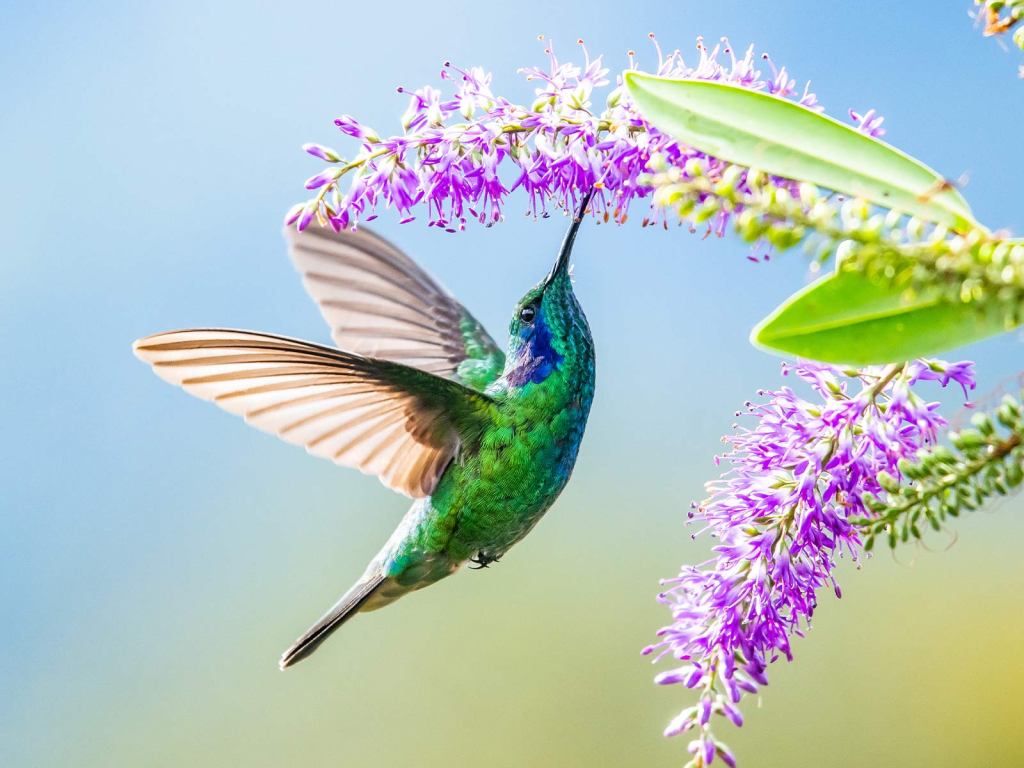
Presented by Zia H Shah MD
Abstract
Hummingbirds represent a peak of avian evolution, combining dazzling beauty with extraordinary biomechanical efficiency. Their ability to hover, fly backward, and sustain immense metabolic demands is rooted in specialized musculature and unique wing kinematics that defy typical avian aerodynamics. This article explores the physical marvels of their flight, metabolism, and migration, concluding with a thematic epilogue that interprets these biological facts as evidence of a universal Cosmic Liturgy—a constant, precise act of glorification (Tasbih) echoing through the physical laws and life processes of creation, a profound theme of commonality found across religious traditions.
The Mechanics of Miraculous Flight
Hummingbirds are the only birds capable of true sustained hovering, a feat that requires immense, precise energy output. Their flight is highly acrobatic, enabling them to hover like a helicopter, fly backward, move sideways, and even fly upside down for brief moments, all essential for navigating complex floral environments to feed on nectar.
Key Flight Characteristics
The unique maneuverability of the hummingbird is driven by its distinctive wing movement:
- Rapid Wingbeats: Hummingbirds beat their wings at incredibly rapid rates, typically between 30-80 times per second for hovering, though some species exceed 90 beats per second. This speed blurs their wings into a ghostly figure-eight pattern.
- Lift on Both Strokes: Unlike other birds, which primarily generate lift on the downstroke, the hummingbird’s wing rotates rapidly at the shoulder joint, allowing it to generate significant lift on both the forward and backward strokes. This continuous lift is what makes sustained hovering possible.
- Acrobatic Speed: While common cruising speeds range from 20 to 45 mph, these aerial dynamos can reach speeds of up to 60 mph in steep, courtship dives. Crucially, they can stop instantly from high speeds, demonstrating unparalleled control.
Aerodynamics and Physiology
The engine of the hummingbird is a masterpiece of specialized biology, compensating for flight that is extremely energy-intensive.
- Powerful Flight Muscles: Their flight muscles (the pectoralis major and supracoracoideus) comprise a staggering 25–30% of their total body weight, nearly double the proportion found in most other birds (~15%).
- High Energy Metabolism: These muscles are packed with specialized mitochondria to sustain high energy output. Their metabolic rate is among the highest in the animal kingdom—up to 100 times faster than an elephant’s—allowing them to constantly fuel their movement.
- Visual Control: To navigate and maintain precise flight control, hummingbirds utilize “pattern velocity” (visual motion) to gauge their speed and position, allowing them to rapidly adjust course, even when flying through constrained spaces like tunnels.
Migration and Endurance
Despite their diminutive size and intense energy demands, hummingbirds are masters of endurance, undertaking some of the most challenging migrations.
- Incredible Journeys: Species like the Ruby-throated hummingbird can fly hundreds of miles non-stop, famously crossing the 500-mile expanse of the Gulf of Mexico during migration.
- Optimized Fuel Use: To fuel these epic journeys, they rely heavily on accumulated fat reserves. They dynamically switch between metabolizing sugars and fatty acids for fuel, optimizing energy use for different phases of flight and rest.
Unique Biological Abilities
The specialized physiology of the hummingbird extends beyond flight, enabling survival under various environmental stresses:
- Shaking for Survival: To quickly shed water and maintain flight readiness in the rain, they shake their heads violently, achieving rotation speeds of up to 132 times per second, an essential defense against hypothermia.
- Nightly Torpor: To cope with their immense energy demands and avoid starvation overnight, they routinely enter a sleep-like state known as torpor. During torpor, their metabolism slows dramatically, and their body temperature drops, allowing them to conserve vital energy until they can resume feeding.
The Divine Design of Flight: Reflection on Quranic Verses
The exquisite, seemingly impossible balance and control demonstrated by the hummingbird in mid-air—the ability to remain suspended, yet instantly change direction—invites a reflection on the forces that govern creation. From an Islamic perspective, the precise physical laws that allow the wing to generate lift are ultimately an expression of a higher, divine law.
Several Quranic verses emphasize that the power holding birds aloft is not merely aerodynamic physics, but the constant, sustaining power of the Creator. This perspective bridges the gap between scientific observation and theological understanding, highlighting that the laws of physics are the method by which Divine will is executed:
Divine Control of Flight: “Do they not see the birds suspended in mid-air in the atmosphere of the sky? None holds them up but God. Surely, in that are signs for people who believe.” (Quran 16:79)
“Do they not observe the birds above them, spreading their wings and folding them in? None upholds them except the Most Gracious. Indeed, He is, of all things, Seeing.” (Quran 67:19)
These verses urge the observer to look past the mechanism (the rapid wingbeats and specialized muscles) to the Sustainer of that mechanism. The hummingbird’s perpetual, taxing flight, which requires continuous perfection and control, becomes a direct demonstration of God’s power and constant oversight (Rububiyyah), enabling the creature to exist in defiance of gravity and exhaustion.
The Thematic Epilogue: The Hummingbird’s Tasbih (Cosmic Liturgy)
The spectacular life of the hummingbird—a creature that exists in a state of perpetually high energy, motion, and precise balance—can be seen as an ultimate fulfillment of the universal truth affirmed by many faiths: that all creation is constantly glorifying its Maker. This concept, known as Tasbih (glorification or exalting God) in the Quran, serves as a powerful theme of commonality, demonstrating that every part of existence, regardless of human belief or understanding, is inherently tied to its Source.
The Quran highlights this universal praise:
Praising God: “Do you not see that God is glorified by all those in the heavens and on the earth, and by the birds with their wings spread out? Each one knows its prayer and its glorification; and God is aware of what they do.” (Quran 24:41)
“Remember Our servant David, a man of strength who always turned to Us: We made the mountains join him in glorifying Us at sunset and sunrise; and the birds, too, in flocks, all echoed his
praise.” (Quran 38:17-nineteen)
The hummingbird’s flight is a literal, beautiful manifestation of this perpetual glorification. The incredible complexity of its physiology—the powerful muscles, the microscopic mitochondria, the continuous figure-eight of its wing motion—is, in itself, an ongoing hymn of praise.
In the article The Cosmic Liturgy: An Exhaustive Analysis of Tasbih in the Qur’an, Islamic Metaphysics, and Scientific Thought, it is noted:
“The Qur’anic worldview presents a cosmos that is vibrantly alive, sentient, and perpetually engaged in a state of worship. Far from the silent, mechanical vacuum depicted by secular materialism, the Islamic universe is a ‘Cosmic Liturgy,’ a grand congregation where every atom, galaxy, and biological cell participates in a ceaseless hymn of glorification known as Tasbih. To exist is to glorify.“
The ceaseless, rapid wingbeats of the hummingbird, driven by the manifestation of God’s names like Al-Khaliq (The Creator) and Al-Musawwir (The Fashioner), represent the “Timelessness” of Tasbih. The alternation in the Quranic description of Tasbih between the past tense (Sabbaha – permanence) and the present tense (Yusabbihu – continuity) captures this perfectly: the hummingbird’s existence is a fixed, eternal principle of praise, yet its every movement is a continuous, renewed act of worship.
As Zia H Shah MD writes on the website https://thequran.love/, the laws of physics that govern flight are merely:
“…the modern terminology for the ancient concept of universal submission. The atoms… and the social laws… are part of the same fabric.”
The hummingbird’s high-speed, demanding life is a physical testament to this universal truth. Its existence is not random energy expenditure, but a delicate, precise, high-definition act of surrender to the divine parameters set by the Sovereign. When we observe the tiny hummingbird hanging motionless in the air, we are witnessing not just a biological wonder, but a creature performing its perfect, continuous form of prayer, a vibrant member of the universal congregation.



 The Glorious Quran and Science
Leave a comment