
Presented by Zia H Shah MD
I. Introduction: The Ontological Anchor of Christendom
For nearly two millennia, the psychological and social architecture of Western civilization was organized around a single, specific ritual act: the Eucharist. Originating from the Greek eucharistia, meaning “thanksgiving,” this rite was not merely a commemorative meal or a symbolic gesture of communal solidarity.1 It was the axis mundi of the Christian cosmos—the precise coordinate where the temporal intersected with the eternal, and where the mundane material world was transfigured into the divine. The claim was audacious, irrational, and psychologically consuming: that through the recitation of specific formulae by an ordained priest, common bread and wine were converted, in their deepest ontological reality, into the Body and Blood of Jesus Christ.
This belief system constituted what might be termed the “psychological experience of the sacred” for the common Christian. It provided a tangible, oral, and corporeal union with the Creator, satisfying a profound human need for contact with the Mysterium Tremendum—the overwhelming mystery of the divine.2 The pre-modern European mind did not experience the world as a closed system of material causes; rather, the world was “porous,” open to the influence of spirits, demons, and grace. The Eucharist was the supreme instance of this porosity, a daily miracle where God became edible, entering the digestive tract of the believer to effect a transformation of the soul.3
However, the trajectory of Western intellectual and social history is the story of the gradual deconstruction of this sacramental realism. As the West transitioned from the medieval synthesis through the Renaissance and into the Enlightenment, the intellectual frameworks that supported the “irrationality” of the Eucharist began to fracture. The rise of empirical science, the philological critique of scripture, and the philosophical skepticism of thinkers like David Hume and Voltaire rendered the doctrine of the Real Presence increasingly untenable to the rational mind.4 The “psychological experience of the sacred,” once anchored in the objective reality of the consecrated Host, was forced to retreat into the subjective realm of “feeling” and “symbol,” eventually evaporating under the glare of psychoanalytic scrutiny and secular indifference.
This report provides an exhaustive examination of this historical and psychological trajectory. It analyzes the theological permutations of the Eucharist across the major Christian denominations, detailing how the shift from “Transubstantiation” to “Memorialism” mirrored the broader disenchantment of the world. It explores the rationalist siege that dismantled the metaphysical plausibility of the sacrament, citing the specific critiques of the Enlightenment philosophes who equated the rite with cannibalism and superstition. Furthermore, it employs the depth psychology of Sigmund Freud, Carl Jung, and Rudolf Otto to diagnose the psychic void left by the abandonment of the ritual. Finally, it examines the concrete sociological manifestation of this collapse: the “empty churches” of 2024 and 2025, fulfilling Friedrich Nietzsche’s parable of the Madman who declared the death of God and the wiping away of the horizon.
II. The Theology of Presence: Divergence and the Fracture of Reality
To understand the magnitude of the loss of the “sacred” in modernity, one must first comprehend the density of what was believed to be present. The history of Eucharistic theology is not merely a history of doctrinal disputes; it is a history of the Western mind attempting to articulate the relationship between matter and spirit. As the definitions fractured, so too did the unified psychological experience of Christendom.
2.1 The Roman Catholic Doctrine: Transubstantiation and the Physics of the Miracle
The Roman Catholic Church maintains the most metaphysically assertive position regarding the Eucharist, a position that anchored the medieval worldview. Codified at the Fourth Lateran Council (1215) and reaffirmed with militant precision at the Council of Trent (1545-1563), the doctrine of Transubstantiation employs Aristotelian categories to explain the mechanism of the miracle.3
The Church teaches that upon the priest’s consecration, the substance (the essential reality or “is-ness”) of the bread and wine is wholly converted into the substance of the Body and Blood of Christ. Crucially, the accidents (the empirical properties such as taste, smell, texture, weight, and chemical composition) remain those of bread and wine. This distinction is vital for understanding the pre-modern psyche. It asserts that reality is not limited to empirical sense data. A peasant in 13th-century France participating in the Mass believed they were gazing upon and consuming the Creator of the universe, despite the sensory contradiction. This act required a suppression of the empirical senses in favor of a metaphysical truth, training the mind to prioritize spiritual authority over material observation.1
The psychological implication of this doctrine is profound. It creates a world where things are not what they seem, where the divine is hidden beneath the mundane. The Eucharist is also understood as a “propitiatory sacrifice,” making the Cross present in an unbloody manner. This allows the believer to actively participate in the mechanism of salvation, not just as a spectator but as a beneficiary of a cosmic transaction occurring hic et nunc (here and now).3 The priest, acting in persona Christi, becomes a mediator of ontological change, wielding a power that transcends the laws of nature.
2.2 The Eastern Orthodox Approach: Metousiosis and the Apophatic Mystery
In contrast to the Latin West’s desire for scholastic definition, the Eastern Orthodox Church approaches the Real Presence through apophaticism—the refusal to define divine operations too strictly. While Orthodoxy affirms that the elements truly become the Body and Blood of Christ (using the term metousiosis or “change of essence” after the 17th century to counter Protestantism), they generally reject the rigid Aristotelian distinction between substance and accidents.1
For the Orthodox, the Eucharist is a “Mystery” (Sacrament). The change is attributed to the epiklesis—the invocation of the Holy Spirit upon the gifts—rather than solely the recitation of the Words of Institution (“This is my Body”). This theological nuance preserved a sense of cosmic mystery in the East that was arguably eroded in the West by the attempt to explain the “physics” of the sacrament.8 By keeping the mechanism of the change shrouded in mystery, the Orthodox psyche maintained a reverence for the ineffable, protecting the experience of the sacred from the dissecting knife of rationalism that would eventually plague the West. The use of leavened bread (symbolizing the risen, living Christ) versus the Western unleavened bread (symbolizing the sinless, distinct Christ) further highlights the Eastern emphasis on the vital, mystical union over the legalistic or substantial definition.8
2.3 The Lutheran Sacramental Union: The Iron and the Fire
The Protestant Reformation introduced the first major fractures in the psychological experience of the Eucharist. Martin Luther, while rejecting Transubstantiation as a philosophical overreach and a “scholastic sophistry,” vehemently retained the doctrine of the Real Presence. He proposed a Sacramental Union (often mislabeled Consubstantiation), teaching that the true body and blood of Christ are present “in, with, and under” the forms of bread and wine.1
Luther employed the analogy of a glowing iron rod in a fire: the fire (Christ) and the iron (bread) are united in a single red-hot reality, yet neither destroys the nature of the other. The iron remains iron; the fire remains fire; yet they are inseparable in the experience of the heat. This view attempted to preserve the objective sacredness of the object without negating the physical reality of the bread, representing a bridge between the medieval worldview and the emerging empiricism.1 However, by removing the “miracle” of the annihilation of the bread’s substance, Luther inadvertently opened the door to questioning the necessity of the metaphysical claim at all.
2.4 The Reformed and Presbyterian Shift: Spiritual Presence and Receptionism
The decisive break from the “objective” sacred occurred with John Calvin and the Reformed tradition. Calvin rejected both Transubstantiation and the Lutheran Union, arguing on Christological grounds that Christ’s physical body is locally present in Heaven (at the “Right Hand of the Father”) and therefore cannot be physically, locally present in the elements on earth.1
In this theology, the Holy Spirit acts as the bridge, uniting the believer on earth with Christ in heaven. The “feeding” is real but spiritual, received only by faith. This is often termed “Receptionism,” implying that the presence is contingent on the disposition of the receiver. If a non-believer consumes the elements, they receive only bread and wine (the manducatio impiorum is denied), whereas in the Catholic and Lutheran view, the objective reality of Christ is present regardless of the recipient’s belief.1
This theological shift marks the beginning of the “subjectivization” of the sacred. The locus of the miracle moved from the object (the bread) to the subject (the believer’s psychology). The bread became a “sign” and a “seal,” but not the thing itself. This set the stage for the modern era, where the sacred is entirely a construct of the human mind rather than an external reality to be encountered.
2.5 The Zwinglian and Memorialist Turn: The Empty Symbol
At the far end of the spectrum lies the view of Huldrych Zwingli and many modern evangelical/Baptist traditions: Memorialism. Here, the Eucharist is purely a commemorative meal. The bread and wine are symbols prompting mental recollection of Christ’s death, similar to looking at a photograph of a lost loved one. There is no ontological change, no spiritual presence in the elements, and no “eating of God”.10
Psychologically, this represents the total disenchantment of the ritual. The “sacred” is stripped from the material object and resides solely in the cognitive memory of the participant. The terror and awe of the Mysterium Tremendum are replaced by the somber reflection of the funeral.
Table 1: Comparative Eucharistic Theologies
| Denomination | Doctrine | Locus of Presence | Mechanism | Psychological Focus |
| Roman Catholic | Transubstantiation | Objective (In the elements) | Change of substance; accidents remain | Awe, Adoration, Consumption of Deity |
| Eastern Orthodox | Real Presence / Mystery | Objective (In the elements) | Work of Holy Spirit (Epiklesis); undefined | Mystical Union, Participation in Divine Life |
| Lutheran | Sacramental Union | Objective (In/With/Under) | Union of natures (Iron/Fire analogy) | Paradox, Trust in the Word |
| Reformed | Spiritual Presence | Subjective/Relational | Holy Spirit unites believer to Heaven | Faith, Spiritual Nourishment, Ascent |
| Baptist/Memorialist | Memorialism | Cognitive (Memory only) | Mental recollection; no ontological change | Remembrance, Obedience, Community |
III. The Rationalist Siege: From Renaissance Critique to the Death of Magic
The “irrationality” of the Eucharist—the claim that a finite object contains the infinite, and that bread is flesh—became the primary target of the intellectual movements that birthed modernity. As the West moved from the Renaissance into the Enlightenment, the psychological capability to sustain the “double-think” of Transubstantiation collapsed under the weight of empiricism and rational critique.
3.1 The Critique of Substance and Accidents: The Collapse of Metaphysics
The Renaissance recovery of classical skepticism and the subsequent Enlightenment scientific revolution made the Aristotelian distinction between “substance” and “accidents” increasingly untenable. Early rationalists and Reformers argued that the Catholic position broke the laws of logic and nature. As noted in theological critiques, Transubstantiation posits “the appearances of bread without breadiness,” essentially claiming that accidents (properties) can exist without a subject (substance) in which to inhere.4
For the rational mind, this was a philosophical absurdity. “What does quantity inhere in?” the critics asked. If the bread weighs an ounce, has a white color, and tastes like wheat, but is “actually” the body of a man who lived 1700 years ago, then the connection between perception and reality is severed. Enlightenment thinkers argued that if God could deceive the senses in the Eucharist, then the Apostles could have been deceived about the Resurrection. The entire epistemological foundation of Christianity was placed at risk by the insistence on this “miracle”.4
John Tillotson, the Archbishop of Canterbury (1630–1694), articulated this rationalist critique with devastating clarity. He argued that Transubstantiation was not just false, but impossible to believe without destroying the very faculties of judgment used to believe it. “That our Lord having left us no other image of himself but the Sacrament,” Tillotson argued, “we ought to make no other image of our Lord.” But if the Sacrament is the Lord, then the image and the reality are collapsed in a way that defies reason.12
3.2 Hume, Miracles, and the Empirical Assault
David Hume, the Scottish empiricist, delivered the most damaging philosophical blow to the Eucharistic worldview in his seminal essay “Of Miracles” (Section X of An Enquiry Concerning Human Understanding, 1748). Hume did not just attack the Eucharist; he attacked the epistemological framework that allowed for it.
Hume’s central maxim was that “a weaker evidence can never destroy a stronger.” He argued that the evidence of the senses (that the host looks, tastes, and smells like bread) is immediate, constant, and universally verifiable. In contrast, the evidence for the Real Presence relies on the testimony of ancient texts and the authority of tradition—forms of evidence that are derivative and prone to error.5
Hume explicitly cited the “doctrine of the real presence” as the ultimate example of a belief that “contradicts sense.” He wrote:
“But a weaker evidence can never destroy a stronger; and therefore, were the doctrine of the real presence ever so clearly revealed in scripture, it were directly contrary to the rules of just reasoning to give our assent to it. It contradicts sense, though both the scripture and tradition, on which it is supposed to be built, carry not such evidence with them as sense.” 13
For Hume, the Eucharist was the test case for the irrationality of religion. If one accepts the Eucharist, one must abandon the “rules of just reasoning.” This marked the moment where the “psychological experience of the sacred” was formally divorced from the definition of “sanity.” To be a rational modern subject was to reject the Real Presence; to accept it was to embrace a cognitive dissonance that the Enlightenment deemed unacceptable.14
3.3 Voltaire, Diderot, and the Satire of “Cannibalism”
If Hume provided the philosophical coffin for the Eucharist, the French Philosophes drove the nails in with satire and ridicule. They stripped the Eucharist of its mystical veil, reducing it to anthropology and barbarism.
Voltaire, the titan of the Enlightenment, viewed the Eucharist not as a holy mystery but as a grotesque superstition. In his correspondence with Frederick the Great, he famously ridiculed the practice, stating:
“[N]either antiquity nor any other nation has imagined a more atrocious and blasphemous absurdity than that of eating God. This is how Christians treat the autocrat of the universe.” 15
For Voltaire, the idea of “eating God” (theophagy) was a sign of intellectual immaturity. It was a primitive remnant that civilized man must outgrow. The notion that the Creator of the vast Newtonian universe could be compressed into a wafer and digested by a human being was, to Voltaire, the height of human arrogance and folly.
Denis Diderot’s Encyclopédie (1751-1772) employed a subtler but perhaps more devastating tactic. Utilizing the structure of the encyclopedia itself as a weapon, the editors used “cross-references” to subvert religious authority. As noted in historical analyses, the Encyclopédie linked articles on “Eucharist,” “Communion,” and “Altar” with “Cannibalism” and “Anthropophagy”.16 By taxonomically categorizing the Christian holy of holies alongside primitive flesh-eating rituals of the New World, Diderot re-framed the psychological experience of the Eucharist from “divine communion” to “savagery.”
This linguistic reframing had a profound psychological effect. It made the Eucharist socially and intellectually embarrassing. The “sacred” requires reverence to exist; satire is the universal solvent of reverence. By mocking the Host as a “god of dough” subject to digestion and decay, the Enlightenment thinkers disenchanted the object, turning it from a vessel of divinity into a target of wit.18
IV. The Psychological Architecture of the Sacred: Freud, Jung, and Otto
As the theological and philosophical validity of the Eucharist waned, the 20th century saw the rise of psychological theories attempting to explain what the ritual was doing to the human mind. The “psychological experience of the sacred” did not disappear; it was pathologized or re-interpreted as a function of the unconscious.
4.1 Freud: Totem, Taboo, and the Eating of the Father
Sigmund Freud, the father of psychoanalysis, viewed the Eucharist through the lens of his anthropological and psychological theory of the “primal horde.” In Totem and Taboo (1913), Freud argued that the roots of all religion lie in the collective guilt of the sons who killed the primal father to possess his women and power. Overwhelmed by remorse, the sons established a “totem animal” as a substitute for the father, which was forbidden to be killed—except during the ritual “totem meal”.19
For Freud, the Christian Eucharist is the most explicit, albeit sublimated, survival of this primitive mechanism. The “Son” (Christ) offers himself to appease the Father’s wrath, and the community consumes the Son/God to internalize the divine authority and expiate their “parricide guilt” (Original Sin). Freud famously stated:
“The psycho-analysis of individual human beings teaches us with quite special insistence that the god of each of them is formed in the likeness of his father… and that at bottom God is nothing other than an exalted father.” 19
In this view, the Eucharist is a psychological compulsion—a repeated ritual to manage the neurosis of guilt. It is a “festival of atonement” rooted in a prehistoric crime. The loss of this ritual in modernity, Freud implies, leaves the “parricide guilt” unmanaged. Without the ritual outlet of the Mass, this free-floating guilt manifests as secular neuroses or is projected onto political leaders (the “Rex” figure), leading to the rise of totalitarianism as a secular substitute for the church.21
4.2 Jung: Transformation Symbolism and Individuation
Carl Jung offered a more sympathetic, though still psychological, interpretation. In his essay “Transformation Symbolism in the Mass” (1942), Jung argued that the Eucharist is a projection of the process of individuation—the psychological journey toward the integration of the self. The transformation of the bread and wine represents the transformation of the human psyche from the raw, unconscious state (nature) to a spiritualized, conscious whole (spirit).22
Jung believed that the Mass functioned as a “psychic dam” or container. It captured the dangerous, numinous energies of the collective unconscious—specifically the archetype of the “Self” or “God-image”—and allowed the individual to encounter them safely through ritual. The liturgy mediated the contact between the ego and the unconscious.24
Jung warned that the “excarnation” and rationalization of the West were psychologically dangerous. He believed that as these rituals lose their power (the “death of God”), the psychic energy previously contained in the sacrament spills over into the secular world. It is not destroyed; it is displaced. It manifests as mass movements, ideologies, and “isms”—essentially, the worship of the State or the Ego. For Jung, the “empty churches” signal a psyche in peril, stripped of its protective symbolic machinery and left vulnerable to the “demons” of the unconscious, now wearing political or technological masks.25
4.3 Rudolf Otto: The Numinous and the “Wholly Other”
The German theologian and philosopher Rudolf Otto provided the most distinct phenomenology of the sacred in his seminal work The Idea of the Holy (1917). Otto described the core religious experience as an encounter with the Numinous, characterized as the Mysterium Tremendum et Fascinans—a mystery that is both terrifying (tremendum) and fascinating (fascinans).2
The Eucharist was the primary vehicle for this encounter in the Western tradition. It presented the “Wholly Other” (God) in a tangible form that induced “creature-feeling”—a sense of absolute dependence and insignificance before the majesty of the divine.28 The Latin Mass, with its silence, incense, and unintelligible language, cultivated this sense of the “Other.”
The decline of the Eucharist represents the loss of access to the Mysterium Tremendum. Modernity has domesticated the world; there is no longer a designated space for the “terrifying” aspect of the divine. Consequently, the psychological need for awe remains unfulfilled. Otto’s analysis suggests that when the Church becomes too rational, too understandable, and too “horizontal” (focused on community rather than transcendence), it ceases to facilitate the Numinous experience. The modern “empty church” is empty because it is no longer the house of the Tremendum; it is merely a meeting hall, and the human soul seeks the Numinous elsewhere—in horror movies, extreme sports, or the sublime terror of the technological singularity.29
4.4 Ritual Failure and the Modern Psyche
Contemporary ritual theory helps explain why the Eucharist fails to hold the modern subject. As noted in snippets 30 and 31, for a ritual to be effective (performative efficacy), it requires a “shared social imaginary”—a common agreement on the rules of the game. It also requires “sincerity” and “opacity” (a sense that the ritual is not just made up by humans).
In the modern West, the consensus on the “rules” of reality has shifted to scientific materialism. When a modern person enters a church, they experience “ritual opacity”—they do not understand the symbols, and they suspect the performers (priests) are either insincere or deluded. The “risk” of the ritual—that one is handling the dangerous Body of God—is gone. Without the risk, there is no psychological payoff. The ritual becomes a “misfire” or an “abuse” (in Austin’s speech act terms), failing to precipitate the change in the subject that it promises.31
V. Nietzsche’s Parable: The Death of God and the Wiping of the Horizon
No analysis of the collapse of the sacramental worldview is complete without Friedrich Nietzsche’s diagnosis in The Gay Science (1882), specifically Section 125, “The Madman.” This parable is not merely an assertion of atheism; it is a lament for the loss of the metaphysical horizon that the Eucharist once sustained. It serves as the prophetic script for the 21st century’s empty churches.
5.1 “Who Gave Us the Sponge to Wipe Away the Entire Horizon?”
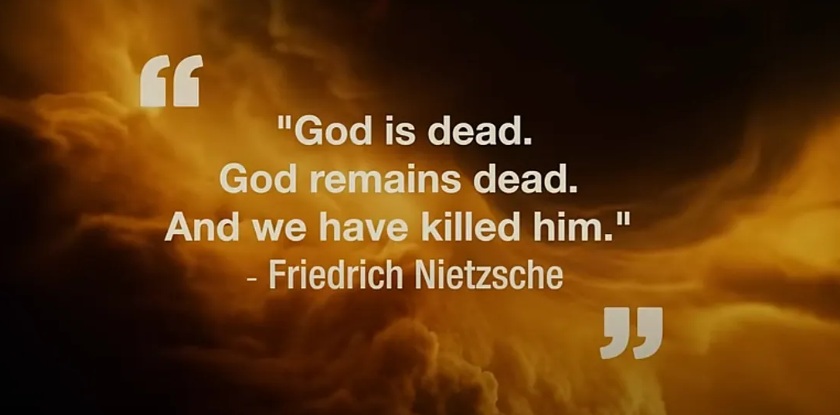
In the parable, a Madman runs into the marketplace carrying a lit lantern in the bright morning hours, crying, “I seek God! I seek God!” When mocked by the secularizing crowd (the “unbelievers” who represent the complacent Enlightenment rationalists), he screams his verdict: “God is dead! God remains dead! And we have killed him!”.32
The Madman then asks a series of terrifying cosmological questions that map perfectly onto the loss of the sacramental worldview:
“How were we able to drink up the sea? Who gave us the sponge to wipe away the entire horizon? What were we doing when we unchained this earth from its sun? Where is it moving to now? Where are we moving to? Away from all suns? Are we not continually falling?” 33
The “Horizon” represents the absolute frame of reference—the sacred order that gave meaning to all human action. The Eucharist was the anchor of this horizon. By “eating God,” the Christian was oriented within a cosmic drama. To “wipe away the horizon” is to remove the absolute reference point.
The “Unchaining of the earth from its sun” signifies the loss of gravitational center. In the Eucharistic cosmos, the Earth revolved around the Sun of God’s presence. Without the Real Presence, there is no longer a physical link between heaven and earth; the earth drifts in a cold, indifferent void (nihilism). The psychological sensation is one of “falling”—a vertigo caused by the absence of a sacred ground.
5.2 “What Festivals of Atonement Will We Have to Invent?”
Crucially, the Madman asks:
“The holiest and the mightiest thing the world has ever possessed has bled to death under our knives: who will wipe this blood from us? With what water could we clean ourselves? What festivals of atonement, what holy games will we have to invent for ourselves?”.32
This is a direct allusion to the Eucharist, which is the Christian “festival of atonement” (Hilasterion). Nietzsche understood that the death of God leaves a vacuum of guilt and the need for ritual. The “blood” on the knives is the guilt of deicide—the guilt of killing the Sacred Source of meaning.
If the Eucharist is the mechanism by which guilt is removed and communion is restored, its obsolescence implies that modern man is left with his guilt but without the ritual means to expiate it. We must “invent” new games—new secular rituals—to cope. This anticipates the rise of the “secular sacred”: the Nuremberg Rallies, the rock concert, the sports stadium, the therapeutic session. These are the “games” we have invented to replace the Mass, trying desperately to become “gods ourselves” to be worthy of the murder we committed.
5.3 “I Come Too Early”: The Prophecy of the Empty Church
The Madman finally throws his lantern on the ground, shattering it, and declares:
“I come too early… my time is not yet. This tremendous event is still on its way, wandering; it has not yet reached the ears of men… This deed is still more remote to them than the remotest stars – and yet they have done it themselves!”.32
Nietzsche recognized that even though the intellectual death of God had occurred (via the Enlightenment critiques of Hume and Voltaire), the sociological collapse had not yet fully materialized. The churches were still standing in 1882; the habits of Christendom lingered.
The “empty churches” of 2024-2025 are the arrival of the event the Madman predicted. The “deed” has finally reached the ears of men. The “tombs and sepulchers of God,” as the Madman calls the churches in his requiem, are now visible in every European city. The psychological experience of the sacred has not just faded; it has been structurally dismantled. We are living in the time the Madman foresaw.
VI. Disenchantment and Excarnation: The Sociological Mechanisms of Loss
Why did the “psychological experience of the sacred” disappear so thoroughly? Two primary sociological theories explain the mechanics of this collapse: Max Weber’s Disenchantment and Charles Taylor’s Excarnation.
6.1 Max Weber and the Entzauberung (Disenchantment)
Max Weber argued that modernity is characterized by Entzauberung, literally “de-magic-ation”.35 In the pre-modern world, the Eucharist was effective because the world was viewed as “enchanted.” Spirits, grace, and demons were causal agents that could inhabit material objects. The Eucharist was “magic” in the technical anthropological sense: a ritual act that altered ontological reality.
With the rise of scientific rationality, the world became opaque and strictly causal. “There are no mysterious incalculable forces that come into play… one can, in principle, master all things by calculation”.35 In a disenchanted world, bread is chemically starch and gluten. It cannot be the Body of Christ because the category of “sacramental substance” no longer exists in the cognitive map of the modern West.
The Eucharist, stripped of its “magic,” becomes a mere symbol—a “memorial” that effects no change. As Weber noted, this leads to a profound “sense of loss” as the richness of the mythical world evaporates. The modern individual is trapped in the “iron cage” of rationality, where efficiency reigns but meaning is scarce. The empty church is the architectural symbol of this cage—a space designed for magic that now sits vacant because the magic has been explained away.36
6.2 Charles Taylor and Excarnation
In his monumental work A Secular Age, philosopher Charles Taylor describes the shift from medieval to modern religion as a process of Excarnation—the transfer of religious life out of bodily forms of ritual and into the “head”.37
Pre-modern Christianity was “embodied.” It was smelled (incense), tasted (Eucharist), touched (relics), and enacted (processions, pilgrimage). The Reformation and the subsequent Enlightenment prioritized “belief”—cognitive assent to propositions—over ritual participation. Religion became something you thought, not something you did.
Taylor argues that this “excarnation” made religion fragile. A “head-centric” faith is vulnerable to intellectual doubt. If the Eucharist is just a mental reminder, one can easily forget it or replace it with another thought. But if the Eucharist is a physical consumption of the divine, it bypasses the intellect and roots itself in the body/habit.
The “empty churches” are the result of a faith that was excarnated until it became a ghost, and finally, a nothingness. We moved from “eating God” to “thinking about God” to “forgetting God.” The body was left behind, and without the body, the spirit evaporated.39
VII. The Hollow Sanctuary: Demographics of the Void (2024-2025)
The philosophical and psychological shifts described above have manifested in concrete sociological data. The “empty churches” are not merely a cliché or a temporary dip; they are a statistical reality representing the final collapse of the Eucharistic community in the West.
7.1 The Rise of the “Nones” and the Decline of Attendance
Recent data from 2024 and 2025 confirms a precipitous, almost terminal, drop in religious affiliation and attendance across the Western world.
- United States: The decline in the U.S. is accelerating. According to Gallup (2025), the percentage of Americans saying religion is important in their daily life dropped from 66% in 2015 to 49% in 2025.40 This is one of the steepest declines in the OECD. Church attendance has flatlined, with only 3 in 10 Americans attending weekly (21% weekly, 9% almost weekly). The “Nones” (unaffiliated, agnostics, atheists) are now the largest single “religious” demographic in many Western contexts, particularly among the young.41
- France: In the “Eldest Daughter of the Church,” the collapse is stark. Data from 2025 indicates that only 41% of French people believe in God, while 59% declare themselves unbelievers. Less than 2% of the population are “practicing Catholics” (weekly attendance). While there is a slight “renaissance” of adult baptisms (10,384 in 2025, a 45% increase), this is a “remnant” phenomenon—a small, intense core forming in a sea of secularism.42
- Germany: The institutional exit is massive. The Kirchenaustritt (formal church leaving) continues to hemorrhage members. In 2024 alone, over 300,000 Catholics and 345,000 Protestants officially deregistered. This is driven partly by the church tax, signaling that the Eucharist no longer holds value worth paying for. The German Catholic Church is described as “dying a painful death”.45
7.2 Church Closures: The Physical Erasure of the Sacred
The physical landscape of Europe is changing to reflect the death of the Eucharist. The “tombs of God” are literally being closed or repurposed.
- United Kingdom: A 2025 survey by the National Churches Trust warns that up to 2,000 churches could close by 2030. Rural churches are particularly vulnerable, with 7% facing imminent closure due to lack of funds and congregants. The survey highlights that 5% of churches are “definitely” or “probably” going to close within five years.48
- Adaptive Reuse and Profanation: Across the Netherlands, Germany, and Scandinavia, churches are being repurposed as skate parks, nightclubs, bookstores, and apartments.50 This is the ultimate “disenchantment”—the sacred space is not just abandoned; it is profaned, returned to secular utility. The “Gate of Heaven” becomes a coffee shop.
Table 2: The Collapse of the Eucharistic Assembly (2024-2025 Statistics)
| Region | Metric | Data Point | Source |
| USA | Importance of Religion | Dropped to 49% (2025) from 66% (2015) | Gallup 40 |
| USA | Weekly Attendance | ~30% (21% weekly, 9% almost weekly) | Gallup 41 |
| Germany | Departures (Catholic) | >300,000 formally left in 2024 | Catholic Culture 45 |
| Germany | Departures (Protestant) | 345,000 formally left in 2024 | Reddit/EKD Stats 46 |
| UK | Projected Closures | ~2,000 churches by 2030 | National Churches Trust 48 |
| France | Belief in God | 41% believe; 59% unbelievers (2025) | Ifop 44 |
| France | Adult Baptisms | 10,384 (2025) – A “Remnant” Increase | CNA 43 |
7.3 The “Remnant” and the Future
Interestingly, the data shows a polarization. While the “middle” is collapsing (cultural Christians are leaving), the “core” is hardening. The rise in adult baptisms in France and the stability of “Traditional Latin Mass” communities suggests that those who do remain are seeking the “high voltage” version of the sacred—the very version that rationalism tried to kill.42 They are seeking the “risk” and the “magic” that the modern liberal church abandoned in its attempt to be relevant. However, statistically, this is a minority movement. For the vast majority of the West, the psychological experience of the sacred is dead.
VIII. Conclusion: The Psychological Experience of the Sacred Has Disappeared
The trajectory from the Last Supper to the empty cathedrals of the 21st century is the story of the West’s psychological restructuring. The Eucharist was more than a ritual; it was the mechanism by which Western man integrated his psyche with the cosmos. It provided a daily method for metabolizing guilt, encountering awe (the Mysterium Tremendum), and physically internalizing the divine. It was the “medicine of immortality” and the anchor of the “horizon.”
The deconstruction of this mechanism—first by the theological hair-splitting of the Reformation, then by the empiricism of Hume and the satire of Voltaire, and finally by the psycho-social displacements of the 20th century—has left a void. Nietzsche’s Madman was correct: the sponge has wiped away the horizon. The “death of God” was not just an intellectual event; it was a ritual event. When we stopped “eating God,” we stopped being the people who could eat God.
The “psychological experience of the sacred” has largely disappeared because the conditions for its existence—a porous world, an embodied faith, and a reverence for the irrational—have been systematically dismantled by the very civilization the Eucharist built. We are left, as Weber predicted, in a “polar night of icy darkness,” rational, efficient, and profoundly disenchanted. We wander the marketplace of modernity, lantern in hand, inventing new “festivals of atonement” (politics, consumption, therapy) to quiet the unease of a species that once dined with the Divine but now eats bread alone. The churches stand empty not because the doors are locked, but because the Ghost has left the machine, and the modern psyche no longer knows how to invite Him back.
Works cited
- Five views of the Eucharist – Christianity in View, accessed November 30, 2025, http://christianityinview.com/eucharist.html
- The Numinous Experience (Indication of the Interior Sense of God: #1) – Magis Center, accessed November 30, 2025, https://www.magiscenter.com/blog/numinous-experience
- Eucharistic Theology in Christian Denominations and Its Scientific, Philosophical, and Islamic Refutation – The Glorious Quran and Science, accessed November 30, 2025, https://thequran.love/2025/07/18/eucharistic-theology-in-christian-denominations-and-its-scientific-philosophical-and-islamic-refutation/
- A Critique of Transubstantiation | The North American Anglican, accessed November 30, 2025, https://northamanglican.com/why-do-we-reject-transubstantiation/
- Hume’s syllogism against transubstantiation – prior probability, accessed November 30, 2025, https://priorprobability.com/2025/03/03/next-up-david-humes-essay-of-miracles/
- Transubstantiation – Wikipedia, accessed November 30, 2025, https://en.wikipedia.org/wiki/Transubstantiation
- Transubstantiation and the Eucharist – The Coming Home Network, accessed November 30, 2025, https://chnetwork.org/2010/03/16/transubstantiation-and-the-eucharist/
- The Eucharist, origins and a comparison between traditions – Hamish Powell, accessed November 30, 2025, https://hamishpowell.com/blog1/theeucharistcomparison
- Theological differences between the Catholic Church and the Eastern Orthodox Church, accessed November 30, 2025, https://en.wikipedia.org/wiki/Theological_differences_between_the_Catholic_Church_and_the_Eastern_Orthodox_Church
- A Protestant Discovers Transubstantiation – Universal Life Church, accessed November 30, 2025, https://www.themonastery.org/training/sermons/a-protestant-discovers-transubstantiation
- What If Protestants Are Right About the Eucharist? | Catholic Answers Magazine, accessed November 30, 2025, https://www.catholic.com/magazine/online-edition/what-if-protestants-are-right-about-the-eucharist
- History and Philosophy of Transubstantiation | Isseicreekphilosophy’s Blog – WordPress.com, accessed November 30, 2025, https://isseicreekphilosophy.wordpress.com/2012/02/24/history-and-philosophy-of-transubstantiation/
- Of Miracles – Hume Texts Online, accessed November 30, 2025, https://davidhume.org/texts/e/10
- C.S. Lewis’s Critique Of Hume On Miracles – ePLACE: preserving, learning, and creative exchange, accessed November 30, 2025, https://place.asburyseminary.edu/cgi/viewcontent.cgi?article=2076&context=faithandphilosophy
- Christianity – Wikiquote, accessed November 30, 2025, https://en.wikiquote.org/wiki/Christianity
- Diderot’s 1750 Encyclopedia – OER Project, accessed November 30, 2025, https://www.oerproject.com/OER-Materials/OER-Media/Videos/WHP-1200/Unit4/Diderots-1750-Encyclopedia
- Diderot’s 1750 Encyclopedia – Transcript – OER Project, accessed November 30, 2025, https://www.oerproject.com/-/media/WHP/PDF/Transcripts/Diderots_1750_Encyclopedia.pdf
- On the Eucharist and Human Digestion? – Christianity Stack Exchange, accessed November 30, 2025, https://christianity.stackexchange.com/questions/64057/on-the-eucharist-and-human-digestion
- Sigmund Freud: Religion | Internet Encyclopedia of Philosophy, accessed November 30, 2025, https://iep.utm.edu/freud-r/
- Totem and Taboo (Chapter 2) – Freud and Religion – Cambridge University Press, accessed November 30, 2025, https://www.cambridge.org/core/books/freud-and-religion/totem-and-taboo/EF968DF6A97E0AAAD1F06166051E33E8
- Totem, Taboo and the Concept of Law: Myth in Hart and Freud – Washington University Open Scholarship, accessed November 30, 2025, https://openscholarship.wustl.edu/cgi/viewcontent.cgi?article=1003&context=law_jurisprudence
- Readings in Jung: “Transformation Symbolism in the Mass” Online Study Group, accessed November 30, 2025, https://jungstlouis.org/product/readings-in-jung-transformation-symbolism-in-the-mass-online-study-group/
- The Collected Works of C.G. Jung: Volume 11: Psychology and Religion: West and East – Association of Jungian Analysts, accessed November 30, 2025, https://www.jungiananalysts.org.uk/wp-content/uploads/2018/07/C.-G.-Jung-Collected-Works-Volume-11_-Psychology-and-Religion_-West-and-East.pdf
- ‘Transformation Symbolism in the Mass’ by Carl Jung (1940), accessed November 30, 2025, http://ahistoryofthepresentananthology.blogspot.com/2013/06/psychology-and-religion-by-carl-jung.html
- Individuation and the Self – The SAP – The Society of Analytical Psychology, accessed November 30, 2025, https://www.thesap.org.uk/articles-on-jungian-psychology-2/about-analysis-and-therapy/individuation/
- Rudolf Otto on “Numinous” Religious Experience – 1000-Word Philosophy: An Introductory Anthology, accessed November 30, 2025, https://1000wordphilosophy.com/2025/05/24/otto/
- The idea of the Holy, accessed November 30, 2025, http://faculty.trinity.edu/mbrown/whatisreligion/PDF%20readings/Otto-Idea%20of%20the%20Holy-cmb%20highlights.pdf
- Rudolf Otto’s The Idea of the Holy 1: Summary – Bytrentsacred, accessed November 30, 2025, https://www.bytrentsacred.co.uk/index.php/rudolf-otto/the-idea-of-the-holy-1-summary
- The Disappearance of the Sacred in Modernity | by Timah – Medium, accessed November 30, 2025, https://medium.com/@timah/the-disappearance-of-the-sacred-in-modernity-9bf66272c3ae
- The Lord’s Supper and Ritual Theory: Interpreting 1 Corinthians 11:30 in Terms of Risk, Failure, and Efficacy | Request PDF – ResearchGate, accessed November 30, 2025, https://www.researchgate.net/publication/321668914_The_Lord’s_Supper_and_Ritual_Theory_Interpreting_1_Corinthians_1130_in_Terms_of_Risk_Failure_and_Efficacy
- Chapter 1 Ritual Failure—Ritual Negotiation—Ritual Innovation in: Felix Culpa – Brill, accessed November 30, 2025, https://brill.com/view/book/9789004460966/BP000008.xml
- What Did Nietzsche Mean by ‘God is Dead’? – Intellectual Takeout, accessed November 30, 2025, https://intellectualtakeout.org/2016/04/what-did-nietzsche-mean-by-god-is-dead/
- Nietzsche – Thus Spoke Zarathustra, accessed November 30, 2025, https://yale.imodules.com/s/1667/images/gid6/editor_documents/nietzsche_-_the_gay_science.pdf
- THE GAY SCIENCE – Stanford University, accessed November 30, 2025, https://web.stanford.edu/~jsabol/existentialism/materials/nietzsche-gay-science-hurry.pdf
- Disenchantment | Philosophy, Sociology & Modernity – Britannica, accessed November 30, 2025, https://www.britannica.com/topic/disenchantment-sociology
- Craft, magic and the re-enchantment of the world, accessed November 30, 2025, http://instytucjonalizm.uw.edu.pl/wp-content/uploads/sites/75/2018/04/Craft-Magic-and-the-Re-enchantment-of-the-World.pdf
- “Embodied Living in the Age of Excarnation” by Joel Oesch – Concordia University Wisconsin, accessed November 30, 2025, https://www.cuw.edu/academics/schools/arts-and-sciences/_assets/theological-journal/2018_v6i1-Fall/Article-Oesch.pdf
- ASecularAge – Charles Taylor, A Secular Age (Cambridge, Mass., Harvard University Press, 2007). | European Journal of Sociology / Archives Européennes de Sociologie, accessed November 30, 2025, https://www.cambridge.org/core/journals/european-journal-of-sociology-archives-europeennes-de-sociologie/article/asecularage-charles-taylor-a-secular-age-cambridge-mass-harvard-university-press-2007/2E6955583CE6647BA7105494C89B9247
- “Reform”: Charles Taylor and Excarnational Christianity, accessed November 30, 2025, https://americanreformer.org/2025/09/reform-charles-taylor-and-excarnational-christianity/
- Drop in U.S. Religiosity Among Largest in World – Gallup News, accessed November 30, 2025, https://news.gallup.com/poll/697676/drop-religiosity-among-largest-world.aspx
- Church Attendance Has Declined in Most U.S. Religious Groups – Gallup News, accessed November 30, 2025, https://news.gallup.com/poll/642548/church-attendance-declined-religious-groups.aspx
- Celebrating a Catholic Renaissance in France – Crisis Magazine, accessed November 30, 2025, https://crisismagazine.com/opinion/celebrating-a-catholic-renaissance-in-france
- Record number of adult baptisms in France shows surge among youth, accessed November 30, 2025, https://www.catholicnewsagency.com/news/263349/france-sees-record-10384-adult-baptisms-in-2025-45-percent-increase-as-young-catholics-lead-revival
- The Twilight of French Catholicism | FSSPX News, accessed November 30, 2025, https://fsspx.news/en/news/twilight-french-catholicism-52802
- Over 300000 Germans left the Catholic Church in 2024 | News Headlines, accessed November 30, 2025, https://www.catholicculture.org/news/headlines/index.cfm?storyid=65207
- Churches lost more than a million members in 2024. : r/de – Reddit, accessed November 30, 2025, https://www.reddit.com/r/de/comments/1jl2l1b/kirchen_haben_2024_mehr_als_eine_million/?tl=en
- German Catholic church ‘dying painful death’ as 520000 leave in a year – The Guardian, accessed November 30, 2025, https://www.theguardian.com/world/2023/jun/29/german-catholic-church-dying-painful-death-as-500000-leave-in-a-year
- Hundreds of UK churches fear closure by 2030, major survey warns, accessed November 30, 2025, https://premierchristian.news/us/news/article/hundreds-of-uk-churches-fear-closure-by-2030-major-survey-warns
- In UK, thousands of churches to be closed over next five years, survey says, accessed November 30, 2025, https://spzh.eu/en/news/88472-in-uk-thousands-of-churches-to-be-close-over-next-five-years-survey-says
- Decline of Christianity in the Western world – Wikipedia, accessed November 30, 2025, https://en.wikipedia.org/wiki/Decline_of_Christianity_in_the_Western_world
- Europe is Closing Many Churches – Chicago Commercial Appraisal Group, accessed November 30, 2025, https://www.commercialappraiser.com/more/Q697/R9629/D/europe-is-closing-many-churches/
New study: ‘Traditional liturgical experiences predict stronger belief in the Real Presence’, accessed November 30, 2025, https://www.catholicnewsagency.com/news/266685/new-study-traditional-liturgical-experiences-predict-stronger-belief-in-the-real-presence


 The Glorious Quran and Science
Leave a comment