
Epigraph:
وَجَعَلْنَا السَّمَآءَ سَقْفًا مَّحْفُوْظًا وَّهُمْ عَنْ اٰيٰتِهَا مُعْرِضُوْنَ
And We (Allah) have made the heaven a roof, well protected; yet they turn away from its Signs. (Al Quran 21:32)
Presented by Zia H Shah MD
Abstract:
This article explores the Aurora Borealis (Northern Lights) as a nexus of scientific wonder, philosophical reflection, and theological insight. It begins by examining the aurora’s physical causes – the interplay of solar winds with Earth’s magnetic shield – and highlights how this dazzling spectacle arises from the planet’s protective systems. We then delve into the concept of the “protected sky” in Abrahamic tradition, with a focus on Islamic teachings, uncovering how classical Quranic commentators and modern scholars alike interpret the heaven as a divinely fortified canopy. Philosophical perspectives, from Immanuel Kant’s awe before the starry heavens to contemporary reflections on cosmic purpose, are woven in to illustrate how natural marvels like the aurora have long inspired deeper questions of meaning. By integrating established findings in physics and cosmology with classical theology and philosophy, the article presents a richly embellished narrative: the Northern Lights emerge not only as an atmospheric phenomenon but as a signpost provoking contemplation on humanity’s place in a vast, ordered universe. In doing so, it highlights a harmonious convergence of scientific explanation, spiritual significance, and philosophical wonder at the cosmos.
Introduction
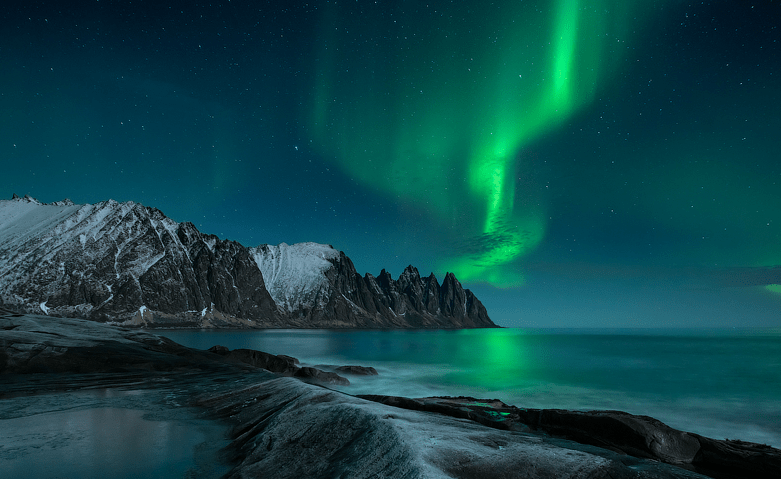
On certain enchanted nights, curtains of green, red, and violet light dance across polar skies – a display known as the Aurora Borealis (or Northern Lights in the north, and Aurora Australis in the south). This ethereal phenomenon, most commonly seen in high-latitude regions like Norway, Greenland, or Alaska, has captivated human imagination for millennia thequran.love thequran.love. On rare occasions, intense solar storms extend the aurora’s reach to much lower latitudes: for instance, during a strong geomagnetic storm in 2024, the aurora was visible as far south as Hawaii, and another in early 2025 brought its glow to New York and Idaho thequran.love. Such episodes remind us that the aurora’s beauty is rooted in an “underlying harsh reality” thequran.love: the Earth is ceaselessly bombarded by charged particles from the Sun.
Modern science reveals that the very spectacle which dazzles observers is also a byproduct of Earth’s protective defenses at work. This raises intriguing questions at the intersection of science and spirituality. Ancient scriptures speak of the sky as a guarded canopy – for example, the Quran proclaims, “We made the sky a roof, well-protected; yet they turn away from its signs” (21:32). Could the Northern Lights be among these “signs” hinted at, symbolizing the safeguarding of life on our planet? In what follows, we explore the Aurora Borealis from three interwoven perspectives: the scientific, explaining how Earth’s physics produce such auroral lights; the theological, particularly Islamic, reflecting on the notion of a divinely protected sky; and the philosophical, contemplating the sense of awe and meaning that such natural wonders inspire. Through this multidisciplinary lens, the aurora’s shimmering curtains of light become not only an atmospheric event but also a gateway to deeper understanding – a convergence of cosmic science, faith, and the human quest for meaning.
The Science Behind the Northern Lights: Earth’s Protective Shield in Action
The aurora’s dancing lights are the visible trace of an invisible drama in near-Earth space. Physicists explain that the Aurora Borealis results from complex interactions between the solar wind – a stream of charged particles emitted by the Sun – and the Earth’s magnetosphere – the magnetic force-field that surrounds our planet thequran.love.
Solar Wind and Magnetosphere: The Sun continuously emits high-speed electrons and protons. During periods of heightened solar activity (such as solar flares or coronal mass ejections), this solar wind intensifies thequran.love. When the wave of charged particles reaches Earth, our planet’s magnetic field serves as a critical shield. Earth is enveloped by a giant magnetic bubble called the magnetosphere, which deflects most of these solar particles, funneling only a fraction toward the polar regions along magnetic field lines thequran.love thequran.love. Without this magnetic protection, charged particles traveling at millions of miles per hour would directly strike Earth’s atmosphere and surface, with potentially lethal consequences for life thequran.love. In fact, the magnetosphere is “key to helping Earth develop into a habitable planet” by preventing the solar wind from stripping away our atmosphere thequran.love. The brilliant auroral lights are a beautiful side-effect of this protective process.
Atmospheric Collision and Light Emission: As guided streams of solar particles cascade into Earth’s upper atmosphere near the poles, they collide with gas molecules – primarily oxygen and nitrogen. These high-energy collisions excite the gas atoms, causing them to emit photons of specific wavelengths. The result is glowing curtains of light in the night sky thequran.love thequran.love. Oxygen emits green or occasionally red light, while nitrogen produces shades of purple and blue thequran.love. Thus, the vivid colors of the Northern Lights mirror the chemistry of our atmosphere and the physics of excitation and emission.
That such a delicate interplay produces immense beauty is itself awe-inspiring. But equally important is what the aurora signifies: it is a luminous testament to Earth’s protective layers doing their job. As one science writer put it, understanding the aurora “underscores the dynamic relationship between our planet and the Sun” and reveals how these lights are “a display of how we have been saved from the lethal consequences of solar winds” thequran.love. In essence, every flicker of the aurora borealis is an optical announcement that Earth’s defenses against space weather are hard at work.
Earth’s Magnetic Fortification: Lessons from Mars
Enveloping Earth, the magnetosphere acts as a shield deflecting most solar particles, but what if a planet lacks such a shield? Here, Mars offers a cautionary tale. Mars today is a barren, cold desert with a thin atmosphere – but it wasn’t always so. Scientific evidence suggests that in its early history, Mars had a global magnetic field and a thicker atmosphere capable of supporting liquid water on the surface. However, as Mars’ small molten core cooled, its magnetic dynamo faded, and the planet’s magnetic field collapsed thequran.love. Without that protective shield, the relentless solar wind directly pummeled the Martian atmosphere, gradually stripping it away into space thequran.love. NASA’s MAVEN orbiter has confirmed that solar wind and radiation were responsible for much of Mars’ atmospheric loss, fundamentally altering its climate thequran.love. In short, Mars lost its sky’s protection, and with it went the water and warmth that might have made it habitable thequran.love thequran.love.
By contrast, Earth’s magnetosphere – generated by the convective motions of its liquid iron-nickel outer core – has been sustained over billions of years thequran.love. This magnetic field carves out a teardrop-shaped region around our planet, blunting the force of solar winds. On the day side, the magnetosphere is compressed by solar particles, while on the night side it stretches into a long magnetotail thequran.love. Within this magnetic cocoon, charged particles from the Sun are largely held at bay or rerouted around the planet. Some become trapped in two concentric zones known as the Van Allen radiation belts, discovered in 1958 by James Van Allen thequran.love. These doughnut-shaped belts of charged particles further buffer Earth: they capture and store a portion of the solar wind’s energetic particles and cosmic rays, preventing many of these from reaching Earth’s surface thequran.love. In effect, the Van Allen belts and magnetosphere form a multi-layered defense system, a natural force field safeguarding life on Earth thequran.love.
It is sobering to realize that the gorgeous auroral lights are a visible symptom of conditions that, on an unprotected world, would spell destruction. Without our magnetic field, Earth might have suffered Mars’s fate – a gradual erosion of the atmosphere and exposure of the surface to deadly radiation thequran.love thequran.love. The aurora reminds us how fortunate we are: our planet’s “giant bubble of magnetism” defends us from the Sun’s fury thequran.love, allowing Earth to remain a life-friendly oasis in a hostile cosmos.
The Atmosphere’s Other Protective Roles
In addition to the magnetosphere, other layers of the Earth’s atmosphere work as safeguards ordained by the laws of physics (or, as believers would say, by the design of the Creator). The Quran’s verse about a “protected roof” finds striking echoes in several critical functions that atmospheric science has uncovered:
- Filtering Harmful Radiation: The stratospheric ozone layer absorbs the majority of the Sun’s dangerous ultraviolet rays, preventing most UV radiation from reaching the ground thequran.love. This natural sunscreen spares living organisms from genetic damage and is essential for life as we know it.
- Vaporizing Meteoroids: Every day, our planet is bombarded by countless meteoroids – ranging from sand grains to boulders – hurtling through space. When they hit the atmosphere at high speed, friction heats and incinerates most of them long before they can strike the surface thequran.love. We see this as harmless “shooting stars” streaking the sky. Without this atmospheric shield, even small meteors would crash into Earth with destructive force.
- Regulating Climate: The atmosphere moderates Earth’s temperature through the greenhouse effect, trapping heat to maintain a livable climate. It also redistributes heat via winds and weather systems, preventing extreme temperature swings between night and day thequran.love. In a very literal sense, the sky keeps our world temperate and habitable.
These features make our sky a well-engineered canopy for life. From halting deadly radiation and rocks from space to providing air to breathe and rain from clouds, the heavens perform a host of protective tasks. Modern science confirms that without the combined effect of the magnetosphere, ozone layer, and atmospheric blanket, life on Earth would be extremely precarious – or even impossible thequran.love. The more we discover about these phenomena, the more the ancient description of the sky as a “protected roof” rings true thequran.love. As a contemporary Islamic commentary notes, what pre-modern scholars described in general terms – a heaven safeguarded by divine decree – corresponds in remarkable detail to the specific protective systems we now understand scientifically thequran.love thequran.love.
Theological Reflections: A “Well-Protected Sky” in the Quran and Abrahamic Thought
Across the Abrahamic traditions, the sky and heavens have often been seen as a sign of divine order and care. The Bible, for instance, opens Psalm 19 with the famous line: “The heavens declare the glory of God; the skies proclaim the work of His hands.” biblehub.com. In other words, the vast firmament above us – with its celestial lights and life-sustaining traits – is viewed as an expression of God’s grandeur and providence. Similarly, the Islamic scripture, the Quran, contains verses that draw human attention to the sky’s special character. One such verse (Al-Anbiya 21:32) was quoted at the outset of this discussion: “And We made the sky a roof, well-protected; yet they turn away from its signs.” In Arabic: “wa ja‘alnās-samā’a saqfan maḥfūẓan wahum ‘an āyātihā mu‘riḍūn.”
Classical Islamic Interpretation of a Guarded Canopy
Classical Muslim scholars, writing centuries before modern science, pondered what it meant for the sky to be a “roof preserved and protected”. They offered diverse but not mutually exclusive interpretations. Many early commentators emphasized physical security: the sky, like a solid dome over the earth, does not collapse upon us because God holds it up. For example, the renowned 13th-century exegete Al-Qurṭubī cited another Quran verse – “He holds back the sky from falling on the earth except by His permission” (22:65) – to illustrate that maḥfūẓ (protected) means God safeguards the sky from literal collapse thequran.love thequran.love. Ibn Kathīr likened the sky to a ceiling raised without pillars, marveling at how it stands firm by divine support thequran.love. This imagery underscored Allah’s power in maintaining cosmic order: the heavens stay reliably in place, a boon we rarely even think about.
Other interpretations were more metaphysical. A number of classical scholars suggested the sky is protected from the tampering of evil forces. They referenced Quranic passages (e.g. 37:6–10, 15:17–18) describing how rebel jinn (devils) attempting to eavesdrop on heavenly decrees are repelled by meteoric “flames” or shooting stars. On this basis, some said the sky is “guarded by stars from devils,” forming a spiritual security system in the cosmos thequran.love thequran.love. In essence, the uncorrupted heavens contrast with the earth below, where sin and disorder occur – the sky remains a realm of purity, free from demonic influence or any breach of God’s order.
Yet another view in classical exegesis alludes to the sky’s structural elegance. The sky is “protected such that it needs no pillars” thequran.love – an architectural marvel by the Creator. This metaphorical image invites believers to reflect on how the vast vault of heaven stays aloft, a feat of engineering achieved effortlessly by divine command (as also noted in Quran 13:2, “Allah is He who raised the heavens without pillars that you see”). All these interpretations, while different in detail, converge on a common theme: the sky’s very stability and integrity are intentional signs of divine design thequran.love. As the verse concludes, many people “turn away from its signs” – failing to consider what the sky’s order and protection signify about the Creator’s wisdom thequran.love. Classical scholars like Fakhr al-Dīn al-Rāzī emphasized that the heavenly order, from the regular orbits of sun and moon to the sheltering canopy above, points back to Allah’s power and planning in upholding the universe thequran.love. The problem is not the absence of signs, but human heedlessness in the face of them thequran.love.
Modern Insights and Quranic Exegesis in the Scientific Age
With the advent of modern science, Muslim thinkers began to revisit these age-old Quranic verses in light of contemporary knowledge. The 20th century saw a proliferation of writings connecting Quranic descriptions of nature with scientific phenomena. In the 1970s, for example, Maurice Bucaille’s The Bible, The Qur’an and Science famously highlighted 21:32, proposing that the Quran’s reference to a “protected sky” astonishingly anticipates modern discoveries about atmospheric protection thequran.love. This and similar efforts gave rise to a genre known as I‘jāz ‘ilmī (scientific miraculousness of the Quran), which sought to show harmony between scripture and science.
Responsible scholars, however, approach these connections with nuance. They caution that while modern science can enhance our appreciation of Quranic wisdom, it should not eclipse the scripture’s spiritual message thequran.love. The primary intent of verses like 21:32 was – and remains – to evoke gratitude and awareness of God’s care, not to serve as a physics textbook. As contemporary commentators observe, the verse historically reminded people of Allah’s power and mankind’s ingratitude, a lesson still paramount thequran.love. What has changed is that today we can also perceive additional layers of meaning in “protected sky”: layers such as the ozone layer, the magnetic field, or the atmospheric filters that classical scholars could not have imagined thequran.love thequran.love. Crucially, this is seen not as a revision of the verse’s meaning, but as an enrichment. One writer put it aptly: earlier Muslims would say “Yes, the sky is a strong roof held up by Allah and jinn cannot pierce it,” whereas a Muslim today can add, “Yes – and furthermore, this sky has exactly the properties needed to shield us from meteors and radiation, truly a sign of wise design” thequran.love. The core understanding remains that God intentionally made the sky beneficial and secure; our scientific insights simply broaden the ways in which we recognize that security operating thequran.love thequran.love.
The Quranic term “āyāt” (signs) in verse 21:32 is especially noteworthy. The verse says unbelievers turn away from the signs of the sky. In Arabic, āyah can mean a divine message or miracle, and in the Quran it often refers to phenomena of nature that point to God’s existence and mercy thequran.love. Classical exegetes like Qurtubī noted that the “signs of the sky” include the sun, moon, stars, the cycles of night and day – all the celestial events humanity observes thequran.love. In our context, one might say that the aurora borealis is precisely such a “sign in the sky.” It is a striking natural wonder that, for those inclined to faith, signifies more than itself: it signifies a providential order underlying the cosmos. The Quran asks, in essence, how people can see such marvels and yet ignore what they signify. A modern Muslim scholar, reflecting on this verse, comments that the Quran is drawing attention to a “divinely placed system of protection” in the atmosphere, implicitly urging us not to live in oblivion of the Creator after witnessing such signs thequran.love thequran.love. In theological terms, believers view the aurora’s cause – the geomagnetic shield and atmospheric layers – as part of Allah’s rahmah (mercy) built into nature thequran.love. The spectacle in the sky thus becomes a reminder of our planet’s fortunate design. Indeed, some modern theologians parallel this to the “fine-tuning” argument: the idea that Earth’s ability to harbor life (thanks to features like the magnetosphere) reflects not mere chance but intentional calibration thequran.love. Whether one fully embraces that argument or not, it is clear that the Quranic worldview encourages seeing purpose and mercy in the very fact that our sky protects us.
From an Abrahamic perspective at large, then, the Northern Lights can be seen as a convergence of scientific reality and spiritual symbolism. Scientifically, they manifest the operation of Earth’s protective physics; spiritually, they exemplify the “heavens declaring the glory of God” as both the Bible and Quran teach biblehub.com thequran.love. The two perspectives are not in competition but in concert: knowledge of how the aurora occurs deepens, rather than diminishes, the sense of wonder that it evokes. This naturally leads us into the realm of philosophy – to ponder why such awe arises in us at all, and what it means.
Philosophical Perspectives: Awe, Wonder, and Human Meaning in the Cosmos
Staring up at the aurora or a star-filled night sky has long prompted humans to reflect on their place in the vast universe. Philosophy, both ancient and modern, grapples with the same reality that science and theology describe, but asks: What does it mean for us as thinking beings? Why do phenomena like the Northern Lights move us so deeply?
One of the most famous philosophical reflections on the night sky comes from Immanuel Kant. In 1788, Kant wrote of the “starry heavens above me” as one of two things that filled his mind with ever-growing awe and admiration, the other being the moral law within him cambridge.org. He saw in the sublime expanse of countless stars a humbling vision of “worlds upon worlds, systems upon systems” extending into limitless space and time cambridge.org. The sheer scale of the heavens, he noted, “annihilates my importance as an animal creature… a mere speck in the cosmos,” yet at the same time the exercise of reason and moral conscience “infinitely elevates my worth as an intelligence” capable of grasping these truths cambridge.org cambridge.org. Kant’s point resonates strongly with the experience of witnessing the Northern Lights: one feels tiny under the cosmic dome, yet uniquely significant in being able to appreciate and reflect upon its grandeur. The sense of awe that nature invokes has a paradoxical quality – it makes us feel small, but also connected to something much greater, hinting at a larger context of meaning.
Philosophers categorize this feeling as the sublime: an aesthetic and emotional response to something vast or powerful beyond ordinary experience. The aurora, with its otherworldly glow and immense scale, is a classic example of a sublime natural phenomenon. The 18th-century thinker Edmund Burke described how the sublime in nature (like towering mountains or thunderstorms) can evoke both delight and a degree of fear – a pleasurable terror, as it were, in the face of nature’s magnitude. In the aurora’s case, the fear is muted by distance (we know those eerie flames of light won’t harm us directly), but there is still a tingling sense of witnessing something beyond human control, a cosmic performance staged by forces larger than ourselves. This kind of awe has profound effects. It can momentarily dissolve the ordinary boundaries of the self; individual worries pale before the spectacle of the cosmos. Modern psychological studies have even found that awe-inspiring moments – gazing at the Grand Canyon, or indeed the Aurora Borealis – tend to increase people’s inclination to believe in a greater power or order in the universe sciencedaily.com sciencedaily.com. The experience of awe “increases our motivation to make sense of the world,” notes psychologist Piercarlo Valdesolo, and can trigger a search for deeper explanation that sometimes leads to spiritual or supernatural interpretation sciencedaily.com sciencedaily.com. In experiments, people who watched awe-inspiring videos became more likely to perceive intentional design behind random events, suggesting that awe might predispose the mind to see purpose rather than chance sciencedaily.com sciencedaily.com. It is as if the soul, when deeply moved by nature’s majesty, naturally reaches out for a higher context to place that experience – something philosophers and theologians might call the transcendent.
From a philosophical standpoint, then, the aurora invites reflection on age-old questions. Are we witnessing merely a play of physical forces – charged particles guided by magnetic fields – or are we also seeing the handiwork of a Creator, as religious tradition would have it? The materialist outlook would say that our sense of meaning is one we project onto the natural world; the aurora itself has no purpose, it is we who imbue it with significance. A theistic or teleological outlook, by contrast, would argue that our capacity to appreciate beauty and the fact that the cosmos contains such beauty are not coincidences but indications of underlying purpose. The Islamic scholar Fazlur Rahman once wrote that the Quranic view of nature is fundamentally value-charged – nature is full of signs (āyāt) inviting moral and spiritual insight, not a neutral backdrop thequran.love thequran.love. In this view, when we feel awe under the Northern Lights, we are responding appropriately to a world meant to evoke awe and gratitude. Our emotional reaction is in harmony with a cosmos imbued with divine signs.
Even secular philosophers acknowledge that the human confrontation with the vastness of the cosmos is a defining feature of our existence. The 17th-century French thinker Blaise Pascal, though a religious man, spoke of the frightening silence of “infinite spaces” – the realization of the universe’s enormity can be unsettling. Yet, where Pascal felt existential dread, others have found existential meaning. In the 20th century, scientists like Albert Einstein (who had a deeply philosophical bent) wrote about a “cosmic religious feeling” – a sense of reverence for the rational beauty and order of nature. Einstein, while not orthodox in faith, felt that the laws of nature revealed an intelligence far superior to man’s, evoking humility and wonder. This aligns well with the Quranic sentiment that those who “reflect on the creation of the heavens and the earth” (Quran 3:191) are led to recognize profound purpose and cry out, “Our Lord, You have not created this in vain!”. Whether one uses religious language or not, the intuition that the cosmos is not absurd or meaningless is strengthened by encounters with natural splendor.
Awe, in summary, bridges our scientific and spiritual imaginations. It is a feeling that can be analyzed in terms of neuroscience (e.g. the downregulation of the brain’s default-mode network, resulting in a diminished ego and increased connectivity with the world), but it also carries an intellectual and moral dimension. Awe challenges us to reconsider our priorities and place in the world. It has been associated with greater altruism and a sense of common humanity – under the vast auroral sky, the petty divisions of human society can fade, replaced by a shared feeling of planetary citizenship. Philosophers today, like environmental ethicists and scholars of eco-spirituality, suggest that cultivating awe for nature might be key to fostering a more reverent attitude toward the Earth. The Northern Lights, in their sublime beauty, exemplify a natural phenomenon that can still stop modern men and women in their tracks and make us ponder the deeper questions.
Epilogue: Illuminating Earth’s Horizon – Science, Faith, and the Meaning of a Celestial Spectacle
As we step back and absorb the myriad threads explored – the physics of solar winds and magnetic fields, the Quranic portrayal of a safeguarded sky, and the philosophical musings on human awe – a unified tapestry of meaning begins to emerge. The Northern Lights are more than a scientific curiosity or a pretty light show. They are a vivid reminder of how interconnected the cosmos and life are: the Sun’s eruptions, Earth’s magnetic heartbeat, the chemistry of our atmosphere, and the neuropsychological response of a viewer standing under the polar sky all converge in one phenomenon. In an age often described as disenchanted, where science and secularism dominate the narrative, the aurora can re-enchant by showing that understanding the mechanics of nature does not strip away wonder – it amplifies it. Knowing that the auroras are born from a solar gale deflected by Earth’s invisible shield lends them a new poetic resonance: we are watching our planet’s guardians at work, in real time, painting the sky with their protective touch.
For people of faith, especially in the Islamic tradition, this realization becomes an invitation to gratitude and contemplation. The Quran encourages observing the sky and reflecting on the blessings it provides: stable air to breathe, gentle rain, protection from hazards, and signs of transcendence. The aurora’s grandeur can be seen as one of those signs – an indirect but compelling ayat urging us not to “turn away” thequran.love from the implications of a finely balanced world. In the contemporary context, this has never been more relevant. We have gained the power to disrupt the very protections that nature has afforded us – thinning the ozone layer, altering the climate, cluttering near-Earth space – thereby endangering the “well-protected roof” we rely on. A spiritually informed perspective, shared by religious and philosophical thinkers alike, would implore humanity to act as responsible stewards of this planet, honoring the protective systems as part of a sacred trust. The sight of the Northern Lights, by revealing the invisible shields that safeguard life, can instill a renewed sense of responsibility to preserve what we have been given.
Moreover, the aurora offers a unifying vision in a fragmented world. No matter our creed or culture, we all live under the same sky and benefit from the same atmospheric grace. In a time when divisions run deep, one could imagine people across the globe looking up at a spectacular auroral display – from Canada to Russia to Scandinavia – all sharing in a collective human astonishment. Such moments remind us of our common origin and destiny under the heavens. They echo the sentiment of the Quranic verse that all humans are invited to ponder these signs, and the biblical psalm that the heavens “pour forth speech” day after day – a speech that transcends language, addressing every soul gotquestions.org biblehub.com. The message conveyed is one of hope and humility: hope that we are part of an intelligible and meaningful universe, and humility in recognizing our small but significant place within it.
In conclusion, the Northern Lights stand at a crossroads of science, philosophy, and theology – illuminating more than the dark polar skies, but also the pathways of human understanding. By studying them scientifically, we appreciate the precise cosmic conditions that allow life to flourish under a celestial canopy. By interpreting them through scripture, we reconnect that scientific knowledge with a sense of divine care and purpose. By experiencing them with a philosophically attuned mind, we find our hearts opened in wonder, prompted to ask the big questions that define the human condition. Under the aurora’s shimmering arc, one cannot help but feel that, indeed, “the heavens declare the glory of God” and that our curiosity to comprehend such glory is itself a gift. In the meeting of light and insight, we rediscover what it means to be both children of the Earth and observers of the stars – destined to seek knowledge, meaning, and ultimately, a reverence for the magnificent reality we inhabit.
If you would rather read in Microsoft Word file:

 The Glorious Quran and Science
Leave a comment