

Presented by Zia H Shah MD
Introduction
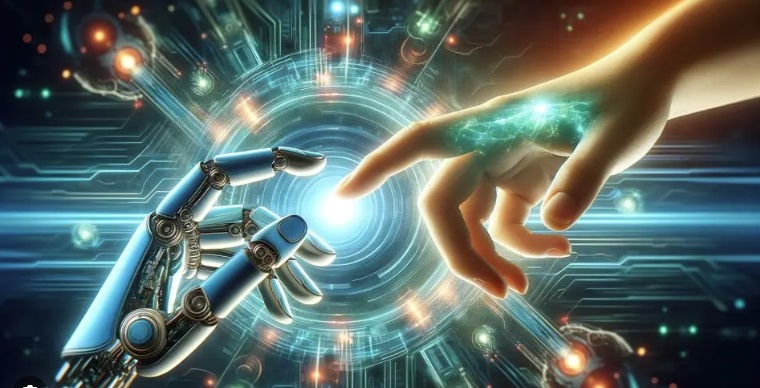
Human memory and thinking work very differently from how ChatGPT (an AI language model) “remembers” and processes information. In simple terms, our brains and AI have short-term memory (quick, active memory) and long-term memory (stored knowledge), but they use these in unique ways. They also differ in raw processing power and have distinct limitations. In this comparison, we’ll explore how a person’s memory and thinking compare to ChatGPT’s system, highlighting similarities and differences in plain language. We’ll also note recent improvements in AI (as of 2025) – such as bigger “memory” windows in newer models and methods for giving AI external memory – to keep things up to date.
Active Memory: Human Working Memory vs. ChatGPT’s Context Window
Human Working Memory: Humans have a very limited active memory. Think of it like a small notepad or a scratchpad in your mind. You can only hold a few pieces of information there at once. Psychologists often say we can juggle about 7 ± 2 items in our short-term memory (for example, remembering a phone number or a short list) . If someone tells you a new phone number, you might repeat it to keep it in mind – otherwise you’ll forget it within 15–30 seconds if you don’t transfer it to long-term memory . This working memory is like your brain’s RAM: it’s fast but very limited in capacity and duration.
ChatGPT’s Context Window: ChatGPT doesn’t “remember” things in the human sense – it has no brain or neurons – but it has an active memory analogous to our working memory. This is usually called the context window. It’s essentially the amount of text the AI can keep “in mind” at once while having a conversation or answering a question. You can imagine reading a book through a small window that only shows a few sentences at a time; as you slide the window along, you forget what’s behind it and see new text . That’s how ChatGPT’s context window works: it has a limited span of recent conversation or text it considers, and anything beyond that is effectively forgotten (unless reintroduced). Early versions of ChatGPT could only hold a few thousand words at once (roughly a few pages of text). Newer AI models have dramatically expanded this short-term memory. For example, OpenAI’s GPT-4 model can handle up to 32,000 tokens (words or parts of words) in its context, and an enhanced version called GPT-4 Turbo can juggle 128,000 tokens – that’s around 240 pages of text at once ! This is far more than a human can consciously hold in mind. In practice, that means ChatGPT can “remember” earlier parts of a long document or conversation up to that limit. However, if a conversation goes beyond the window (say you keep chatting and exceed the token limit), older details drop out – the AI will no longer have those earlier words in its active memory, just as we might forget details when our mental notepad is full .
Comparison – Active Memory: Both humans and ChatGPT have a notion of short-term memory, but the limitations are different. A person’s working memory can only track a handful of items and is constrained by time – we quickly forget new info unless we repeat or write it down. ChatGPT’s working memory (context window) can encompass much larger chunks of information (tens of thousands of words for latest models), and it doesn’t “fade with time” but rather with length: it forgets anything that doesn’t fit in the window. In a sense, ChatGPT’s short-term memory is wider but shallower – it can take in a lot of text precisely as given (far more raw data than a person could hold in mind), but it has no true understanding beyond that text and no lasting retention once it moves out of the window. Humans might forget precise details, but we retain the gist or integrate it with what we already know. ChatGPT, by contrast, has to be fed the relevant text again if we want it to recall something said earlier once it’s outside the context window. Recent improvements (like those larger GPT-4 windows and techniques called retrieval, which we’ll discuss later) are allowing AI to maintain context over longer interactions, but the fundamental mechanism is still like a sliding window of tokens. If it’s not in the window, it’s gone.
Long-Term Memory: The Brain’s Knowledge vs. AI’s Stored Knowledge
Human Long-Term Memory: Our brains store an immense amount of information in long-term memory – all our facts, experiences, skills, and memories of life events reside here. This isn’t a single “place” but rather a vast network of neurons (brain cells) with strengthened connections that encode our knowledge and experiences. The capacity of human long-term memory is huge – effectively millions of pieces of information over a lifetime. To give a rough sense of scale, scientists have tried to estimate it in computer terms: some suggest the human brain could store on the order of 2.5 petabytes of data (that’s 2.5 million gigabytes) . In everyday terms, that would be like hundreds of millions of pages of text or roughly as much information as the entire internet – an astonishing capacity. While these estimates are not exact, they illustrate that the brain can hold a lifetime of memories: faces of school friends, how to ride a bicycle, facts learned in school, the plot of your favorite movie, and so on. Human long-term memory is also associative and richly interconnected – e.g. the smell of apple pie might suddenly remind you of your grandmother’s kitchen because those memories are linked. We retain knowledge not by rote storage of bytes but by strengthening connections in neural networks. Importantly, humans can continue learning throughout life: we constantly update our long-term memory by forming new connections or strengthening existing ones when we learn new facts or have new experiences. We do forget things over time or if we don’t revisit them, and memories can fade or become distorted. But generally, long-term memory is durable – you might clearly recall your first day of high school even decades later.
ChatGPT’s “Memory” in Model Weights: ChatGPT, being an AI, does not have memories in the way humans do – it doesn’t have personal experiences or a life history. Instead, its knowledge comes from the data it was trained on. During training, the model processed huge amounts of text (books, articles, websites) and statistically “learned” patterns in language and information. All this learned information is stored in the model’s parameters (often thought of like the “weights” of the neural network). You can think of the model’s billions of parameters as analogous to the connections in a brain – they encode the strength of associations between different words and concepts. Once training is done, the model doesn’t store new facts on the fly; instead, it draws on this internal knowledge base. In simple terms, ChatGPT’s long-term memory is “baked into” its neural network weights. It’s not like a database of facts it can look up; rather, the knowledge is distributed across many parameters. As one AI expert puts it, “the knowledge [AI models] absorb during training becomes embedded in their weights”, and querying the model prompts the relevant patterns to activate . For example, if ChatGPT knows the capital of France, it’s not because it has a specific “Paris = capital of France” entry saved somewhere – it’s because during training it saw enough text about Paris and capitals to adjust its weights so that the question “What is the capital of France?” leads it to respond “Paris”.
Differences in Long-Term Memory: The difference between human and ChatGPT memory here is stark. Human memory is adaptive and continuously learning – we can acquire new information today and store it alongside what we learned years ago. ChatGPT’s knowledge is static up to its last training cut-off. If ChatGPT was trained on data up to, say, 2022, it will not know events or facts beyond that unless explicitly updated. It doesn’t learn from conversation in the way a person learns from conversation. For instance, if you tell a human a new fact, they might remember it tomorrow; if you tell ChatGPT a new fact in one session, it might use it within that session, but it won’t retain that fact in a new session tomorrow unless that fact was also in its training data or provided again. OpenAI has started to address this by allowing some level of persistent memory for ChatGPT (for example, a feature to remember information about you between sessions), but under the hood this isn’t the same as the model truly rewriting its weights on the fly. Rather, it’s done by storing a bit of text separately and retrieving it when needed . In other words, it’s like giving ChatGPT a notebook where it can jot down things and look them up next time – helpful, but not the same as the integrated, seamless memory a human has.
Another key difference is updating and forgetting. If we want to teach an AI model new information (beyond its training data), it requires a process called fine-tuning or retraining the model on new examples. This is resource-intensive and if done naïvely can cause the model to “forget” some of what it learned before – a phenomenon known as catastrophic forgetting . For example, if a language model is fine-tuned heavily on medical texts to improve its medical advice, it might inadvertently get worse at other topics it used to know, because the weight updates for the new info interfered with old knowledge. Humans, by contrast, incorporate new learning more fluidly into existing memory – learning a new fact about world history doesn’t usually erase another fact you knew (though our memory can interfere in more subtle ways, it’s not a complete overwrite). We have mechanisms to consolidate memories and generally retain old knowledge while adding new (though sometimes we do replace old beliefs with new ones if they conflict – but that’s often a deliberate update rather than an unintended wipe-out).
Analogies – Libraries and Encyclopedias: One way to picture it is: a human brain is like a library that’s constantly writing new books and editing old ones – it stores stories, facts, skills, and it can pick up a new “book” (memory) any time. ChatGPT, on the other hand, is like a huge encyclopedia that was printed on a certain date. It has an enormous amount of information up to that point (far more breadth than any single human), but if you ask it about something that happened after the encyclopedia was printed, it won’t know unless it has a way to get an update. The “encyclopedia” (its neural network) isn’t easily added to; you’d have to print a whole new edition (retrain the model) to truly include new entries. To cope with this, modern AI systems use tricks like Retrieval-Augmented Generation (RAG) – essentially, giving the AI access to an external knowledge source (like letting it search a database or the web) when answering questions . That’s like giving our static encyclopedia a live internet connection or an extended library it can consult. This improves factual accuracy and makes the AI more up-to-date, but it’s again somewhat separate from the AI’s own “core” memory (the model weights). It’s more like you or me picking up a reference book to answer a question we don’t remember well – the knowledge wasn’t in our head, but we knew where to find it. Similarly, ChatGPT can be augmented with tools and external memory to get around its built-in memory limits.
Summing Up Long-Term Memory: In summary, humans have an integrated, ever-learning memory (with emotional and sensory richness) that lasts a long time (though we may forget or misremember). ChatGPT’s built-in memory is essentially its training – it’s immense in scope but fixed in time. However, as of 2025, developers are finding ways to give AI systems something akin to long-term memory: whether by expanding the context window to carry more conversation history, by plugging in databases and search (so the AI can fetch info as needed), or by allowing certain user-specific data to persist across chat sessions. One author described modern AI assistants as using three kinds of “memory” working together: a short-term working memory (the context window), a retrieval system (like a knowledge pantry it can pull facts from), and a long-term store (notes or facts that persist across sessions, like user preferences) . In a way, engineers are trying to mimic the layers of human memory with these tools. But it’s worth remembering: ChatGPT doesn’t “remember” in the personal, autobiographical sense – it doesn’t recall that funny joke you told it yesterday unless that info is provided to it again. It has no inner life or personal past; its “memories” are all information from training or what you explicitly tell it in the conversation.
Processing Power and Thinking: Brain vs. AI
Human Brain Processing: The human brain might be slower at raw math or text processing than a computer, but it is a marvel of parallel processing and efficiency. The brain contains about 86 billion neurons interconnected by roughly hundreds of trillions of synapses (connections) . Each neuron is like a tiny processor that can fire signals up to perhaps a few hundred times per second. This is slower in frequency than modern computer chips (your laptop’s processor might run at billions of cycles per second), but because the brain does so many things in parallel, its overall computational ability is enormous. In fact, when researchers compare raw processing power, they estimate the brain may perform on the order of an exaFLOP of operations – that’s a billion billion operations per second – all while running on just around 20 watts of power (about what a dim light bulb uses) ! By contrast, one of the world’s most powerful supercomputers (as of 2023) also achieved roughly an exaFLOP of performance, but it required 20 megawatts of power (millions of watts) to do so . This highlights how energy-efficient the brain is. The brain’s computing is also specialized – it excels at pattern recognition, sensory integration, and learning from very little data. For example, a child can learn a new concept from just one or two examples, whereas a typical AI might need thousands of examples to reliably learn the same thing. Our brains also handle multiple tasks at once: we can observe our environment, carry on a conversation, and plan our next action in parallel (though our attention is limited, we do have many subsystems working simultaneously). The brain’s processing is deeply integrated with emotion and survival instincts too – it’s not just cold computation; it decides what to focus on or remember partly based on meaning and emotional significance.
ChatGPT’s Processing: ChatGPT runs on computer hardware – specifically, on clusters of powerful GPUs (graphics processing units) or similar chips optimized for machine learning computations. The “thinking” ChatGPT does is fundamentally different from human thought: it’s performing matrix multiplications and other mathematical operations on its internal numbers (the parameters) to compute probabilities of the next word. However, thanks to the efficient design of these algorithms and hardware, it can do this extremely quickly. ChatGPT’s model (especially newer versions like GPT-4) is massive in scale – it has on the order of hundreds of billions of parameters (think of these like adjustable knobs that were tuned during training). For reference, the earlier GPT-3 model had 175 billion parameters , and later models are even larger. This number is smaller than the number of synapses in a human brain, but it’s still huge for a computer model. When you ask ChatGPT a question, behind the scenes it activates a large number of these “connections” in parallel across many layers to produce an answer. Modern AI models leverage parallel processing too: they use many GPU cores simultaneously to handle different parts of the computation at once. This is why ChatGPT can respond in a matter of seconds even if the task is complex – it’s crunching a lot of data quickly in parallel. In terms of raw speed, computers have an edge in doing deterministic, repetitive calculations. ChatGPT can “read” and summarize a 50-page document much faster than a human could, because it isn’t actually reading word by word in real time – it’s processing the text as data through matrix operations, which might take only a few seconds given enough computing power.
However, processing power isn’t the whole story. The brain’s style of computation is different: it’s analog, context-aware, and flexible, whereas ChatGPT’s computation is digital and follows patterns learned from data. ChatGPT doesn’t understand the world the way humans do; it doesn’t have sensory inputs (except specialized models that can take images) or physical experience. It processes text and produces text. It’s essentially a sophisticated pattern matcher. This means that on certain tasks, ChatGPT far outpaces humans, while on others it falls short. For example, ChatGPT can recall an obscenely large range of facts or mimic a writing style almost instantaneously – no single human can match the breadth of information it was trained on. It can also perform certain logical or mathematical operations faster (like translating a sentence or summarizing a report quickly). But when it comes to common-sense reasoning, understanding nuance, or learning from a single interaction, humans still have the advantage. A human can listen to a story and catch a subtle joke or read between the lines – something ChatGPT might miss because it has no true understanding beyond what language patterns suggest. Likewise, a human can devise a completely new idea or invention inspired by very little, whereas an AI needs lots of examples to generalize well (and still doesn’t truly invent new concepts from scratch, it recombines what it has seen).
One useful analogy is that the human brain is like a parallel supercomputer running on biological hardware, whereas ChatGPT is like a huge calculator running on electronic hardware. The brain computes with spikes of electricity and chemical signals in a highly distributed network; ChatGPT computes with electrical binary operations in a very large but more structured network. Both involve layers of “neurons” (real neurons in brains vs. artificial neurons in the neural network model) – in fact, neural networks are loosely inspired by brain architecture. But current AI neurons are vastly simplified and operate in uniform layers, unlike the diverse, self-organizing clusters in the brain. The bottom line on processing is: the brain is incredibly efficient and adaptable, handling complex tasks with minimal energy and even self-repairing or re-organizing as needed, whereas ChatGPT requires significant computational resources (many servers and a lot of electricity) to run and was created via a massive training process (using terabytes of data and a lot of computing power over time). As of 2025, efforts are being made to make AI processing more efficient and brain-like (neuromorphic computing, etc.), but there’s still a big gap between human cognitive processing and AI’s number-crunching approach.
Limitations and Challenges: Forgetting, Bias, Accuracy, and Speed
Both human memory systems and ChatGPT have their limitations, and it’s enlightening to compare them:
• Forgetting and Memory Limits: Humans forget things – that’s a natural limitation. Our short-term memory clears out quickly (you’ll forget a new Wi-Fi password unless you repeat it or write it down), and even long-term memories can decay or get lost. We might remember the gist of an event but forget details, or our recall might mix things up. ChatGPT, in its base form, forgets entire conversations once you start a new session. It has what AI researchers call a “stateless” nature – it doesn’t carry info from one chat to the next  unless explicitly provided. Within a single session, it has a fixed memory window (as discussed) – beyond that, it simply cannot recall earlier text. It also doesn’t truly know what happened in the world outside of what it was trained on or what you tell it. You could say ChatGPT has severe amnesia by design: if yesterday you told it your dog’s name is Luna and today you start a fresh chat, it won’t know who Luna is . Humans, by contrast, remember personal facts day to day. We might not recall every word of yesterday’s conversation, but we’ll remember the key points and who said them. That said, humans can suffer their own forms of forgetfulness (ever walk into a room and forget why you came? or fail to recall a person’s name you just met minutes ago?), so neither system is perfect.
• Biases: Humans have cognitive biases – we’re influenced by our experiences, culture, emotions, and evolutionary quirks. These biases can lead us to remember things inaccurately or make prejudiced judgments. For example, a person might have a confirmation bias (remembering information that supports their belief and forgetting contrary info). ChatGPT inherits biases from the data it was trained on. Since it learned from human-written text (the internet, books, etc.), any biases in that material can appear in its output. Studies have found that AI language models can produce content that reflects gender or racial biases and other stereotypes present in training data  . For instance, if the training texts more often associate certain jobs with a particular gender, the model might unknowingly reflect that in its responses. OpenAI and other developers try to mitigate this by fine-tuning models with guidelines to avoid overtly biased or harmful content. Still, subtler biases can creep in. The difference is that human bias is personal and varies from person to person, whereas ChatGPT’s bias is systemic – it’s a statistical reflection of the large corpus of text it saw. ChatGPT doesn’t have opinions or beliefs, but it might give answers that skew a certain way because of how it was trained or because of deliberate alignment tuning. Also, a human can sometimes recognize and correct their bias with reflection; ChatGPT has no self-awareness to recognize bias unless it’s explicitly instructed to check itself.
• Accuracy and “Hallucinations”: Human memory is fallible – we misremember details or even form false memories. People can be very confident in an incorrect memory. ChatGPT has an analogous issue where it can produce very confident-sounding answers that are completely wrong. In AI, this is often called a hallucination. For example, ChatGPT might state a fake but plausible-sounding historical fact or a made-up citation. This happens because the AI’s goal is to produce plausible language, not to guarantee truth. It has no built-in fact-checking against reality – it only knows what was likely to be said next in texts it learned from . If your prompt leads it into territory where it “thinks” an answer should be given but it doesn’t actually know the correct answer, it will literally make something up that looks right. This is akin to a person guessing an answer rather than admitting they don’t know, except ChatGPT doesn’t have a conscience to feel uncertain – it just follows probabilities. OpenAI has been working on reducing these hallucinations (and newer models have improved somewhat ), encouraging the AI to say “I don’t know” more often or use tools to find answers. But as of 2025, hallucinations remain a fundamental challenge for AI . Humans at least have the ability to know what we don’t know (though some people confidently assert wrong facts too!). We can check sources, use logic, or just refrain from answering if unsure. ChatGPT doesn’t truly know when it’s out of its depth – unless it has seen a very similar question in training, it might just fabricate an answer that statistically looks good. So, in terms of accuracy: humans make mistakes and can be wrong, especially if we’re guessing or our memory is faulty, but AI can be wrong in ways that are surprising because it speaks in a confident, articulate manner even when the content is nonsense. It requires the user to stay skeptical and verify important facts. Essentially, ChatGPT has knowledge breadth without guaranteed accuracy, whereas a human might have less breadth but potentially more reliable judgment on what they truly know versus what they’re unsure about.
• Speed and Capacity: Here, machines have an edge in many respects. ChatGPT can output a detailed paragraph in a few seconds – something that might take a human much longer to compose. It can also process large volumes of text quickly. For instance, if you give ChatGPT a 20-page document and ask for a summary, it can scan through and generate a summary in moments. A human would need significant time to read and summarize that document. So in raw processing speed and volume, ChatGPT is much faster. It doesn’t get tired or distracted either – it will diligently continue producing text as long as you prompt it (though quality might degrade if the conversation goes in circles or hits its limits). Humans, on the other hand, have limited attention spans and we get fatigued. We also can only read so fast. However, humans can think abstractly and creatively in ways AI currently can’t. We might take longer to write an essay, but we can inject genuine original insight, feelings, and nuanced understanding of context that AI might miss. Also, humans have the advantage of visual and physical intuition about the world that pure text-based AI lacks. For example, a person knows that if you drop a glass it might shatter, or how it feels to stand in the rain, or the social cues in a conversation – these aren’t explicitly “memories” we query, but embodied knowledge from living in the world. ChatGPT doesn’t have experiences; it only knows what it’s read. That can limit its depth of understanding, even if it can process information at lightning speeds.
• Decision-Making and Reasoning: Both humans and ChatGPT can solve complex problems, but the way they do it differs. Humans use a mix of logic, intuition, and experiential knowledge. We also have meta-cognition – thinking about our own thinking – which helps us plan multi-step solutions and check our work. ChatGPT’s reasoning, insofar as it exists, comes from patterns in training data; it can perform logical sequences because it has seen logical patterns and can replicate them. It can even do mathematics or coding to a degree by following learned patterns. But sometimes if a problem requires truly understanding a scenario or doing an involved step-by-step reasoning, ChatGPT might falter or produce an error that a human wouldn’t (or would catch upon review). On the flip side, ChatGPT has “read” millions of problem solutions during training, so it might surprise a human with a correct answer to a tricky question by sheer pattern recall, even if it doesn’t know why the answer is correct the way a human solver would. In essence, it’s like the difference between a student who memorized a bunch of answers versus a student who learned the underlying concepts – the one who memorized can answer quickly when it fits a pattern they’ve seen, but might be stumped or make odd mistakes when a truly novel problem is presented.
To summarize the limitations: Humans are limited by memory capacity and speed, and we have our own biases and errors, but we possess understanding, adaptability, and self-awareness of those limits. ChatGPT is limited by its fixed training data, lack of true memory beyond context, and its mandate to generate plausible answers even when it might be incorrect. It’s incredibly fast and knowledgeable in a broad sense, but it’s not trustworthy by itself to be correct or fair – it mirrors the strengths and weaknesses of its data. Both systems benefit from working together: a human using ChatGPT can cover for some of their own limitations (e.g. quickly looking up information or getting a draft written), while applying human judgment can cover the AI’s limitations (e.g. verifying facts, providing common-sense checks and ethical considerations).
Conclusion
Human memory and ChatGPT’s “memory” may use the same word, but they operate on very different principles. In similarity, both have a form of short-term memory (we have our working memory; ChatGPT has its context window) and a form of stored knowledge (we have life-long memories; ChatGPT has training data encoded in weights). Both can recall information and use it to answer questions – you might recall a fact from a textbook you read in college, while ChatGPT might output the same fact if it appeared in its training text. Both can also forget – we forget details or events, and ChatGPT “forgets” anything not in the current conversation. They even both can be biased or wrong: a person might unconsciously incorporate bias or misremember something, and ChatGPT might reflect bias from its training data or hallucinate a false answer. But the differences are profound: human memory is experiential, associative, and continuously learning, whereas ChatGPT’s is static, statistical, and only updated through deliberate re-training or provided context. The human brain processes information with understanding, emotions, and an awareness of self and context; ChatGPT processes information by recognizing patterns and has no consciousness or true comprehension of meaning.
By 2025, AI models like ChatGPT have made strides in bridging some gaps – for instance, greatly expanding the active memory window (so the AI can handle much longer conversations or documents without losing context) , and using retrieval methods or plugins to fetch information on the fly (so the AI can incorporate up-to-date facts or remember user-specific details across sessions). These additions make ChatGPT feel more memory-capable and context-aware than earlier versions. We can liken this to giving the AI a better short-term memory (a bigger whiteboard to work with) and an external long-term memory (notes in a notebook it can refer to). Meanwhile, the processing power of these models continues to grow, with engineers finding ways to make them both larger in knowledge and faster in response. Yet, despite these improvements, ChatGPT doesn’t truly “think” like a human. It doesn’t understand in the rich way we do; it doesn’t have goals or feelings; it can’t enjoy a sunset or recall its childhood (it had none!). Our human memory is tied to our identity and experience, full of personal meanings, whereas ChatGPT’s “memory” is impersonal, a vast compilation of text.
In plain terms, you might say: the human brain is an adaptive, living memory system with limited immediate recall but deep understanding, while ChatGPT is a high-powered text machine with enormous recall capacity but no understanding. Each has its strengths: people have insight, flexibility, and true learning, and ChatGPT has speed, breadth, and consistency. Each has weaknesses: we forget and get biased; it can confuse and lacks true judgment. Rather than one being simply “better,” they are complementary. Understanding these differences helps us use tools like ChatGPT wisely – as powerful assistants that can augment our memory and processing, but which still rely on human guidance for true comprehension, moral judgment, and sensible application of knowledge.


 The Glorious Quran and Science
Leave a comment