
Epigraph
الَّذِي أَحْسَنَ كُلَّ شَيْءٍ خَلَقَهُ ۖ وَبَدَأَ خَلْقَ الْإِنسَانِ مِن طِينٍ
Presented by Zia H Shah MD
Abstract
Orchids (family Orchidaceae) comprise one of the largest and most diverse groups of flowering plants, with over 25,000 species spread across the globenews.wisc.eduarchive.aramcoworld.com. Their blossoms exhibit an extraordinary beauty and complexity that have long captivated scientists, philosophers, and theologians alike. This article examines how such remarkable diversity and elegance may have arisen through natural evolutionary processes—focusing on key biological insights like specialized pollination strategies, adaptive radiations, and symbiotic relationships—and probes whether this extraordinary beauty might indicate a deeper purpose. We weave together scientific findings on orchid evolution with philosophical reflections on beauty and teleology (purpose in nature), and further explore a theological perspective inspired by the Quran. In particular, Quranic verse 32:7 (“Who made everything He created good…”) is invoked to consider guided evolution: the idea that natural evolutionary processes, no matter how undirected they may appear, unfold under divine intent. By integrating botanical science with philosophy and Islamic theology, we aim to present a scholarly yet poetic inquiry into whether the orchid’s splendor is mere happenstance or a sign of design.
Introduction
Across humid tropical forests, high alpine meadows, and even arid deserts, orchids bloom in an astounding variety of forms and colors. They range from the flamboyant pinks and purples of a florist’s Phalaenopsis to bizarre shapes that mimic bees or butterflies. The orchid family is a botanical marvel by any measure: an estimated 25,000 species (some sources place the number even higher) are known in the wild, a number that outnumbers all mammals, birds, and reptiles combinednews.wisc.edu. Orchids occur on every vegetated continent except Antarctica and have colonized habitats as diverse as peat bogs, tropical rainforests, cloud-swept mountain slopes, Mediterranean scrub, and semi-desertsarchive.aramcoworld.comarchive.aramcoworld.com. They can grow upon lofty tree branches as epiphytes, cling to rocky cliffs as lithophytes, or sprout from soil in woodlands and grasslands as terrestrialsarchive.aramcoworld.com. Some are so adroitly adapted that one Australian species (Rizanthella gardneri) spends its entire life underground, even flowering beneath the soilarchive.aramcoworld.com.
Such global ubiquity and ecological versatility raise fundamental questions: How did the orchid family diversify into so many stunning forms? What evolutionary innovations underlie their success? And, at a deeper level, why does nature produce such extravagant beauty and intricate design—does it serve a biological function alone, or might it also point to an underlying purpose or intent? Charles Darwin himself was fascinated by orchids, seeing in their floral “contrivances” a powerful demonstration of natural selection’s creative force. Yet, beyond the realm of science, others have wondered whether the splendor of an orchid might be more than an accident of survival—perhaps a hint of a guiding hand in nature. This article will explore these ideas in depth, beginning with the biological and evolutionary foundations of orchid diversity and then turning to the philosophical and theological implications of their beauty and complexity.
The Global Diversity and Adaptations of Orchids
Orchids are not only abundant in species, but also remarkably diverse in their morphology and life strategies. Botanists classify orchids into approximately 880 genera, and new species are still being discovered regularly, especially in biodiverse tropical regionsarchive.aramcoworld.com. This immense radiation did not happen all at once; it was the product of long evolutionary history. Recent molecular clock studies indicate that orchids began differentiating in the age of the dinosaurs and then underwent several accelerations in speciation over the past 60 million yearsnews.wisc.edu. Notably, three major waves of orchid diversification have been identified, corresponding to key innovations and environmental opportunitiesnews.wisc.edu.
One pivotal innovation was the evolution of pollinia – the fusion of pollen grains into coherent packets. Unlike most flowers that shed pollen as loose grains, many orchids package hundreds or thousands of pollen grains together into pollinia that attach as a unit to pollinatorsnews.wisc.edu. This ensures that when a pollinator (such as a bee or moth) visits the flower, it carries off an entire payload of pollen which can be efficiently delivered to another orchid of the same species. The origin of pollinia is thought to have “sparked the first acceleration” of orchid speciation tens of millions of years agonews.wisc.edu, giving orchids a reproductive edge. Another major adaptation was the move to an epiphytic lifestyle (living on trees) combined with colonization of extensive tropical mountain rangesnews.wisc.edunews.wisc.edu. By perching in high canopy branches, epiphytic orchids accessed new niches with abundant light and less competition from ground-dwelling plants. In regions like the Andes and New Guinea highlands, the proliferation of cloud forests provided ideal moist habitats and drove a burst of orchid diversificationnews.wisc.edunews.wisc.edu. Indeed, life in these cloud-cloaked mountains around 40–33 million years ago corresponds to the second and third great spurts of orchid speciationnews.wisc.edu.
Interestingly, some classic orchid traits did not by themselves trigger rapid speciation, even though they are essential to orchid biology. For example, orchids are famous for their tiny “dust-like” seeds and their dependence on fungal symbiosis for seed germination. Each orchid seed is microscopic and lacks an endosperm (the nutrient-rich tissue found in most seeds)en.wikipedia.org. In nature, an orchid seed cannot germinate on its own – it must encounter specific mycorrhizal fungi that invade the seed and feed the embryo with sugars and nutrientsen.wikipedia.orgen.wikipedia.org. This remarkable symbiosis allows an orchid seed, which carries virtually no food reserves, to develop into a seedling drawing energy from its fungal partner. (We will discuss this symbiotic relationship in more detail in a later section.) Additionally, orchids have a unique floral structure in which the male and female parts are fused into a single column, and an intricate mechanism often ensures that each pollinator visit results in pollinia being picked up or deposited. These features—the tiny, wind-dispersed seeds, the obligate fungal partnership, and the fused floral column—establish orchids as highly derived plants. Yet researchers found that these traits alone did not accelerate species formation until other factors (like pollinia, epiphytism, and new habitats) came into playnews.wisc.edunews.wisc.edu. In other words, orchid diversity has no single explanation; it arose from a combination of evolutionary innovations and ecological opportunities that together enabled orchids to radiate into an unrivaled assortment of formsnews.wisc.edu.
Amid this diversity, what unites all orchids is an astounding adaptability. Orchids have evolved to survive on almost every corner of the Earth where plants can growarchive.aramcoworld.comarchive.aramcoworld.com. They can be found just south of the Arctic Circle and on isolated oceanic islands, thriving in habitats ranging from steamy tropical lowlands to high-altitude slopes. Along the way, they have evolved various adaptations: some orchids in seasonally dry environments produce water-storing organs like pseudobulbs or underground tubers to endure droughtarchive.aramcoworld.com. Epiphytic orchids often develop spongy root tissues (velamen) that absorb moisture from humid air. The leaves of orchids can be broad and leathery in dark understory species, or reduced to tiny scales in twig epiphytes that rely more on their roots for photosynthesis. Morphological ingenuity is a hallmark of the orchid family.
Yet it is in their flowers that orchids truly display evolutionary ingenuity—and it is to these flowers that we now turn, for they hold the key to both the orchids’ success and their enchanting beauty.
Intricate Pollination Strategies: Coevolution and Deception
Orchid flowers are often exquisitely beautiful, but their beauty is not for beauty’s sake alone—it has a function. In the evolutionary dance between flowers and their pollinators, orchids have become masters of both cooperation and deception. Many orchids develop striking colors, patterns, and fragrances to attract specific animal pollinators (bees, wasps, butterflies, moths, birds, even bats). In some cases, the flower offers a genuine reward, such as nectar, to its visitor. In other cases, the orchid cheats – tricking the pollinator into visiting with false promises. In fact, roughly one-third of all orchid species pollinate by deception, offering no real nectar or pollen reward to their duped visitorsnews.wisc.edu. This remarkable statistic has earned orchids a reputation as the con artists of the plant world, engaging in what one researcher poetically called “lies all for the sake of love”news.wisc.edu.
One of the most famous examples of orchid deception is the bee orchid (Ophrys apifera) and its relatives in the Ophrys genus. Bee orchids produce flowers that astonishingly resemble female insects—in shape, color, and even scent. The velvety lip of an Ophrys flower mimics the body of a female bee or wasp, complete with iridescent patches and hairy textures, and the bloom emits chemical signals (pheromones) virtually identical to those of a receptive female insect. Male bees are irresistibly lured in and attempt to mate with the flower lip in a behavior scientists term pseudocopulation. While the male gets nothing but a wasted effort, the orchid attaches its pollinia to the insect during this strugglenhm.ac.uk. When the frustrated male moves on and subsequently clasps another orchid flower, he unwittingly transfers the pollen. This highly selective, coevolved plant–pollinator relationship is a textbook example of sexual deception as a mode of pollinationen.wikipedia.org. The intricacy of the mimicry – down to specific scents to attract particular bee species – attests to the power of evolutionary adaptation. A slight improvement in resemblance or scent can give an orchid flower a higher chance of fooling its pollinator, and thus natural selection has, over generations, sculpted these flowers into uncanny bee look-alikes. To human eyes, the result is both fascinating and beautiful: a living masquerade that blurs the line between plant and insect.
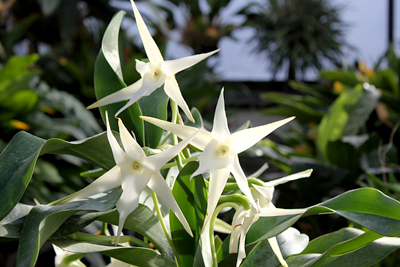
Not all orchids rely on trickery. Some form honest mutualisms with their pollinators. For example, many tropical orchids have nectar-rich spurs and are pollinated by butterflies, moths, or hummingbirds that seek out the sweet liquid. An extraordinary case of coevolution in this regard involves Angraecum sesquipedale, the famed “Star of Bethlehem” orchid of Madagascar. This orchid bears pristine white, star-shaped flowers with an exceptionally long green nectar spur – up to 30–35 cm in length. When Charles Darwin received a specimen in 1862, he was astonished by the spur’s length and famously exclaimed in a letter: “Good Heavens, what insect can suck it!”theguardian.com. Darwin theorized that there must exist a moth with an equally extraordinary long proboscis (tongue) to reach the nectar at the spur’s endtheguardian.comtheguardian.com. His prediction was met with skepticism at the time – no such insect was known. Yet Darwin’s bold understanding of evolution led him to assert that flower and insect must have evolved in tandem, each driving the other to new extremes. Sure enough, decades later researchers discovered the pollinator: a sphinx moth (Xanthopan morganii praedicta) with a proboscis over 22 cm long, perfectly suited to feed from A. sesquipedaletheguardian.com. In 1992, direct observations and photographs finally documented this moth sipping from the orchid’s spur and carrying its pollinia, confirming Darwin’s century-old predictiontheguardian.com. This story remains one of the classic triumphs of evolutionary biology, showcasing coevolution. The orchid’s survival became tied to the moth’s feeding adaptation: a shorter-tongued moth would get no nectar, a shorter-spurred orchid would get no visits. Over time, natural selection stretched the spur and the tongue in a reciprocal arms race of length. The outcome is a spectacular partnership, one that inspires wonder – the creamy starry flowers of Darwin’s orchid releasing a heavy nighttime perfume to summon a specific moth out of the darknesskew.orgkew.org. In evolutionary terms, it is a perfectly sensible arrangement; in aesthetic terms, it appears almost intentional in its elegance, as if nature had sculpted a lock and key for the joy of fitting together.
Orchid pollination mechanisms are as diverse as the family itself. Some orchids engage in food deception, producing flowers that look or smell like a rich source of pollen or nectar but offer none. (Certain Dendrobium orchids, for instance, emit an odor of honey or carrion to attract flies and bees that normally seek those meals.) Other orchids provide real rewards: Catasetum orchids produce enticing fragrances and actually shoot their pollinia onto visiting euglossine bees (orchid bees) that collect these scents; Vanilla orchids offer nectar to their hummingbird pollinators. In a few cases, orchids can self-pollinate if visits fail – a strategy of last resort for reproductionarchive.aramcoworld.com. The extremes of orchid pollination even include trap mechanisms: the bucket orchids (Coryanthes species) have a curved flower that temporarily traps orchid bees in a fluid-filled bucket, forcing them to escape through a narrow passage where pollinia are deposited on their bodies. Every such adaptation, no matter how peculiar, serves the same purpose – ensuring the orchid’s pollen is transferred to another flower of its species, thus achieving fertilization.
From the human perspective, these pollination strategies greatly amplify the allure of orchids. We admire not just their visual beauty but the cleverness of their designs. The sight of a bee orchid in bloom, mimicking a female bee with flirtatious perfection, or the knowledge of Darwin’s orchid and its ghostly nocturnal moth, can inspire a sense of awe. It is as if each orchid flower carries a secret: it is a gorgeous puzzle piece meant to fit the body of a specific animal partner. This intricate fit between flower and pollinator raises profound questions. Are such elaborate biological “solutions” simply the product of mindless evolution experimenting over eons? Or, as some philosophical and theological viewpoints might suggest, do they hint at a guiding wisdom inherent in nature’s processes? Before confronting those questions directly, we must examine one more aspect of orchid biology that exemplifies life’s interdependence: the symbiosis between orchids and fungi.
Symbiosis and Survival: Orchids and Their Fungal Partners
Orchids not only deceive and collaborate with animals; they also depend intimately on invisible partners underground. A defining feature of Orchidaceae is the reliance on mycorrhizal fungi, particularly during seed germination and early growth. An orchid seed is a miraculously tiny capsule of life—so small and lightweight that millions can be released like dust from a single seed pod. These dust seeds are an evolutionary strategy for wide dispersal on the wind, allowing orchids to colonize new areas (even remote islands arriving by air). However, the strategy comes at a cost: the seed’s minute size means it carries no endosperm, no built-in food supply as most plant seeds do. Lacking any significant nutrient reserves, an orchid embryo can only sprout if it quickly finds external nutritionen.wikipedia.org. In nature, that nutrition is provided by a specific fungus that infiltrates the seed.
When an orchid seed lands in a suitable spot, fungal hyphae (filaments) invade it and form a network within the developing tissue, effectively acting as the seed’s initial root and digestive system. The fungus breaks down organic matter or draws nutrients from the soil and delivers essential carbohydrates and minerals to the tiny orchid embryo, enabling it to grow into a small seedling called a protocormen.wikipedia.orgen.wikipedia.org. Only with the fungus’s help can the protocorm develop leaves and roots of its own, at which point the young orchid plant can start making its food via photosynthesis. In many orchids, the relationship continues even after the plant matures – fungal threads persist in the roots, and the adult orchid may still exchange sugars and nutrients with its fungal partner throughout its lifeen.wikipedia.orgen.wikipedia.org. Some orchids, notably the unusual achlorophyllous species (lacking chlorophyll), remain fully dependent on fungi indefinitely. These species, often called mycoheterotrophs, never produce green leaves or conduct photosynthesis; instead, they steal all their energy from fungi which in turn get it from other plants. Ghost orchids and coralroot orchids are examples of such “fungus-farming” orchids.
This orchid–fungus symbiosis is another remarkable instance of coevolution and adaptation. It underscores the idea that no organism is an island: the success of orchids in spreading to diverse habitats was possible only because compatible fungi were also present in those soils or tree bark. If an orchid seed falls where the right fungal species is absent, it simply will not germinate. Conversely, the fungi themselves benefit by drawing some nutrients from the orchid (such as vitamins or specific carbon compounds) or by accessing new environments via the orchid’s dispersal. Over evolutionary time, orchids have even become selective about their fungal partners, a specificity that sometimes constrains where orchids can live. The very rarity of some wild orchids is attributable partly to the rarity of their mycorrhizal fungi. Conservationists thus have to consider soil microbiology when reintroducing or protecting endangered orchids—illustrating how intricately life forms are interlinked.
From a broader perspective, the orchid–fungus partnership highlights nature’s web of cooperation underpinning the emergence of complex life forms. Just as orchid flowers and insects form a cooperative pair above ground, orchid seeds and fungi form one below ground. Both are needed for the orchid’s life cycle to come full circle. There is a quiet beauty in this hidden relationship: while the showy orchid blooms draw our gaze, a humble fungus makes that beauty possible from behind the scenes. To a philosophically minded observer, such interdependence can inspire reflection on the connectedness and apparent intentionality of natural systems. The fungus “exists to” enable the orchid, and the orchid “exists to” propagate the fungus—a reciprocal exchange that almost resembles a purpose-driven design. Or is it simply a fortuitous alignment that evolution chanced upon and preserved? Questions of purpose often arise when we see multiple parts working together so coherently in living systems. We now turn to these philosophical considerations: Is the orchid’s beauty and complexity just a byproduct of survival, or does it point beyond itself to something deeper?
Beauty, Complexity, and the Question of Teleology
Standing before a tropical orchid in full bloom—its petals a delicate lattice of color, its form symmetrically alluring—it is easy to be struck by a sense of wonder. Biologically, we can explain much of an orchid’s appearance as adaptation: the colors attract pollinators with specific visual capabilities; the patterns (such as ultraviolet nectar guides) direct insects where to land; the fragrances carry messages on the breeze to suitable mates. In a purely Darwinian sense, what we call “beautiful” in a flower is simply what has been naturally selected to entice pollinators and ensure reproduction. But is beauty nothing more than a means to an end in nature? This is a question that straddles science and philosophy. Evolutionary biologists often describe features in terms of function or survival value, avoiding implications of intentional beauty. Yet, from Aristotle’s ancient notion of final causes (purposes in nature) to modern debates in the philosophy of biology, the idea of teleology—that there is an end-directedness or purpose to biological forms—continues to intrigue thinkers.
In orchids, the interplay of beauty and function is particularly pronounced. The late Stephen Jay Gould once remarked that nature’s quirky designs (like the orchid’s complex flower mechanism) are the result of evolutionary history, not a conscious architect – a product of contingency and natural law rather than foresight. Darwin, too, was content with natural selection as the “watchmaker” that fashioned the intricate contrivances of orchid flowers, showing that no supernatural design was needed to explain them. And yet, one can acknowledge the sufficiency of natural selection and still ask: why is the natural world structured such that conscious beings like ourselves are able to perceive and be moved by the beauty of an orchid? Is it a coincidence that what facilitates an orchid’s reproductive success (its form and fragrance) also happens to evoke in humans a response of aesthetic pleasure or even spiritual awe?
Some philosophers and scientists argue that our notion of “beauty” in nature is anthropocentric – we find orchids beautiful because our brains evolved to respond to certain symmetrical shapes and rich colors (perhaps for evolutionary reasons of our own), effectively a byproduct of our cognition. Under this view, an orchid’s form has no purpose other than to engage its pollinator; any appearance of a broader meaning or appeal is incidental. But others have suggested a different perspective: perhaps the very elegance of natural solutions and the emotional resonance they invoke in us hint at a deeper order. The appearance of design in nature is one of the central arguments that theological and teleological viewpoints bring forth. The complexity and coordination observed in life – orchids being a prime example with their multi-faceted relationships (to pollinators, to fungi, to climate) – can be interpreted as signs of an inherent directiveness or guidance in the evolutionary process itself.
Critics of a purely random evolutionary narrative point to the sheer improbability of highly complex, interdependent systems arising by unguided chance. In the context of our discussion, they might ask: is it reasonable that an orchid’s flower, a fungus in the soil, and an insect in the air all “accidentally” aligned their life strategies so precisely with one another? Or consider the view expressed by one contemporary Muslim thinker, who notes that “the more we learn about the biological makeup of living beings, the more it becomes apparent that it is impossible to conclude that all these purposefully functioning structures are the result of pure luck and blind chance.” Instead, we observe “things arranged intentionally” and “in great dynamic cooperation” within organisms and ecosystemsyaqeeninstitute.org. Such coordination, he argues, “is only possible with comprehensive knowledge and power and cannot result from ignorant beings acting cluelessly.”yaqeeninstitute.org. This line of reasoning resonates with the intuition that nature’s complexity resembles an artful composition rather than a series of accidents. It revives in modern language the classical teleological argument: that the intricate order and adaptedness of living things bespeak some guiding principle—if not an external Designer in a crude sense, then at least a goal-oriented character to evolution.
Within academic biology, direct teleology (the idea that evolution has goals) is generally avoided; scientists instead use concepts like teleonomy, referring to the appearance of purpose that arises from naturally selected functions. An orchid flower is teleonomic: it looks designed for a task (pollination), but this “design” emerged from cumulative selection, not from an explicit blueprint or intention. Yet the boundary between teleonomic explanation and teleological interpretation can blur when one steps back and asks the “why” in an ultimate sense. Why should a random mutation process guided by differential survival produce structures that give an impression of intentional engineering? Is it purely our human pattern-seeking that imposes that impression, or could it be that the evolutionary process is itself embedded in a larger purposeful framework? These are philosophical questions that science per se may not answer, but they naturally arise from reflecting on scientific findings.
For many, orchids exemplify the beauty of evolutionary adaptation; for others, they also exemplify the beauty of creation. Far from being mutually exclusive, these perspectives can complement each other. The evolutionary biologist sees in the orchid a record of natural history and innovation—an ancestor adapting its flower bit by bit until a bee was beguiled or a moth entranced. The philosopher or theologian might see in that same process the unfolding of a rational order or aesthetic intention—nature not as a chaotic tangle, but as a cosmos (a word that tellingly means both order and ornament). In the next section, we will explore how Islamic theology, in particular, approaches the question of purposeful creation, and how it can accommodate the evolutionary narrative of life’s diversification. Through the lens of the Quran and Islamic thought, we will examine the concept of guided evolution—the idea that evolution’s outcomes, such as the orchid’s splendor, are part of a divinely ordained pattern that “made everything He created good” (Quran 32:7).
Guided Evolution: An Islamic Perspective on Nature’s Beauty
Islamic theology has a rich tradition of contemplating nature as a tapestry of signs (ayat) pointing to the Creator. The Quran repeatedly invites observers to reflect on the natural world – the heavens, the mountains, the plants, the animals – as evidence of divine wisdom, mercy, and power. Far from seeing nature as random or purposeless, the Islamic worldview emphatically holds that nothing in creation is in vain. “You see no imperfection whatsoever in the creation of the All-Merciful” says one Quranic verse (67:3), and another declares: “He…Who made everything He created good”al-islam.org. The latter statement, from Surah al-Sajdah (32:7), frames a fundamental principle: all of creation is based on goodness, wisdom, and beautyal-islam.org. In classical Islamic thought, this is linked to the concept of Tawhid (divine unity) – since God is one and perfect, His creation is coherent and purposeful, not a flawed or haphazard jumble. The natural world, in this view, is imbued with intentional order. Every creature, from the lowliest fungus to the most elaborate orchid, has its role and its due measure.
How would such a perspective interpret the stunning diversity of orchids and their evolutionary history? Many Muslim scholars and thinkers today embrace the scientific evidence for evolution (at least for non-human life), but they do so without discarding the idea of divine purpose. Instead, they see evolution as the mechanism by which God’s intent is realized in the organic world—a mechanism guided providentially even as it operates through natural laws. In this paradigm of guided evolution, the development of an orchid’s intricate form through natural selection is not “mere chance” but is ultimately traceable to a divine decree that nature be productive and self-organizing in a way that yields complexity and beauty. The Quran describes God as having “planned and proportioned” the creation (87:2–3) and bringing forth living creatures in stages: for example, “Allah has caused you to grow from the earth a [progressive] growth” (71:17) is sometimes cited as an allusion to humanity’s humble biological origins from earth and water. Another relevant verse states, “And We made every living thing from water” (21:30), suggesting a common origin of life. These hints resonate with evolutionary ideas and have led several modern Muslim scholars to propose that the evolutionary process itself is one of the signs of God – a sign of His creative sunnah (way) in nature.
Crucially, the Islamic concept of guidance (Arabic: hidayah) applies not only to moral and spiritual guidance for humans but also, in a broad sense, to how every creature is guided to its ordained purpose. The Quran says of the Lord of the Worlds: “He gave everything its form, then guided it” (20:50). In light of this, one might poetically say that God guided the orchid and the bee to find each other—that the gradual evolution of complementary structures in orchid and insect was foreseen within the possibilities God implanted in nature. This does not imply a crude intervention at each step, but rather that the entire matrix of natural laws and initial conditions was established with wisdom so that, eons later, orchids and bees (and countless other marvels) would emerge. As Islamic scholar Sheikh Nazir Khan writes, the Quran’s view is that “the emergence of species on earth is not the result of blind chance but rather the result of a purposeful cause.”yaqeeninstitute.org. This aligns with the earlier-cited perspective that random mutation and selection alone seem insufficient to account for the high-order coordination seen in biologyyaqeeninstitute.org. In a Quranic light, what looks to atheists like “chance” is just a name for our ignorance of deeper causes under God’s plan.
Islamic commentary on Quran 32:7 (“Who made everything He created good”) often emphasizes that God’s creative acts have husn (goodness/excellence) and hikmah (wisdom)al-islam.org. The 14th-century scholar Ibn Kathir, for instance, interprets this to mean that there is nothing inherently evil or faulty in how God creates; any perceived flaws are due to human misuse or limited understanding. Applied to nature, this means every creature’s form is as it should be, within a balanced ecosystem. Even the deceptive orchid flowers that provide no nectar could be seen as part of a greater good—ensuring the survival of a splendid plant species and the continued co-evolution of the ecosystem. The world is not a clashing chaos but an interconnected whole in which “neither has the world been created without a purpose, nor has man strayed into it aimlessly”al-islam.org. This statement from an Islamic commentary neatly encapsulates a teleological worldview: purpose pervades existence.
It should be noted that within the Muslim community, views on biological evolution vary. Some hold creationist views, but a significant number—including scientifically trained scholars—support forms of theistic evolutionen.wikipedia.org. They argue that accepting evolution as a process does not negate God’s role; rather, it illuminates the sophistication of His creation methods. For example, the emergence of an orchid’s complex structures via incremental evolution can be seen as an expression of God’s will manifesting gradually (“Kun fayakoon” – “Be, and it is,” sometimes occurring via natural causes over long spans). Muslim thinkers historically were not strangers to ideas of transformation and development in nature; figures like the 14th-century historian Ibn Khaldun speculated about a progressive continuum in creation, and the 13th-century poet Rumi mused about humans evolving through mineral, plant, and animal stagesen.wikipedia.orgen.wikipedia.org. These were philosophical ruminations rather than scientific theories, but they indicate that the concept of life unfolding in stages under divine guidance is not alien to Islamic thought.
Bringing this back to our beloved orchids: an Islamic theological resonance would suggest that the beauty of the orchid is not incidental. The Quran in one verse paints an image of the earth adorned with beauty: “And the earth – We spread it out and cast therein firmly set mountains, and caused to grow therein every kind of beautiful species, as a sign and reminder for every servant who turns (to God)” (50:7-8)messageinternational.org. Here we find a direct linkage between the beauty of plant life (“every kind of beautiful species”) and divine purpose – the beauty is intended to give insight and remind observers of God. In this view, every lovely orchid bloom is like a letter in a grand book of nature, inviting contemplation. Its striking form and symmetry reflect the underlying order that God imbued in creation, and its very existence is good (as 32:7 affirmed). Thus, to admire an orchid can become an act of spiritual reflection: one appreciates the material cause (the evolutionary adaptations that led to its form) while also appreciating the ultimate cause (the divine intent that nature be comprehensible, orderly, and yes, beautiful). This integration of scientific and spiritual appreciation epitomizes the idea of guided evolution in an Islamic sense—natural processes doing God’s work, as it were.
Of course, stating that “God intended it” is not a substitute for empirical explanation; rather, it operates at a different explanatory level. Science will continue to unravel how orchid genes control petal development or how pollinator behavior drives flower evolution. Theology asks why such intelligible patterns and fruitful interactions exist at all. When held together, one might say that evolution is the how of the orchid’s diversity, and God’s beneficent wisdom is the why. The Islamic narrative would assert that these two are not contradictory but complementary: God made everything with excellence (including the laws of evolution), thus orchids evolved to be excellent (beautiful and well-fitted to their roles).
As we survey an orchid’s form, marveling at its purpose-built attributes—the bucket to trap a bee, the spur to guide a moth, the mimicked pheromone to dupe a wasp—our perspective can oscillate between the proximate cause and the ultimate cause. The proximate cause: these traits maximize the orchid’s reproductive success. The ultimate cause (in a believer’s heart): these traits manifest a divinely ordained harmony in creation, where even struggle and deception play roles in a larger balance that yields “good” – the continuation of life, the proliferation of diversity, and the emergence of conscious beings who can appreciate it all. In the end, whether one leans more on the scientific or the spiritual interpretation, the orchids invite us to ponder meaning as well as mechanism. We conclude now with a reflective epilogue, gathering the threads of our exploration.
Epilogue: The Orchid’s Lesson – In Beauty, a Sign
In a remote mountain forest, shrouded in mist, an epiphytic orchid unfurls its blossoms. A tiny bee, drawn by a promise it can scarcely understand, arrives and dances with the flower. Unseen below, fungal filaments nourish the orchid’s roots, completing a silent pact made eons ago. Such is the tableau of life: countless interactions, each creature pursuing its own survival, yet in the tapestry of existence, something wondrous emerges – an order, a beauty, a sense of fittingness. The orchids, in all their dazzling diversity, have taught us a dual lesson. On the one hand, they exemplify nature’s patient ingenuity: how from simple beginnings can arise a complexity that beggars imagination, given time, variation, and selection. On the other hand, they exemplify nature’s eloquence: a feeling that this ingenuity is not random babble but a form of speech, perhaps even, as the Quran suggests, signs for those who reflect.
As we conclude this journey through science and philosophy, we find ourselves at a gentle intersection of awe. The scientist’s awe at the orchid – “See how extraordinary structures can evolve through natural processes!” – meets the philosopher’s awe – “How remarkable that these processes produce forms that appear so meaningful and good!” – and these meet the theologian’s awe – “Glory be to the One who crafted life with such art that even its mechanisms of change generate splendor.” In the orchid, mechanism and meaning seem to touch petals.
Is there purpose in the beauty of an orchid? The answer may depend on the lens one wears. To a strict materialist, the only purpose is reproductive fitness, and beauty is a fortunate coincidence of perception. To a spiritual mind, that very coincidence smells sweet of destiny – as though the world were meant to be discovered and celebrated by conscious observers. Perhaps, in the end, the orchid’s delicate form invites us not to choose one lens, but to embrace a multifaceted vision: to see the natural explanation and the transcendent significance together. The orchid simply is – gloriously, unexpectedly, itself – and in being itself, it serves a multitude of purposes: it perpetuates its lineage, it maintains the balance of its ecosystem, it brings joy to a human admirer, and it testifies (for those inclined to hear) to the subtle principles underpinning existence.
In a famous hadith (saying) of Prophet Muhammad, he said, “God is beautiful and loves beauty.” An orchid in bloom might be viewed as a whisper of that love – a small reflection of divine beauty expressed through petals and perfume. Its evolution can be seen as the tune, and God’s will as the composer’s hand, writing a melody that unfolds over millions of years. The result is an intricate hymn of life, one that we are fortunate to witness. In our age of science, we no longer need to choose between wonder at how and wonder at why. We can, and perhaps must, hold both. The global diversity of orchids speaks to us of life’s endless creativity, and their extraordinary beauty speaks to us of meaning – inviting us, as Quran 50:7-8 says, to gain insight and remember the greater context of our existencemessageinternational.org.
In the stillness of a garden or the depths of a jungle, whenever we encounter an orchid’s graceful bloom, may we appreciate it with minds informed by knowledge and hearts illumined by reverence. For in that union lies a fuller understanding: the orchid’s story is one of survival and selection, and a story of goodness and purpose. It is a story that ultimately reminds us of our own place in creation’s web – observers, thinkers, and perhaps stewards, tasked to recognize that the same forces which shaped the orchid have also enabled us to behold it and ask why. And in that reflective gaze, the orchid may indeed reveal one more secret: that beyond its biological purpose, it has found another purpose in stirring the human soul. Such is the providence of guided evolution, and such is the grace of extraordinary beauty in our world.



 The Glorious Quran and Science
Leave a comment