
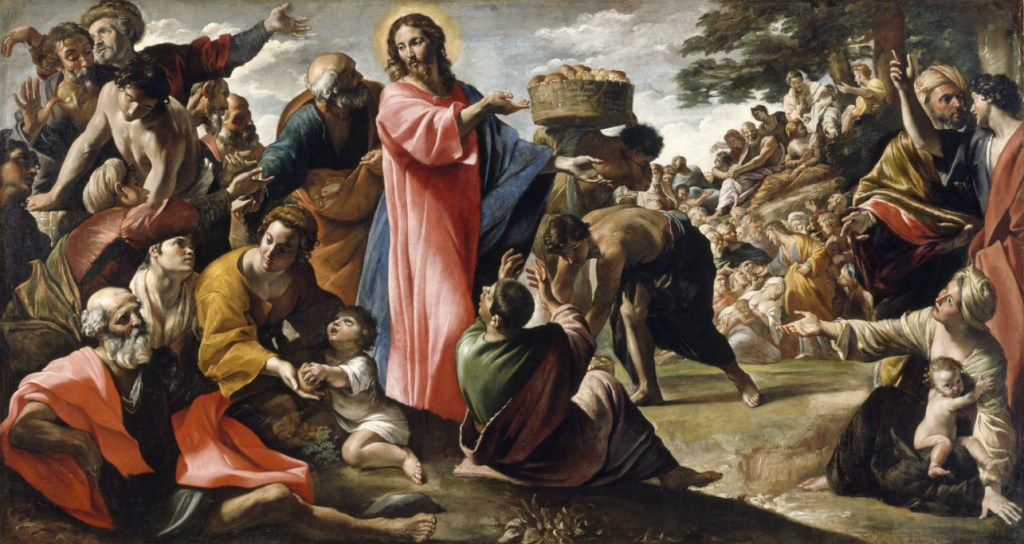
Written and presented by Zia H Shah MD
Abstract
The miracle of feeding a multitude with only a few loaves and fish is a prominent story in the Christian Gospels and finds intriguing echoes in Islamic Hadith literature. This essay provides a comprehensive, critical examination of these narratives across traditions. We first outline the Gospel accounts of Jesus feeding thousands and comparable hadith reports of Prophet Muḥammad providing abundant food from scant provisions. We then analyze these stories from multiple perspectives: a literal theistic view that embraces them as divine miracles; allegorical and spiritual interpretations that see symbolic significance; naturalistic or psychological explanations (such as collective sharing or perceived satiation) that attempt to demystify the events; and historical-critical approaches that consider them legendary embellishments. Grounded in both Christian and Islamic theological contexts, the analysis explores how such miracle stories function within faith communities—strengthening belief, conveying moral lessons, and shaping devotional practices—while also discussing how secular scholars and skeptics receive and interpret them. The essay concludes with a thematic epilogue reflecting on the enduring power of these narratives and the diverse lenses through which they are understood.
Introduction
Accounts of miraculously feeding large crowds with minuscule amounts of food occupy a special place in both Christianity and Islam. In the New Testament Gospels, Jesus famously feeds thousands with only a few loaves of bread and a couple of fish, an event so significant that it is the only miracle (besides the Resurrection) reported in all four Gospels en.wikipedia.org. In Islamic tradition, the Qur’an does not recount a similar episode for the Prophet of Islam, yet the Hadith literature preserves several narratives in which Muḥammad, by God’s blessing, feeds many people from a meager supply. These stories have been cherished by believers of both faiths for centuries, serving as signs of divine provision and compassion. At the same time, they have invited a range of interpretations and critical questions. Did these events happen exactly as described, in a literal sense, or were they meant to convey a deeper metaphor? Could natural or psychological phenomena explain what was experienced by the crowds? Or are these accounts best understood as pious legends that grew around revered figures? In what follows, we will explore the miracle of the multiplied loaves in the Gospels alongside its counterparts in Hadith, examining each through theological, allegorical, psychological, and historical-critical lenses. By comparing how each tradition treats such miracles and how believers and scholars have interpreted them, we gain insight into the function of these narratives in religious imagination and community identity.
Read further in Microsoft Word file:


 The Glorious Quran and Science
Leave a comment