
Written and collected by Zia H Shah MD
Early Life and Spiritual Quest
Martin Luther was born on November 10, 1483, in Eisleben, Saxony, into a family of miners of modest prosperity. Raised with a strict religious upbringing, young Luther was educated in Latin schools and later at the University of Erfurtbritannica.complato.stanford.edu. In 1505, a life-changing thunderstorm drove him to make a fearful vow: if spared, he would become a monkbritannica.com. True to his word, Luther abandoned law studies and entered an Augustinian monastery, despite his father’s dismaybritannica.com. As a monk, Luther threw himself into the rigors of fasting, prayer, and confession, yet he found no peace. He later recalled that even as an obedient monk he felt “a sinner before God with an extremely disturbed conscience,” struggling with Anfechtungen – spiritual anxieties about his salvationplato.stanford.edu. Neither penances nor pious works could assuage his terror of divine judgment. This personal spiritual crisis set the stage for Luther’s later quest to find a merciful God and the true path to salvation.
Luther’s theological education exposed him to both Scholastic thought and emerging humanist ideasplato.stanford.eduplato.stanford.edu. He especially immersed himself in the Bible and the writings of St. Augustine, grappling with questions of sin, grace, and forgivenessplato.stanford.eduplato.stanford.edu. By around 1515, while lecturing as a young professor at Wittenberg, Luther experienced an illumination (later called the “tower experience”) regarding justification by faith – the idea that humans are saved not by their own good works or the church’s sacraments, but solely by God’s grace through faith in Christtif.ssrc.orgtif.ssrc.org. This insight, though possibly gradual, was revolutionary for Luther. It resolved his inner turmoil and became the cornerstone of his theology: salvation is a free gift of God, received by faith alone (sola fide), not earned by human effort. Luther’s personal spiritual breakthrough would soon have public consequences.
The 95 Theses: Protesting Indulgences and Church Abuses
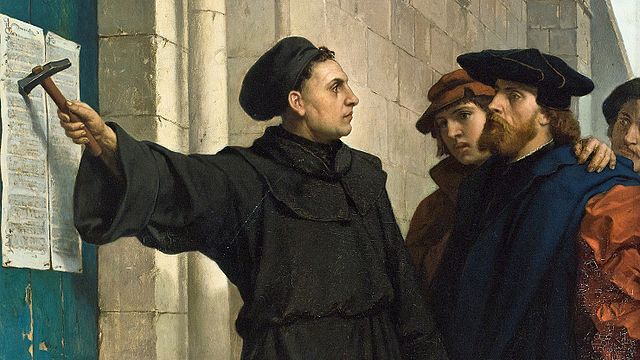
By the 1510s, the Catholic Church was promoting the sale of indulgences – certificates believed to reduce punishment for sins in purgatory – as a fundraiser for grand projects like St. Peter’s Basilica in Rome. Friar Johann Tetzel’s aggressive indulgence campaign in German lands offended Luther’s conscience. He saw it as a corrupt practice that misled common people into thinking God’s grace could be purchased with moneyorigins.osu.eduplato.stanford.edu. Outraged that the faithful were being exploited “to fund such lavish projects” under the pretense of saving soulsbiography.com, Luther decided to speak out. On October 31, 1517, the 33-year-old theology professor penned Ninety-Five Theses, sharp propositions criticizing the indulgence trade and questioning papal authority to grant pardons. He intended these theses as an invitation to scholarly debate, not an act of rebellionorigins.osu.eduplato.stanford.edu. In accordance with academic custom, Luther may have posted the theses on the door of Wittenberg’s Castle Church, and he certainly sent a copy to his archbishop. Either way, thanks to the recently invented printing press, Luther’s 95 Theses quickly spread far beyond Wittenbergplato.stanford.edu. Within weeks, his protest was circulating across Germany, finding an eager audience among clergy and laity disillusioned with church corruption.
Luther’s 95 Theses struck a nerve. He denounced the notion that salvation could be “bought” and argued that true repentance was a matter of inner contrition, not financial transactionplato.stanford.eduplato.stanford.edu. He even hinted that the pope had no authority to release souls from purgatory – a direct challenge to papal supremacy. This bold critique of papal policy was “an act of some defiance” within the Church’s political structureplato.stanford.edu. Yet at this stage Luther did not intend to start a new church. As a devout Catholic monk, he hoped Church leaders would see the truth in his arguments and reform from within. The 95 Theses were written in Latin, aimed at fellow academics and clergy. But once translated and printed in German, they caused a sensation. Many laypeople, princes, and even other clergy rallied behind Luther’s frank call for reform. What had begun as a modest university disputation now threatened to shake the very foundations of Christendom.
Read further in Microsoft Word file:



 The Glorious Quran and Science
Leave a comment