
Written and collected by Zia H Shah MD, Chief Editor of the Muslim Times
Introduction
As we get deeper into the secrets of quantum mechanics it will have bearing on our theology in many ways including how information is preserved for our accountability in our Afterlife.
Quantum mechanics demands that information is preserved: a quantum state’s evolution is reversible and in principle the past can be reconstructed from the present en.wikipedia.orgen.wikipedia.org. This cornerstone of unitarity seems to clash with black hole physics. In the 1970s, Stephen Hawking’s seminal work on black holes suggested that anything falling into a black hole is eventually “evaporated” away as featureless Hawking radiation with no information about what fell inyork.ac.uk. If a black hole completely evaporates, what happens to the information of its swallowed contents? This conundrum is known as the black hole information paradoxyork.ac.uk. It pits quantum theory (which says information cannot be destroyed) against a naïve interpretation of general relativity (which seemed to allow information to vanish behind an event horizon and be lost when the black hole disappears)en.wikipedia.orgresearchgate.net.
Reconciling these views has been a central problem in theoretical physics. The No-Hiding Theorem emerged from quantum information theory as a fundamental principle addressing information loss and has proven especially relevant to this paradox. In essence, the no-hiding theorem asserts that if information disappears from one place, it must have moved somewhere else – it cannot simply be hidden in correlations beyond reachphys.org. In this article, we explain the origin and meaning of the no-hiding theorem, its implications for the black hole information paradox, and how it connects the insights of Stephen Hawking and Leonard Susskind. We also survey how this theorem extends beyond black holes to quantum computing, cryptography, and error correction, illustrating the pervasive role of information conservation in physics.
The No-Hiding Theorem in Quantum Information Theory
In classical information science, information can be concealed either by relocating it or by hiding it in correlations. A simple example is a one-time pad cipher: a secret message is encrypted with a random key such that neither the encoded message nor the key alone reveals anything – the information resides only in the correlation between themyork.ac.uk. One might expect that quantum information could similarly be hidden in correlations between a system and its environment. Braunstein and Pati’s no-hiding theorem (2007) showed that this intuition fails in the quantum realmyork.ac.ukyork.ac.uk. In the words of Braunstein, “quantum information can run but it can’t hide”york.ac.uk – if quantum information disappears from one subsystem, it must reside in the rest of the universe.
Formally, the no-hiding theorem states that if a quantum process (any physical evolution) causes information to be lost from a system (for example, the system’s state becomes maximally random or decohered), then all of that missing information appears in the environment’s state – it cannot be hidden solely in system-environment correlationsphys.orgen.wikipedia.org. In other words, there is no way to have information that is “nowhere to be found” locally, even if subsystems are entangled. This is a direct consequence of the linearity and unitarity of quantum mechanicsen.wikipedia.org. The combined system+environment still holds the information in a scrambled form, and no observer with access to the environment alone or the system alone finds the original information missingphys.org. Information is never truly lost in a closed quantum system.
This result extends earlier quantum no-go theorems that distinguish quantum from classical information behavior:
- No-Cloning Theorem: One cannot make an independent perfect copy of an unknown quantum state (information cannot be freely duplicated).
- No-Deleting Theorem: One cannot perfectly erase an unknown quantum state (information cannot be destroyed).
- No-Hiding Theorem: One cannot hide quantum information in bipartite correlations alone; if it leaves its original system, it must exist somewhere in the environmentphys.org.
Together, these principles reflect the conservation of quantum informationphys.orgphys.org. Unlike classical bits, which can be copied or tossed away, quantum information behaves like an indestructible entity that can only move around. The no-hiding theorem in particular highlights a profound difference between classical and quantum hiding: while classical information can be hidden in shared correlations (as in a coded message and key), an “unknown” quantum state cannot be fully hidden between just two subsystemsar5iv.orgar5iv.org. Either the original system or the environment will carry some imprint of that statear5iv.orgar5iv.org.
Theoretical origin: Braunstein and Pati’s proof of the no-hiding theorem was rooted in considering what it would mean to randomize (completely decohere) a quantum state and yet preserve information in correlations. They showed that any process that takes a pure state and hides it in correlations between a system and an environment would violate quantum mechanicsar5iv.orgar5iv.org. Intuitively, if an initial pure state $|\psi\rangle$ of a system ends up as a completely mixed state $\rho$ on that system (containing no information about $|\psi\rangle$), the joint final state of system + environment must still be pure (since the overall evolution is unitary). The no-hiding theorem proves that in such a case the environment itself must be in a state that contains all the information about the original $|\psi\rangle$phys.org. There is no “quantum one-time pad” for two parties: at least one subsystem (the environment, if the system is random) knows something about the input statear5iv.orgar5iv.org. In fact, it was found that while two subsystems cannot share quantum data in a way that each individually has no information, it is possible to distribute a quantum state’s information among three or more subsystems such that no pair of them reveals anything (this is the basis of quantum secret sharing schemes)ar5iv.org. This multi-partite hiding does not contradict the theorem – it actually underscores it, since the “environment” in that case effectively comprises more than one part.
The no-hiding theorem is a robust statement. It applies not just to ideal mathematical transformations but to any physical process that appears to destroy information. Even if the process is imperfect or approximate, any deviation from truly featureless randomness in the system will correspondingly indicate leakage of information to the environmentar5iv.org. Braunstein and Pati showed that the theorem generalizes Landauer’s principle (the principle that erasing one bit of information increases the entropy of the environment by at least one bit) to quantum theoryar5iv.org. In effect, hiding quantum information is equivalent to erasing it – the missing information must be dumped as entropy in the environmentar5iv.org.
After its theoretical proposal in 2007en.wikipedia.org, the no-hiding principle was put to the test. In 2011, an experiment using NMR (nuclear magnetic resonance) techniques took a single qubit in a pure state, completely randomized it (making the qubit’s state maximally mixed as if information were “erased”), and then showed that the original state could be recovered by accessing the ancillary qubits (environment) that had interacted with iten.wikipedia.org. The lost information had not been destroyed at all, but rather had migrated to the ancilla – exactly as the no-hiding theorem predictsen.wikipedia.org. This was the first experimental confirmation that quantum information, unlike classical information, cannot vanish into inaccessible correlations: it always remains encoded in some physical subsystem of the universeen.wikipedia.orgphys.org.
The Black Hole Information Paradox
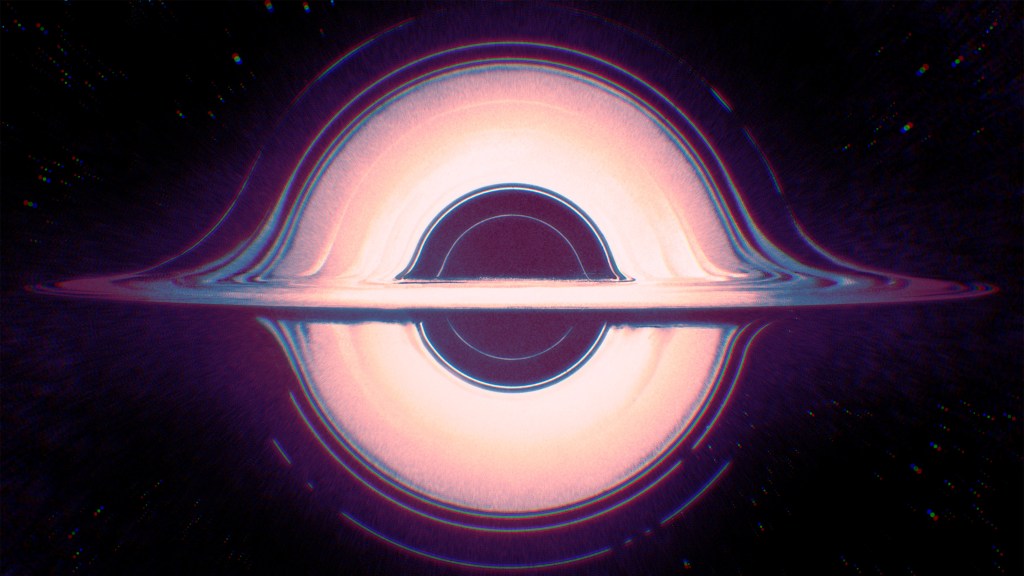
An artistic rendering of a black hole and its surrounding warped spacetime. In black holes, extreme gravity and quantum effects intersect, giving rise to the information paradox.
The stage is now set to see why the no-hiding theorem is so pertinent to black holes. The black hole information paradox arises from Hawking’s discovery that black holes radiate like thermal bodies. Hawking calculated that black holes emit radiation (now called Hawking radiation) due to quantum pair production near the event horizon, causing the black hole to lose mass and eventually evaporatear5iv.orgar5iv.org. Crucially, this Hawking radiation in the semiclassical calculation is completely featureless – it carries no imprint of what fell into the black hole. The radiation’s properties depend only on the black hole’s mass, charge, and spin (consistent with the classical no-hair theorem) and not on the details of the swallowed objectsen.wikipedia.org. Moreover, the causal structure of a black hole spacetime (with an event horizon shielding the interior) suggests that anything that happens inside the black hole cannot influence the exterior regionen.wikipedia.org. Combining these ideas: once a black hole evaporates entirely, all the quantum information about the infallen matter would seem to have vanished from our universeen.wikipedia.orgresearchgate.net. As Hawking phrased it, “Not only does God play dice, but he sometimes confuses us by throwing them where they can’t be seen”aps.org – meaning nature might hide outcomes (information) behind an event horizon, never to be revealed.
Stephen Hawking’s Perspective: Information Loss and Evaporation
Hawking’s 1976 analysis painted a stark scenario: black hole evaporation appears to turn an initial pure quantum state (the collapsing matter and any entangled partners it had outside) into a completely mixed state of radiation, as if the information content of the initial state was irretrievably lostar5iv.orgar5iv.org. In Hawking’s view, quantum evolution in the presence of a black hole breaks predictability – given what comes out of the black hole (thermal radiation), one cannot retrodict what fell inen.wikipedia.org. This amounted to a violation of unitarity and was a genuinely shocking claim: it implied that quantum mechanics, as normally formulated, might not hold in our universe once gravitational effects become significantresearchgate.netresearchgate.net. The paradox “shook the very base” of both quantum theory and general relativityresearchgate.net. If Hawking was right, a “fundamental law” of physics – information conservation – would be violated, or else our understanding of spacetime had to change dramatically.
For decades, Hawking held that the most logical outcome of his calculations was that black holes genuinely destroy information. He argued that subtle correlations in Hawking radiation could not carry all the detailed information out, especially since the radiation is essentially determined by only a few macroscopic parameters of the holeen.wikipedia.org. One possible way to save information without contradicting his calculation was to imagine that information might somehow escape but remain hidden in correlations between the radiation and the black hole’s interior. However, as long as the black hole exists, anything inside is unobservable to the outside; and once the black hole is gone, there is no “interior” left to hold information. A tiny Planck-sized remnant (a speculative object sometimes proposed to hold the information) also seemed implausible to store arbitrarily large amounts of informationresearchgate.netresearchgate.net. Thus, it seemed that information about initial states simply disappears from the observable universe – a conclusion in direct conflict with quantum theory’s mandates.
Hawking’s stance led to a famous bet in 1991 with colleagues Kip Thorne and John Preskill. Hawking and Thorne bet that information that falls into a black hole is destroyed forever, whereas Preskill bet that it is not lost and would eventually be recoverable if we had a correct theory of quantum gravityaps.orgaps.org. For a long time, it appeared Hawking might win on technical grounds: no one had a concrete mechanism for how information could escape a completely evaporating black hole.
Leonard Susskind’s Perspective: Unitarity and the Holographic Principle
On the other side of this debate, physicists like Leonard Susskind argued passionately that quantum mechanics must remain valid – black holes must somehow preserve information, even if it is extraordinarily encoded. Susskind, along with Gerard ’t Hooft and others, developed ideas that would radically change our understanding of black holes and support information conservation. In the 1990s, Susskind proposed the principle of black hole complementarity, suggesting that no single observer can see information being both destroyed and preserved – roughly, an outside observer sees information encoded at the horizon and eventually returning via radiation, while an infalling observer sees nothing special and crosses the horizon with the information. This principle allowed physicists to imagine that information is not truly lost, even if naïvely it seems so, by carefully accounting for what different observers can witness.
Building on such intuition, the holographic principle emerged as a profound proposal. Originally suggested by ’t Hooft and elaborated by Susskind, the holographic principle posits that all the information contained in a volume of space can be represented as information on the boundary of that region (much like a hologram stores 3D information on a 2D film)aps.org. For black holes, this means the information about everything that has fallen in might be entirely stored on the event horizon (a two-dimensional boundary) rather than in the three-dimensional interior. As a black hole radiates and shrinks, the information on the horizon can in principle be transferred to the outgoing radiation rather than lost. This idea got concrete support from string theory in the late 1990s through the AdS/CFT correspondence (discovered by Juan Maldacena), which is a realization of the holographic principle. In AdS/CFT, a black hole in a curved AdS spacetime is dual to a quantum system (a conformal field theory) with no gravity on the boundary – and in that dual description it is manifest that information is never lost (the boundary theory is unitary). This provided a powerful indication that black hole evaporation can indeed be a unitary process, with information preserved (albeit scrambled in a complex way).
Susskind recounts in his book The Black Hole War that these ideas eventually persuaded Hawking to change his minden.wikipedia.org. By 2004, consensus was shifting due to the holographic principle’s success: a majority of theoretical physicists believed that black hole evaporation must be information-preservingaps.orgaps.org. Hawking conceded the bet in 2004, agreeing that information comes out after all. In a famous public event in Dublin (July 2004), Hawking presented John Preskill with an encyclopedia on baseball – “from which information can be retrieved at will” – symbolizing that he was paying off the bet and acknowledging that black holes do not permanently hide informationaps.orgaps.org. (Kip Thorne, however, refused to concede immediately, reflecting that the exact mechanism of information escape was still mysterious, and indeed new puzzles like the firewall paradox soon emergedaps.org.)
From Susskind’s perspective, the ultimate reason information must be preserved is simple: quantum mechanics cannot break down. If a physical theory like general relativity suggests that unitarity might fail, then that theory must be incomplete or modified in the regime where the conflict occurs. The holographic principle and developments in string theory offered a path to modify our understanding of spacetime (introducing quantum gravity effects at the horizon scale) to resolve the paradox. Susskind often emphasizes that black holes aren’t cosmic incinerators of information but rather highly sophisticated scramblers. The information that falls in gets rapidly mixed and encoded in near-imperceptible correlations among the outgoing Hawking radiation particles, but it is there in principle. The challenge has been to demonstrate how those correlations work without contradicting semi-classical gravity. Modern calculations (as of 2019–2020) have indeed found signs of the so-called “Page curve” behavior of entropy, consistent with information gradually leaking out over the course of evaporationquantamagazine.orgquantamagazine.org, lending further support to Susskind’s once-controversial stance that black hole evaporation is unitary.
The No-Hiding Theorem and Black Hole Information
We now turn to how the no-hiding theorem interfaces with these perspectives. The no-hiding theorem sharpened the black hole information paradox by ruling out one potential loophole. If Hawking radiation truly carries no information about what formed the black hole (as Hawking initially asserted), one might imagine that the information is not really destroyed but is somehow encoded in correlations between the radiation and the black hole’s remaining interior (or some Planck-scale remnant). Braunstein and Pati tackled exactly this “hidden correlation” scenario in formulating the paradox more rigorouslyar5iv.orgar5iv.org. They showed that under the assumption that Hawking’s semi-classical calculation is correct (i.e. the outgoing radiation’s state is independent of the infalling matter’s state), the no-hiding theorem leaves no room for the information to hide: neither the Hawking radiation alone nor any correlations between the radiation and the black hole’s internal state can carry the missing informationar5iv.orgar5iv.org. In short, if the radiation is truly featureless and uncorrelated with what fell in, then the information does not exist anywhere – a flagrant violation of quantum mechanics. The theorem “rigorously rules out any ‘third possibility’ that the information escapes from the black hole but is nevertheless inaccessible as it is hidden in correlations” between the radiation and the interiorar5iv.org.
This result dramatically tightens the paradox. It means that one cannot argue the information is somehow safe in mysterious nonlocal correlations – it’s either out in the open (carried by the radiation or remaining part of the hole in a retrievable form) or it’s truly gone. Thus we are faced with a binary choice: either unitarity fails, or Hawking’s semi-classical picture failsar5iv.org. There is no subtle in-between. Braunstein and Pati concluded that “either quantum mechanics or Hawking’s analysis must break down” to resolve the paradoxyork.ac.uk. Given the enormous evidence for quantum mechanics, most physicists interpret this as evidence that Hawking’s approximations (which treat the Hawking radiation as perfectly thermal and independent of infalling information) must break down when quantum gravity effects are accounted forar5iv.orgar5iv.org. In other words, new physics is required, and indeed the no-hiding theorem “shows that there’s got to be new physics out there” in the context of black holesyork.ac.uk.
By providing a clear criterion, the no-hiding theorem supports the likes of Susskind: any acceptable resolution of the information paradox must involve a violation of Hawking’s original assumptions (for example, subtle correlations in the Hawking radiation, or a quantum-gravitatively altered horizon structure)ar5iv.orgar5iv.org. It is not enough to say “maybe the info is hidden and we just can’t get it” – quantum theory disallows that kind of permanent hiding. Thus, the theorem buttresses the principle of black hole unitarity. Hawking’s scenario is untenable unless we are willing to let quantum mechanics go, which virtually no physicist is. Conversely, if one insisted on Hawking’s exact scenario, the no-hiding theorem tells us unitarity is broken and “predictability in gravitational collapse” indeed fails (Hawking’s own phrasing in 1976aps.org). Either way, the theorem forces a tough choice and thereby “accentuates the crisis for quantum physics” in the black hole contextar5iv.orgar5iv.org, demanding a clear resolution.
In light of this, the no-hiding theorem can be seen as supporting the holographic principle and other ideas that introduce correlations where Hawking’s original calculation had none. For instance, if black hole radiation is not perfectly thermal but has tiny subtle correlations that accumulate over time (as Don Page and others suggested in the 1990s via the Page curve analysis), then the conditions of the no-hiding theorem are circumvented: the information is in fact gradually leaking out. Braunstein and Pati note that even arbitrarily small deviations from Hawking’s ideal thermal spectrum could carry away information, and the no-hiding theorem can quantify how much information could be rescued by such deviationsar5iv.org. Modern research indeed indicates that quantum gravity effects induce just such deviations – too small to have been noticed in Hawking’s leading-order calculation, but sufficient in principle to let information escape over the long lifetime of a black holeaps.org.
In summary, the no-hiding theorem has provided a consistency check for proposed solutions to the black hole paradox. Any theory in which black hole evaporation is unitary must violate the condition that the radiation is independent of the initial statear5iv.orgar5iv.org, and holography does exactly that by encoding the initial state on the horizon and in the correlations among emitted quanta. Hawking’s own change of heart aligns with this: he effectively acknowledged that subtle new physics (for example, quantum perturbations of spacetime topology or horizon “hair”) must allow information to escape, thus respecting the no-hiding principle and restoring unitarityaps.org. The paradox is not yet considered fully resolved in the research community – debates continue via ideas like black hole firewalls or soft hair – but any acceptable resolution will be one that avoids information mysteriously vanishing. Thanks to the no-hiding theorem, we recognize that information cannot just hide – it must go somewhere, even for a black hole.
Beyond Black Holes: Broader Implications and Applications
The no-hiding theorem, while born from fundamental theory, has ripple effects across quantum science and technology. Its core message – that information cannot be destroyed or even wholly confined to inaccessible correlations – informs several areas:
- Quantum Computing and Error Correction: In building quantum computers, decoherence (interaction with the environment) is the enemy that causes loss of quantum information. The no-hiding theorem offers a conceptual silver lining: when a qubit decoheres, the information isn’t gone – it has leaked into the environmentphys.org. This means that if one could monitor the environment or engineer it cleverly, the lost information could in principle be recovered. Quantum error correction schemes exploit this by encoding logical qubits into entangled states of many physical qubits so that no single qubit (or small subset) has all the information. For example, in a quantum error-correcting code, an error (like a qubit interacting with the environment) entangles the environment with only part of the codeword, while the logical information remains recoverable from the larger code block. This is consistent with no-hiding: the environment by interacting gets some information, but the code design ensures that partial environment information reveals nothing definitive about the logical state. Only by accessing a large portion of the system (which the environment cannot unless multiple errors occur) could one reconstruct the state. In essence, quantum error correction intentionally “hides” information across multiple subsystems (three or more) so that no small part (and no local environment interaction) can irreversibly damage it – a practical application of the same principle that underlies no-hidingar5iv.org.
- Quantum Cryptography and Secret Sharing: No-hiding highlights a fundamental constraint on quantum encryption. A perfectly secure classical cipher can hide all information of a message between two correlated pieces (ciphertext and key). Quantumly, however, if one were to “encrypt” a qubit by distributing it between two parties or two quantum subsystems, some trace of the original would inevitably remain locally accessiblear5iv.orgar5iv.org. This is why quantum secret sharing protocols distribute a secret quantum state among multiple parties – for instance, splitting a state into three parts such that any two parties together can reconstruct it, but any one alone has no information. This three-party scheme is possible because, as the no-hiding theorem permits, information can be hidden in correlations among three or more subsystemsar5iv.org. But with only two subsystems, quantum information cannot be completely obfuscated. This insight guides the design of quantum cryptographic protocols: truly secure quantum information distributions must involve sufficiently many pieces that unauthorized subsets have absolutely no knowledge. The theorem thereby assures us that any attempt by an eavesdropper to glean information from less than the threshold shares is fundamentally futile – they’ll only see random data, with the actual info residing in higher-order correlations that they don’t have.
- Quantum Thermodynamics and Information: The no-hiding theorem reinforces the deep link between information and entropy. In classical Landauer erasure, if you erase a bit of information, you must increase the entropy (heat) of the environment by at least one bit’s worth. Quantum mechanically, erasing or randomizing a quantum state means the missing information lives as entropy in the environmentar5iv.org. This has implications for designing quantum memory and understanding the thermodynamic cost of quantum operations. It tells us that any apparently irreversible process (like thermalization) is in fact hiding information in degrees of freedom we neglected. This perspective encourages us to search for and possibly exploit those degrees of freedom (for example, using ancilla systems to capture entropy) if we want to make processes reversible or to retrieve “lost” information.
- Experimental Tests of Fundamentals: The experimental confirmation of the no-hiding theoremen.wikipedia.org stands out as one of the first tests of a quantum information conservation law. It opens up the possibility of testing other subtle aspects of quantum information flow. For instance, future quantum simulators might deliberately “hide” information in complex entangled states and then attempt to recover it by appropriate unitary transformations on a larger Hilbert space. Such experiments deepen our understanding of entanglement and could inform the development of quantum technologies that are resilient against information leakage.
In summary, the no-hiding theorem is more than an abstract statement; it is a reminder that information has a kind of permanence in the quantum world. This permanence underlies why quantum computers can, in principle, reverse computations (uncompute) without losing data, and why quantum cryptographic protocols can promise security (because information can’t be in a secret place that nobody knows – either it’s accessible to someone or it doesn’t exist). It also frames why the loss of information from a black hole would be such a fundamental problem – it would violate this deeply ingrained principle that physics does not allow information to just vanish.
Conclusion
The no-hiding theorem occupies a unique place at the intersection of quantum information theory and fundamental physics. It arose from the effort to understand how quantum information might be conserved or lost, and in doing so it delivered a clear verdict: information cannot simply disappear into inaccessible correlations. This insight strengthens the foundation of quantum mechanics – the continuity and recoverability of information – while challenging us to revise other theories (like classical gravity) that seem at odds with itar5iv.org. In the context of black holes, the no-hiding theorem has turned a mystery into a stricter ultimatum: if black holes are to obey quantum laws, they must somehow encode and return the information of everything that falls into themar5iv.orgar5iv.org. This has lent theoretical support to approaches like Susskind’s holographic principle and has, in part, led to Hawking’s eventual concession that information is preserved, not lostaps.org.
For non-specialists and experts alike, the story of the no-hiding theorem is an illustration of how progress in physics often comes from synthesizing ideas across domains. A principle proven on a chalkboard for qubits becomes a clue to the fate of astronauts falling into black holes. It reminds us that quantum information is a tangible “something” that the universe keeps safe, even under the most extreme conditions. Ongoing research in quantum gravity (such as investigations into the entanglement structure of Hawking radiation, or the nature of spacetime microstates) is essentially an effort to explicate how the universe keeps that information safe and what mechanisms allow it to resurface. While we do not yet have the final answer to the black hole information paradox, the no-hiding theorem has set a non-negotiable target for any solution: information out in the universe must always be accounted for. As our understanding evolves – through new theoretical insights or perhaps future observations of quantum gravitational phenomena – the no-hiding theorem will remain a guiding beacon, assuring us that the universe does not play a shell game with information. It may hide information temporarily or in clever ways, but ultimately, there is nowhere in the universe for information to hide and never be foundphys.orgar5iv.org.
Sources:
- S. L. Braunstein & A. K. Pati, Phys. Rev. Lett. 98, 080502 (2007) – Original no-hiding theorem proofar5iv.orgar5iv.org.
- J. R. Samal et al., Phys. Rev. Lett. 106, 080401 (2011) – Experimental test of no-hiding (NMR)en.wikipedia.org.
- Lisa Zyga, Phys.org (Mar 7, 2011) – News on experimental confirmation of no-hidingphys.orgphys.org.
- University of York Press Release (Oct 2007) – “Quantum information can run but can’t hide” (Braunstein)york.ac.ukyork.ac.uk.
- S. W. Hawking, Comm. Math. Phys. 43, 199 (1975); Phys. Rev. D 14, 2460 (1976) – Black hole radiation and breakdown of predictabilityen.wikipedia.orgen.wikipedia.org.
- L. Susskind & J. Lindesay, Black Holes, Information and the String Theory Revolution (World Scientific, 2005) – Discussion of unitarity and holographyen.wikipedia.org.
- J. Preskill, in ICTP Lecture Notes (2004) – Overview of black hole information puzzle and bet resolutionaps.orgaps.org.
- S. Chakraborty & K. Lochan, Universe 3, 55 (2017) – Review of information paradox and potential resolutionsresearchgate.netresearchgate.net.
- G. Musser, Quanta Magazine (Oct 29, 2020) – “Black Hole Paradox Nears Its End” (recent developments on Page curve)quantamagazine.org.



 The Glorious Quran and Science
Leave a comment