
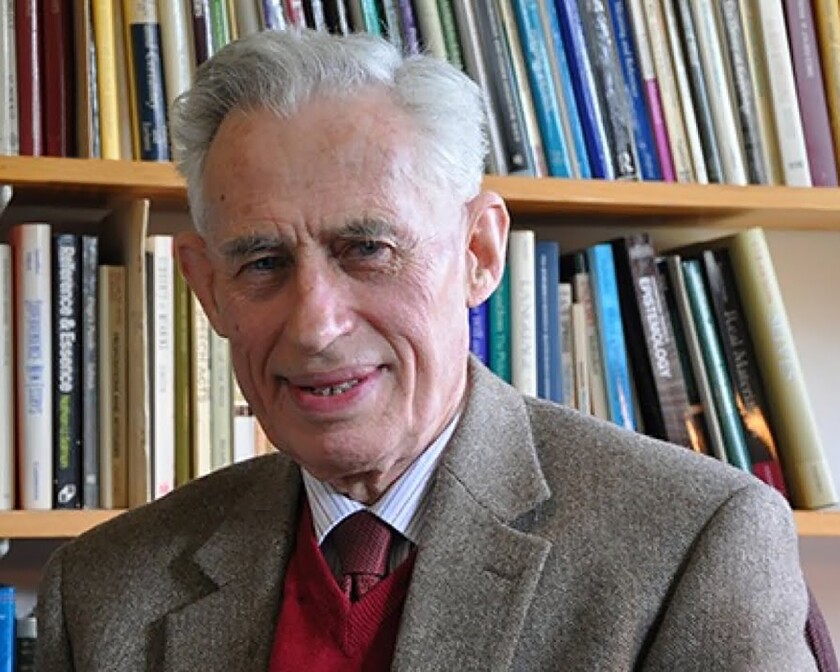
Presented by Zia H Shah MD
There are only four or five academic Christian philosophers that I read or listen to and sometimes learn from. Richard Swinburne is definitely one of them.
There is a whole lot we can learn from Richard Swinburne about the philosophy of Monotheism.
Swinburne, born on December 26, 1934, in Smethwick, England, is a distinguished British philosopher renowned for his profound contributions to the philosophy of religion and the philosophy of science. He pursued his undergraduate studies at Exeter College, Oxford, earning a first-class degree in philosophy, politics, and economics. Swinburne’s academic career includes teaching positions at the University of Hull and the University of Keele. In 1985, he was appointed as the Nolloth Professor of the Philosophy of the Christian Religion at the University of Oxford, a position he held until his retirement in 2002. During his tenure, he became a Fellow of Oriel College and was elected a Fellow of the British Academy in 1992.
Swinburne is perhaps best known for his rigorous defense of theism through a series of influential works. His seminal trilogy—The Coherence of Theism (1977), The Existence of God (1979), and Faith and Reason (1981)—systematically examines the rationality of belief in God. In these works, he employs inductive reasoning to argue that the existence of God is more probable than not, considering various aspects of the universe and human experience. Beyond this trilogy, his tetralogy on Christian doctrine, including The Evolution of the Soul (1986) and The Christian God (1994), delves into topics such as the nature of the soul and the attributes of God.
Throughout his career, Swinburne has engaged deeply with both philosophical and theological questions, advocating for the compatibility of faith and reason. His work has significantly influenced contemporary discussions on the rationality of religious belief, bridging analytic philosophy and traditional theological concepts. Swinburne’s methodical approach and commitment to intellectual rigor have established him as a central figure in modern philosophical theology.
Where I disagree with him on doctrines that are exclusive to Christianity, we can bank on some of the other episodes of Closer to Truth:
…
…
…



 The Glorious Quran and Science
Leave a comment